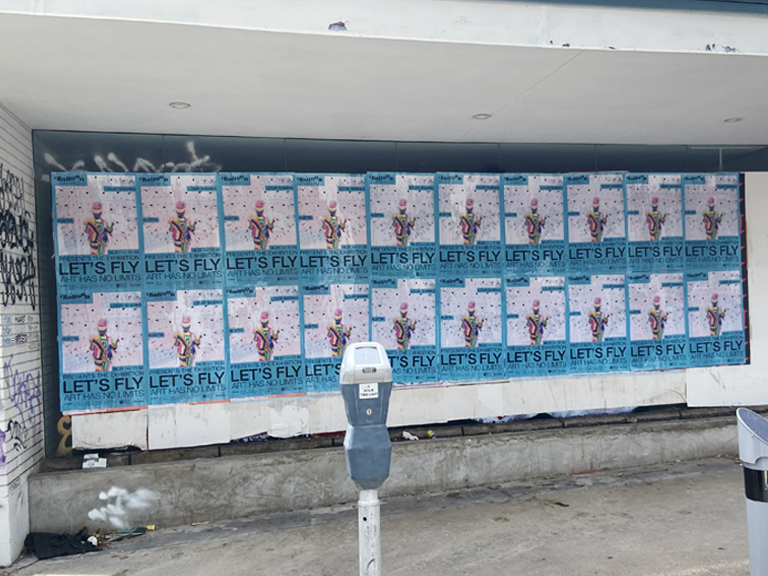
Most of the London wheatpaste campaigns coordinated through American Guerrilla Marketing are booked by people sitting in New York, Los Angeles, Chicago, or Nashville. US-based film studios, music labels, streaming platforms, fashion brands, and entertainment companies run London campaigns regularly without a single team member setting foot in the UK during the campaign. It’s entirely doable — but it requires the right infrastructure on the UK side and a clear understanding from the US side of what the process actually looks like.
This guide is written specifically for US marketing teams, brand managers, and producers who want to run a London wheatpaste campaign but are navigating the coordination from across an ocean. It covers the timeline, the print logistics, how to evaluate a UK operator from a distance, what documentation you should expect, and the handful of things that genuinely can’t be done without someone on the ground in London.
The short version: you can run a professional, documented, legally compliant London wheatpaste campaign from the US if you have the right operator. The work on your end is the brief, the artwork, and the approval cycle. The work on the UK end is everything physical. That division of labor works well when the operator is genuinely capable and has real London surface access. When they’re not, you find out on the day the campaign goes up — which is too late.
The Timeline: What Two to Three Weeks Actually Means
Two to three weeks is the minimum lead time for a functional London wheatpaste campaign booked from the US. Here’s what that time actually contains:
| Week |
Activity |
| Week one, days 1-3 |
Brief received, surface list confirmed, artwork specifications shared with US team |
| Week one, days 4-7 |
Artwork approved for street scale, UK print production initiated |
| Week two, days 1-3 |
Printed posters received, crew scheduled, final surface list confirmed |
| Week two, days 4-7 |
Overnight posting, GPS photos taken |
| Day after posting |
Photo documentation report delivered to US client |
Where this timeline breaks down is artwork delays. US creative teams working on London campaigns sometimes deliver artwork late, or deliver artwork that hasn’t been adapted for street scale and needs revision. Every day of artwork revision eats into the two-week window. The safest approach is to have print-ready artwork confirmed before the operator brief is submitted, not after.
Print Production: UK vs. Shipping From the US
This question comes up on nearly every US-booked campaign. The answer is almost always UK print production, and the reasons are practical:
- UK customs: Printing materials shipped from the US to the UK are subject to customs clearance, which is unpredictable. A shipment that should arrive in three days can sit in customs for a week. For a campaign with a fixed posting date, that delay kills the campaign.
- Shipping cost: A pallet of A0 posters is heavy. International freight from the US to London costs £300-£800 minimum. That money buys a full UK print run of several hundred posters at a trade print house.
- Lead time: US production timelines don’t account for international shipping. A two-week US print lead time plus five to seven days of shipping leaves almost no buffer.
The only situation where US printing makes sense for a London campaign is when the artwork requires specialized production — metallic finishes, custom substrates, proprietary printing techniques — that isn’t available from UK trade printers. For standard A0, A1, or large-format paper poster printing, UK production is the right call every time.
“The number of US campaigns that have been delayed by customs holding a print shipment is not small. The fix costs more time and money than UK printing would have. Print in the UK.”
Evaluating a UK Operator From the US
The quality of your London campaign is almost entirely determined by the quality of the UK operator. Evaluating that from the US means asking the right questions before money changes hands:
Surface List Verification
Ask for a sample surface list from a previous campaign in the neighborhoods you’re targeting. A genuine operator will have this readily available — it’s part of their standard documentation. The list should include specific addresses, not just neighborhood names. If an operator responds to this request by describing their network in general terms without providing specifics, they may not have the kind of established surface relationships they’re claiming.
Previous Campaign Documentation
Ask to see GPS photo documentation from a previous campaign. Specifically: timestamped photos geotagged to specific addresses. This is the standard for professional campaigns and any competent operator will have it. If the documentation they show you is a handful of unlabeled photos, that’s a red flag about what their reporting will look like for your campaign.
Insurance
Ask whether the operator carries public liability insurance covering wheatpasting activities. In the UK market, this matters more than in many US cities because the regulatory framework is clearer and enforcement actions do happen. An uninsured operator who gets hit with an enforcement action has no protection for themselves or for you.
UK-Specific Knowledge
Have a conversation about specific London neighborhoods — ask where they’d recommend posting for your specific demographic and why. A genuine London operator will have specific, opinionated answers. An operator who’s primarily US-based and claiming UK capacity will give you generic answers that could apply to any city.
The five-hour time zone difference between EST and GMT means that London posting operations happen overnight US time — typically 11pm-5am London time, which is 6pm-midnight Eastern. For US teams tracking a campaign in real time, morning in New York is after the London crew has finished their overnight posting shift. Documentation typically arrives in US inboxes during early morning Eastern hours.
What Requires Local Presence (and What Doesn’t)
Most of the work of a London wheatpaste campaign does not require a US team member to be on the ground. The exceptions are:
- Site visits for large-format special placements: If the campaign includes an oversized or custom-location placement — like artwork on a specific building wall near a premiere venue — someone needs to visit and confirm the surface before it’s committed to the brief. This can be done by the UK operator on the brand’s behalf, with photos and measurements shared remotely.
- UK media or PR coordination: If the campaign includes elements that interface with UK press (a premiere, a gallery opening, a UK press launch), having a UK PR presence on the ground is valuable. This is separate from the wheatpasting coordination.
Everything else — brief, artwork approval, surface list sign-off, posting schedule, and documentation review — can be handled entirely remotely via email, video call, and shared documents.
Communication Across Time Zones
The practical reality of managing a London campaign from a New York office is that your working day overlaps with London’s afternoon. Morning briefings in New York (9am-noon EST) are afternoon in London (2pm-5pm GMT). This overlap is sufficient for most campaign coordination. Issues that arise during the UK overnight posting session will be waiting for you when you arrive at your US desk in the morning.
Establish clear communication protocols upfront: what communication channel the UK operator uses, what turnaround time to expect on responses, and what constitutes an issue that needs immediate escalation versus a routine update. Campaigns that go sideways usually go sideways because these protocols weren’t established — not because of the time zone difference per se.
Remote Booking Is the Core Intent Behind This Query
This keyword is not looking for creative inspiration. It is looking for process. Searchers are usually US-based marketers, agencies, or entertainment teams who need a London campaign but cannot manage the job on the ground. The strongest adjacent results in this space emphasize remote coordination, local execution, and confidence-building details like timelines, approvals, and proof of posting.
That means the content should walk through the handoff points that matter most to a remote client. How is artwork delivered? Should printing happen in the UK? What information is needed to build a surface list? How far in advance should a London run be booked? How are overnight installs documented for a team waking up in New York or Los Angeles? Searchers also care about language differences, cost expectations in pounds, and whether one partner can handle both planning and fieldwork.
The right ranking angle is operational ease. A page for this keyword should reassure the reader that distance does not create chaos if the workflow is set up correctly. Clear sections on brief intake, neighborhood selection, print production, launch timing, reporting, and communication windows make the article feel built for actual remote buyers rather than for general SEO traffic.
That practical, remote-buyer framing is the real conversion angle. When the page reduces uncertainty around time zones, approvals, and field execution, it becomes far more useful to the exact audience searching for a London campaign from abroad.
That is why pages for this query should keep returning to handoff clarity. Remote buyers want fewer moving parts, one accountable team, and a reporting process that fits their home-office workflow. Those details often decide whether the inquiry converts.
Frequently Asked Questions
The Full Process for US Clients Booking a London Campaign
Running a London wheatpaste campaign from the US is entirely practical — AGM does it regularly for US-based entertainment companies, brands, and labels. But the process is different from booking a New York or Los Angeles campaign, and the differences matter.
Step 1: Initial Brief and Market Scoping (Days 1-3)
We start with the same questions regardless of where the client is based: What’s the campaign objective? What’s the target audience in London? Which neighborhoods align with that audience? What’s the format — poster style, dimensions, print spec? What’s the timeline from posting to campaign end? For US clients, we add a question that domestic clients don’t face: Do any elements of the artwork need to be adapted for a UK audience or UK regulatory environment?
On the UK side, we run the brief against our London surface network simultaneously. Within 48-72 hours of receiving a brief, we can return a proposed surface list with wall photography, dimensions, neighborhood context, and confirmed access status. That response is the basis for the client’s approval decision.
Step 2: Surface List Approval and Print Brief (Days 3-7)
Once the surface list is approved, print production begins. We work with UK trade printers to produce campaign artwork at London format specifications. A0 (841mm x 1189mm) is the most common format, printed at 150gsm for campaigns in the autumn through spring months. Print turnaround from approved files to delivered posters is three to five working days from our UK print partners.
For US clients working across time zones, AGM uses an asynchronous approval workflow: brief submitted by US client end-of-day, UK-side response ready by start-of-next-US-business-day. This typically means campaign approvals move forward without waiting for overlapping working hours, compressing the pre-campaign timeline significantly.
Step 3: Crew Briefing and Pre-Campaign Logistics (Days 7-14)
Our London operators receive their posting brief 48 hours before the posting night. The brief includes: GPS coordinates for each confirmed surface, wall photographs, access notes (any specific timing or approach requirements per location), paste specification, and documentation requirements. Operators walk a portion of their assigned route the day before posting to confirm surfaces are clear and accessible.
Step 4: Posting Night
All London wheatpaste campaigns post between 3am and 5am. For US clients, this means the campaign is live while they’re sleeping — which is fine, because there’s nothing to approve or manage during the posting itself. The crew works the route, documents each placement with GPS-tagged photos, and compiles the documentation package for morning delivery.
Step 5: Documentation Delivery (Morning After)
US clients receive the proof-of-posting report by 9am-10am Eastern time on the morning after posting. The report includes a photo for every placement, GPS coordinates, a map overlay showing the campaign geography across London, and a summary of total placements by neighborhood. This report is formatted for the US client’s marketing team and often passes directly into their campaign analytics system.
What US Clients Should Budget for London
Budget expectations from the US market often need calibration for London. The UK has a different cost structure: print costs are broadly similar to the US at volume, but surface access fees (documented permission on private walls) add a cost layer that informal US posting models don’t always include. Here’s a realistic framework:
Entry-level London campaign (one neighborhood, 15-20 locations, A0 format): £2,500-£3,500 all-in. Good for testing the market or supplementing a larger campaign.
Mid-size campaign (three neighborhoods, 35-50 locations, mix of A0 and Quad Crown): £5,500-£9,000 all-in. The typical first UK campaign for a US brand with a proven US street marketing practice.
Full London market campaign (six-plus neighborhoods, 80-120 locations, large format): £15,000-£30,000+. Entertainment releases, major brand launches, London Fashion Week campaigns.
We’ve run campaigns for US clients across all three budget tiers. The most common progression is entry-level on the first UK campaign to test market response, then scaling to mid-size or full London coverage once the format proves itself. The brands that scale up fastest are the ones where documentation from the first campaign gives them data to justify the investment.
After the First Campaign: Building a London Street Presence Over Time
The first London wheatpaste campaign for a US brand is usually a test — a way to validate whether the format works for the brand’s specific objectives in the London market. The brands that benefit most from London street campaigns are the ones that treat the first campaign as the beginning of an ongoing practice rather than a one-off experiment.
A brand that runs London campaigns consistently — around product launches, release events, seasonal activations — builds a cumulative street presence that goes beyond any individual campaign. London’s arts-engaged demographic notices brands that appear regularly in their neighborhoods. A label or entertainment company whose campaigns appear in Shoreditch or Dalston across multiple years develops a genuine physical presence in those neighborhoods that algorithms and digital targeting cannot replicate.
For US brands building a long-term London strategy, AGM maintains an evergreen surface list that keeps approved walls in reserve across the key neighborhoods. When a new campaign brief comes in, the surface selection is faster because the groundwork is already in place. Permission relationships are current. Crew briefings reference prior campaign experience on specific walls. The cumulative effect is better campaigns at lower coordination cost over time.
Building the UK Market Playbook
After two or three London campaigns, US brands typically have enough data to build a UK market playbook: which neighborhoods delivered the best social amplification, which formats held best in London’s climate, which campaign timing windows correlated with the strongest downstream metrics. That playbook is the strategic asset that transforms London wheatpasting from a tactical experiment into a documented part of the UK market strategy.
The US entertainment brands that have built the strongest London street presence over time are the ones that treat each campaign as a data point in an ongoing strategy, not a standalone event. The market knowledge compounds. The surface relationships mature. The creative brief gets tighter with each iteration because you know what works here, not just in the US.
Can you run a London wheatpaste campaign entirely from the US?
Yes. With the right UK operator partner, a London wheatpaste campaign can be fully coordinated from the United States. The US team provides artwork files and the campaign brief; the UK operator handles surface access, UK print production, crew scheduling, and GPS documentation — all delivered remotely within 24 hours of posting. No US team member needs to be in London.
What is the most common mistake US brands make when booking London wheatpaste campaigns?
The three most common mistakes are insufficient lead time, shipping posters from the US instead of printing in the UK (which risks customs delays that kill the timeline), and working with operators who don’t have genuine London surface relationships. Two to three weeks minimum lead time with UK print production and a verified operator with real surface credentials eliminates most of the risk.
How do you verify a London wheatpaste operator’s surface credentials from the US?
Ask for a sample surface list with specific addresses, ownership details, and permission basis for each location. Ask to see GPS photo documentation from a previous campaign in the same neighborhoods. A professional UK operator provides this without hesitation — it’s standard campaign documentation. If an operator deflects these requests, their surface claims are likely not as solid as they’re presenting.
What is the best way to handle payment for a London wheatpaste campaign from the US?
Wire transfer in GBP is the most efficient payment method for a direct UK operator engagement. American Guerrilla Marketing invoices in USD for US clients to eliminate currency conversion complexity. Budget an additional 3-5% for transaction costs if paying from a US dollar account through a UK operator. GBP fluctuations against USD should be factored into multi-month campaign budgets.
How long does it take to set up a London wheatpaste campaign from the US?
The minimum timeline from initial brief to first posting is two weeks, assuming print-ready artwork is available and the operator’s surface list is confirmed. Three weeks is more comfortable for most campaigns. Campaigns involving large-format artwork, premiere coordination, or five-plus boroughs benefit from four to five weeks lead time. The single most common cause of timeline compression is late artwork delivery from the US side.