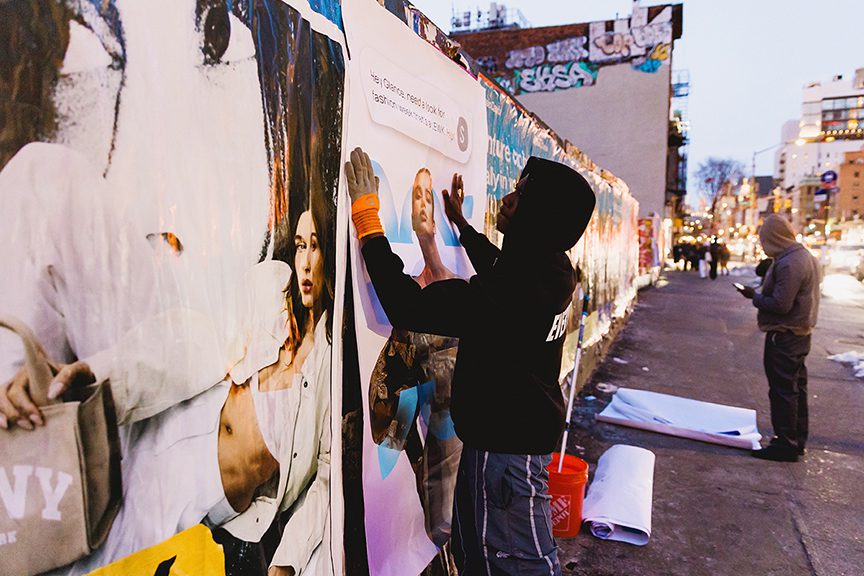
Wheatpaste Advertising NYC: Street Campaigns That Stick in 2026
We’ve been pasting walls in New York City for years. Our crews know which blocks move, which surfaces hold, and which neighborhoods actually convert foot traffic into brand attention. Wheatpaste advertising is one of the most immediate, physical, and visually commanding formats in outdoor marketing, and it’s one we take seriously. When a 20-sheet poster goes up on a scaffolding wall on Bowery or a run of full-bleed prints wraps a construction barrier on Grand Street, something happens that digital ads can’t replicate: people stop, photograph, and talk.
This guide covers everything you need to know about how we run wheatpaste campaigns in NYC, from site scouting to print specs to what your brand can realistically expect in terms of exposures and social lift. If you’ve been considering outdoor poster advertising and want to understand the full picture, read on.
What Wheatpaste Actually Is (and Why Brands Still Reach for It)
Wheatpaste is one of the oldest advertising formats still in active commercial use. It predates every digital channel. It predates television. Advertisers in 19th-century Paris and New York covered entire building facades with pasted-on paper posters, and the method hasn’t changed much at its core. What’s changed is how brands approach it strategically, how print production has advanced, and how a single well-placed poster can travel across Instagram, TikTok, and Reddit before noon.
We’ve watched brands with massive digital budgets come to us specifically because wheatpaste does something their programmatic spend can’t: it puts a physical object in a physical neighborhood, at human eye level, in a context that feels organic to the street. That authenticity is the product.
The Paste, the Paper, the Wall
The mechanics of wheatpaste are straightforward, and the simplicity is part of what makes it durable as a medium. Our crews mix a paste from wheat flour and water, sometimes with a small amount of corn starch added for extra tack. The ratio matters. Too thin and the poster bubbles and peels within 48 hours. Too thick and the paste clumps, shows through thinner papers, and resists even application. We’ve dialed this in over hundreds of campaigns across every climate condition New York throws at us, from August humidity on the Williamsburg Bridge approach to February freeze-dry on the scaffolding walls lining the south side of Canal Street.
We apply the paste directly to the wall surface first, position the poster, then apply another coat on top. That top coat is what seals the piece and gives it its characteristic slight sheen when dry. On brick and unpainted wood, the adhesion is exceptional. On painted metal or glass, we adjust our formula and sometimes use additional materials depending on the surface conditions we find during our site visit.
Paper selection matters as much as paste consistency. We typically work with paper weights ranging from 60 lb uncoated text stock for single-day saturation runs to 80 lb satin or gloss for campaigns meant to hold for several weeks. Heavier stocks resist moisture better, which matters enormously on a city block where a garbage truck can spray road water six feet up a wall during a rainstorm.
How Wheatpaste Differs from Other Outdoor Formats
Traditional billboard and transit formats are bought through media companies at fixed CPMs with fixed placements. You get what the inventory offers. Wheatpaste lets us place your brand exactly where the audience you want actually spends time. There’s no minimum contract with a media owner. There’s no waiting for an availability window. Our crew goes out, and the poster goes up.
Compared to printed vinyl or static boards, wheatpaste integrates with its environment in a way that vinyl wraps don’t. A well-designed poster pasted on a Rivington Street wall sits inside a visual context that’s been built by decades of street art, local business signage, and cultural layering. Brands that understand how to design for that context benefit enormously from the association.
Compared to sticker campaigns or flyposting, full-format wheatpaste commands far more attention simply by scale. A poster running 48 inches wide by 72 inches tall is impossible to ignore at 10 feet. A sticker on a mailbox is a different thing entirely. We run both, but when a client wants presence, wheatpaste at scale is the answer.
And compared to digital out-of-home, wheatpaste has no rotation schedule. Your ad isn’t sharing a screen with six other brands in a five-spot loop. When it’s on the wall, it’s on the wall, full creative, full dwell time, until the next poster goes up or weather takes it down.
Where We Run Wheatpaste Campaigns in NYC
We’ve scouted and mapped more than 200 active sites across the five boroughs. Not all of them are active at any given time. Surfaces change, construction comes down, building owners repaint. Our team stays current because we’re on these streets constantly, between campaigns and during them. That ground-level knowledge is the difference between placing your poster where it lives for three weeks and placing it somewhere it gets covered by another piece the next morning.
The neighborhoods we work most frequently are the ones where our clients’ target demographics actually live, shop, eat, and commute. Here’s how we think about the geography.
Lower East Side and SoHo Corridors
The Lower East Side remains one of our most active zones. The stretch of Bowery between Houston Street and Canal Street is dense with wall real estate, particularly along the scaffolding runs and the blank side walls of older commercial buildings. We’ve run campaigns on Bowery that held clean and unobstructed for over three weeks because the foot traffic in that corridor skews toward design-aware, culturally engaged adults who read the street rather than walking past it.
Houston Street itself is a major east-west artery that feeds foot traffic from the Village into the Lower East Side throughout the day. The blocks between Broadway and Essex Street on Houston see thousands of daily pedestrian crossings. Our sites there are positioned at eye level on the south-facing walls of buildings with good sidewalk clearance, so there’s no obstruction between the viewer and the piece.
Rivington Street and Grand Street carry a different character. These are residential and retail mixed blocks with a tight pedestrian rhythm. People walk these streets at a slower pace than they do on Houston. Dwell time goes up. We’ve tracked campaigns on Rivington where our monitoring photos showed the poster completely intact, no bubbling, no tags, for 18 days straight. That’s exceptional performance for any outdoor format in this city.
SoHo runs along a different logic. The concentration of retail flagships and the tourist and shopper density on Broadway between Houston and Canal Street makes it one of the highest-impression corridors in Manhattan. We’ve placed campaigns on the side streets feeding Broadway, particularly Prince Street and Spring Street, targeting the foot traffic that spills off the main shopping blocks into the residential and restaurant zones. The walls here tend to be cleaner and better maintained, which means our production quality shows properly.
West 14th Street and the blocks surrounding Union Square give us access to a commuter-plus-retail audience that’s distinct from the downtown creative scene. The foot traffic volume is enormous, the demographic skews toward working professionals and students from NYU, and the visual environment is dense enough that a well-scaled poster stands out rather than disappearing into visual noise.
Brooklyn: Williamsburg, Bushwick, and Beyond
Brooklyn is where a significant portion of our campaign volume runs. Bedford Avenue through Williamsburg is one of the most walked commercial streets in the borough, and our wall sites there position brands directly in the sightlines of the pedestrian traffic moving between the L train at Bedford and the retail and restaurant blocks to the north and south.
Wythe Avenue has become one of the most brand-saturated visual corridors in Brooklyn, and for good reason. The stretch from North 7th Street down to the Wythe Hotel area sees a concentration of hospitality workers, hotel guests, and the Friday-through-Sunday crowd that defines Williamsburg’s cultural identity. Our sites on Wythe are positioned on the east-facing walls that catch afternoon light, which matters for photography. A poster that reads well in direct sunlight looks better in organic social posts, which extends the campaign’s effective lifespan beyond its physical run.
The Williamsburg Bridge approach on the Brooklyn side, specifically the blocks around Driggs Avenue and Broadway in Williamsburg, gives us access to the commuter flow between Manhattan and Brooklyn. Cyclists and pedestrians using the bridge path pass our wall sites every day in high volume. These are fast-moving exposures, but the repetition factor is high because the same people cross the bridge multiple times per week.
Bushwick is our primary zone for campaigns targeting the arts, music, and nightlife audience. The corridors around Myrtle Avenue and the blocks radiating out from the Jefferson Street L stop carry a specific demographic profile that’s difficult to reach through traditional media. Wheatpaste is genuinely native to Bushwick’s visual environment, which means a brand that places there isn’t fighting the context, it’s becoming part of it.
Flatbush Avenue in Brooklyn gives us access to a completely different audience profile: a high-density residential and commercial corridor with strong Caribbean and West African cultural presence, significant foot traffic from multiple subway lines, and a growing base of younger residents moving into the neighborhood. Campaigns on Flatbush perform strongly for brands targeting audiences that outdoor media consistently underserves.
How We Plan a Wheatpaste Campaign
A wheatpaste campaign doesn’t start with a print order. It starts with a conversation about your audience, your geography, and your creative. From that conversation, we build a campaign brief that defines the neighborhoods, the wall count, the print format, and the timing. Only then do we go into production.
Site Scouting and Wall Selection
Our team scouts every site we use before we commit it to a campaign. We photograph the wall surface, note the lighting conditions at different times of day, check the surrounding visual context for competing clutter, and evaluate the pedestrian flow patterns on the block. We don’t pull from a static database of sites and assume they’re still viable. New York changes constantly and we scout accordingly.
When we’re evaluating sites for a specific campaign, we’re looking at several factors at once. Surface condition is primary. Brick with minimal paint layering holds paste better than painted brick or concrete. We know which surfaces on Bowery, on Bedford, on Wythe, on Canal Street, hold a piece cleanly for two-plus weeks and which ones require more frequent maintenance visits. We route our crews to hit both the initial posting and any needed touch-up work during the campaign window.
Sight lines matter as much as surface quality. A perfect wall on a block with no pedestrian clearance is worth less than a rougher surface in a spot with a wide sidewalk and natural foot traffic convergence points like crosswalks, transit stops, or storefront clusters. We weight these factors based on the campaign’s objectives. Impression volume campaigns get the high-traffic sites. Brand environment campaigns prioritize context alignment over raw footfall.
We also track competitive posting activity on our key sites. Some corridors have a de facto pecking order for outdoor art and advertising. We know where our crews can post and expect clean visibility for a meaningful campaign window. We don’t place clients where their work gets covered in 24 hours by someone else’s crew.
Print Specs and Sizing
Wheatpaste posters come in a range of standard sizes, and the right choice depends on the wall dimensions, the viewing distance, and the creative. Our most common formats are:
24″ x 36″ (single sheet): The workhorse format for high-density saturation campaigns. We can place these in clusters for a wallpaper effect or as standalone placements in smaller spaces.
36″ x 48″ (single sheet): The standard medium format. Good viewing distance at 15 to 25 feet. Fits most of our wall inventory across both Manhattan and Brooklyn sites.
48″ x 72″ (single sheet): Our primary large-format size. This is the poster that stops people on the sidewalk. Requires walls with at least 7 feet of clear vertical height, which we confirm during the site scout.
Multi-panel builds: For walls that warrant it, we construct posters from multiple printed panels joined on the wall during the posting. These can run 8 feet by 12 feet or larger on the right surface. Our crews are trained in panel alignment and we’ve built multi-panel pieces on scaffolding walls on Canal Street and on the side walls of larger commercial buildings in Bushwick.
For artwork file delivery, we accept print-ready PDFs at 150 DPI at full size, or at 300 DPI at 50% scale. All files should be in CMYK color space with no spot colors unless we’ve specifically arranged for spot color printing with our production partners. Bleed should extend at least 0.5 inches on all sides. We review every file before going to press and flag any issues that would affect print quality.
Printing, Materials, and Production
The production side of wheatpaste is where a lot of agencies cut corners, and where those corners show up in campaign performance. Paper that bubbles, ink that fades in 48 hours, paste that fails in the first rain: all of these are avoidable with the right materials and procedures. We’ve been through enough campaigns to know exactly what works and what doesn’t.
Paper Weight and Paste Formulas
We’ve tested a wide range of paper stocks across our campaign history. Our current standard for most campaigns is 80 lb uncoated text stock. It’s heavy enough to resist moisture and hold its shape on the wall, light enough to wet and apply without tearing, and it takes ink well without the color shift you get on some coated stocks when paste soaks through from the back.
For campaigns running during winter months or when rain is likely during the posting window, we go up to 100 lb text or sometimes 80 lb cover stock, depending on the size of the piece. Heavier paper requires more paste and more skill to apply without trapping air bubbles, but it dramatically extends the life of the piece on the wall. A campaign that’s supposed to run for three weeks doesn’t get to run for three weeks if the paper fails after five days of rain and freeze cycles.
Our paste formula uses a standard wheat starch base with a water-to-starch ratio we’ve refined over years of posting in New York’s specific climate conditions. We add a small amount of white glue to increase tack on smoother surfaces. For summer campaigns where heat accelerates drying, we adjust the water ratio to give the crew more working time during the posting process. For winter work, we keep the paste thicker to compensate for cold surfaces that would otherwise cause adhesion failure within the first few hours.
We mix fresh paste for every campaign posting. Pre-mixed paste that’s been sitting for more than 24 hours loses tack and can develop mold that weakens the bond. Every crew goes out with fresh mix. This is non-negotiable for us, and it’s one of the small operational details that separates campaigns that hold from campaigns that don’t.
Turnaround Times and Quantities
Standard production turnaround for wheatpaste campaigns is five to seven business days from approved print-ready files to posters in hand. For clients who’ve worked with us before and have their files prepared properly, we’ve turned around production in four days when timing required it. Rush orders are possible with our production partners for an additional fee.
Minimum quantities depend on the format. For 24″ x 36″ single-sheet posters, our minimum print run is 50 pieces. For larger formats, minimums drop because individual pieces cover more wall. Multi-panel builds are quoted on a per-campaign basis because the panel count varies by the target wall dimensions.
Most of our campaign packages include poster quantities sufficient for the initial posting plus a 20% overage for touch-up visits during the campaign window. Posters get tagged, covered, or damaged, and having inventory on hand for maintenance is part of running a campaign that delivers consistent exposures across its full run.
Wheatpaste Campaign Pricing and Packages
Pricing for wheatpaste campaigns in New York reflects three main components: production costs for printing, crew costs for posting and maintenance, and any creative services if the client needs design support. We’re transparent about how these components add up because we’ve found that clients who understand the cost structure make better decisions about campaign scale.
What Drives Cost
Print production cost scales with format size, paper stock, and quantity. Larger formats cost more per piece to print because they use more material and require larger equipment. Higher paper weights cost more per pound. Shorter print runs cost more per unit than longer ones because setup costs are amortized over fewer pieces.
Crew cost scales with the number of sites, the geographic spread of the campaign, and the number of maintenance visits. A 20-site campaign concentrated in Williamsburg and Bushwick costs less in crew time than a 20-site campaign spread across four boroughs. We’re honest about this because it affects how we recommend campaigns be structured.
Rush timing adds cost. If we have five days to plan the posting logistics, organize crews, confirm sites, and buy supplies, we run efficiently. If a client needs everything posted in 48 hours, we pay premium rates for crew availability and rush-order supplies. We can do it, but it costs more and we’d rather tell you upfront.
Creative services are a separate line item. We have designers on staff who’ve spent years creating work specifically for street-level formats, understanding how type reads at a distance, how color translates on uncoated stock, and how to design for the visual environment of specific NYC neighborhoods. If you come to us with finished artwork, that line goes away. If you need us to develop the creative, we quote it based on the scope of the project.
Pricing Comparison Table
Package
Sites
Format
Duration
Maintenance Visits
Starting Price
Starter
10 sites
24″ x 36″
1 week
None
From $1,200
Neighborhood
25 sites
36″ x 48″
2 weeks
1 visit
From $3,500
Borough
50 sites
48″ x 72″
3 weeks
2 visits
From $7,000
City Run
100+ sites
Mixed formats
4 weeks
3 visits
From $14,000
Multi-Panel
5 to 10 sites
Custom large-format
2 to 3 weeks
1 to 2 visits
From $5,500
All prices above are starting points and vary based on neighborhoods selected, rush timing, creative requirements, and seasonal demand. We quote every campaign individually and provide itemized breakdowns so you know exactly where your budget is going. There are no hidden fees. If something is going to cost extra, we tell you before you sign anything.
Campaign Results: What Our Clients Actually See
Results from a wheatpaste campaign are real and measurable, even though the format isn’t digital. We document every campaign with geo-tagged photography at posting, mid-campaign, and closeout. We track how long pieces hold on each site. We pull foot traffic data for the corridors we’ve posted. And we watch what happens on social media when a well-placed poster hits its audience.
Impression Counts and Dwell Time
We base our impression estimates on pedestrian foot traffic data for the specific blocks and corridors where we post. For our top-performing sites, this data is updated quarterly and calibrated against city transportation data and retail foot traffic research. We’re not inflating numbers by counting every person who might theoretically walk past a block in a month. We count the actual flow on the specific stretch of sidewalk where the poster is visible.
A single site on the Bowery between Houston and Canal Street generates between 8,000 and 14,000 pedestrian exposures per day depending on the day of the week and the season. A site on Bedford Avenue in Williamsburg runs 6,000 to 10,000. Flatbush Avenue in Crown Heights can match or exceed those numbers depending on the specific block. Multiply those daily figures by a three-week campaign window and you’re looking at meaningful cumulative reach for each individual posting location.
Dwell time is where outdoor poster advertising diverges sharply from digital display formats. Digital display advertising counts an impression when an ad renders in a browser. The platform counts it even if the user never looked at it, scrolled past it, or had the window open in another tab. A pedestrian walking past a 48″ x 72″ poster on a wall has to actively not look to miss it. People slow down for strong creative. People stop and photograph pieces they find interesting. At our best-performing sites, we’ve observed average dwell times of 8 to 15 seconds per impression during our campaign monitoring walks. That’s substantially longer than the average digital display impression.
Our post-campaign reports include a full site-by-site impression estimate, a photo log showing the condition of each placement over the campaign window, and a qualitative assessment of site performance based on observed foot traffic patterns. We provide this for every campaign, at every price point.
Social Amplification from Street-Level Art
One of the most consistent secondary outcomes from well-designed wheatpaste campaigns is organic social documentation. People photograph posters they find visually interesting or culturally relevant. Those photographs go on Instagram, TikTok, Reddit, and Twitter. The poster gets a second life in digital channels at no additional cost to the campaign.
This isn’t accidental. We work with clients to design for the camera as well as for the wall. A poster that photographs well, in the context of a recognizable neighborhood visual environment, gets shared. A poster that’s just a product shot with a logo doesn’t earn the same organic attention. Our team consults on creative direction specifically to maximize the social amplification potential of each campaign, because every organic post is an earned media impression on top of the paid street placement.
We’ve tracked social amplification on campaigns that generated zero paid social spend and still accumulated thousands of tagged posts because the street creative was strong and the placement was in the right neighborhood at the right time. A launch campaign for a fashion brand on Wythe Avenue in Williamsburg will find its audience through organic social even before the brand runs any paid promotion, provided the creative is designed to earn that attention. We know how to design for that outcome, and we know how to place the work where the right eyes find it first.
Some of our clients build their entire launch strategy around the street-to-social flywheel: post the work on the physical wall, let the neighborhood document it, use the organic UGC as creative for their own social channels. It’s a compressed and efficient content production model that wheatpaste enables in a way no other outdoor format does. A billboard doesn’t become a TikTok. A well-posted wheatpaste campaign absolutely can.
How long does a wheatpaste poster stay up?
Lifespan depends on the surface, weather conditions, and the traffic on that specific wall from other posters. On our best sites, a properly pasted poster on 80 lb stock holds cleanly for two to three weeks. On higher-traffic surfaces in competitive corridors, we plan for one to two weeks and schedule maintenance visits to address any coverage or damage. We always recommend a campaign window that accounts for realistic surface conditions rather than best-case assumptions.
How quickly can you get a campaign up?
With print-ready artwork approved by end of day Monday, we can typically have posters printed and up on walls by Thursday or Friday of the same week. If you need everything up faster than that, rush production and crew scheduling is possible but adds cost. We’ve turned around same-week campaigns for clients with genuine urgency. Give us a call and we’ll tell you exactly what’s possible on your timeline.
Do you photograph the postings?
Yes, every time. Our crews photograph each site at the time of posting with geo-tagged images. We do a mid-campaign photo check on campaigns running two weeks or longer. We provide a final campaign report with the full photo log and an impression summary. You see exactly what went up, where it went, and how it held.
Can you match a specific neighborhood or demographic target?
Yes. This is one of the core advantages of wheatpaste over media-bought outdoor formats. We select sites based on your audience profile. Fashion and streetwear brands get placed on Bedford and Wythe. Music and arts campaigns go into Bushwick and East Williamsburg. Consumer goods targeting a downtown Manhattan professional audience go into the SoHo and West Village corridors. We match site selection to the specific demographic and cultural context that serves your campaign goals.
What file formats do you accept for artwork?
We accept print-ready PDFs in CMYK color space at 150 DPI at full size or 300 DPI at 50% scale. Bleed should be a minimum of 0.5 inches on all sides. We also accept layered InDesign files with linked assets packaged, or Photoshop PSDs at the appropriate resolution. If you’re unsure about your files, send them and we’ll review them for free before going to press.
What’s the minimum campaign size you’ll take?
Our smallest standard package starts at 10 sites. We can discuss smaller saturation runs in specific cases, but below 10 sites the economics generally don’t work in the client’s favor relative to the setup and logistics costs. A 10-site campaign in a single neighborhood like Williamsburg or the Lower East Side still delivers meaningful, measurable presence. We’d rather talk you into the right size campaign for your goals than take any order regardless of fit.
Can you handle the creative design as well as the production and posting?
Yes. We have designers on staff who specialize in street-format creative. They understand how type and image read at scale, how color translates on uncoated poster stock, and how to design pieces that work within the visual context of specific NYC neighborhoods. Creative services are quoted separately from production and placement. If you have an agency or in-house design team handling the creative, we work directly with your existing files once they’re print-ready.
How do you handle campaigns across multiple boroughs?
We run multi-borough campaigns regularly. Our crew network covers Manhattan, Brooklyn, Queens, and the Bronx. Campaigns spanning multiple boroughs require more logistics coordination and typically a slightly longer posting window to complete the full run, but we’ve executed city-wide campaigns with 100-plus sites across multiple neighborhoods in a single week. We build the logistics plan based on your specific site list and timeline, and we handle all crew coordination internally.
Do you offer campaign monitoring during the run?
Yes. All packages at the Borough level and above include scheduled mid-campaign site checks. Our team visits each location, documents the current condition of the poster, and flags any sites that need maintenance. We bring replacement inventory on monitoring visits so any posters that have been damaged or covered can be replaced on the spot. For Starter and Neighborhood packages, we offer monitoring visits as an add-on service.
Can wheatpaste campaigns be combined with other guerrilla marketing formats?
Absolutely, and we recommend it for campaigns with larger budgets or broader reach objectives. Wheatpaste pairs well with street team activations, branded sticker campaigns, sidewalk stenciling, and ambient installations. When multiple format types hit the same neighborhood in the same window, they reinforce each other. Consumers see the poster on the wall, see the stencil on the sidewalk, and encounter the street team on the corner. The cumulative effect is much stronger than any single format running alone. We plan integrated campaigns and price them accordingly.
Ready to Paste? Let’s Talk.
We’ve pasted thousands of walls across New York City. We know which surfaces hold, which blocks move, and how to put your brand in front of the audience that matters to your campaign. Launching a product, building neighborhood awareness, creating a street moment that earns organic social attention: our crews know how to make it happen.
American Guerrilla Marketing is based in New York City. Our team is available to consult on campaign planning, creative direction, site selection, and production. We don’t run cookie-cutter packages. We talk through your goals and build the campaign around them.
Frequently Asked Questions
How long does a wheatpaste poster stay up?
Lifespan depends on the surface, weather conditions, and the traffic on that specific wall from other posters. On our best sites, a properly pasted poster on 80 lb stock holds cleanly for two to three weeks. On higher-traffic surfaces in competitive corridors, we plan for one to two weeks and schedule maintenance visits to address any coverage or damage. We always recommend a campaign window that
How quickly can you get a campaign up?
With print-ready artwork approved by end of day Monday, we can typically have posters printed and up on walls by Thursday or Friday of the same week. If you need everything up faster than that, rush production and crew scheduling is possible but adds cost. We’ve turned around same-week campaigns for clients with genuine urgency. Give us a call and we’ll tell you exactly what’s possible on your tim
Do you photograph the postings?
Yes, every time. Our crews photograph each site at the time of posting with geo-tagged images. We do a mid-campaign photo check on campaigns running two weeks or longer. We provide a final campaign report with the full photo log and an impression summary. You see exactly what went up, where it went, and how it held.
Can you match a specific neighborhood or demographic target?
Yes. This is one of the core advantages of wheatpaste over media-bought outdoor formats. We select sites based on your audience profile. Fashion and streetwear brands get placed on Bedford and Wythe. Music and arts campaigns go into Bushwick and East Williamsburg. Consumer goods targeting a downtown Manhattan professional audience go into the SoHo and West Village corridors. We match site selectio
What file formats do you accept for artwork?
We accept print-ready PDFs in CMYK color space at 150 DPI at full size or 300 DPI at 50% scale. Bleed should be a minimum of 0.5 inches on all sides. We also accept layered InDesign files with linked assets packaged, or Photoshop PSDs at the appropriate resolution. If you’re unsure about your files, send them and we’ll review them for free before going to press.
What’s the minimum campaign size you’ll take?
Our smallest standard package starts at 10 sites. We can discuss smaller saturation runs in specific cases, but below 10 sites the economics generally don’t work in the client’s favor relative to the setup and logistics costs. A 10-site campaign in a single neighborhood like Williamsburg or the Lower East Side still delivers meaningful, measurable presence. We’d rather talk you into the right size
Can you handle the creative design as well as the production and posting?
Yes. We have designers on staff who specialize in street-format creative. They understand how type and image read at scale, how color translates on uncoated poster stock, and how to design pieces that work within the visual context of specific NYC neighborhoods. Creative services are quoted separately from production and placement. If you have an agency or in-house design team handling the creativ