Experiential Marketing Companies New York | AGM 2026
We’ve stood at the corner of 34th Street and Seventh Avenue at 7:30 in the morning, handing out branded coffee cups to 40,000 commuters before most agencies had finished their first meeting. We’ve activated in the plaza at Hudson Yards on a Tuesday afternoon and watched 300 people stop, pull out their phones, and start filming. We’ve built installations in the Flatiron District that turned a quiet Wednesday into a trending moment on social media. That’s what experiential marketing in New York looks like when it’s executed at a high level, and it’s what our team at American Guerrilla Marketing does every single week. If you’re comparing experiential marketing companies in New York and you want the team that actually runs campaigns on these streets, read on.
What Makes Experiential Marketing in New York Different From Every Other Market
New York City is not a test market. It’s the main event. The density, the pace, the mix of locals and tourists, the sheer volume of foot traffic on any given block, it all creates conditions that don’t exist anywhere else in the country. A campaign that works in Austin or Chicago still has to prove itself here. When it does, the impact is exponential. When it fails, the city moves on before you’ve had a chance to diagnose what went wrong.
The Scale and Speed of New York Streets
Our crews work in a city where 8.3 million people live and millions more pass through every single week. Grand Central Terminal sees over 750,000 people on a busy day. Times Square draws 50 million visitors a year. Union Square is one of the most photographed public spaces in the country. When we activate in these locations, we’re reaching a cross-section of humanity that no media placement can replicate. That scale demands a different level of planning, coordination, and execution than most markets require.
We move fast here because New York doesn’t slow down for your activation. Our field teams are trained to set up quickly, adapt to crowd flow, and keep energy high for hours at a time. We don’t lose momentum when foot traffic shifts or when weather changes the dynamic on Fifth Avenue. We adjust and keep working.
Over the years, we’ve learned that the difference between a good experiential campaign and a great one in New York often comes down to the first 30 minutes. If our setup is sharp, our team is energized, and our creative has a strong visual hook, the crowd response builds on itself. New Yorkers are quick to ignore things that don’t earn their attention, but when something does earn it, they become participants. They pull out their phones, they bring their friends over, they stay longer than they planned. That’s the momentum we build for every campaign we run.
Why New York Rewards Brands That Commit Fully
We’ve seen brands come into this city with tentative budgets and cautious concepts. They get modest results. We’ve also seen brands commit fully, greenlight a real activation, put their product in people’s hands in the Meatpacking District, build something worth photographing at Rockefeller Center, show up where their audience actually lives and works. Those campaigns generate press, social content, and word-of-mouth that paid advertising can’t replicate.
New York rewards commitment. The city’s residents are sharp, they’ve seen everything, and they ignore average. When a brand does something that genuinely surprises them or makes their commute a little more interesting, they talk about it. They post about it. They remember it. That’s the whole game, and it’s the game we’ve been playing since we launched.
One of the clearest examples from our own work: we ran a product sampling campaign for a beverage brand along the High Line on three consecutive Saturdays in October. The location, the seasonal timing, the crew energy, and the product itself all aligned. By the third Saturday, people were returning who’d sampled the week before and brought friends. That kind of organic amplification only happens when every element is working, and it happens more often in New York than anywhere else when you get it right.
Our Experiential Marketing Services in New York City
We don’t offer a single template. We build campaigns that fit the brand, the market, and the moment. Here’s what we execute on the ground in New York, across all five boroughs.
Brand Activations and Pop-Up Experiences
Brand activations are at the core of what we produce. We design, staff, and execute pop-up experiences in high-traffic New York locations, from the plazas at Hudson Yards to the sidewalks along Broadway in SoHo. Our team handles everything: concept development, fabrication sourcing, staffing, logistics, and on-site management.
A good activation creates a moment. It gives someone a reason to stop, engage, and walk away with a clear memory of your brand. We’ve done activations in Bryant Park that ran for three days and generated thousands of organic social exposures. We’ve built product experiences inside Grand Central that introduced a new product to a cross-section of New York that no single media placement could have reached.
We’re particular about staffing these activations. Our brand ambassadors aren’t temps pulled from a general pool. They’re trained, brand-briefed, and coached on how to have real conversations with people, not recite scripts. The quality of the human interaction at an activation determines whether someone remembers the brand a week later. We invest in that quality because it shows in the results.
Guerrilla Installations and Street-Level Campaigns
We specialize in campaigns that meet people where they are. On the streets, in the subway, in the parks and plazas that New Yorkers actually move through. We place eye-catching installations, produce chalk art campaigns on sidewalks in the West Village, run projection campaigns on building facades in Williamsburg, and execute street-level stunts that make people stop mid-stride.
This kind of work requires deep knowledge of New York’s physical spaces. We know which corners on Canal Street get the heaviest foot traffic at what times. We know the sightlines in Dumbo that make a visual installation most effective. We know which subway stations in Brooklyn get the most consistent commuter volume. That knowledge comes from years of running campaigns here, not from a data report.
Street-level campaigns require a different creative approach than traditional advertising. The audience isn’t sitting still and looking at a screen. They’re moving, they’re distracted, they’re processing a thousand inputs at once. Our creative team designs experiences that cut through that noise with visual clarity and physical presence. The best street campaigns stop people before they’ve made a conscious decision to stop. That’s the bar we set for every installation we produce.
Sampling and Product Demo Campaigns
Sampling in New York is its own discipline. Handing someone a product on a busy street in Chelsea is different from a suburban parking lot demo. The pace is faster, the audience is more skeptical, and the window to make an impression is shorter. We’ve built sampling programs that account for all of that.
Our sampling teams work in high-density corridors. The blocks around Penn Station during the morning rush, the stretch of Columbus Avenue near Lincoln Center on weekend afternoons, the farmers market crowds at Union Square on Saturdays. We train our teams to be efficient and genuine at the same time, to connect with people quickly without feeling pushy or scripted.
We track every interaction. We measure sample distribution, conversion actions, social shares, and any follow-up data the client wants to capture. Sampling is about creating the first real experience someone has with your product, and making sure that experience lands in a way they remember and act on.
Projection and Ambient Media Campaigns
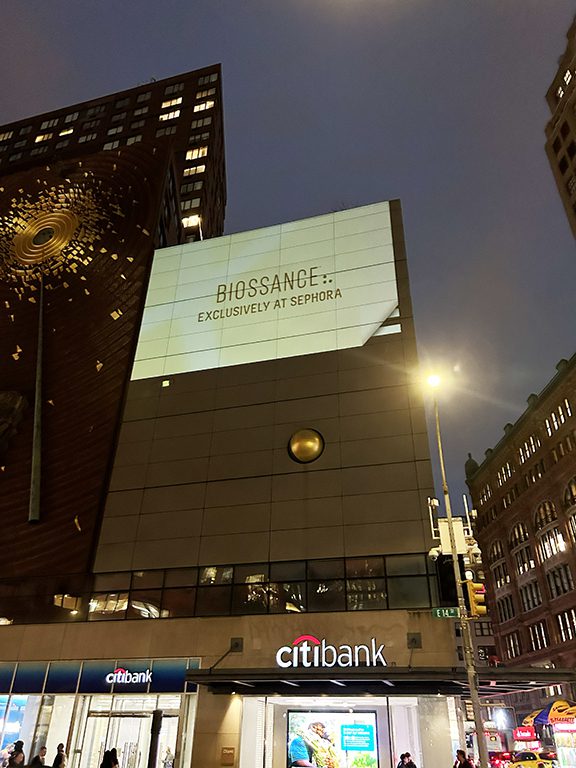
Projection campaigns have become one of our most requested services in the last two years. We’ve projected brand imagery onto the facades of buildings in Tribeca, onto surfaces near the bridges in Long Island City, and onto blank walls in the Gowanus neighborhood of Brooklyn. When you project a brand message on a building at 9 PM on a Friday night, you’re reaching pedestrians, drivers, residents, and the social media accounts of anyone who films it.
Ambient media, the kind that integrates into the environment rather than shouting at it, works particularly well with New York audiences. We’ve done pavement stencil campaigns on the blocks around Barclays Center on game days, magnetic placement campaigns on surfaces in the Financial District, and street furniture campaigns along the avenues in Midtown. Each approach reaches people in a moment of genuine attention, not while they’re actively trying to skip an ad.
The New York Neighborhoods We Know and Work In
We’ve run campaigns across all five boroughs. Here’s where we spend the most time and why each area presents distinct opportunities for the right brand.
Midtown, Hudson Yards, and the Grand Central Corridor
Midtown Manhattan is the most concentrated professional audience in the world. From Park Avenue south to 34th Street, the morning and evening rush hours move hundreds of thousands of commuters through a relatively small geographic area. We activate in this zone regularly, from Grand Central Terminal to the Vessel at Hudson Yards, and we know exactly what works here.
Hudson Yards has become one of our favorite activation spots. The plaza draws a mix of office workers, shoppers, and tourists. The physical space is clean and wide, which makes it possible to build larger brand footprints without competing with chaotic street noise. We’ve staged activations at the base of the Vessel that drew crowd formation within minutes of opening, and the sightlines from the elevated park above mean your activation becomes part of the skyline for anyone passing through.
The Grand Central area rewards campaigns that work with commuter psychology. People move through here with purpose, but they’re looking for something that breaks the routine. We design activations in that corridor to be quick to engage, easy to share, and memorable enough to mention later in the day.
SoHo, the Flatiron District, and Lower Manhattan
SoHo is where we place campaigns for brands that want to reach a style-conscious, socially active audience. Broadway between Prince and Spring streets is one of the best stretches in the country for brand visibility. The area draws New Yorkers who live and shop there and visitors who come specifically because SoHo is worth seeing. Our crews know how to work this area with precision without being intrusive, which is exactly what it takes to win here.
The Flatiron District, especially the blocks around the Flatiron Building on 23rd Street, gives us a high-visibility zone with a slightly different audience mix. Tech workers, media professionals, tourists, and local shoppers converge there. We’ve run several multi-day activations on the blocks around Madison Square Park that held consistent engagement over the full duration. The park itself serves as a natural gathering space, which makes brand interactions feel organic rather than forced.
Lower Manhattan, from the World Trade Center area down to Wall Street, gives us access to the financial audience during the week and a tourist-heavy crowd on weekends. The Oculus at the World Trade Center is one of our preferred environments for indoor activations in that part of the city. The architecture draws attention naturally, which means any brand presence we create there benefits from elevated visual interest from the start.
Brooklyn, Queens, and the Outer Boroughs
We don’t stop at the bridges. Brooklyn is where some of our most creative work happens. Williamsburg’s Bedford Avenue corridor is one of the highest-traffic pedestrian streets in the borough, and the audience there skews young, culturally aware, and highly active on social media. We’ve done projection work on buildings in Dumbo that generated earned media coverage beyond what the client expected. We’ve run sampling campaigns in Crown Heights and Bushwick that reached communities that Manhattan-only campaigns miss entirely.
Astoria and Long Island City in Queens give us access to a dense, diverse population with strong neighborhood identity. Flushing is another area where we’ve run campaigns for brands that want to reach the Asian-American community in New York specifically and authentically. The foot traffic in the Flushing Main Street corridor rivals what you’d find in many major Manhattan blocks, and the community engagement there is some of the strongest we’ve seen anywhere in the five boroughs.
The outer boroughs often give us our most engaged audiences. People in these neighborhoods aren’t as saturated with brand activations as Midtown commuters. When we show up with something real, the response is warmer and more organic. Local pride runs deep, and brands that show up in these communities earn trust that’s hard to manufacture anywhere else.
How We Run Campaigns: From First Call to Final Report
A lot of agencies talk about process. We’ll tell you ours because it’s what makes our campaigns work in a city as demanding as New York. Every step matters, and we’ve refined each one through years of running actual campaigns on these streets.
Research, Scouting, and Strategic Planning
Every campaign starts with location intelligence. Our team physically scouts the sites we’re considering before committing to any plan. We look at foot traffic at different times of day, pedestrian flow patterns, sightlines, competitive clutter, and the specific character of each block or space. We’re not working from someone else’s foot traffic report. We walk the ground ourselves, often multiple times at different hours.
From that scouting work, we build a strategic plan that covers location, timing, staffing, creative, and measurement. We get specific about timing because New York’s foot traffic patterns are hyperlocal. The 8 AM rush on Lexington Avenue is not the same as the 11 AM lunch crowd on West 14th Street. We match campaign timing to the audience patterns we’ve observed in person.
This planning phase also involves direct creative alignment with the client. We’re honest about what works in specific New York contexts and what doesn’t. If a concept that worked in another market won’t translate to the physical reality of SoHo on a Saturday afternoon, we say so and come in with alternatives. Our clients get stronger campaigns because we’re direct in the planning stage rather than finding out what doesn’t work after the campaign has started.
Fabrication, Logistics, and Pre-Campaign Setup
Once the plan is locked, we manage the production side. This includes coordinating any fabrication for physical installations, managing logistics for sampling product or branded materials, and setting up the operational infrastructure for campaign days. We’ve transported custom branded structures to Midtown sites in the early morning hours to beat traffic. We’ve managed refrigerated product delivery to sampling locations across multiple boroughs on the same day.
Our production team understands how to move things around New York. Loading dock restrictions, service entrance logistics, street staging requirements, and the timing windows that keep everything running, these are problems we’ve solved under pressure on real campaign days. We’ve built systems around those solutions so they don’t slow us down anymore.
Pre-campaign setup also includes a full staff briefing. Every person on a campaign team, from brand ambassadors to field supervisors, gets a full briefing on the brand, the target audience, the activation goals, and the specific location we’re working in. We don’t brief people once and hope for the best. We run through scenarios, answer questions, and make sure every member of our crew feels ready before we put them in front of the public.
On-Site Execution and Field Management
On campaign days, our team is on-site before anything opens. We stage, brief our field staff, run through contingencies, and are ready to go when foot traffic starts. Our field managers stay present throughout the activation, on the ground, watching how the campaign is landing, making real-time adjustments, and solving problems before they become issues.
We communicate throughout the day with whoever needs to be in the loop on the client side. Clients get photo and video updates, real-time distribution numbers, and direct calls if anything significant changes. We don’t disappear after setup. That level of accountability is a standard we’ve held since we started, and it’s one of the main reasons clients come back to us for repeat campaigns.
At the end of each campaign, we deliver a full recap report. This covers distribution numbers, photos and video, social mention tracking, any consumer feedback gathered on-site, and our team’s honest assessment of what worked, what we’d adjust, and what the data suggests for follow-up activity. We use these reports internally to improve future campaigns. Our clients use them to build the case for repeat investment.
Campaign Types, Formats, and Investment Ranges
Not every campaign looks the same, and the investment varies based on scope, duration, and complexity. Here’s how our experiential programs typically structure across different formats and budget levels. Use this as a starting point for your own planning.
Campaign Type
Duration
NYC Locations
Staffing
Estimated Budget
Best For
Entry-Level Activation
1 day
Union Square, Herald Square, Flatiron District
2 to 4 brand ambassadors
$5,000 – $10,000
Product launches, first NYC market test
Mid-Tier Program
2 to 5 days
SoHo, Midtown, Brooklyn corridors
4 to 10 ambassadors plus field manager
$15,000 – $50,000
Multi-neighborhood reach, campaign launches
Sampling Program
1 to 7 days
Penn Station, Grand Central, Columbus Circle
3 to 8 samplers plus supervisor
$6,000 – $30,000
Food, beverage, consumer packaged goods
Guerrilla Street Campaign
1 to 3 days
Williamsburg, Dumbo, Lower East Side
2 to 6 crew members
$8,000 – $25,000
Cultural brands, music, fashion, lifestyle
Projection or Ambient Media
1 to 5 nights
Tribeca, Long Island City, Gowanus, Bushwick
2 to 4 crew plus equipment operator
$10,000 – $40,000
Brand awareness, event tie-ins, album drops
Full-Scale Brand Experience
5 or more days
Multiple boroughs, custom or branded venues
10 or more staff including production team
$75,000 – $200,000+
Major launches, brand reintroductions
Entry-Level and Mid-Tier Activations
Entry-level activations are typically single-day programs with a focused geographic footprint. These work well for product launches, local market tests, and brands that want to see results before committing to a larger program. Our team can execute a strong single-day activation at Union Square or Herald Square with a staffed engagement experience that gets real product into real hands. Many clients start here and scale up once they’ve seen what a well-run New York street activation can do for their brand.
Mid-tier programs give brands enough scope to make a real impression across multiple days or locations. These campaigns often combine a hero location in Midtown with secondary activations in Brooklyn or the Village, reaching multiple audience segments across the same campaign cycle. The multi-day format also allows our team to learn from day one and sharpen execution on day two, which typically means measurably better engagement numbers as the program progresses.
Full-Scale Brand Experiences
Full-scale experiential campaigns in New York involve multi-day programs across multiple neighborhoods, custom fabrication, large staffing teams, and often integrated digital and social components. These campaigns represent the top of our service range and deliver the kind of results that justify the investment. For brands doing major product launches, rebranding efforts, or high-visibility market entries into New York, this level of commitment is what moves the needle in a measurable way. We’ve managed campaigns at this level that generated press coverage, viral social content, and sales lift that the brand’s own analytics team was still tracking three months later.
Why We’re Among the Top Experiential Marketing Companies in New York
There are agencies that say they do experiential marketing in New York. Here’s what sets us apart from the rest of the market, and why brands keep coming back to us after their first campaign.
We’ve Run These Campaigns Ourselves, Personally
Our team has personally executed activations across every major neighborhood in this city. Our founders and senior staff haven’t only managed campaigns from conference rooms. They’ve been on the corner of Canal and Broadway in February. They’ve managed crowd flow at Grand Central during the evening rush. They’ve solved the problem of a delivery truck running two hours late when an activation starts in 90 minutes. That firsthand operational experience shapes everything we do.
When we give a client a recommendation about timing, location, or activation format, it’s grounded in what we’ve watched work and fail in real conditions on real New York streets. We don’t guess. We draw on a body of direct experience that most agencies, especially those headquartered outside New York, simply don’t have. Our recommendations carry weight because they come from people who’ve been on the ground doing this work.
This direct experience also makes us better problem-solvers. In New York, something always comes up. A permit takes longer than expected. A location gets closed for a film shoot. A sudden crowd surge shifts the foot traffic pattern in a way that changes where your activation should be positioned. We’ve encountered all of these situations and found solutions in real time. That’s a skill you only develop by actually running campaigns, not by reading about them.
Speed, Flexibility, and Crew Quality
New York moves fast and it doesn’t accommodate brands that can’t keep up. We’re built for speed. We can turn campaigns around quickly when a brand needs to move on a market opportunity. We can adjust plans mid-campaign when conditions on the ground change. Our team makes decisions under pressure without losing quality.
We’ve executed campaigns for clients who came to us with a three-week lead time for a Times Square area activation. We made it happen. That kind of responsiveness is a real competitive advantage in a market where opportunities open and close faster than most campaign timelines allow. When a brand needs to respond to a cultural moment or a competitor’s move, we can move with them.
Our crew quality is something we’re genuinely proud of. We’ve invested years in building a network of brand ambassadors, field managers, production staff, and creative collaborators who know how to work in New York and how to represent brands at a high level. The people who show up to your activation are the people who determine whether it succeeds. We put serious energy into having the right people on the ground, every time.
A Network Built Across New York Over Years of Active Work
We’ve spent years building relationships with property owners, venue managers, local vendors, fabricators, and the broader event and production community in New York. Those relationships mean we can access spaces and resources that other agencies can’t. Our vendor network means we’re not starting from scratch on every campaign. We’re calling people we’ve worked with before who know how we operate and what our standards are.
That network also means faster problem-solving when something doesn’t go according to plan. If we need an additional generator at a Grand Central activation on short notice, we know who to call. If we need a custom fabrication piece turned around in 72 hours for a SoHo pop-up, we have the relationships to make that happen. The network is one of the most valuable things we’ve built over the years, and it directly benefits our clients in the form of better access, faster execution, and lower friction across every campaign we run.
What types of brands do you work with in New York?
We work with a wide range of clients. Consumer packaged goods brands use us for product sampling and launch activations. Fashion and lifestyle brands run street-level and projection campaigns with our team. Technology companies use us for product launch experiences in high-profile New York locations. We’ve also worked with entertainment companies, nonprofits, and political organizations on high-impact street campaigns. Our work spans industries because experiential marketing produces results across categories when it’s executed with real precision and genuine knowledge of New York’s streets.
How far in advance do we need to book a campaign?
Our standard lead time is four to six weeks for most programs. For more complex activations that involve custom fabrication or multi-location coordination, we prefer eight to twelve weeks. That said, we’ve executed campaigns with as little as two to three weeks of lead time when a client had a tight window and a clear brief. Call us early when you can, but don’t count yourself out if your timeline is shorter than ideal. We find solutions.
Do you handle brand ambassador staffing and training?
Yes. Staffing is part of what we manage on every campaign we run. We recruit, train, and manage brand ambassadors ourselves. We don’t outsource this because the quality of the human interaction at an activation is too important. Our ambassadors are briefed on the brand, trained on key messages, and coached on how to engage with New York audiences specifically. The difference between a mediocre activation and a great one usually comes down to the people holding it together on the street.
What neighborhoods and boroughs do you cover?
We cover all five boroughs. In Manhattan, we work regularly in Midtown, SoHo, the Flatiron District, the Financial District, the West Village, Hell’s Kitchen, Harlem, and Washington Heights. In Brooklyn, we’re active in Williamsburg, Dumbo, Park Slope, Crown Heights, Bushwick, and Bay Ridge. In Queens, we cover Astoria, Long Island City, Flushing, and Jackson Heights. We’ve also run campaigns in the Bronx and on Staten Island when the brief calls for it. New York is all five boroughs to us, and we bring the same level of preparation to every one of them.
How do you measure the results of an experiential campaign?
We track a combination of quantitative and qualitative metrics. On the quantitative side, we measure sample or collateral distribution, foot traffic conversion rates at activations, social media reach and exposures from organic shares, and any digital conversion data tied to QR codes or landing pages built into the campaign. On the qualitative side, we gather real consumer feedback from the field, document photo and video evidence of engagement, and assess the overall quality of interactions. Every campaign ends with a full written recap delivered to the client, covering all of this plus our own honest assessment of the program.
Can you run campaigns across multiple boroughs on the same day?
Yes. We regularly staff and manage multi-location programs across New York. We’ve run campaigns with field teams in Midtown, Brooklyn, and Queens running at the same time. Our field management structure is built to handle distributed operations. We use a clear chain of communication between site managers and our central coordination team to keep everything aligned across locations throughout the day. Clients get updates from all locations, more than one.
What’s the minimum budget for a campaign in New York?
Our programs start around $5,000 for a single-day, single-location activation with a small staff. This doesn’t get you a full production, but it does get you a professional, well-run experience at a high-traffic New York location with trained brand ambassadors and a post-campaign report. Most clients find that investing at the $10,000 to $25,000 range gives them enough scope to see real results. We’re always direct with clients about what’s achievable at different investment levels, and we’d rather have that honest conversation upfront than set expectations we can’t meet.
How do you handle weather or unexpected changes on campaign day?
Weather is the most common variable we manage in New York. Our campaigns include contingency planning for rain, cold, heat, and wind. Depending on the activation type, we have covered location alternatives, modified setup configurations, or adjusted timing protocols ready to go. We monitor weather closely in the days before and the morning of every campaign. Our field managers are experienced in making real-time decisions about adjustments without losing the campaign’s effectiveness. We’ve run successful activations in November rain in Chelsea and August heat waves in Flushing. The campaign goes on.
Do you offer ongoing monthly or quarterly programs?
Yes. Several of our clients run with us on a monthly or quarterly basis, scheduling recurring activations throughout the year to maintain a consistent brand presence on New York streets. These ongoing programs typically come with better coordination efficiency and often a better cost structure than one-off campaigns. If you’re thinking about building a sustained street presence in New York over time, we’d encourage a conversation about what a longer-term program could look like for your brand. Brands that show up consistently in this city build a kind of recognition that single campaigns can’t create.
How is American Guerrilla Marketing different from larger experiential agencies?
Larger agencies often bring significant overhead, long lead times, and account structures where senior creative and strategy staff are replaced by junior teams on the day-to-day. We operate differently. Our senior people stay involved from the first conversation through the final recap. Our New York knowledge is current because we’re actively running campaigns here every week, across all five boroughs. We’re also faster. When an opportunity comes up in this market, we can move on it in ways that larger organizations can’t. Clients who’ve worked with both types of agencies come to us because they want real responsiveness and real New York expertise, not a brand name on a pitch deck.
Ready to Activate? Let’s Talk About Your New York Campaign
We’ve run campaigns on the streets of New York long enough to know what works, what doesn’t, and how to build experiences that people actually remember. If you’re evaluating experiential marketing companies in New York and you want the team that has genuinely done this work at a high level, across every neighborhood in the city, with crews that show up prepared and deliver results, we’d like to be in that conversation.
We’ll ask you about your brand, your goals, your timeline, and your budget. We’ll tell you exactly what we’d do, where we’d do it, and why. No vague strategy decks. No promises we can’t keep. Just a direct conversation from a team that knows New York’s streets better than most agencies know their own offices.
American Guerrilla Marketing has been running experiential campaigns across New York City for over a decade. From Grand Central Terminal to the streets of Bushwick, from Hudson Yards to the Flushing Main Street corridor, our team has activated, installed, sampled, and created experiences that move people and move product. We’re on the ground in this city every week. Let’s put that experience to work for your brand.
Frequently Asked Questions
What types of brands do you work with in New York?
We work with a wide range of clients. Consumer packaged goods brands use us for product sampling and launch activations. Fashion and lifestyle brands run street-level and projection campaigns with our team. Technology companies use us for product launch experiences in high-profile New York locations. We’ve also worked with entertainment companies, nonprofits, and political organizations on high-im
How far in advance do we need to book a campaign?
Our standard lead time is four to six weeks for most programs. For more complex activations that involve custom fabrication or multi-location coordination, we prefer eight to twelve weeks. That said, we’ve executed campaigns with as little as two to three weeks of lead time when a client had a tight window and a clear brief. Call us early when you can, but don’t count yourself out if your timeline
Do you handle brand ambassador staffing and training?
Yes. Staffing is part of what we manage on every campaign we run. We recruit, train, and manage brand ambassadors ourselves. We don’t outsource this because the quality of the human interaction at an activation is too important. Our ambassadors are briefed on the brand, trained on key messages, and coached on how to engage with New York audiences specifically. The difference between a mediocre act
What neighborhoods and boroughs do you cover?
We cover all five boroughs. In Manhattan, we work regularly in Midtown, SoHo, the Flatiron District, the Financial District, the West Village, Hell’s Kitchen, Harlem, and Washington Heights. In Brooklyn, we’re active in Williamsburg, Dumbo, Park Slope, Crown Heights, Bushwick, and Bay Ridge. In Queens, we cover Astoria, Long Island City, Flushing, and Jackson Heights. We’ve also run campaigns in t
How do you measure the results of an experiential campaign?
We track a combination of quantitative and qualitative metrics. On the quantitative side, we measure sample or collateral distribution, foot traffic conversion rates at activations, social media reach and exposures from organic shares, and any digital conversion data tied to QR codes or landing pages built into the campaign. On the qualitative side, we gather real consumer feedback from the field,
Can you run campaigns across multiple boroughs on the same day?
Yes. We regularly staff and manage multi-location programs across New York. We’ve run campaigns with field teams in Midtown, Brooklyn, and Queens running at the same time. Our field management structure is built to handle distributed operations. We use a clear chain of communication between site managers and our central coordination team to keep everything aligned across locations throughout the d
What’s the minimum budget for a campaign in New York?
Our programs start around $5,000 for a single-day, single-location activation with a small staff. This doesn’t get you a full production, but it does get you a professional, well-run experience at a high-traffic New York location with trained brand ambassadors and a post-campaign report. Most clients find that investing at the $10,000 to $25,000 range gives them enough scope to see real results. W