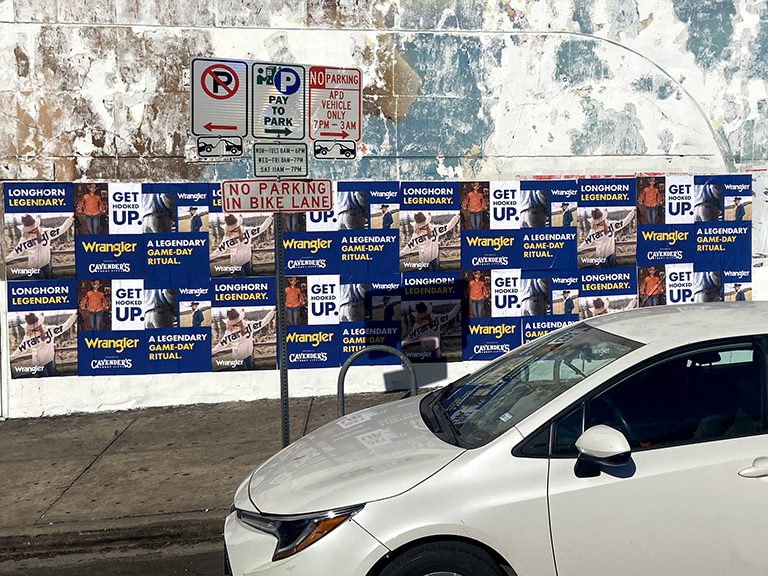
Wheatpaste Posters: Design, Print & Street Placement
Wheatpaste posters are not a nostalgia format. They are the most cost-efficient way to put a brand at street level, at scale, in the neighborhoods where conventional advertising inventory does not exist.
Wheatpaste posters work because cities are experienced at street level, not from above. The pedestrian who walks past the same block every day has a relationship with the walls of that block. A poster that appears overnight on a wall they pass twice a day registers differently than a digital advertisement they scroll past in two seconds. The physical scale, the specific placement, and the visual permanence of a large-format paper poster on a brick wall creates a type of attention that is increasingly rare and therefore increasingly valuable.
We have been producing and installing wheatpaste posters professionally for over a decade. The campaigns range from focused single-neighborhood placements for local businesses and emerging artists to coordinated national programs hitting eight or more cities simultaneously for major consumer brands. The medium scales well in both directions, and understanding how to use it well across different contexts is what this guide covers.
Wheatpaste posters are large-format paper prints adhered to wall surfaces using a paste adhesive made primarily from wheat starch. The paste penetrates both the paper and the wall surface, creating a bond that holds the print in place through weather, foot traffic, and time. The paper is typically uncoated, between 60 lb and 100 lb weight, which provides the right balance of paste absorption, print quality, and outdoor durability.
The process is straightforward at the technical level but requires skill to execute well. A paste coat goes down on the wall, the paper goes on top while the paste is still wet enough to allow positioning, a squeegee or wide brush smooths the paper from center to edges to push out air, and a sealing coat of paste goes over the surface to laminate the installation. Done correctly, the poster conforms to the surface, bonds completely, and dries into a weather-resistant installation that holds for weeks.
What Makes a Good Wheatpaste Poster Location
Location selection is where the strategy of a wheatpaste poster campaign lives. The most important factor is pedestrian flow. A wall that is in front of 2,000 people per day delivers fundamentally different campaign value than a wall seen by 200 people per day, even if the second wall has a cleaner surface or a better position in the neighborhood’s visual geography.
After pedestrian flow, we look at: audience match between the people walking that block and the campaign’s target demographic, surface quality and how well the substrate will accept paste, viewing angle and distance from the dominant pedestrian approach, and competition from other poster activity in the immediate area. The last factor matters more in some cities than others. In New York’s Bushwick, it is a significant consideration. In a quieter corridor in Pilsen or East Austin, competition for specific wall faces is much lower.
Wheatpaste Posters vs. Other Outdoor Advertising Formats
Understanding how wheatpaste posters compare to the other options in the outdoor advertising environment helps brands make informed format decisions rather than defaulting to whatever they already know.
Format
Average Cost Per Location
Lead Time
Location Control
Cultural Register
Wheatpaste Poster
Low to moderate
10-14 days
High (specific walls)
Street-level, authentic
Transit Shelter Ad
Moderate to high
4-8 weeks
Limited (network placement)
Conventional advertising
Billboard (static)
High
4-8 weeks
Fixed inventory only
Conventional advertising
Digital OOH
High to very high
2-4 weeks
Network inventory only
Conventional advertising
Hand-Painted Mural
High per location
3-6 weeks
High (specific walls)
Art installation, premium
Chalking / Stencil
Low
5-7 days
High (sidewalk specific)
Ultra-guerrilla, temporary
The Case for Wheatpaste Posters Over Transit and Billboard
Transit shelter and billboard advertising buys reach through a network whose inventory is defined by the media company, not by the brand. The brand specifies a market and a broad demographic target; the network places the ad where there is available inventory that fits those parameters. The brand does not choose which specific walls or shelters their advertising appears on, and the location selection is not driven by the audience quality of the specific location but by what the network has available.
Wheatpaste posters reverse this logic entirely. The brand specifies the exact neighborhood, the exact block, and in many cases the exact wall face they want to be on. Our location selection is driven by audience quality at the specific placement, not by network availability. For brands with specific neighborhood and demographic targeting needs, this difference is substantial.
Types of Wheatpaste Poster Campaigns
Different campaign objectives call for different wheatpaste poster strategies. Here is how we think about the primary campaign types.
Launch and Release Campaigns
Product launches, album releases, film openings, and store launches benefit from wheatpaste poster campaigns because the format creates physical presence in the city on a specific date. The campaign lands overnight, and the next morning the target neighborhood wakes up to posters that were not there the night before. This overnight-reveal quality creates a specific kind of announcement impact that no digital format replicates.
For launch campaigns, timing is everything. The campaign needs to be live before or concurrent with the launch moment. Print production and execution logistics need to be managed against the launch date with sufficient buffer for any last-minute changes to creative or location. We have executed enough launch campaigns to build the timing management into our standard workflow, but brands that come to us two days before a launch date create risk that cannot always be managed without expedited fees and compressed timelines.
Sustained Presence Campaigns
Some brands run wheatpaste poster programs as a continuous marketing presence rather than as event-specific campaigns. This approach typically involves monthly or bi-monthly poster runs across the same core neighborhoods, maintaining a consistent brand presence in the visual environment over an extended period. The cumulative effect of sustained presence builds brand recognition in ways that a single campaign cannot, and it positions the brand as genuinely embedded in the neighborhood rather than visiting it for a one-time campaign moment.
Event and Venue Promotion
Concerts, club nights, exhibitions, pop-up events, and retail activations use wheatpaste posters as the primary promotion vehicle in the neighborhood surrounding the venue or location. For event promotion, geographic concentration around the event location matters more than broad neighborhood coverage. The goal is saturation within walking and transit distance of the event, not broad market awareness across the full city.
Geographic Saturation Campaigns
When a brand needs to claim a specific neighborhood visually, a geographic saturation campaign covers every viable wall face in a defined zone with consistent creative. This approach creates the sense that the brand is everywhere within the target area, which is a different effect from standard distributed campaign placement. Saturation campaigns require higher print quantities and more intensive location scouting to identify every viable surface in the zone.
AGM Field Note: Saturation campaigns work best when the creative is designed specifically for the saturation context. When the same poster is on every wall in a one-block radius, the repetition itself becomes a message. It signals that the brand is committed to this neighborhood and this moment. Creative that acknowledges the saturation strategy through bold, clean design and a strong single message amplifies this effect. Creative designed for variety across a diverse campaign wall set does not produce the same saturation impact when repeated at close range.
Wheatpaste Poster Production: From Design to Installation
The production chain for a wheatpaste poster campaign involves four stages: artwork preparation and review, print production, field execution, and documentation delivery. Each stage has quality requirements that affect the campaign’s final output.
Artwork Preparation
Artwork for wheatpaste posters needs to be prepared for large-format print production, which has different requirements than digital or small-format print production. The minimum resolution threshold is 150 DPI at final output dimensions. Color mode is CMYK. Bleed is required on all edges. Fonts must be embedded or outlined. Vector logos and wordmarks are preferred over raster versions.
We review all artwork before accepting it into the production workflow. Files that do not meet specifications get flagged and returned with specific correction guidance before print production begins. This protects the campaign budget and ensures that what goes up on the wall reflects the brand correctly.
Print Production
Most brand campaigns are produced on wide-format inkjet printers using 60 lb to 80 lb uncoated text stock. Wide-format production handles any quantity from a single copy to several hundred efficiently, with turnaround times of three to five business days for standard volumes. Higher-quantity campaigns may use offset litho production for cost efficiency, with longer lead times of seven to twelve business days.
Field Execution
Execution crews are briefed with a site list, paste, materials, and documentation equipment. Campaigns typically execute late at night to minimize interference with pedestrian flow during application. Each site is photographed immediately after installation. A real-time reporting system tracks campaign progress against the site list during execution so we have a live status of completions at any point in the night.
Campaign Report Delivery
The campaign report is compiled and delivered within 48 to 72 hours of execution completion. It includes placement photos organized by location, geo-tagged maps for larger campaigns, and execution notes. The photo set is provided at high resolution suitable for immediate social, press, and internal marketing use.
Integrating Wheatpaste Posters with Digital Marketing
Wheatpaste poster campaigns generate content that has real value in digital channels. The physical campaign becomes a digital content source. Execution photography, installation time-lapses, and behind-the-scenes documentation translate directly into social media content that performs well because it shows real-world scale and street-level presence rather than studio-produced brand imagery.
The most effective integration strategy we see brands use is: produce the wheatpaste campaign, document it thoroughly, publish the documentation as social content beginning on the day the campaign goes up, and then continue publishing from the documentation set over the following week or two as the campaign is still live in the streets. This extends the campaign’s social footprint well beyond the execution date and amplifies the street-level presence into digital audiences who may not have seen the posters in person.
Brands that use the physical campaign as a digital content engine consistently get more value per campaign dollar than brands that treat the street campaign and the digital campaign as separate programs. The wall is content. The documentation proves presence. The combination of physical installation and digital amplification is where the format’s full value is realized.
AGM Field Note: We specifically shoot campaign documentation for dual use: reporting and content. We frame shots to show the poster in a way that reads well at social media dimensions, not just at a standard documentation angle. This means slightly different framing, attention to background and context, and selection of the best light available at the time of installation. The extra three minutes per site this takes produces documentation that is actually usable as brand content, not just a compliance photo.
Markets We Cover for Wheatpaste Poster Campaigns
We execute wheatpaste poster campaigns in every major US market. Our established primary markets with experienced local crews and pre-scouted wall inventory include:
New York City: All five boroughs, with depth in Brooklyn and lower Manhattan
Los Angeles: Melrose Ave, Fairfax District, Arts District, Silver Lake, Echo Park
Chicago: Wicker Park, Bucktown, Logan Square, Pilsen, Wrigleyville
Miami: Wynwood, Design District, Little Havana, Brickell
Austin: East 6th Street, South Congress, North Loop, South Lamar
Atlanta: Old Fourth Ward, Ponce City Market corridor, East Atlanta Village
Nashville: 12 South, Gulch, East Nashville, Germantown
Denver: RiNo (River North), Capitol Hill, South Broadway
Additional markets are available with appropriate lead time for crew preparation and location scouting. Multi-city campaigns across any combination of these markets can be coordinated to execute simultaneously or in a defined sequence.
The Relationship Between Wheatpaste Posters and Neighborhood Identity
Wheatpaste posters are one of the primary ways neighborhoods signal their cultural identity to people who move through them. The walls of Bushwick, the corridors of Melrose Ave, and the blocks around Wynwood all carry a specific visual character that is shaped substantially by the accumulation of paste-up campaigns, street art, and brand installations on their walls. Brands that engage with this dynamic intelligently, placing campaigns that fit the aesthetic and cultural register of the neighborhood, build genuine affinity with the audience that lives and works there. Brands that place campaigns without regard for fit generate friction rather than the credibility they are seeking.
Understanding neighborhood identity is not a soft concept. It is a practical determinant of campaign effectiveness. An audience in Bushwick that encounters a campaign on their walls makes an immediate, largely unconscious assessment of whether the brand in question belongs in their visual environment. The assessment is based on creative quality, brand relevance to the neighborhood’s cultural context, and the quality of the execution itself. All three factors are within the brand’s and agency’s control, and all three should be considered in campaign planning.
What Neighborhood Fit Looks Like
A streetwear brand with genuine cultural roots in the skate and urban music communities runs a campaign in Bushwick with bold graphic design, strong brand typography, and paste-up art commissions from artists who already have a following in the neighborhood. The campaign fits because the brand fits, and because the execution quality signals that the brand understands and respects the visual culture it is entering.
A financial services brand or a mass market retail chain running the same format in the same neighborhood faces a harder challenge. The format can work across a wider range of brand categories than its artistic origins might suggest, but the creative has to be exceptional to overcome the initial mismatch signal between the brand’s category associations and the neighborhood’s self-image. We have seen brands from unexpected categories execute successful wheatpaste campaigns in culturally sensitive neighborhoods by investing in creative quality and artist collaboration that genuinely earns the space.
Long-Duration and Sustained Wheatpaste Poster Programs
Most brands think about wheatpaste posters in the context of a single campaign with a defined start and end date. Some of the most effective uses of the format, however, involve sustained programs that maintain a consistent brand presence in target neighborhoods across an extended period, whether that is a quarter, a season, or an entire year.
How Sustained Programs Work
A sustained wheatpaste poster program runs regular campaign cycles, typically monthly or bi-monthly, with fresh creative at each cycle. The core location set is maintained across cycles, with new posters applied over aging ones. Each cycle produces new documentation that is used for social content through the next cycle. The cumulative effect over several cycles is a brand that feels genuinely rooted in the neighborhood rather than visiting it for a one-time campaign.
Sustained programs have a significant efficiency advantage over single campaigns: the scouting, location relationships, crew familiarization with sites, and production infrastructure all build up over successive cycles, reducing the marginal cost and lead time of each subsequent run. By the third or fourth cycle of a sustained program, we are executing with the efficiency of a well-tuned operation rather than the cost and time of a fresh campaign build.
Creative Refresh Strategy for Sustained Programs
Creative refresh in a sustained program can follow two different strategies. The first is consistent brand imagery with seasonal or campaign-specific elements updated each cycle, which is the approach taken by brands whose wheatpaste presence is about sustained brand awareness rather than specific campaign messaging. The second is distinct creative at each cycle tied to a specific campaign moment, product launch, or brand story chapter, which is the approach taken by brands whose wheatpaste program supports an ongoing content and launch calendar.
Both strategies work. The consistent imagery approach builds the most recognizable neighborhood presence over time. The distinct creative approach generates more varied and interesting documentation for social content. Some sustained programs combine both, running consistent brand elements alongside a rotating focal creative that changes each cycle.
Documentation Accumulation Over Sustained Programs
One of the underappreciated benefits of sustained wheatpaste poster programs is the accumulation of documentation over time. A brand that runs monthly cycles in Bushwick for six months builds a library of sixty-plus documented placements across multiple creative cycles, in various weather and lighting conditions, with the neighborhood’s changing seasonal character as a backdrop. This documentation library becomes a significant brand content asset that supports social media, press, and internal marketing use well beyond the period of the physical campaign.
How Brands Use Wheatpaste Posters to Build Momentum
The strongest wheatpaste poster campaigns do not just announce something once. They build momentum around a release, opening, or brand moment by making the city feel involved. When the same image starts appearing across the right blocks over a short window, the campaign gains a sense of inevitability. It feels like something is happening, not merely being advertised.
Pre-Launch Presence
Some brands use wheatpaste posters to seed anticipation before a launch date. The poster may reveal the product, the artist, or the event directly, or it may use a visual teaser with minimal copy. The point is to turn the city into part of the build-up. This works especially well in neighborhoods where the audience is used to reading walls for signals about what is coming next.
Launch-Day Saturation
Other campaigns hold the whole run for a coordinated overnight install so the neighborhood wakes up to a fully formed presence. That overnight saturation effect is one of the medium’s biggest strengths. It creates a before-and-after moment on the block, and that surprise factor gives the campaign energy that digital sequencing cannot match.
Post-Launch Reinforcement
After the announcement moment, wheatpaste posters continue doing useful work by keeping the campaign visible in the daily routes of the target audience. A release that launches on Friday but stays on the wall through the rest of the month keeps accumulating recognition. People may first see the poster as announcement, then as reminder, then as confirmation that the brand is still present. That layered effect matters.
AGM Field Note: The best wheatpaste campaigns usually have a rhythm: teaser, takeover, then documentation. When all three are planned together, the wall works harder for the budget.
Creative Systems for Multi-Location Poster Campaigns
At scale, wheatpaste posters work best when the creative behaves like a system instead of a single isolated image. The campaign may use one hero file, but it should also be able to support anchor walls, smaller fills, neighborhood-specific crops, and documentation that all still feel visually related.
One Hero, Several Crops
A common smart approach is one master visual with alternate crops for different wall formats. That keeps the brand language consistent while allowing each wall to feel composed rather than squeezed. A tall portrait crop might work on narrow surfaces in Manhattan, while a wider variation serves larger Brooklyn anchor faces. The audience still reads them as one campaign.
Consistent Typography Rules
Typography should follow rules across the system. If the campaign title is bold condensed uppercase in one format and thin mixed-case in another, the visual memory breaks down. We guide clients toward consistency in type weight, placement logic, and message hierarchy so that every placement reinforces the same identity even when the exact wall size changes.
Documentation-Friendly Design
We also think about how the artwork will look in photos. Wheatpaste posters live twice: once on the wall and once in the documentation. High-contrast design, recognizable focal imagery, and clean edge framing usually produce stronger photos, which means the campaign works harder across social and PR after the install. Good documentation should not be an accident.
Where Wheatpaste Posters Fit in a Broader Street Strategy
Wheatpaste posters are often the backbone of a broader street campaign. They create the repeated visual field that other tactics can then amplify. If a brand is combining murals, flyering, OOH takeovers, event support, or creator content, the poster layer is often what ties the rest together geographically.
Anchor and Support Roles
Large-format posters can act as anchor installations while smaller posters spread the same message across surrounding routes. In a mixed street strategy, the anchors generate the hero photography and the support placements create the repeated presence. This is a practical use of budget because not every wall needs to be oversized to make the market feel covered.
Market Testing
Wheatpaste posters are also a useful testing format. A brand considering a larger mural or street activation in a city can use posters first to learn which neighborhoods photograph best, which creative read strongest, and where the audience response feels most aligned. The next campaign gets better because the street already taught you something.
Frequently Asked Questions
What are wheatpaste posters?
Wheatpaste posters are large-format paper prints adhered to wall surfaces using a water-based paste adhesive, typically made from wheat starch. They create outdoor advertising installations on surfaces that conventional advertising formats cannot access, at a cost significantly below traditional outdoor advertising channels.
How do wheatpaste posters differ from conventional outdoor advertising?
Conventional outdoor advertising (transit shelters, billboards, digital OOH) places ads within a media network’s fixed inventory, which the brand cannot fully control. Wheatpaste posters are placed on specific walls selected for audience quality at the individual location. The brand has direct control over which walls, which neighborhoods, and which specific streets the campaign appears on.
What is the minimum number of locations for a wheatpaste poster campaign?
There is no strict minimum. We have run campaigns with as few as five key locations for artists and small brands looking for targeted presence in a specific neighborhood. Most brand campaigns run 20 locations or more to create a noticeable neighborhood presence. High-saturation campaigns run 50 to 200+ locations to create the sense of complete market coverage.
What types of brands use wheatpaste poster campaigns?
Record labels, film studios, footwear and streetwear brands, fashion houses, beverage companies, restaurants and food brands, technology companies, consumer packaged goods brands, and cultural institutions have all used wheatpaste poster campaigns. The format works for any brand targeting urban, young, culturally engaged consumers who spend time in the neighborhoods where street-level campaigns operate.
How do I know the campaign was executed correctly?
We document every placement with photography at the time of installation and deliver a complete campaign report within 48 to 72 hours of campaign completion. The report includes photos organized by location and geo-tagged placement maps for larger campaigns. There is no estimate or aggregate reporting, only confirmed documented placements.
Can wheatpaste posters work for small, local businesses?
Yes. A small local business in the right city with a well-defined neighborhood target can run a meaningful wheatpaste campaign with 10 to 20 locations in the primary blocks around their location or event. The format scales down economically and does not require a major brand budget to produce useful results. We scope campaigns for businesses at every size.
How far in advance should I contact you?
Two to three weeks is the comfortable lead time for most single-market campaigns with ready artwork. Three to four weeks is better for multi-market programs. If you have an upcoming launch date and have not started the conversation, contact us immediately and we will advise on what is achievable in the available time.
Do you work with creative agencies?
Yes. We work with clients directly and with agencies managing campaigns on behalf of their clients. Agency partners typically manage the creative brief and artwork delivery; we manage print production, location selection, crew execution, and campaign reporting. Our communication and reporting format adapts to agency requirements for client presentation.
What happens to the posters after the campaign ends?
Wheatpaste posters naturally degrade over time, lifting at the edges and eventually weathering off the wall surface. They do not require active removal in most cases. On walls where we have ongoing relationships, we may return to apply new campaign material over the previous cycle. The paste is water-based and non-toxic, and the paper is biodegradable.