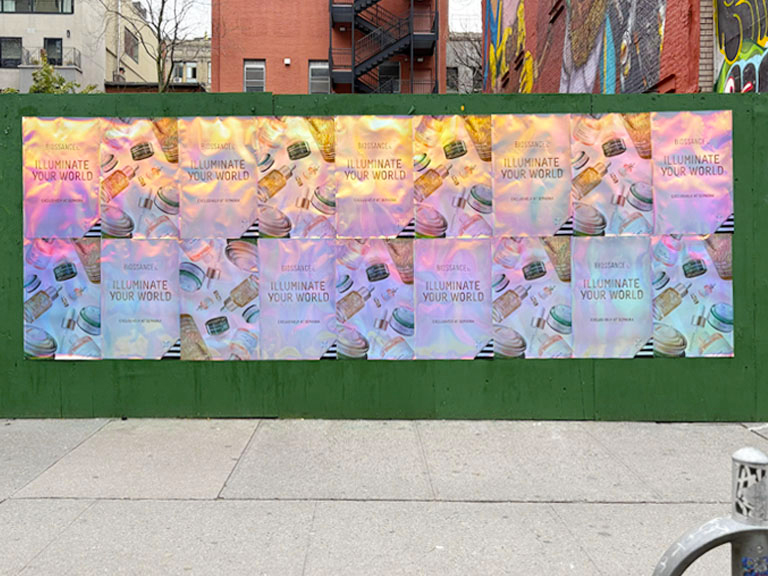
Wheatposting: What It Is and How Poster Campaigns Work in Urban Markets
Wheatposting is what happens when a brand stops waiting for consumers to come to their feed and starts showing up where those consumers actually live. Here is the full picture of how the format works.
People call it different things in different cities. Wheatposting in one community. Wheatpasting in another. Street postering. Poster bombing. Bill posting. The terminology shifts by geography and subculture, but the technique is the same everywhere: use a paste adhesive to bond a large-format printed poster to an urban wall surface, and let the foot traffic do the rest.
We have been running wheatposting campaigns for brands across the United States for years. The format is one of the oldest in urban advertising and one of the most durable because it delivers something genuinely difficult to replicate in digital or conventional outdoor media: physical presence in the specific neighborhood where the target audience lives and moves every day.
This guide explains what wheatposting is, how the technique works, what makes campaigns succeed or fail, how professional campaigns are planned and executed, and why the format continues to be part of the advertising mix for brands ranging from independent music labels to major entertainment companies.
Wheatposting is the practice of using a paste adhesive, traditionally made from wheat flour and water, to bond large-format printed posters to vertical surfaces in urban environments. The technique involves applying paste to a surface, pressing the poster against it, and then applying a sealing coat of paste over the top of the installed poster. The result is a durable bond that holds the poster in place for weeks.
The format has deep roots in street culture. Political organizers, artists, and event promoters have used paste-adhesive poster installation to communicate with urban audiences since the mid-nineteenth century. Concert promoters in New York and London have used it for decades to blanket neighborhoods with gig posters before major shows. Artists have used it to create installations at urban scale that galleries could not provide. Activists have used it to put messages into public space faster and more cheaply than any other medium.
Brands discovered the format because they discovered where their audience’s attention was. A consumer who has been desensitized to digital advertising by years of banner blindness and algorithm changes has not been desensitized to a well-designed, boldly printed poster on a brick wall at eye level on their morning walk. The physical presence of the poster in their real environment creates a different quality of presence than anything on a screen.
How Wheatposting Works: The Technical Process
The wheatposting process has several stages, each of which affects the quality and longevity of the final installation.
The Paste
The adhesive that gives wheatposting its name is a paste made from wheat flour and water. The basic formula is straightforward: cook one part flour into two parts boiling water, stir until smooth and thick, and allow to cool. The result is a functional paste that bonds paper to most masonry surfaces and holds for two to four weeks under average weather conditions.
Professional campaigns use a range of paste formulas depending on the surface type, the weather window, and the desired installation longevity. Adding white PVA glue to the flour paste improves adhesion on smoother surfaces. Using commercial methylcellulose wallpaper paste instead of home-cooked flour paste provides more consistent performance across varying temperature and humidity conditions. For large-scale multi-city campaigns, we use commercial paste because the consistency of results outweighs the cost premium over home-cooked formulas.
The Surface
Surface selection is the most important variable in campaign longevity. Brick and rough concrete provide the best adhesion because the texture of the surface creates mechanical grip that supplements the chemical bond of the paste. Construction board and plywood surfaces are also strong. Smooth painted surfaces, glass, and metal are poor wheatposting surfaces and should be avoided.
We inspect every surface before recommending it for a campaign. A brick wall that has been recently painted is a significantly worse surface than the same wall with bare brick exposed. A construction board in good condition is better than one with existing peeling posters that will destabilize any new installation. Getting the surface right before committing to a location is the most practical thing we do in campaign planning.
The Poster
Poster paper for wheatposting needs to be heavy enough to survive the installation process without tearing when wet but light enough to conform to surface texture. We specify 80 to 100 lb matte text stock for standard campaigns and weatherproof synthetic stock for campaigns in wet-weather windows or on exposed surfaces. Newsprint is too fragile for professional campaign use.
Print quality matters because the poster may be on the wall for four to six weeks. A print that fades rapidly in sunlight or a print with color registration issues that are invisible in digital proof become visible problems on a wall where the poster is examined by pedestrians at two-foot range. We review print files before production and flag quality issues before anything goes on press.
The Installation
Installation follows a consistent process. Apply paste to the surface. Press the poster from the top down, smoothing out bubbles. Apply a sealing coat of paste over the installed poster, working from center to edges. Press edges and corners firmly. Allow to cure. The top coat is the step that most amateur installations skip and most professional installations depend on.
The top coat is everything: We have tested dozens of installation variations over the years. The single change that most improves campaign longevity is the top coat. A poster installed with base coat only fails significantly faster than the same poster on the same surface with a top coat applied. The top coat seals the paper against moisture, bridges small bubbles and gaps, and adds a protective layer that extends campaign duration measurably. Never skip the top coat.
Where Wheatposting Campaigns Work Best
Wheatposting campaigns produce the best results in dense urban environments where pedestrian foot traffic is high, where the target demographic concentrates in specific neighborhoods, and where street-level visual culture has an existing audience that notices and engages with urban poster installations.
City
Best Wheatposting Zones
Primary Audience
Surface Inventory
New York City
SoHo, Williamsburg, LES, Bushwick
Creative, 22-40, diverse
Excellent (brick, construction)
Los Angeles
Fairfax, Silver Lake, Venice, Hollywood
Entertainment, streetwear, 18-38
Good (commercial walls)
Chicago
Wicker Park, Logan Square, Pilsen
Creative, music, food, 20-38
Very good (brick, construction)
Miami
Wynwood, Brickell, South Beach
Arts, hospitality, 22-42
Good (art district walls)
Austin
6th Street, South Congress, Red River
Music, tech, 20-38
Moderate (venue walls, barriers)
Creative Requirements for Wheatposting Campaigns
The creative demands of wheatposting are different from digital or print advertising. The poster is encountered by a pedestrian in motion, at a distance of 5 to 20 feet, for a viewing window of one to three seconds. The design has to work inside that constraint.
The rules are simple. One dominant visual. One clear brand mark. Six words or fewer of text. High contrast with the installation surface. Scale large enough to read from 15 feet. Any design that requires stopping and reading fails in the wheatposting format. The pedestrian who slows down to read a complex street poster is the exception. The design has to work for the person who never slows down.
Bold typography works well for wheatposting because type at sufficient scale is readable at a glance in a way that complex imagery sometimes is not. A single word or short phrase in large, heavy-weight typography on a contrasting background can be one of the strongest wheatposting creative formats, particularly for music and event campaigns where the message is simple: show name, date, venue.
Photography in wheatposting creative needs to be high-contrast and cropped tightly. A portrait that fills the entire poster at close crop registers as a face in one second. The same portrait at smaller scale surrounded by whitespace and graphic elements requires two to three seconds to process. We always crop tighter than the brand design team initially proposes for wheatposting creative, and the results consistently justify the adjustment.
How We Run Wheatposting Campaigns at AGM
Every wheatposting campaign we run starts with a brief. The client tells us the target city or cities, the target audience, the campaign timing, the creative assets, and the budget. We turn that brief into a location plan and a format recommendation within 48 hours.
Location scouting puts our team on the ground in the target neighborhoods to identify and photograph specific installation surfaces. We assess each surface for adhesion quality, pedestrian exposure, demographic character of the surrounding area, and expected installation longevity. The client sees the full location list and photos before we confirm any installation.
Creative review checks the submitted artwork against the format requirements before production. If the design has legibility issues at street scale, we flag them before anything goes to print. Most issues are easily resolved with minor adjustments to scale, contrast, or text size.
Production coordination covers paper specification, quantity, delivery timing, and packaging for field transport. Posters arrive at the installation site in good condition, correctly sized, and on schedule.
Installation happens overnight by a two-person experienced crew. We work systematically through the location list, installing at each surface and documenting as we go.
Documentation is delivered within 24 hours of installation. Every location is photographed in daylight with GPS timestamps. The photo report shows the complete campaign installation and serves as the client’s delivery confirmation.
Multi-city wheatposting: We coordinate wheatposting campaigns across multiple cities at the same time from a single brief. If a music label needs posters in New York, Los Angeles, and Chicago in the same week for an album release, we manage all three markets with separate crews and deliver a consolidated photo report that covers all three cities. One point of contact. Three cities. One report.
Why Brands Keep Coming Back to Wheatposting
Digital advertising costs have been rising for years. Standard outdoor placements in major cities are expensive and often require long lead times. Social media organic reach has collapsed. Brands that need to move fast, reach a specific urban audience, and create physical cultural presence are finding the format increasingly valuable relative to conventional alternatives.
The cost efficiency is one reason. A wheatposting campaign covering 40 locations in the right neighborhoods in New York or Los Angeles generates sustained daily brand exposure at a total cost that would buy a small fraction of that volume in standard digital or outdoor inventory. The encounter is different in quality from a digital ad, but it is also different in permanence: a poster on a wall is there every morning for three weeks, not skipped after three seconds.
The social amplification bonus is another reason. A well-placed, well-designed poster gets photographed. Those photographs get shared. Brands that have run wheatposting campaigns with distinctive creative have seen their campaigns amplified on social media platforms by people who encountered the physical installation and shared it organically. That organic reach is an extension of the campaign beyond its physical footprint at zero additional cost.
The cultural signal is the third reason. A brand that shows up on walls in SoHo, in Williamsburg, in Silver Lake, in Wicker Park is communicating something that no digital ad communicates: we belong to this place. That signal resonates with urban audiences in a way that is difficult to achieve through any other channel, and it is the reason that brands with strong cultural ambitions continue to allocate significant campaign budget to wheatposting despite the availability of cheaper reach through digital channels.
Wheatposting vs. Other Outdoor Advertising Formats
Understanding where wheatposting fits in the broader outdoor advertising environment helps brands decide when and how to use it most effectively. The format has specific advantages and limitations that make it the right choice for some campaign objectives and the wrong choice for others.
Format
Typical Cost
Audience Targeting
Visual Impact
Cultural Credibility
Wheatposting (wheat paste)
Low to medium
Neighborhood-specific
High at street level
High
Billboard (static)
Medium to high
Corridor-based
High at distance
Low
Transit advertising
Medium
Ridership-based
Medium (close range)
Low to medium
Digital OOH
High
Location and time-based
High (motion capable)
Low
Indoor venue placement
Low
Venue-specific
Low to medium
Medium to high
Wheatposting’s primary advantages are neighborhood specificity, street-level visual impact, and cultural credibility with urban audiences. Its primary limitations are the temporary nature of the installation and the narrower geographic coverage compared to a billboard or transit buy of equivalent cost. The format is most effective when those advantages align with the campaign goal: building presence with a specific urban demographic in a specific set of neighborhoods over a defined campaign window. For brands targeting culturally aware urban consumers in their twenties and thirties, wheatposting routinely outperforms standard outdoor formats both in quality of street presence and in the organic social amplification that strong installations generate.
Wheatposting for Small Brands and Independent Artists
Wheatposting is not exclusively a major-label or major-brand format. Independent artists, small businesses, local event promoters, and emerging brands with modest budgets have been using the format for decades because it offers scale-appropriate options at the lower end of the budget spectrum. The format scales to fit a range of campaign sizes and budgets. Contact AGM to discuss the right scope for your market and objectives.
We work with clients across the full size spectrum, from major label tour campaigns with national multi-city budgets to independent artists promoting a local show with a 15-location single-night installation in the neighborhood around the venue. The process is the same. The location scouting, the creative review, the installation, the documentation: all of those steps apply regardless of campaign scale. What changes is the number of locations, the geographic scope, and the total budget. The quality standard does not change with the budget.
Wheatposting Campaign Planning: What We Need From You
To build a wheatposting campaign proposal, we need four things from the client: the target city or cities, the target audience description, the campaign timing window, and the budget range. With those four inputs, we can build a location plan, format recommendation, and cost estimate within 48 hours.
Target city sets the market parameters: which neighborhoods are viable for the audience target, what the surface inventory looks like, what the typical campaign cost is in that market. Target audience drives location selection within the city: we are not going to install in Williamsburg for a campaign targeting the finance professional demographic, and we are not going to install in Midtown for a campaign targeting the streetwear and music audience. Campaign timing determines installation scheduling and expected duration. Budget range determines campaign scale.
What we do not need to start: finished creative. We prefer to have the location plan confirmed before creative is finalized so we can provide format specifications that match the specific surfaces in the campaign plan. A poster designed for 24×36 inches may need to be reworked for the 48×72 inch format of the construction board surfaces we have available in the target zone. Better to know that before production than after.
AGM Field Note: The most common mistake first-time wheatposting clients make is providing finished creative in the wrong format before discussing the campaign plan. We can work around format issues, but it adds steps and sometimes cost to the production process. Call or email us before your creative is locked in. A ten-minute conversation about the planned campaign often changes the creative spec in ways that save time and money in production.
Frequently Asked Questions
What is wheatposting?
Wheatposting is an alternate spelling of wheatpasting or wheat pasting, which is the practice of bonding large-format printed posters to walls and other vertical surfaces using a wheat flour and water paste adhesive. The technique is used for street-level advertising, art installations, and promotional campaigns in urban environments.
Is wheatposting the same as wheatpasting?
Yes. Wheatposting, wheatpasting, wheat pasting, and wheat posting all refer to the same technique: using a paste adhesive to install large-format posters on urban surfaces. The terminology varies by region and community. The technique is identical regardless of the spelling used.
What is the paste used in wheatposting made from?
Traditional wheatposting paste is made from wheat flour and water, cooked to a thick consistency. Professional campaigns often use commercial methylcellulose wallpaper paste or a flour-PVA glue blend for improved adhesion and weather resistance. The paste is applied to the surface before the poster and again over the top of the installed poster to seal it.
How long do wheatposting campaigns stay up?
Properly installed wheatposting campaigns on brick or concrete surfaces typically last three to six weeks. Weather conditions, surface porosity, and the quality of the top coat application all affect duration. Protected surfaces in dry climates produce the longest-lasting installations.
What cities is wheatposting most common in?
New York City, Los Angeles, Chicago, Miami, Austin, Seattle, and Boston are the most active wheatposting markets in the United States. Each city has specific neighborhoods and corridors where poster campaigns have the strongest cultural presence and the highest concentration of target demographics.
Who uses wheatposting for advertising?
Music labels and artists, film studios, streetwear and lifestyle brands, event promoters, food and beverage brands, and tech companies are the most common users of wheatposting for advertising. The format is particularly effective for brands targeting urban youth, creative, and entertainment-engaged consumers.
How do I start a wheatposting campaign for my brand?
Contact a professional street-level advertising agency like AGM with your campaign brief: target city, target audience, creative assets, and campaign timeline. We handle location scouting, creative review, production coordination, installation, and photo documentation. The typical lead time from brief to installation is two to three weeks.
Does AGM run wheatposting campaigns?
Yes. We run wheatposting and street poster campaigns in New York City, Los Angeles, Chicago, Miami, Austin, Boston, Atlanta, Seattle, Denver, San Francisco, and Washington DC. We cover location scouting through final campaign documentation.
Can wheatposting be combined with other street marketing tactics?
Yes. Wheatposting pairs well with street team activations, sticker campaigns, and event-based marketing. The most common combination we run is outdoor wheatposting for wall presence paired with street team hand-to-hand distribution near the installation locations. The poster creates passive awareness. The street team creates an active brand encounter. Running both in the same neighborhood at the same time compounds the campaign’s total street presence in ways that either format alone cannot achieve.
What cities produce the best results for wheatposting campaigns?
New York City, Los Angeles, and Chicago are the strongest wheatposting markets in the US by surface inventory volume, audience density, and cultural receptivity to the format. Miami, Austin, San Francisco, Seattle, Boston, and Atlanta are strong secondary markets. Smaller cities with active arts and music scenes including Denver, Nashville, Portland, and New Orleans can produce excellent results in specific neighborhoods with the right campaign brief. We have run campaigns in all of these markets and can advise on which locations produce the strongest results for specific audience targets.