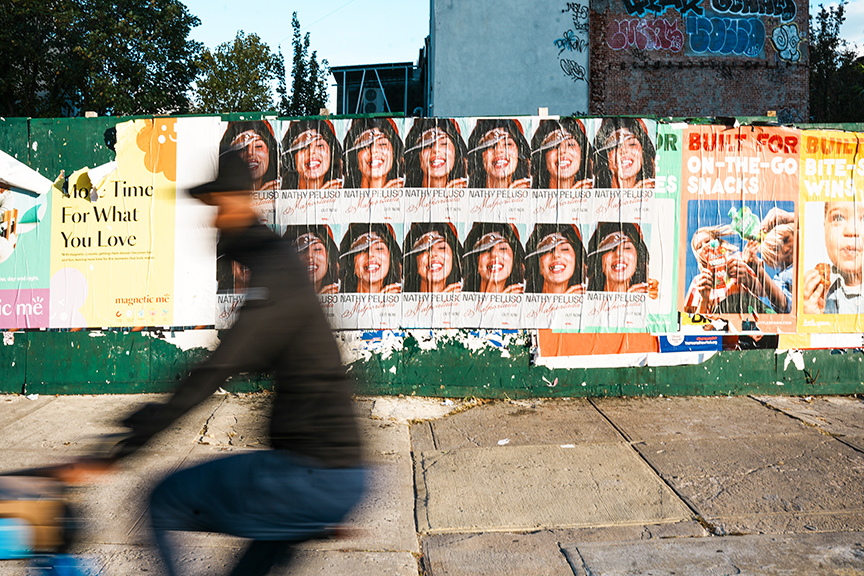
Typical depends on context. For street campaigns, it’s 24×36. For movie theaters, 27×40. For schools, 22×28. Our crews deal with all of them. Here’s the complete guide.
What’s the typical poster size? It’s a reasonable question with no single right answer. Poster sizes are tied to specific environments, industries, and traditions. What’s typical in one context is non-standard in another.
Our teams at American Guerrilla Marketing work with all of these sizes every week. We know which formats work on a construction wall on West 14th Street in the Meatpacking District, which ones belong in a music venue in Silver Lake, and which ones go up on bulletin boards inside coffee shops in Logan Square in Chicago.
Let’s break down what typical looks like in every major context.
For outdoor advertising campaigns in the United States, the typical poster size is 24 inches wide by 36 inches tall. Our crews work with this size more than any other.
At 6 square feet, a 24×36 poster provides enough real estate for a strong headline, supporting image, and a brand name or logo. The format is readable from across a standard city street, roughly 15 to 20 feet of distance, when headlines are set at 150 points or larger.
The 24×36 is typical because it’s efficient. Print shops produce it on 24-inch roll stock with zero paper waste. The 2:3 aspect ratio is widely understood by designers and clients. Frames in this size are sold at mass-market retailers, which extends the format into home decor and gives it cultural familiarity beyond advertising alone.
When a client asks us to run a campaign and hasn’t specified size, we quote 24×36 as the starting point. It’s the known quantity, the format that works across the widest range of outdoor posting surfaces.
Typical Outdoor Size: 24×36 inches. Two feet wide, three feet tall. This is the size our crews post most often on construction walls, exterior building surfaces, and approved posting boards in urban neighborhoods across the US.
Typical Poster Sizes by Category
Category
Typical Poster Size
Common Paper Stock
Outdoor street campaign
24 x 36 in
80-100 lb satin or uncoated text
Movie theater lobby (one-sheet)
27 x 40 in
80-100 lb gloss or satin
Concert / music venue
18 x 24 in
80 lb uncoated or satin
Interior window / bar / café
11 x 17 in
80 lb gloss or satin
School / office project
22 x 28 in (board)
Cardboard or foam core
Bus shelter / transit
40 x 60 in
Vinyl or heavy coated paper
Art print / home decor
18 x 24 or 24 x 36 in
Satin or fine art paper
Academic conference poster
36 x 48 in (environment)
80-100 lb gloss or satin
Typical Poster Size for Music and Entertainment
The music industry has its own size traditions. What’s typical varies by whether you’re inside the venue or outside it.
Inside a music venue, the typical poster size is 18×24 inches. This is the classic gig poster format. You see 18×24 in the hallways of venues on Beale Street in Memphis, on the walls of clubs along the Sunset Strip in Los Angeles, near the merch table at venues on Bourbon Street in New Orleans. It’s big enough to make a visual statement. Small enough to carry home rolled in a tube.
Outside the venue, the typical size shifts to 24×36. Street campaigns announcing shows at venues like Brooklyn Steel in New York or the Fillmore in San Francisco use 24×36 on the walls and construction boards within a 10-block radius of the venue. Larger artists may go to 27×40 for high-traffic placements on major pedestrian corridors.
Limited-edition gig poster prints, the kind that collectors seek out, are typically 13×19 inches. This size straddles the line between a printed poster and a fine art print. It frames well in standard art frames and sells as merchandise at the merch table or through online stores after the show.
Typical Poster Size for Film and Entertainment Marketing
Movie posters have the most rigidly defined typical size in any industry. The US one-sheet at 27×40 inches is the standard for theater lobby display. Full stop.
For street campaigns supporting film releases, 24×36 is typical. A major studio release might also use 40×60 for bus shelter placements and 48×70 for subway platform displays in cities like New York and Chicago.
Television and streaming campaigns often mirror film marketing formats. Series launches for major streaming platforms running on Netflix, Hulu, or Apple TV+ typically use the same 24×36 outdoor format for street campaigns, often with distinctive visual styles that create awareness before a premiere date.
We’ve run street campaigns for film and streaming content in neighborhoods targeted by audience demographics. A prestige drama campaign might concentrate in Park Slope and the Upper West Side in New York. An action film campaign might run heavier in Astoria, Bensonhurst, and Flushing. The format stays at 24×36. The location strategy shifts.
Typical Poster Size for Retail and Brand Campaigns
Retail and brand campaigns use posters across multiple environments, so the typical size shifts by placement type within a single campaign.
Exterior wall placements near retail locations: 24×36 inches. These go on construction boards, approved exterior walls, and building surfaces in the blocks surrounding the store. They drive foot traffic from the neighborhood into the location.
Window placements: 11×17 or 18×24. These go in the store’s own windows and in the windows of neighboring businesses with approval. Smaller format fits window panes cleanly and doesn’t obstruct visibility into the store.
Interior placements: 11×17 at eye level. Inside the store, at shelving units, near the register, in fitting rooms. The close viewing distance makes the smaller format more appropriate.
Event or launch marketing: Multiple sizes deployed at the same time. 24×36 on surrounding streets, 18×24 in venue or store interiors, 11×17 in neighborhood cafés and bars.
Multi-Format Campaigns: For retail and brand launches, we rarely use just one size. A typical brand campaign we run uses 24×36 for exterior walls, 18×24 for venue interiors, and 11×17 for window and bar placements. Each size serves a different moment in the target customer’s path through the neighborhood.
What Makes a Poster Size “Typical” Rather Than “Custom”?
A size becomes typical when:
Paper or substrate is stocked at that dimension by most print shops
Frames or display hardware are manufactured to fit it
Design software ships with it as a template option
The industry has used it long enough to make it the assumed default
The economic incentives of efficiency (waste reduction) favor it
24×36 meets all five criteria for outdoor advertising. 27×40 meets all five for theater display. 22×28 meets all five for school and office use. These are the sizes that have become entrenched through repeated use across thousands of campaigns and print runs.
A custom size is one that doesn’t meet these criteria. It’s a size you order specifically for a non-standard application. A 25×35 poster, for example, is not typical. No print shop stocks 25-inch roll paper. No standard frame exists. No design template defaults to it. Producing it requires custom setup and typically costs more per unit.
How to Choose the Right Typical Size for Your Campaign
Starting from scratch on a campaign? Here’s how we narrow down the typical size for each client’s situation.
Step 1: Identify the placement environment. Outdoor wall? Interior venue? Retail window? Each environment has a typical size that fits its physical constraints.
Step 2: Determine viewing distance. How far away is the viewer when they first see the poster? Under 5 feet: 11×14 or smaller. 5 to 10 feet: 11×17. 10 to 20 feet: 18×24. Over 20 feet: 24×36 or larger.
Step 3: Match the campaign to the content type. Photography-heavy campaigns need larger formats to show visual detail. Text-heavy campaigns can work at smaller sizes with legible type. Event-specific campaigns need to include key information (date, venue, time) at readable size from the intended viewing distance.
Step 4: Set the budget and quantity. Typical sizes are cheaper per unit than custom sizes. Larger sizes cost more than smaller ones for the same quantity. Work backward from your print budget to determine what quantity and size you can produce.
Step 5: Confirm with the printer. Before finalizing the design at a specific size, call the print shop and confirm they can deliver that size in your quantity within your timeframe. Lead times and availability can shift without warning, especially around holiday periods or in markets where print supply chains are under pressure.
Frequently Asked Questions
What’s the typical poster size for a campaign?
For outdoor street campaigns in the US, the typical poster size is 24×36 inches. For interior campaigns (bars, cafés, retail windows), the typical size is 11×17 or 18×24. For entertainment campaigns in theater lobbies, the typical size is 27×40 (one-sheet).
Is 18×24 a typical poster size?
Yes. 18×24 is a typical size for music venue posters, retail interior displays, and medium-format outdoor campaigns. It’s smaller than the outdoor standard (24×36) but larger than the interior standard (11×17). It’s widely used and stocked by most professional print shops.
What’s the typical concert poster size?
18×24 is the typical interior concert poster size. 24×36 is typical for exterior walls near a venue. Limited-edition gig posters for collectors are often 13×19.
What’s the typical movie poster size?
27×40 inches is the typical US movie poster size for theater lobby display. For outdoor street campaigns supporting film releases, 24×36 is the typical format.
Can I use 11×17 for an outdoor campaign?
11×17 works outdoors only in specific close-distance contexts: utility pole posting, venue exterior doors, windows at eye level where pedestrians pass within 3 to 5 feet. For walls where the viewer is farther away, 18×24 or 24×36 is the appropriate typical size.
What size is too small to be a typical campaign poster?
8×10 inches and smaller are too small for most campaign applications. At that size, content isn’t visible from a useful distance and the format doesn’t create enough visual presence to register. 11×17 is the practical minimum for any meaningful campaign poster placement.
The format is the same across US cities. 24×36 is typical in New York, Los Angeles, Chicago, Miami, and Austin. What varies is the posting surface environment: some cities have more construction board availability, others have more utility pole inventory, others have better bar and venue relationships. The size stays the same; the placement environment changes by city.