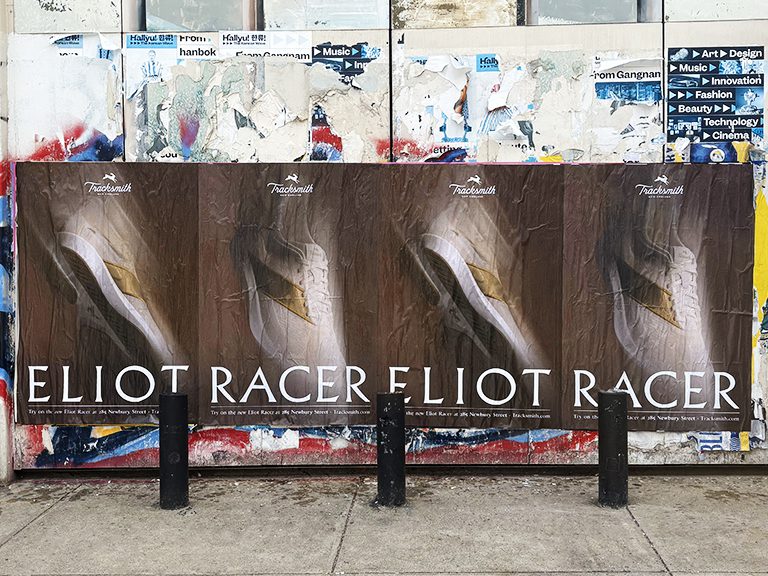
The size of a poster depends on what kind of poster you mean. There is no one universal size. Posters range from 11 x 17 inches at the small end to 48 x 72 inches and beyond at the large end. In between, there are several sizes that the printing industry has standardized around. The right size for you depends on where the poster is going and what it needs to accomplish.
We run poster campaigns for a living. We place posters in Bushwick and in Beverly Hills, on construction walls in Midtown and in bar windows in Greenpoint. We know these sizes well, from the economics of printing to the visual impact of each format at street level. Here is the practical guide.
If you want a single answer to “what’s the size of a poster,” the most honest one is: 24 x 36 inches is the size most people imagine when they picture a poster. It is the US industry default. But context shapes the right answer every time.
Small Poster Size: 11 x 17 Inches
The 11 x 17 inch poster is the smallest format the industry treats as a poster rather than a flyer. It matches tabloid paper size, which makes it one of the most economically produced poster formats. Every commercial print shop handles tabloid as a routine job.
Where this size lives: coffee shop bulletin boards, bar walls, campus distribution, small gallery announcements, and supporting elements in larger campaigns. If you need to distribute a lot of posters across many indoor locations on a limited budget, 11 x 17 is your format.
Design for close reading. At 11 x 17, your viewer is standing 2 to 5 feet away. You can include more detail than a street poster. But maintain clear hierarchy. The most important information should be the biggest and most prominent element on the page.
Medium Poster Size: 18 x 24 Inches
Eighteen by twenty-four inches is the standard size for retail marketing posters. It is large enough to read from across a retail floor or through a store window from the sidewalk. It is small enough to fit most retail display locations without dominating the space.
For event campaigns, 18 x 24 is the standard indoor companion to the 24 x 36 street poster. You run 24 x 36 outdoors for pedestrian visibility and 18 x 24 indoors for venue and retail placement. This two-size strategy is one of the most commonly used structures in street marketing campaigns.
The Standard Poster Size: 24 x 36 Inches
When people ask “what’s the size of a poster?” the answer that most closely reflects industry consensus is 24 x 36 inches. This is the US general-purpose poster standard. It is what print shops optimize for, what frame stores stock, and what street marketing campaigns use as their default format.
At 24 inches wide by 36 inches tall, this poster reads from 15 to 20 feet away. A pedestrian walking past a construction wall has enough time to read a well-designed 24 x 36 in the seconds of view time they have. It is not too large to manage in distribution and placement, and it is not too small to register in competitive urban visual environments.
For a campaign on Grand Street in Chinatown, Flatbush Avenue in Brooklyn, or Melrose Avenue in Los Angeles, 24 x 36 is the baseline format. It works. It has worked for decades. It will keep working.
The 24 x 36 as the Default Standard
Industry-wide, 24 x 36 is what people mean when they say “a poster.” It is the format that shaped the modern poster network. Frames, display hardware, printing infrastructure, and distribution networks are all built around this size. It is the smartest default for most campaigns.
Entertainment Poster Size: 27 x 40 Inches
The 27 x 40 one-sheet is the US entertainment industry standard. It is the size of movie posters displayed in theater lobbies since the mid-20th century. The theatrical display case infrastructure was built around this specific size. Frame manufacturers and poster stores followed.
For music, film, theater, and event campaigns that want to speak the language of big-release entertainment, 27 x 40 is the format of choice. It signals scale and cultural weight. The four extra inches of height over 24 x 36 give designers more room for credits, supporting text, and premium layout without cramping the primary image.
We run 27 x 40 campaigns for album releases, festival announcements, and brand campaigns that want the premium feel of an entertainment print. It is not dramatically more expensive than 24 x 36, but the visual impact and cultural resonance are meaningfully different.
How Viewing Distance Determines the Right Poster Size
The relationship between poster size and viewing distance is the most important factor in size selection. Here is the practical guide:
Viewing Distance
Recommended Minimum Size
Notes
2-5 feet
11 x 17 in
Counter displays, close bulletin boards
5-12 feet
18 x 24 in
Retail floors, venue interiors
12-20 feet
24 x 36 in
Street-facing, construction walls
20-30 feet
27 x 40 in
High-traffic outdoor, transit-adjacent
30+ feet
36 x 48 in or larger
Wide outdoor spaces, building walls
How Design Content Shapes the Right Poster Size
The right size is also partly a function of design content. What are you putting on this poster?
Simple, bold image + one headline: Works at any size from 11 x 17 to 48 x 72. Strong enough image, large enough type, clean layout. Scale up or down freely.
Event details + artist lineup + supporting info: Needs at least 18 x 24 to prevent crowding. Ideally 24 x 36. The more information you need to communicate, the more space you need to communicate it clearly.
Data-heavy content, research, or detailed visual: Requires 36 x 48 or larger. Academic posters, infographic-style displays, and detailed product diagrams need scale to be readable.
Trying to fit complex content into a small format always results in small, unreadable type or a design that feels cramped and amateur. Give your content the space it deserves.
Design Principle: One Message Per Poster
The most effective street posters communicate one thing. One image. One headline. One action. Not three messages, not a paragraph of body copy, not a full schedule of events. The more you try to say, the less any of it lands. Pick your most important message and let the poster do one thing well.
The Cost of Different Poster Sizes
Size has a direct relationship with printing cost. Larger posters cost more per unit because they use more paper, more ink, and more production time. Here is a general cost framework for standard print shop pricing on a quantity of 100:
At 11 x 17: typically the lowest cost per unit. Tabloid paper is standard stock, and production is highly optimized for this size.
At 18 x 24: moderately higher per unit than 11 x 17. Still a very efficient production size at most print shops.
At 24 x 36: meaningfully higher than 18 x 24 due to paper size and production complexity. But still within the range of practical campaign budgets for most clients.
At 27 x 40 and above: premium cost territory. The increase over 24 x 36 is real. Budget accordingly or reduce print volume to compensate.
For campaigns with fixed budgets, the trade-off between size and quantity is a strategic decision. More smaller posters can outperform fewer larger ones for awareness campaigns. Fewer larger posters can outperform more smaller ones for high-impact placement campaigns. Match your strategy to your campaign objective.
How to Brief Your Designer on Poster Size
Many poster campaigns run into production problems not because of bad design or bad printing, but because the brief between the client and the designer did not include complete size specifications. A designer who sets up a 24 x 36 file at 72 DPI instead of 150 DPI has done the work in good faith but produced a file that will not print well. That is a briefing failure, not a design failure.
A complete designer brief for a poster campaign includes: the final trim size in inches for every size in the campaign; the DPI specification for each size; whether bleed is required and at what margin; the color mode, which is CMYK for print, not RGB; the file format required by the printer, typically PDF/X-1a or a press-ready PDF; and the safe zone specification, which is the distance from the trim edge within which all essential content must fall.
Provide the brief in writing, not verbally. Verbal size discussions in an initial meeting are a reliable source of later confusion. The designer needs a written document to work from. Include the placement environment as context. A designer who knows a poster is going on a construction wall in a busy outdoor environment will make different design choices than one designing for a retail interior. The environment shapes the visual hierarchy, the size of key elements, and the color choices that will work at the intended viewing distance.
If you are running multiple sizes, brief them all together rather than briefing each size separately as an afterthought. When designers work all sizes at the same time from a single brief, they develop a visual system that holds together as a family. When sizes are briefed one at a time, the resulting designs often feel like separate projects rather than a unified campaign.
Ask for physical proofs for any size above 18 x 24 before approving a print run. Monitor proofs are not a reliable preview of large-format print output. Colors shift between RGB monitor display and CMYK print. What looks sharp and vivid on screen can print duller than expected. A physical proof at actual size, or at a representative sample size, is the only reliable way to approve a large format print campaign.
Production Timelines by Poster Size
The size of your poster directly affects how long it takes to produce. Larger sizes take longer to print, require more drying time, and often involve more complex finishing operations like lamination or mounting. Building the right amount of production time into your campaign schedule prevents the rush fees and quality compromises that come from compressing the timeline.
For standard sizes up to 18 x 24, most commercial print shops can produce quantities of 100 to 500 within three to five business days on a standard production schedule. Rush service at a premium can sometimes compress this to one to two days for straightforward jobs.
For 24 x 36, production quantities of 100 to 200 typically require five to seven business days at standard speed. Higher quantities take longer. Rush service is available but more expensive than at smaller sizes because the production equipment runs at lower throughput.
For sizes at 27 x 40 and above, production timelines extend to seven to ten business days for standard quantities. Wide-format printing equipment runs slower than sheet-fed equipment. The print, dry, cut, and finishing cycle takes longer per unit. For any large-format campaign with a hard delivery deadline, we recommend building a minimum of ten business days into the production schedule.
Shipping is an additional timeline consideration that many clients underestimate. Large format posters are typically shipped rolled in tubes. Even with expedited shipping, a cross-country shipment of 24 x 36 tubes takes two to three business days to arrive after leaving the printer. Total turnaround from file submission to poster in hand in a different city is often twelve to fifteen business days for large format work on a standard production schedule.
How to Brief Your Designer on Poster Size
Many poster campaigns run into production problems not because of bad design or bad printing, but because the brief between the client and the designer did not include complete size specifications. A designer who sets up a 24 x 36 file at 72 DPI instead of 150 DPI has done the work in good faith but produced a file that will not print well. That is a briefing failure, not a design failure.
A complete designer brief for a poster campaign includes: the final trim size in inches for every size in the campaign; the DPI specification for each size; whether bleed is required and at what margin; the color mode, which is CMYK for print; the file format required by the printer, typically a press-ready PDF; and the safe zone specification, which is the distance from the trim edge within which all essential content must fall.
Provide the brief in writing. Verbal size discussions in an initial meeting are a reliable source of later confusion. The designer needs a written document to work from. Include the placement environment as context. A designer who knows a poster is going on a construction wall in a busy outdoor environment will make different design choices than one designing for a retail interior. The environment shapes the visual hierarchy, the size of key elements, and the color choices that will read correctly at the intended viewing distance.
If you are running multiple sizes, brief them all together rather than briefing each size separately as an afterthought. When designers work all sizes at the same time from a single brief, they develop a visual system that holds together as a family. When sizes are briefed one at a time, the resulting designs often feel like separate projects rather than a unified campaign.
Always ask for physical proofs for any size above 18 x 24 before approving a large print run. Monitor proofs are not a reliable preview of large-format print output. Colors shift between RGB monitor display and CMYK print. A physical proof at representative size is the only reliable way to approve a large-format campaign before committing to production cost.
Production Timelines by Poster Size
The size of your poster directly affects how long it takes to produce. Larger sizes take longer to print, require more drying time, and often involve more complex finishing operations like lamination or mounting. Building the right amount of production time into your campaign schedule prevents the rush fees and quality compromises that come from compressing the timeline.
For standard sizes up to 18 x 24, most commercial print shops can produce quantities of 100 to 500 within three to five business days on a standard production schedule. Rush service at a premium can sometimes compress this to one to two days for straightforward jobs.
For 24 x 36, production quantities of 100 to 200 typically require five to seven business days at standard speed. Higher quantities take longer. Rush service is available but more expensive than at smaller sizes because the production equipment runs at lower throughput.
For sizes at 27 x 40 and above, production timelines extend to seven to ten business days for standard quantities. Wide-format printing equipment runs slower than sheet-fed equipment. The print, dry, cut, and finishing cycle takes longer per unit. For any large-format campaign with a hard delivery deadline, build a minimum of ten business days into the production schedule after file approval.
Shipping adds time on top of production. Large format posters ship rolled in tubes. Even with expedited shipping, a cross-country shipment takes two to three business days after leaving the printer. Total turnaround from file submission to poster in hand in a different city is often twelve to fifteen business days for large format work on a standard schedule. Plan accordingly and you will never be paying rush fees for something that could have been avoided.
What is a standard print run quantity for a street poster campaign?
A focused neighborhood campaign typically uses 50 to 200 posters at 24 x 36 per week. A city-wide program running multiple neighborhoods over several weeks can require 300 to 1,000 or more. We calculate quantities based on your specific placement plan and refresh schedule rather than general estimates. Knowing your locations first makes your quantity decision precise instead of approximate.
Frequently Asked Questions
What is the most common poster size?
24 x 36 inches is the most commonly used general-purpose poster size in the United States. It is the default for street campaigns, retail displays, and general marketing applications.
What size is a typical concert poster?
Concert posters vary by context. For street and venue distribution, 18 x 24 and 24 x 36 are most common. For premium collector prints and venue lobby display, 27 x 40 is frequently used. Many campaigns run multiple sizes at the same time.
What size is a typical event poster?
Event posters typically use 11 x 17 for small venue and bar distribution, 18 x 24 for indoor venue and retail placement, and 24 x 36 for outdoor street promotion. The right answer depends on your specific placement environment.
What is the difference between a poster and a flyer?
Size is the primary distinction. Flyers are typically 8.5 x 11 inches or smaller. Posters start at 11 x 17 and scale up. Both are printed promotional materials, but they are distributed and placed differently and serve different visibility functions.
What poster size works best for a bar or small venue?
11 x 17 is the standard for bars and small venues. It fits bulletin boards, adheres well to walls in these environments, and is affordable enough to distribute across many locations in a single campaign.
What size poster should I use for a construction wall campaign?
24 x 36 is the standard for construction wall campaigns. It provides enough visual impact to be seen from across the street. For premium placements or flagship walls, 27 x 40 or 30 x 40 provides additional scale.
Close but not identical. An A1 poster is 23.39 x 33.11 inches (594 x 841 mm). A US 24 x 36 is slightly larger. They are different standards and are not interchangeable for framing or display hardware purposes.