Width and Height of a Poster: Full Size Guide | AGM
Poster dimensions seem simple until you’re staring at a printer quote with six size options and no idea which one you need. We’ve ordered tens of thousands of posters. Here’s the breakdown.
Poster size is one of those things that looks straightforward until it isn’t. There are standard sizes, common sizes, large-format sizes, and then the custom sizes that campaigns often require. The width and height you choose affects print cost, design complexity, shipping logistics, and how the piece reads on the wall.
We run outdoor and event poster campaigns across the United States. We work with printers every week. We know which sizes actually exist at standard pricing, which require custom runs, and which ones look great in spec sheets but cause problems at installation. This guide gives you the real picture.
Before getting into every format in existence, here are the six dimensions that cover 90 percent of use cases. If you don’t have a specific reason to go outside this list, start here.
Name
Width x Height
Primary Use
Small / Mini
11 x 17 in
Indoor promotions, door hangers, event listings
Medium / Show bill
18 x 24 in
Concert and event posters, retail point-of-sale
Standard
24 x 36 in
Outdoor street campaigns, movie posters, brand campaigns
The 24 x 36 inch format is the most widely recognized as the “standard” poster size in the United States. It’s the baseline we work from when a client hasn’t specified a size. It’s wide enough to read from a distance, tall enough to anchor a wall, and available at volume pricing from nearly every commercial poster printer in the country.
Width and Height in Context: How Size Affects Visibility
The relationship between width and height is more than an aesthetic choice. It determines how far away a viewer can read your message, how much design content fits without crowding, and what wall surfaces can physically accommodate the piece.
Reading Distance and Legibility
A 24 x 36 inch poster with a 72-point headline (about 1 inch tall) is legible from roughly 10 to 12 feet. A 48 x 72 inch large-format poster with the same proportional headline is legible from 20 to 25 feet. Every doubling of physical size roughly doubles the viewing distance at which text is legible. That math matters when you’re choosing between a small and medium format for a specific installation location.
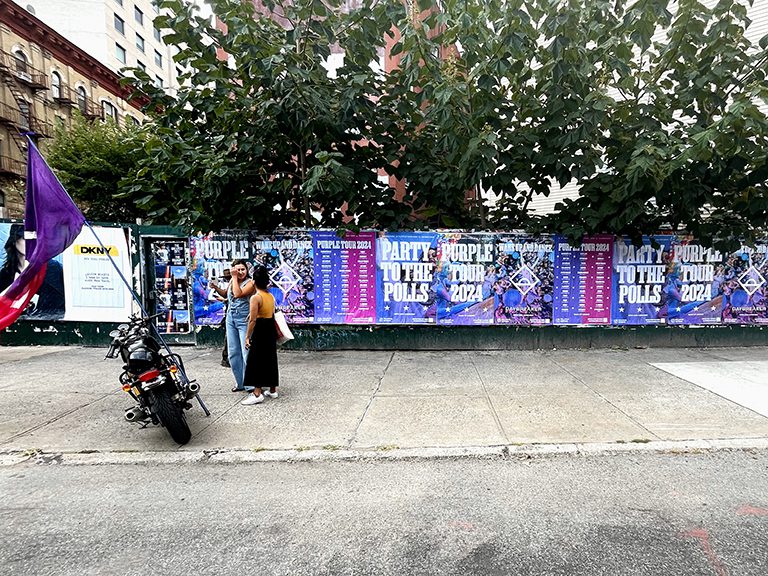
On a busy street in New York, pedestrians walking past a wall on the sidewalk are typically 2 to 4 feet from the poster. At that distance, an 11 x 17 poster is perfectly readable. At 10 to 15 feet, a 24 x 36 poster reads well. For a wall visible from across an intersection, which might be 30 to 50 feet of viewing distance, you want at least 36 x 48 inches, and the text size needs to scale accordingly.
Design Capacity
The width and height of a poster determine how much design content can be included without crowding. A small 11 x 17 poster supports one strong headline, one image, and minimal supporting text. A 24 x 36 inch poster supports a headline, a subhead, a primary image, and body copy. A 36 x 48 inch poster can accommodate complex layouts with multiple images, structured text sections, and detailed information.
A common mistake is trying to put a 24 x 36 design’s worth of content into an 11 x 17 poster. The result is either illegible small text or a layout that looks cluttered and cheap. Match your content volume to your size. If you have a lot to say, you need a bigger poster.
Our production rule: The minimum body copy size for a readable poster at 4-foot viewing distance is 18 points. At 8-foot viewing distance, minimum 24 points. At 15-foot viewing distance, minimum 36 points. Size up your type before you finalize your poster dimensions.
Poster Dimensions by Application Type
Outdoor Street and Campaign Posters
For outdoor street poster campaigns, the industry workhorses are 24 x 36 and 18 x 24. The 24 x 36 format is preferred for most high-traffic locations because it’s large enough to create visual impact at typical sidewalk viewing distances. The 18 x 24 is used when the mounting location is smaller or when budget requires a higher volume of prints at lower cost per piece.
We often print 24 x 36 for primary placements and 18 x 24 for secondary locations in the same campaign. The primary format leads on the most visible walls. The secondary format fills in everywhere else. Both sizes look cohesive in a well-designed campaign where the visual elements are consistent.
Movie and Entertainment Posters
The movie industry has its own specific formats. The “one-sheet,” which is the standard theater lobby poster, is 27 x 40 inches. The “bus shelter” format is 40 x 60 inches (4-sheet equivalent). The “billboard sheet” format scales up to massive dimensions. Most commercial movie posters you see in lobbies and on the street are the 27 x 40 format or the 24 x 36 approximation.
Music and Event Posters
Concert promoters historically used 11 x 17 and 18 x 24 as standard poster formats. These sizes fit in most record store windows, coffee shop bulletin boards, and utility pole staple boards. The 18 x 24 format is large enough to read from across a coffee shop and small enough to tape up quickly and carry in volume. Event posters for festivals and larger shows often go to 24 x 36.
Retail and In-Store Posters
Retail uses a wide variety of sizes depending on the mounting system. Standard retail display frames are typically designed for 11 x 17, 18 x 24, or 24 x 36 formats. Clip rails and snap frames in retail environments come in these standard sizes. If you’re buying frames and posters together, match the dimensions exactly to avoid awkward gaps or overhang.
Trade Show and Exhibition Posters
Tabletop display systems typically use 11 x 17 or 17 x 22. Freestanding backdrop displays are usually 8 x 10 feet (96 x 120 inches) or 10 x 10 feet (120 x 120 inches). Roll-up banner stands commonly hold 33 x 80 or 24 x 72 inch graphics. Confirm your display system’s dimensions before designing.
Converting Poster Dimensions to Other Units
US poster sizes are typically specified in inches. If you’re designing for international print vendors or working with metric measurements, here are the conversions for the most common formats:
Inches (W x H)
Centimeters (W x H)
Millimeters (W x H)
11 x 17
27.9 x 43.2 cm
279 x 432 mm
18 x 24
45.7 x 61 cm
457 x 610 mm
24 x 36
61 x 91.4 cm
610 x 914 mm
27 x 40
68.6 x 101.6 cm
686 x 1016 mm
36 x 48
91.4 x 121.9 cm
914 x 1219 mm
How Poster Width and Height Affect Printing Cost
Poster printing cost scales with size, but not linearly. There are cost threshold jumps at certain dimensions because of how commercial printers batch their work. Understanding these thresholds can save significant money when you have flexibility in size.
Offset Printing (Volume Runs)
For quantities of 500 or more, offset printing is typically more cost-effective than digital. Offset runs are batch-optimized for standard sizes. The most cost-effective formats for offset are 11 x 17, 18 x 24, and 24 x 36. Non-standard dimensions require custom paper cuts, which adds cost to offset runs.
Digital Printing (Short Runs)
For quantities under 500, digital printing is usually more practical. Digital large-format printers can output up to 60 inches wide and any length. Cost increases per square inch as size grows. A 24 x 36 poster costs roughly twice as much as an 18 x 24, not four times as much, because paper and ink costs don’t scale at the same rate as area.
Cost Efficiency Tips
The most cost-efficient sizes per square inch at volume are 11 x 17 and 18 x 24. If you can communicate your message effectively at 18 x 24 rather than 24 x 36, you can print significantly more posters for the same budget. For outdoor campaigns where volume is the goal, 18 x 24 gives you the best reach per dollar when the locations can support that size.
Our approach to size selection for campaigns: We always ask what the primary viewing distance is before settling on a size. If most of the placements are at arm’s reach on a bulletin board, 11 x 17 is efficient. If placements are on walls viewed from 10-plus feet, 24 x 36 is the minimum. Size to the environment, not to the budget.
Custom Poster Dimensions: When to Go Non-Standard
There are legitimate reasons to go with non-standard poster dimensions. Some locations require specific measurements to fit mounting hardware. Some designs require a specific aspect ratio that doesn’t match any standard format. Some campaigns use custom sizes deliberately as a creative statement.
When you go custom, factor in the additional cost. Custom sizes often require special paper cuts, cannot be batched with other print jobs as efficiently, and may have longer lead times. If you can adapt a design to fit a standard size without compromising the concept, that’s usually the right call. If the design absolutely requires a custom dimension, the cost is justified.
Custom widths up to 60 inches are available from most large-format digital printers. Custom heights are limited only by the length of the print roll. We have printed custom campaign pieces that were 12 feet tall and 6 feet wide for specific building installations. Custom is possible. It just requires more lead time and budget.
Poster Width and Height in Different Paper Standards
The United States uses inch-based poster dimensions. Europe and most of the rest of the world uses the ISO A-series paper standard. If you’re printing globally or working with international vendors, here’s how the most common US poster sizes compare to their closest ISO equivalents.
US Poster Size
Closest ISO Size
ISO Dimensions
Size Difference
11 x 17 in (tabloid)
A3
11.7 x 16.5 in (297 x 420 mm)
US slightly taller and narrower
18 x 24 in
B2
19.7 x 27.8 in (500 x 707 mm)
ISO B2 larger on both dimensions
24 x 36 in
A1
23.4 x 33.1 in (594 x 841 mm)
US 24×36 larger on both dimensions
36 x 48 in
A0
33.1 x 46.8 in (841 x 1189 mm)
US 36×48 larger on both dimensions
The practical implication: if you’re designing a poster for both US and international print runs, design to the US dimensions and notify your international vendor, who will either print at the specified US size or advise you on adjustments. Do not assume US and ISO A-series posters are interchangeable. They are not, and mismatches cause costly reprints.
Setting Up Your Poster File: Width, Height, and Bleed
When you hand off a poster file to a printer, the setup in your design file needs to account for three dimension-related elements: the finished size, the bleed area, and the safe zone.
Finished size: This is the dimensions you’ve specified, say 24 x 36 inches. It’s the exact size the trimmed poster will be after printing and cutting.
Bleed area: Add 0.125 inches (1/8 inch) on all four sides beyond the finished size. This extra area extends any background color or images to the edge of the document, so that when the printer trims to the finished size, there’s no white edge showing. Your actual file dimensions for a 24 x 36 inch poster with standard bleed are 24.25 x 36.25 inches.
Safe zone (live area): Keep all critical text and design elements at least 0.25 inches inside the finished trim line. This prevents text from being cut off if the trim is slightly off. For poster text, err toward 0.5 inches inside the trim for anything critical.
Most professional print vendors provide a template file with these zones marked for each standard size. Download the template, design inside it, and export to PDF/X-1a or PDF/X-4 with crop marks and bleed included. That workflow eliminates the most common causes of poster reprints.
What is the standard width and height of a poster in the US?
The most standard poster size in the US is 24 inches wide by 36 inches tall. This is the size most people picture when they think “poster.” The 18 x 24 format is also extremely common, especially for events and music promotions. The 11 x 17 format, often called a “small poster” or “flyer,” is the smallest common poster size.
Is poster size always given as width first or height first?
In the United States, poster sizes are typically given as width first, then height. So a “24 x 36 poster” is 24 inches wide and 36 inches tall. This convention holds for most print vendors and design software. When in doubt, specify “24 inches wide by 36 inches tall” rather than just the numbers to avoid any confusion.
What is the minimum poster size for an outdoor campaign?
For most outdoor locations viewed from 8 feet or more, we consider 18 x 24 the minimum. At 4-foot viewing distances, 11 x 17 can work. For high-visibility street walls with 15+ foot viewing distances, 24 x 36 is the recommended minimum. Anything smaller than 18 x 24 outdoors tends to get lost in the visual environment.
How do poster dimensions affect shipping costs?
Poster tubes are commonly used for shipping rolled posters. A 24 x 36 poster ships in a 36-to-40-inch tube, which is within standard parcel shipping dimensions. Posters over 36 inches in the longest dimension often require oversized freight shipping, which adds significantly to the cost. If you’re shipping large quantities to multiple locations, factor shipping into your total budget.
What poster width and height work best for a concert or event?
The classic event poster size is 18 x 24 inches. It’s the format that fits record store windows, café bulletin boards, telephone poles, and most poster mounting surfaces. For larger shows with more lineup information, 24 x 36 gives you the space. For small, local events, 11 x 17 is sufficient and more cost-effective to print in volume.
Can I mix poster widths and heights in the same campaign?
Yes, and we do this regularly. A campaign might use 24 x 36 for primary high-visibility locations and 18 x 24 for secondary placements. The design needs to be adapted for each size, more than scaled down. A 24 x 36 design that’s proportionally shrunk to 18 x 24 will usually have text that’s too small. Design each size version specifically for its dimensions.
The standard US movie poster, known as the “one-sheet,” is 27 x 40 inches. This is the format used in theater lobbies nationwide. The international standard is slightly different: most European markets use A1 format (23.4 x 33.1 inches, or 594 x 841 mm). The theatrical “bus shelter” poster is 40 x 60 inches (approximately).