Poster size depends on where the poster will be used and what it needs to accomplish. There is no single universal poster size. There are standard sizes for specific contexts, and knowing which standard applies to your use case is the starting point for any poster project.
We print and place posters constantly as part of our campaign work. We have ordered everything from small 11×17 event flyers to large-format 24×36 street campaign posters to outdoor installations that cover entire building walls. Each format has its own dimension conventions, production requirements, and viewing distance considerations.
This guide covers the typical poster sizes across the major use categories so you know exactly what you are working with before you design or order.
The most common standard poster size for general promotional use in the United States is 24 inches wide by 36 inches tall. This is the format you will find at most print shops and in most retail frame sections.
Posters come in a range of standardized dimensions. These standards emerged from the intersection of printing technology, retail frame sizing, and common display requirements. Understanding the full range helps you choose the right format for your specific application.
Small Format: 11 x 17 inches
The 11×17 format is technically a flyer or mini-poster. It is the size of two standard letter sheets (8.5×11) joined vertically. This format is commonly used for event promotion, local business advertising, community notices, and anything that needs to be distributed physically rather than posted on a wall. It prints on standard larger-format printers and office copiers, which makes it inexpensive to produce in small quantities.
The 11×17 format is often used in coffee shops, laundromats, community center bulletin boards, and student union bulletin boards. It is small enough to carry easily but large enough to accommodate a clear headline, an image, and event details at readable text sizes.
Small-to-Medium Format: 18 x 24 inches
The 18×24 format is a step up from the 11×17 and is often called a “half-sheet” poster in retail and display contexts. It is a common size for store window posters, point-of-sale displays, promotional materials at trade shows, and interior event posters. It is large enough to create genuine visual impact but small enough to fit in standard display frames and most store window displays.
This format strikes a good balance for indoor promotional use where you want the poster to be noticed without dominating the space entirely. It is a popular choice for restaurant promotions, retail sales, concert venue advertising, and gallery event announcements.
The Standard: 24 x 36 inches
The 24×36 format is the most widely recognized standard poster size in the United States for general promotional and entertainment use. When people picture “a poster,” this is usually the format they are imagining. It is the standard size for movie posters sold commercially, music posters, art prints, and promotional materials for events.
This format is large enough to have genuine visual presence when placed on a wall, in a window, or on a door. It can be read and understood from across a room. It fits standard retail poster frames. And it produces well on large-format digital inkjet printers, which are widely available at print shops across the country.
For street-level mounted poster campaigns in urban markets, the 24×36 format is one of the most commonly used dimensions. It is visible to pedestrians at walking distance, manageable to handle and install, and sized to fit many standard mounting surfaces without trimming.
Larger Format: 27 x 40 inches
The 27×40 format is the standard theatrical one-sheet, used in movie theater lobbies across the United States. It is slightly larger than the 24×36 consumer format and uses a similar but slightly wider aspect ratio. This is the format for official theatrical marketing materials distributed to exhibitors.
Outside of theatrical contexts, the 27×40 format appears less frequently in general poster production. Most print shops and online poster services center their offerings around the 24×36 standard. But for clients specifically targeting theatrical display or looking for the authentic dimensions of film marketing materials, this is the specification to use.
Extra-Large Format: 36 x 48 inches and Beyond
Posters larger than 24×36 fall into the large-format category. A 36×48 poster is roughly the size of a standard office whiteboard and requires large-format printing equipment to produce. These are used for trade show displays, retail banner posters, photographic wall prints, and high-visibility promotional placements where the standard 24×36 would be lost in the environment.
Beyond 36×48, posters scale into the outdoor advertising and environmental graphics category. Building wraps, outdoor banners, transit shelter panels, and construction hoarding graphics are all effectively large-format posters produced on specialized substrates. These require professional large-format print production and are typically ordered through specialty large-format print vendors.
Viewing distance determines appropriate poster size. A poster viewed from 3 feet away can be 18×24 and remain impactful. A poster viewed from 20 feet needs to be 36×48 or larger to command attention at that distance.
The United States uses non-metric poster sizes that differ from the international ISO paper standard used in most of the rest of the world. Understanding both standards matters when working with international print vendors or designing for campaigns that will run in multiple countries.
The ISO A-series paper sizes are calculated mathematically such that each size is exactly half of the next larger size. A0 is approximately 33×46 inches. A1 is approximately 23×33 inches. A2 is approximately 16×23 inches. A3 is approximately 11×16 inches, which is roughly equivalent to the US 11×17 format.
For poster advertising specifically, A1 (23×33 inches) is the closest ISO equivalent to the US 24×36 standard. In European markets, A1 is the standard format for event posters, promotional materials, and point-of-sale displays in the same contexts where US marketers use the 24×36 format.
The B-series ISO formats are slightly larger than the A-series. B1 (27.8×39.4 inches) is commonly used for theatrical posters in European markets. It is close in size to the US theatrical one-sheet (27×40) but not identical. Building poster layouts around the ISO B1 format allows for easier adaptation to European theatrical and promotional contexts.
Choosing the Right Poster Size for Your Campaign
Selecting the right poster size requires answering a few key questions about how and where the poster will be used.
Where will it be viewed? Indoor locations where viewers will be close to the poster favor smaller formats. A poster in a coffee shop window is typically viewed from inside the shop or from the sidewalk, at distances of 5 to 15 feet. An 18×24 format reads well at those distances. A poster on a building exterior or in a public square is viewed from much farther. A 24×36 or larger format is needed for the poster to have visual impact at greater viewing distances.
How long will it run? Short-run promotional posters for events happening in one to two weeks do not need the durability of a sustained outdoor campaign. A standard inkjet print on poster paper is sufficient for a two-week indoor run. A poster running outdoors for four to eight weeks in varying weather conditions needs UV-resistant inks, heavier substrate, and potentially lamination to maintain quality through the campaign duration.
What is the visual hierarchy of the content? More complex designs with multiple visual elements, supporting text, and detailed information need more space. Minimal designs with a bold image and few words can be highly effective at smaller formats because the simplicity reads clearly even at smaller scale. Match the content complexity to the format size rather than defaulting to a larger format when a well-designed smaller format would serve better.
How Poster Size Affects Print Production Cost
Poster size directly affects production cost. Larger formats require more ink, more paper, and more time to print. But the cost relationship is not linear. The difference in cost between an 11×17 and a 24×36 poster at a standard print shop is often smaller than people expect. The bigger cost driver is quantity and print method rather than size alone.
For short runs of large-format posters (fewer than 50 copies), digital large-format inkjet printing is the most cost-effective option. Most print shops with large-format printers can produce 24×36 and 36×48 posters in this range at reasonable per-unit costs. Setup costs are minimal because no plates or dies are required.
For larger runs (hundreds or thousands of copies), offset printing becomes cost-effective. The per-unit cost drops significantly at scale because the setup cost of plate production is amortized across many units. But offset printing for large formats requires specialized equipment and is typically handled by commercial print vendors rather than retail copy shops.
When planning a poster campaign, always get quotes for the full print run at your intended quantity and size. The cost per unit can vary by a factor of 5 or more between different print methods and vendors for the same specifications.
Horizontal vs. Vertical Poster Orientation
Most standard poster formats are portrait-oriented, meaning they are taller than they are wide. Portrait orientation is the default for wall-mounted and street-posted advertising because it makes more efficient use of vertical wall space and creates a natural reading flow from top to bottom. The eye moves naturally from the dominant visual element at the top to the supporting information and call to action lower in the composition.
environment-oriented posters, which are wider than they are tall, are less common in traditional poster advertising but appear in specific contexts. The UK theatrical quad poster is environment at 30×40 inches. Bus shelter panels that are oriented horizontally use environment formats. Outdoor banners hung horizontally across a street or above a doorway use environment dimensions. Trade show tabletop displays often use small environment formats.
The choice between portrait and environment should follow the content and the placement context. If the primary visual element is a group of people standing, portrait works naturally. If the primary visual is a wide environment or a product shot with a horizontal composition, environment might be the stronger design choice. And if the placement dictates orientation because of available surface dimensions, that constraint should determine the format.
Poster Design Principles for Each Size
Size is more than a production specification. It affects how the design should be approached. Each size range has its own design considerations.
Small format posters (11×17 and 18×24) benefit from tighter composition, larger relative type sizes, and simplified visual hierarchy. When the overall print area is smaller, every element must earn its space. Cluttered small-format posters are very difficult to read and visually ineffective. Restraint in design produces better results at small scale.
Standard format posters (24×36) can accommodate richer compositions with more visual layers, supporting text, and secondary information. The extra real estate allows for more sophistication in the layout without compromising readability. But even at 24×36, the primary message should dominate clearly. Hierarchy matters at every scale.
Large format posters (36×48 and above) must be designed for viewing distance. Text sizes that seem enormous on a computer screen may still be too small to read at the distances from which large posters are typically viewed. Always check effective reading distance for every text element before approving large-format designs. Walk back from a monitor to simulate viewing distance, or better yet, print a section at actual scale to verify readability in person.
Poster Sizes for Street Marketing Campaigns
Street-level marketing campaigns use posters as a core tool for building brand presence in urban neighborhoods. The typical poster size for mounted street campaigns in US markets is 24×36 inches. This size is visible to pedestrians at typical sidewalk distances, practical to handle and install, and sized to fit most standard mounting surfaces without adaptation.
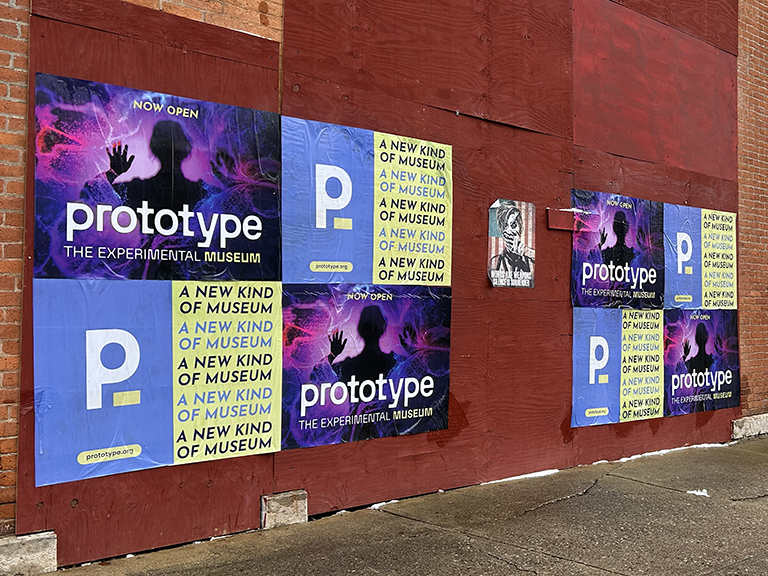
For campaigns covering large outdoor surfaces like construction hoarding, building facades, or large retail windows, posters tile together to create continuous large-format images. Individual tiles are typically printed at 24×36 or 36×48 and installed in a grid pattern. The combined installation can cover areas of hundreds of square feet while each individual piece is manageable to produce and install.
We plan poster sizes in street campaigns based on the specific surfaces available in each target market. A campaign in Soho, where ground-floor retail windows are common, might be sized differently from a campaign in a market where construction hoarding provides the primary mounting opportunity. The size follows the surface, not the other way around.
What poster size is best for outdoor campaigns?
For mounted street campaign posters in urban markets, 24×36 inches is the most commonly used format. For bus shelter panels, the standard is 47.5×68.5 inches. For outdoor billboards, the 24-sheet format measures approximately 104×234 inches. The right outdoor size depends entirely on the specific placement type and viewing distance.
Frequently Asked Questions
What is the most common poster size?
The most common poster size in the United States for general promotional and entertainment use is 24 inches wide by 36 inches tall. This is the standard size for movie posters sold commercially, music and art posters, and most event promotional materials. It is widely available at retail frame shops and print shops.
What size poster fits standard frames?
Standard poster frames are available in 11×17, 18×24, and 24×36 inch sizes at most home goods and art supply retailers. These correspond directly to the standard US promotional poster sizes. The 24×36 format has the widest selection of available frames for general retail purchase.
What is the difference between a 24×36 and a 27×40 poster?
Both are portrait-oriented vertical formats. The 24×36 is the standard retail and promotional poster size. The 27×40 is the theatrical one-sheet used in movie theater lobbies. The one-sheet is 3 inches wider and 4 inches taller than the standard 24×36. Theater display hardware is designed specifically for the 27×40 format.
What poster size is best for a store window?
For most retail store windows viewed from the sidewalk at distances of 5 to 20 feet, the 18×24 or 24×36 format works well. Smaller windows and interior positions favor 18×24. Larger windows with high foot traffic visibility favor 24×36 or larger to ensure the message reads at maximum sidewalk viewing distance.
What size poster is used in New York City transit advertising?
New York City subway and transit advertising uses multiple standardized formats. Platform posters are typically 40×60 inches. Car card posters inside subway cars measure 11×14 or 11×28 inches. Turnstile panels and station domination formats have their own specifications. Each format is specific to its placement type within the transit system.
What is the minimum text size for a poster?
Text size depends entirely on viewing distance. For close-up indoor viewing at 3-6 feet, 24-point body text is typically readable on a 24×36 poster. For street posters viewed from 10-20 feet, key text should be at least 48-72 points. For large outdoor placements viewed from 30 feet or more, critical text should be 3 inches or taller at print size.
What resolution should a poster file be?
For standard close-up viewing formats like 24×36, build the file at 300 DPI at full print size for maximum quality. For large-format prints viewed from a distance (36×48 and above), 150 DPI at full size is typically sufficient because viewing distance reduces the perceived resolution requirement. Always work in CMYK color mode for print.