Movie posters have a long and specific history that has produced standardized formats used across the film industry. The standard size of a movie poster in the United States is 27 inches wide by 40 inches tall. This format is called the one-sheet and it is the dominant format you see in movie theater lobbies, collector markets, and studio distribution systems.
Understanding movie poster sizes matters whether you are working in film marketing, collecting theatrical paper, running a poster-based advertising campaign, or adapting film artwork for street-level placements. Each context requires knowing more than the one-sheet dimensions but the full network of formats the industry uses.
We work with entertainment clients on street-level and out-of-home campaigns regularly. We print, adapt, and place materials derived from theatrical key art across multiple formats and markets. This guide covers everything about movie poster sizes from the theatrical standard to the full range of formats used in film marketing.
The standard US movie poster is the one-sheet: 27 inches wide by 40 inches tall. This is the format used in every movie theater lobby in the country and the basis for most theatrical marketing artwork.
The one-sheet is the foundational format of US theatrical film marketing. It measures 27 inches wide by 40 inches tall. The format is portrait-oriented, with a roughly 2:3 width-to-height ratio that creates the tall vertical format associated with movie marketing.
The name “one-sheet” comes from the era of lithographic poster printing, when the format represented a single press sheet. The term has outlasted the printing technology that originated it. Today, one-sheets are produced on digital large-format printers in quantities from a handful to thousands, but the 27×40 dimension remains the standard.
Movie theater chains use standardized display hardware, including lobby cases, light boxes, and A-frame displays, built specifically to hold the 27×40 one-sheet. When a studio sends theatrical marketing materials to exhibitors, the theaters know exactly what hardware to use because the format has not changed in decades. This infrastructure standardization is what has made the one-sheet so resilient as a format despite the dramatic changes in print production technology.
The one-sheet typically features a centrally placed key art image, the film’s title treatment, the tagline if there is one, and the billing block in small type at the bottom. The billing block lists cast, director, and major production credits in the specific hierarchy and size format that is often contractually specified by talent agreements.
Other Standard Movie Poster Formats
Beyond the one-sheet, studios produce film marketing materials in a range of standardized formats for different placement types and contexts.
The Half-Sheet: 22 x 28 inches
The half-sheet is a environment-oriented format measuring 22 inches tall by 28 inches wide. It is horizontal rather than the vertical orientation of the one-sheet. The half-sheet was more commonly used in mid-20th-century theatrical marketing and appeared primarily in lobby displays and retail environments. It is less common in modern theatrical distribution but still appears in specialty and collector markets.
The Insert: 14 x 36 inches
The insert is a narrow vertical format measuring 14 inches wide by 36 inches tall. It has a very different aspect ratio from the standard one-sheet, being significantly taller relative to its width. Inserts appeared in some lobby display configurations that called for a narrower format than the full one-sheet. This format is largely historical and rarely used in modern theatrical distribution.
The Three-Sheet: 41 x 81 inches
The three-sheet, named for the three press sheets originally required to print it, measures 41 inches wide by 81 inches tall. This large-format poster was historically used on building walls, billboards, and outdoor advertising structures. At nearly 7 feet tall, it has a commanding physical presence that the one-sheet cannot match. The three-sheet is rarely used in contemporary theatrical distribution but appears in some outdoor and specialty marketing contexts.
The Six-Sheet: 81 x 81 inches
The six-sheet is a large square format measuring 81 inches on each side. This approximately 6.75 foot square format appears on transit shelter structures and some outdoor advertising formats. It is the format most commonly used for the large format theatrical posters you see on bus shelter backs in major urban markets during a major release opening campaign.
The Twenty-Four Sheet: Approximately 104 x 234 inches
The 24-sheet is the standard outdoor bulletin billboard format. At roughly 9 feet tall by 19.5 feet wide, it is the largest standard movie poster format. Major studio releases rent outdoor billboard structures in high-traffic urban and highway locations to build mass awareness in the weeks before a theatrical opening. The 24-sheet adaptation of the film’s key art must be redesigned for the extreme wide-format environment orientation, which differs significantly from the portrait-oriented one-sheet composition.
The one-sheet is more than a poster size. It is a cultural artifact. Original theatrical one-sheets from major studio releases are among the most collected paper ephemera in the world, with premium examples selling for tens of thousands of dollars at auction.
Movie Poster Sizes by Country
Format Name
Country/Region
Dimensions
Orientation
One-Sheet
United States
27 x 40 inches
Portrait
Quad
United Kingdom
30 x 40 inches
environment
B1
Europe (ISO)
27.8 x 39.4 inches
Portrait
B2
Japan
20 x 28.7 inches
Portrait
Demi (half-sheet)
France
23.4 x 31.5 inches
Portrait
Two-Sheet
Australia
27 x 40 inches
Portrait
Bus Shelter Panel
US (transit)
47.5 x 68.5 inches
Portrait
The UK Quad: A Different Standard
The United Kingdom uses a completely different standard for theatrical movie posters. The UK quad format measures approximately 30 inches tall by 40 inches wide. This is a environment orientation rather than the portrait orientation of the US one-sheet. British theatrical poster design has historically made full use of the wider horizontal format, often distributing the visual composition differently than the vertically stacked one-sheet design allows.
Collectors who focus on UK theatrical paper specifically seek out quad posters for their distinct design tradition. Many iconic film posters from the 1960s through 1990s were produced in the quad format with artwork commissioned specifically for that horizontal orientation rather than adapted from the vertical US one-sheet.
For brands running campaigns in the UK using theatrical or entertainment-adjacent creative, the quad format is the reference point for theatrical paper dimensions. Building artwork for a quad requires a completely different compositional approach from the US one-sheet because the aspect ratio is fundamentally different.
The Design Language of Movie Posters
Movie poster design has developed a rich visual vocabulary over more than a century of theatrical marketing. The formats, conventions, and design codes of movie posters are immediately recognizable across cultures, even to people who have never consciously studied them.
The portrait format of the one-sheet creates a specific compositional logic. The primary subject, usually the lead character or a central visual element from the film, occupies the upper two-thirds of the vertical space. The title treatment sits below the primary image, often with a bold treatment that the audience reads as a brand mark as much as a title. The billing block at the base of the poster contains the technical credits in the small, dense type format specified by studio contracts.
Genre drives visual coding in movie poster design as much as individual film identity. Horror films use darkness, ominous negative space, and suggestion rather than explicitness. Action films use extreme perspective, motion blur, and bold typography. Romantic comedies use warm tones, casual typography, and images of lead characters in proximity. These conventions are so running that audiences use the poster to identify genre before they read the title.
The color palette of a movie poster communicates mood and genre as quickly as the image content. Blue-orange is the most analyzed color scheme in contemporary action movie marketing, with warm-toned subjects against cool blue backgrounds creating a specific visual energy associated with spectacle and kinetic action. Muted, naturalistic palettes communicate drama and prestige. Saturated, punchy palettes communicate comedy and animation. These color associations are partly cultural convention and partly genuine perceptual psychology.
Typography on movie posters has its own genre conventions. Slab serifs and distressed letterforms appear on horror and period pieces. Clean, bold sans-serifs dominate action and thriller posters. Hand-lettered and script-adjacent type appears on romantic and coming-of-age stories. The type choices communicate genre membership instantly, which is part of how movie posters function as advertising even for audiences who do not consciously process the design elements.
Movie Poster Dimensions and Street Marketing
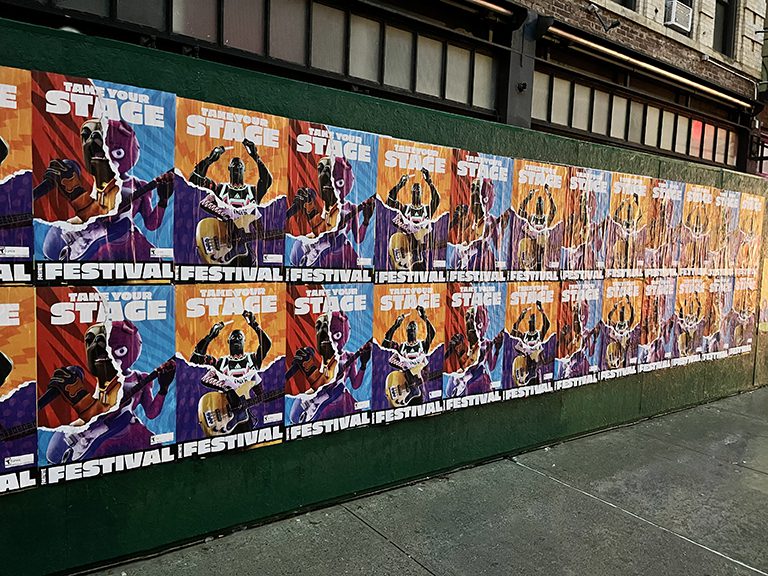
Entertainment brands that run street-level campaigns outside traditional theater lobby placements face the challenge of adapting one-sheet artwork to formats used in street and outdoor marketing.
The 24×36 format used in most street poster campaigns is close to but not identical to the 27×40 theatrical one-sheet. Artwork designed for the one-sheet needs adaptation rather than simple resizing to fit the 24×36 format without losing compositional integrity. A proportional resize of a 27×40 to fit a 24×36 height would produce a 21.6×32 image, leaving white bars on the sides. The artwork must be adapted to fill the 24×36 format properly.
For bus shelter panels, which measure approximately 47.5×68.5 inches, the scale-up from a one-sheet requires significant art direction attention. Elements sized appropriately for a lobby one-sheet may appear too small at bus shelter scale. Type sizes that read well at arm’s length on a lobby poster may be insufficient for a transit shelter panel viewed from a passing car or a moving pedestrian.
We work with entertainment clients to build campaign-specific adaptations of theatrical artwork for each placement format we use in street campaigns. Starting from the high-resolution one-sheet key art file, we adapt the composition, type sizing, and layout for each format to ensure the work looks intentional rather than simply scaled up or squeezed to fit.
Collecting Movie Posters: Why Standard Size Matters
The collector market for original theatrical movie posters is significant and places high value on authentic original materials. Dimensions are one of the key markers collectors use to distinguish original theatrical posters from reproductions, reissues, and home video promotional materials.
An original US theatrical one-sheet from the studio release of a major film will measure close to 27×40 inches. Reproduction posters produced for the home market are typically printed at 24×36 inches. The size difference is meaningful to collectors: an original one-sheet from a classic film in good condition commands dramatically higher prices than even a high-quality reproduction of the same image.
International posters in their native formats, UK quads, Japanese B2s, French demis, also carry collector value. These formats use different artwork, different designs, and different dimensions from the US one-sheet. Collectors who specialize in international theatrical paper seek out these specific formats for their distinct design traditions rather than as substitutes for US originals.
Paper condition, printing method, and provenance also factor into collector value alongside dimensions. A pristine original from a studio print run is more valuable than a used copy of the same format. A rolled poster is typically more valuable than a folded one because theater lobbies stored posters in folds that create fold lines reducing the poster’s display quality and collector grade.
Producing Movie Poster Artwork: Technical Requirements
For anyone producing artwork to movie poster specifications, the technical requirements are specific and unforgiving if ignored.
Files for the standard 27×40 one-sheet should be built at 300 DPI at full size for print. That produces a file of 8100 by 12000 pixels. This is a very large file and requires significant computing resources to work with efficiently. Many designers work at half-size (13.5×20 at 300 DPI, which is 4050×6000 pixels) and output at full resolution through the print software.
Color mode must be CMYK. All professional print production uses CMYK rather than the RGB mode used for screen display. Artwork built in RGB will have its colors shifted when converted to CMYK, sometimes significantly. Building the file in CMYK from the start ensures that the colors on screen are as close as possible to what will print.
Bleed for a 27×40 one-sheet should be at minimum 0.125 inches on all sides, making the full file size 27.25×40.25 inches. All background colors, textures, and non-critical design elements should extend to the full bleed area. Critical content, especially title text, cast names, and the central key art subject, should sit at least 0.25 inches inside the final trim edge to avoid any risk of being cut.
How do I know if a movie poster is an original or a reproduction?
Original US theatrical one-sheets from studio releases measure close to 27×40 inches and show signs of folding (theater lobbies stored posters folded) or rolling from their original distribution. Reproductions are typically printed at 24×36 inches. Paper quality, printing method, copyright date, and collector grading services all help verify authenticity for valuable examples.
Frequently Asked Questions
What is the standard size of movie posters in the US?
The standard US movie poster is the one-sheet, measuring 27 inches wide by 40 inches tall. This is the format used in movie theater lobbies across the country and the standard for theatrical marketing materials distributed to exhibitors by major studios.
What is the difference between a movie poster and a one-sheet?
In industry terminology, they are the same thing. “One-sheet” is the industry term for the standard 27×40 theatrical poster. “Movie poster” is the broader colloquial term that can refer to any promotional poster for a film, including non-standard sizes, reproductions, and promotional materials for home video or streaming releases.
What size are movie posters sold in retail stores?
Commercially sold movie posters in retail and online stores are typically printed at 24×36 inches, which is the standard retail poster format. This is smaller than the theatrical 27×40 one-sheet. Some specialty retailers and collector vendors sell reproductions at the authentic 27×40 dimensions.
What is a UK quad movie poster?
A UK quad is the standard British theatrical movie poster format. It measures approximately 30 inches tall by 40 inches wide in a environment orientation. British theatrical poster design has a distinct tradition built around this horizontal format, different from the vertical portrait orientation of the US one-sheet.
How big is a movie poster compared to a standard wall poster?
The standard retail wall poster is 24×36 inches. The theatrical one-sheet is 27×40 inches. The one-sheet is 3 inches wider and 4 inches taller. Both are portrait-oriented vertical formats with similar visual presence, but the theatrical one-sheet is designed specifically for the hardware in movie theater lobbies rather than for standard retail frames.
Are movie posters the same size worldwide?
No. Movie poster sizes vary significantly by country. The US uses the 27×40 one-sheet. The UK uses the 30×40 environment quad. Japan uses the 20×28.7 B2 format. Europe commonly uses ISO B1 (27.8×39.4 inches). Each market has its own standard for theatrical poster sizing and design tradition.
Bus shelter panel advertising in the US uses a standard panel measuring approximately 47.5 inches wide by 68.5 inches tall. This is significantly larger than the 27×40 one-sheet and requires artwork to be specifically designed or adapted for the bus shelter format rather than simply scaled up from the one-sheet.