
September 7, 2026
What Is the Standard Size for a Poster
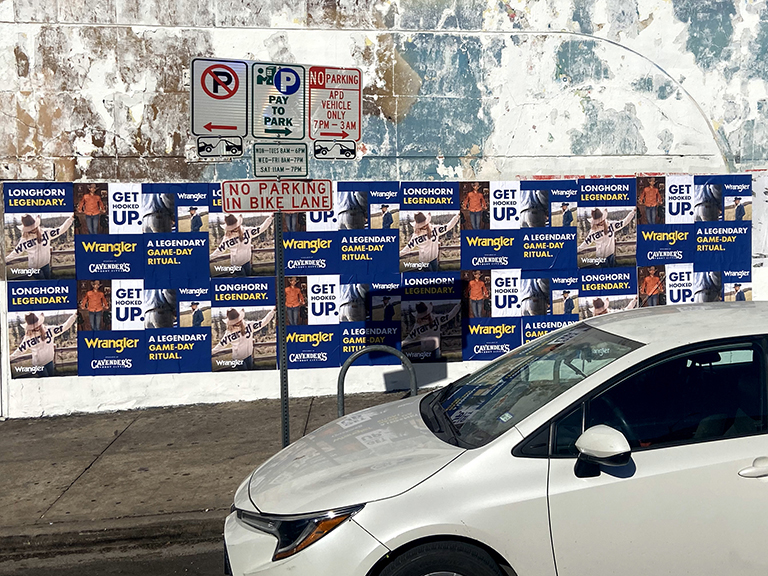
The standard poster size in the United States is 24 inches wide by 36 inches tall. This is the format most people mean when they say “a poster.” It is what most print shops sell, what most retail frames accommodate, and what most promotional and entertainment poster campaigns use as their primary format.
But “standard” is context-dependent. The standard size for a movie theater poster is 27×40 inches, not 24×36. The standard for a bus shelter ad is 47.5×68.5 inches. The standard for an event flyer is 11×17 inches. Each context has its own convention, and knowing which standard applies to your use case is the first step in any poster production project.
We produce and place posters in major US cities as part of marketing campaigns. We have worked with every standard format and several non-standard ones. This guide explains the standard size for a poster in every major context and gives you the production basics you need to get it right.
For general promotional use, 24×36 inches is the standard. For movie theaters, 27×40. For transit shelters, 47.5×68.5. For small indoor promotion, 18×24. Knowing your placement context is always the starting point.
The 24×36 Standard: Why It Dominates
The 24×36 inch format has become the de facto standard for general promotional posters in the United States through a combination of factors that reinforce each other: print economics, retail availability, and accumulated convention.
On the print economics side, the 24×36 format fits efficiently on large-format printer paper rolls that are typically 24 or 36 inches wide. A 24-inch-wide printer can produce a 24×36 poster as a single piece without seaming. This efficiency makes the format straightforward to produce at most print shops and online printing services, which drives availability and competitive pricing.
On the retail side, frame manufacturers have standardized around 24×36 because it is the most common poster size customers want to frame. The availability of frames in this size at retailers from Walmart to IKEA to specialty art shops creates a consumer expectation that posters should be this size. That expectation influences demand, which influences production, which reinforces the standard in a self-sustaining cycle.
Convention compounds the effect. Designers trained on 24×36 work in that format by default. Printers specialize in it. Campaign planners build their budgets around it. The standard persists partly because departing from it requires extra explanation and sometimes extra cost. Standards are sticky once running.
Standard Poster Sizes by Application
Rather than a single universal standard, poster sizes are standardized within specific contexts. Here is how the standards break down by the major application categories.
Event Promotion
For event promotion where the poster will be distributed physically, posted on bulletin boards, or taped in store windows, the 11×17 and 18×24 formats are the most common standards. These sizes are practical to produce, carry, and post. They are too small for distant viewing but appropriate for the close-range viewing contexts typical of event promotion.
For higher-visibility event promotion requiring larger-format visual presence, such as a campaign around a major festival or concert, the 24×36 standard takes over. This format is large enough to command attention in a busy retail district or neighborhood and creates the kind of visual presence that makes a major event feel important.
Entertainment Marketing
Entertainment marketing, including movies, music, television, and streaming, predominantly uses the 24×36 format for commercial poster distribution and the 27×40 for official theatrical materials. The 24×36 is what you buy in a store. The 27×40 is what you see in a movie theater lobby.
For street-level entertainment campaigns in urban markets, the 24×36 is the standard format for mounted and posted materials. Bus shelter advertising for entertainment uses the transit authority’s specific panel dimensions, which vary by market but are commonly around 47.5×68.5 inches.
Retail and Brand Marketing
For in-store and retail promotional use, the 18×24 format is commonly standard for smaller retail environments. Larger retail footprints with higher ceilings and more wall space use 24×36. Point-of-sale standees and promotional displays often use custom sizes specified by the brand’s retail design standards rather than universal poster standards.
For out-of-home brand marketing, the standard formats are defined by the placement type. Outdoor billboards use 24-sheet format (approximately 104 inches by 234 inches). Bus shelters use transit-specific panel dimensions. Street-level mounted posters use 24×36 as the typical standard.
Trade Shows and Events
Trade show poster and banner standards are not as tightly defined as theatrical or retail standards. Common trade show poster formats include 24×36, 36×48, and various banner formats from 24 inches to 72 inches wide depending on the display system being used. Many trade show displays use proprietary hardware systems that dictate specific dimensions rather than general industry standards.
At trade shows, always confirm the display system specifications before producing any materials. Proprietary hardware often requires specific non-standard dimensions that will not be obvious from general poster standards research.
Standard Poster Sizes: Global Comparison
| Region | Standard Name | Dimensions | Application |
|---|---|---|---|
| United States | Standard poster | 24 x 36 inches | General promotional, entertainment |
| United States | Theatrical one-sheet | 27 x 40 inches | Movie theater marketing |
| Europe (ISO) | A1 | 23.4 x 33.1 inches (59.4 x 84.1 cm) | General promotional, events |
| Europe (ISO) | B1 | 27.8 x 39.4 inches (70.7 x 100 cm) | Theatrical, large-format promotional |
| United Kingdom | Quad | 30 x 40 inches (environment) | Theatrical movie marketing |
| Japan | B2 | 20 x 28.7 inches (50.8 x 72.8 cm) | Theatrical, general promotional |
How to Confirm the Right Standard for Your Project
Before committing to a poster size, confirm these four things. Each one affects the size decision directly.
Where will the poster be displayed? This is the most important question. The display environment, whether it is a movie theater lobby, a retail window, a bus shelter, a bulletin board, or a mounted street campaign surface, determines the appropriate format through its hardware constraints and viewing distance requirements.
What display hardware is involved? If the poster will go into a frame, the frame size determines the poster size. If it will go on a transit panel, the transit authority’s specifications determine the size. If it will be mounted on a custom surface, the surface dimensions constrain the format options.
What is the viewing distance? At what distance will typical viewers encounter the poster? Near viewing (1-10 feet) allows smaller formats. Far viewing (20 feet or more) requires larger formats to ensure the design reads clearly at the actual viewing distance.
What is the production budget? Budget determines how many posters you can produce, at what size, on what substrate, and with what print method. Larger formats cost more per unit. Premium substrates cost more. Higher quantities may require switching print methods to achieve efficient per-unit costs.
Getting the Design Right for the Standard Size
Once you know the correct standard poster size for your application, design should follow the format’s specific constraints. Each standard size has its own design implications.
The 24×36 format gives designers substantial space to work with while maintaining the constraints of a single poster surface. The vertical format creates natural visual hierarchy from top to bottom. The primary visual element typically occupies the upper half or two-thirds of the format. The headline and supporting information occupy the lower portion. This top-to-bottom reading flow is the default compositional structure for 24×36 poster design.
Text sizes for a 24×36 poster must account for viewing distance. At typical street viewing distances of 10 to 20 feet, text needs to be at minimum 36 to 48 points to be comfortably readable. Headline text should be significantly larger, typically 72 to 120 points or more for a strong visual statement. Body text below 24 points is rarely readable at street distances and should be avoided in street campaign materials.
Color contrast is critical for poster design at any standard size. The poster is competing with everything else in the visual environment for attention. High contrast between the primary elements and the background, whether through color value contrast or color temperature contrast, is the most reliable way to ensure the poster registers at a glance in a visually busy environment.
How Print Method Affects Standard Poster Quality
The print method you choose for standard poster sizes significantly affects the final quality, cost, and turnaround time of your order. Understanding the differences helps you make the right choice for each production run.
Digital large-format inkjet printing is the dominant method for standard poster sizes in modern print shops. It requires no setup beyond the digital file, can produce single copies as cost-effectively as short runs, and delivers consistent color reproduction across the run. Turnaround is typically same-day or next-day for most standard sizes. This is the right method for runs under 100 copies and for any situation where quick turnaround is more important than the lowest possible per-unit cost.
Offset lithography becomes cost-effective for larger runs, typically 500 copies or more. The setup cost of plate production is significant, but the per-unit cost drops dramatically at scale. For campaigns printing thousands of standard 24×36 posters, offset printing can produce posters at a fraction of the per-unit digital cost. The tradeoff is setup time (typically a week or more including proofing) and minimum order quantities.
Screen printing is used for specialty effects that digital printing cannot achieve: metallic inks, fluorescent colors, high-opacity white on dark stock, and tactile surface finishes. Screen printed posters have a visual richness and physical quality that digital printing does not replicate. For limited-edition music posters, gallery prints, and brand campaigns where the production quality is itself a signal of brand value, screen printing at standard poster sizes is worth the premium cost and longer lead time.
Online print services like Canva Print, Vistaprint, and focused poster printing sites have made standard poster production accessible to anyone without a relationship with a local print shop. For small quantities of standard-size posters needed quickly without specialized substrate or finishing requirements, these services offer competitive pricing and fast turnaround. The tradeoff is less control over substrate options and color accuracy compared to working directly with a specialist print vendor.
When to Deviate from the Standard Poster Size
Sometimes the standard size is not the right choice for a specific project. Here are situations where deviating from the 24×36 standard makes sense.
When the creative concept demands a different format: some design ideas work better in formats that are taller, squarer, or narrower than the standard 2:3 aspect ratio. If the creative concept is strong enough to justify the added complexity and potential extra cost of a non-standard format, the deviation may be worth it.
When the placement requires a non-standard size: some display hardware, venue-specific formats, and custom print programs have dimensions that fall outside standard poster sizes. The placement requirement always takes precedence over the format convention.
When budget allows a format upgrade: a campaign with sufficient production budget might move from 24×36 to 36×48 in specific high-visibility locations to increase impact. The larger format costs more but may deliver disproportionately greater visual presence in those key placements.
When differentiation from competitors is the goal: if every brand in a category uses 24×36 posters in the same neighborhood, a brand that uses a different format can stand out through that difference alone. Format itself can be a creative decision that builds brand distinctiveness in a visual environment.
Practical Tips for Poster Production at Standard Sizes
Every production run goes more smoothly when these basics are in place before the job reaches the printer.
Build your file at the correct dimensions from the start. Do not design at a different size and expect to resize at the end without quality loss or compositional adjustments. Build at the final print size (or half-size at double the DPI) from the beginning.
Work in CMYK color mode, not RGB. This is the single most common production mistake made by designers primarily trained in screen design. RGB colors that look vibrant on screen may appear different after conversion to CMYK for print. Build in CMYK to see accurate color from the start of the design process.
Include bleed. Add at least 0.125 inches of bleed on all sides beyond the final trim dimensions. Extend background colors and patterns to the full bleed area. Keep critical content 0.25 inches inside the final trim boundary. This prevents white edges and cut-off content at the trim stage.
Request a proof for high-volume runs. For campaigns printing 100 or more copies, a physical proof before the full print run allows you to catch color issues, resolution problems, and compositional concerns before they are replicated across hundreds of posters. The cost of a proof is always less than the cost of reprinting a full run.
Paper Weight and Finish: What to Order for Standard Poster Sizes
Paper selection matters as much as dimensions. A 24×36 poster printed on flimsy stock loses credibility fast. The substrate you choose affects durability, visual quality, and how well the poster survives the installation process.
For indoor promotional use, 100 lb gloss text is the minimum. It holds color well and has enough body to stay flat on a wall or in a frame. If the poster will be displayed for more than a few weeks or handled frequently, step up to 80 lb or 100 lb cover stock, which is stiffer and more resistant to creasing and edge wear.
For outdoor applications, coated stock with a UV-protective laminate is essential. Standard indoor poster paper degrades quickly when exposed to sunlight, humidity, and rain. A UV-coated gloss finish extends the life of an outdoor poster dramatically. Some production runs use polypropylene or vinyl substrates for outdoor placement, which are fully waterproof and last several months in direct weather exposure.
Finish choice affects visual impact in the field. Gloss finishes produce vivid color and strong contrast, which helps in visually competitive environments like retail districts and event corridors. Matte finishes reduce glare and feel more premium in gallery or indoor branded contexts. Satin finishes split the difference. Choose based on the environment your poster will live in, more than personal preference.
What is the standard poster size for a band or music event?
Music event posters are typically produced in 11×17, 18×24, or 24×36 format depending on the budget and distribution method. For major venue or festival promotion, 24×36 is the standard. For local venue and bar promotion, 11×17 is often used for cost-effective distribution in high volume. The 18×24 is a common middle ground for regional music events.
Frequently Asked Questions
What is the standard poster size in the US?
The standard poster size in the United States is 24 inches wide by 36 inches tall. This is the most common format for promotional, entertainment, and street campaign posters. It is the default for most print shops and the standard for which most retail poster frames are designed.
Is 18×24 a standard poster size?
Yes. 18×24 inches is a recognized standard poster size, commonly used for indoor promotional applications, store window displays, and retail point-of-sale posters. It is smaller than the 24×36 standard and better suited for close-up viewing environments.
What is the standard poster size for a trade show?
Trade show poster sizes vary based on the display system being used. Common formats include 24×36 for standard poster placements and 36×48 or larger for high-impact display positions. If using a proprietary display system, the system specifications determine the correct format.
What size poster is used for election campaigns?
Political yard signs typically use non-standard dimensions (often 18×24 inches in a horizontal orientation). Posters for political campaigns placed indoors or on public surfaces typically use 11×17 or 24×36 formats depending on the placement context and the visibility required.
What is the standard poster size for a school project?
Tri-fold poster boards for science fairs and school presentations are typically 36×48 inches when fully open. For display boards and classroom posters, 22×28 or 24×36 are common standard sizes. Always confirm the specific dimensions required by the event or teacher before producing any materials.
How do I choose between 18×24 and 24×36 for my poster?
If the poster will be viewed primarily from 3 to 10 feet away in an indoor environment, 18×24 is often sufficient. If the poster will be placed outdoors or in a large indoor space where viewers will see it from 10 feet or more away, 24×36 provides the visual presence needed to read at that distance. When in doubt, 24×36 is the safer choice.
What poster size fits a standard Walmart frame?
For more on this, explore our guerrilla marketing services.
Walmart and most major retailers stock frames in 11×17, 18×24, and 24×36 inch sizes. The 24×36 is the most widely stocked frame size for promotional and art posters. Always check the specific frame size before purchasing posters commercially, as some products labeled “poster” are printed at non-standard sizes that may not fit standard frames.

Ready to Run Your Campaign?
Call us or email us. We’ll tell you exactly what we can do in your market and what it costs.
Related Services
Explore similar advertising solutions offered by American Guerrilla Marketing.
American Guerrilla Marketing — Los Angeles
Street-level campaigns in Los Angeles and nationwide. Wheatpasting, LED trucks, street teams, and more.
(646) 776-2770
Related Articles
-
Street Poster Advertising Ottawa: A Complete Campaign Guide
September 17, 2026
-
Activation Marketing: How Brands Win at Street Level
September 13, 2026
-
Experiential Marketing Firms Chicago | American Guerrilla Marketing
September 12, 2026
-
Pop Up Experiential
September 12, 2026
-
Mobile Pop Up
September 12, 2026