Movie posters have a standard size, and understanding that size matters whether you are designing for a theatrical release, a street campaign, or a promotional print run. The dimensions affect how your art looks, how it prints, and where it can be placed.
We work with posters constantly. We place them on storefronts, construction walls, transit surfaces, and event spaces across major US cities. Knowing the size specifications for different poster types is foundational to doing the work right.
This guide covers the standard movie poster size, the range of alternate formats, and what the dimensions mean for marketers and designers actually working with print at scale.
The standard US movie poster, known as the one-sheet, measures 27 inches wide by 40 inches tall. That is the format you see in movie theater lobbies across the country.
The one-sheet is the dominant format in American film marketing. It measures 27 inches wide by 40 inches tall. That comes out to a 2.25 x 3.33 foot vertical format. The aspect ratio is roughly 2:3, which creates the tall, portrait-oriented format that most people picture when they think of a movie poster.
The one-sheet evolved from earlier printing formats when theatrical posters were printed on standardized press sheets. The name stuck. Today, even though digital printing has eliminated the original constraint, the 27×40 size remains the industry standard.
Theaters use this format because it fits the standard lobby display frames, light boxes, and display cases that theater chains install uniformly across their locations. When a studio delivers marketing materials, the theater knows exactly what hardware they need to display it.
For street-level poster campaigns, the one-sheet is also a common reference point. Many mounted poster programs and poster display surfaces are built around dimensions close to the one-sheet or multiples of it.
Other Common Movie Poster Formats
The one-sheet is the standard, but it is not the only format used in film marketing. Studios and distributors use a range of poster sizes depending on placement, audience, and budget.
The half-sheet measures 22 by 28 inches and sits horizontally. It is a environment format used in some lobby displays and retail locations. It is less common than the one-sheet but still appears regularly in promotional contexts.
The insert is a smaller vertical format measuring 14 by 36 inches. It is a narrow format used in certain lobby displays and specialty placements. It is not as widely used today as it was in the mid-20th century theatrical distribution model.
The three-sheet measures 41 by 81 inches. It is a larger format historically used on outdoor surfaces and building walls. The name comes from the fact that it required three press sheets to print. This format is less common today but appears in some outdoor marketing programs.
The six-sheet is 81 by 81 inches, a large square format used on transit shelters and outdoor advertising structures. You see these on the sides of transit shelters and at major crossroads in urban markets. This format is common in coordinated rollouts for major theatrical releases.
The 24-sheet is a full billboard format at roughly 104 by 234 inches, or about 9 by 20 feet. This is the large outdoor billboard format used in traditional out-of-home advertising. Theaters and studios use this for major releases in high-traffic markets.
International Variations in Movie Poster Size
Movie poster sizes are not uniform globally. Different countries use different standard dimensions, which matters when running international campaigns or sourcing posters from foreign markets.
In the UK, the standard theatrical poster is the quad format. A quad poster measures approximately 30 inches tall by 40 inches wide. That is a environment orientation, which is the opposite of the US one-sheet portrait format. British film poster design traditionally uses this horizontal layout.
In Europe more broadly, the B1 format (27.8 by 39.4 inches) and A1 format (23.4 by 33.1 inches) are common standards. These ISO paper sizes are used in many theatrical and promotional contexts. A1 is roughly similar in scale to a one-sheet, which is why it often substitutes in European theatrical contexts.
Japan uses a distinct format called the B2 poster, which measures 20 by 28 inches. Japanese theatrical posters are typically smaller than their American equivalents and are prized by collectors for their distinct design traditions.
Understanding these format differences matters when you are printing international campaigns or working with assets sourced from overseas distributors. A file designed for a UK quad will not print correctly at one-sheet dimensions without significant reworking.
If you are designing for international placements, confirm the local standard before finalizing dimensions. A file built for a US one-sheet will not fit a UK quad without a redesign.
Movie Poster Sizes in Street-Level Campaigns
Theatrical posters live primarily in movie theaters. But film marketing extends well beyond theater lobbies. Street-level campaigns place posters in high-foot-traffic urban environments to build awareness before and during a film’s theatrical run.
Bus shelter panels are one of the most common street-level placements for film marketing. These panels typically measure 47.5 by 68.5 inches, which is larger than the standard one-sheet. Artwork designed for the one-sheet must be adapted and sometimes reworked to fill a bus shelter panel correctly.
Newsstand tops and transit station placements use a range of formats depending on the market. The New York City transit system uses specific dimensions for platform signage, turnstile posters, and station domination formats that each require their own spec.
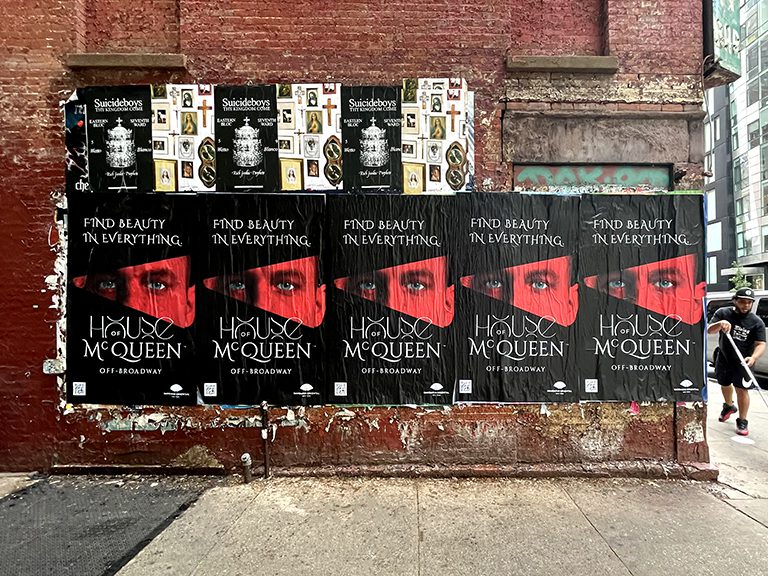
Street-level wheat paste and mounted poster campaigns use a range of sizes. A common format for mounted street campaigns is 24 by 36 inches, which is slightly smaller than the standard one-sheet but works well for ground-level urban placements. This size is familiar, prints efficiently, and fits many standard mounting surfaces.
When we run street campaigns for entertainment clients, we build artwork at one-sheet dimensions first and then adapt for each specific placement format. Starting from the one-sheet gives us the cleanest base to work from.
Resolution and File Requirements for Movie Poster Printing
Knowing the physical dimensions is only part of the equation. Resolution and file format requirements matter equally for getting clean, professional print results.
For a standard 27×40 one-sheet, the file should be built at 300 DPI (dots per inch) at full size for high-quality offset printing. That creates a very large file, often several hundred megabytes for a rich-color design. Many large-format print vendors accept 150 DPI at full size for large-format prints, as viewing distance increases with poster size.
For street-level placements where posters will be viewed from a distance, 150 DPI at full size is usually sufficient. For close-up lobby displays where viewers are within a few feet of the poster, 300 DPI is worth the larger file size.
Color mode matters too. Print uses CMYK (cyan, magenta, yellow, black) rather than the RGB mode used for screens. Artwork built in RGB will shift in color when converted to CMYK. Build and deliver all print files in CMYK from the start to avoid color surprises at the printer.
Bleed and safe zone requirements also apply to poster print files. Most printers require a minimum bleed of 0.125 inches on all sides. Important content, especially text and faces, should sit at least 0.25 inches inside the final trim edge to avoid being cut off in the trimming process.
Poster Size Comparison Table
Format Name
Dimensions (inches)
Orientation
Common Use
One-Sheet
27 x 40
Portrait
US theater lobbies, standard film marketing
Half-Sheet
22 x 28
environment
Lobby and retail display
Insert
14 x 36
Portrait (narrow)
Specialty lobby placements
Three-Sheet
41 x 81
Portrait (large)
Outdoor walls, building faces
Six-Sheet
81 x 81
Square
Transit shelters, outdoor structures
24-Sheet (Billboard)
104 x 234
environment
Billboard structures
UK Quad
30 x 40
environment
UK theater lobbies
Bus Shelter Panel
47.5 x 68.5
Portrait
Transit shelter advertising
Street Poster (Common)
24 x 36
Portrait
Street-level mounted campaigns
Collecting vs. Marketing: Why Movie Poster Size Matters to Collectors
The question of movie poster size comes up frequently in the collector market as well as in marketing. Original theatrical one-sheets from studio releases are among the most collected paper ephemera in the world. The 27×40 format is the standard for US release posters, and collectors verify authenticity in part by checking dimensions and printing characteristics.
Reproduction posters and international variants often differ from the original US one-sheet. A poster labeled as an “original” that does not measure close to 27×40 inches is likely a reissue, reproduction, or an international variant. Collectors and auction houses pay close attention to exact dimensions, printing methods, and fold versus rolled presentation.
For marketing professionals using vintage or retro poster aesthetics in campaigns, understanding the authenticity markers of original theatrical posters can inform design choices and help the work feel credible rather than generic.
How Movie Poster Dimensions Translate to Digital Design
Digital design for print always starts with the end dimensions. If you are designing a movie poster at 27×40 inches and 300 DPI, you are building an image that is 8100 by 12000 pixels. That is a massive file and requires significant computing resources to work with efficiently.
Many designers work at half-size (3.375 x 5 feet at 150 DPI, which is 4050 x 6000 pixels) and then output at full resolution. This is a common workflow compromise that speeds up design without sacrificing final output quality.
For digital mockups and social media promotional use, a 2:3 aspect ratio image at 1000 by 1500 pixels is a reasonable stand-in for the one-sheet format. It will not print well but it communicates the proportions and design accurately for approval and review purposes.
When we brief designers on poster campaigns, we always specify the final physical size, the resolution requirement, and the bleed/safe zone requirements upfront. Getting these specs wrong at the start costs time and money at the print stage.
Where Movie Posters Appear in Modern Campaigns
Movie posters appear in more places today than ever before. Beyond the traditional theater lobby, film marketing teams use poster formats across a wide range of environments.
Urban outdoor campaigns place large-format posters on building walls, construction fencing, and retail storefronts in high-traffic neighborhoods. These campaigns target the cultural centers of major cities where the target audience lives and works.
Transit advertising places posters in subway stations, on bus shelters, and inside rail cars and buses. In cities like New York, LA, and Chicago, transit advertising gives film campaigns access to massive daily ridership numbers.
Retail and entertainment venue partnerships place posters in record stores, bookshops, clothing boutiques, and restaurants that share an audience with the film. These contextual placements reach audiences in an environment they already trust.
College campuses, community centers, and cultural institutions are also strong placements for films targeting specific demographic groups. A documentary about jazz history might place posters at music schools and jazz clubs. A horror film targets record stores and gaming shops in urban neighborhoods.
The History Behind Movie Poster Dimensions
Movie poster sizes did not emerge from design theory. They emerged from the economics of 20th-century printing. When film marketing was born in the early 1900s, printers used standardized press sheets. The one-sheet evolved to fit the most common press sheet size efficiently. That made production cheaper and faster across a nationwide print distribution network.
By the 1920s and 1930s, the one-sheet was firmly running as the standard for US theatrical promotion. Studios operated their own printing facilities and coordinated with theater chains to standardize display hardware. That hardware standardization is what locked the 27×40 dimension into place. Theater lobbies were built and renovated around frames and light boxes designed for that exact format.
The formats we use today trace directly back to that industrial history. The three-sheet and six-sheet formats correspond to multiples of the one-sheet press sheet. The half-sheet and insert formats represent smaller cuts of the same press runs. All of them made economic sense within the studio-controlled print distribution model of mid-century Hollywood.
Digital printing changed the economics but not the format. Today a print shop can produce any size a client wants. But the industry still produces one-sheets at 27×40 because that is what theater display hardware accepts and what the market expects. Tradition and infrastructure combined create standards that outlast their original rationale.
Printing Technology and Its Impact on Poster Production
Offset lithography was the original production method for movie posters. The vibrant, saturated colors on vintage theatrical posters came from careful multi-plate offset work that layered inks to create depth and richness. Original theatrical posters from the 1940s through 1970s are prized partly because offset lithography produced a quality that is genuinely difficult to replicate digitally.
Modern large-format digital printing has replaced offset for most theatrical and street campaign production. Digital printing is faster, cheaper for short runs, and does not require the setup cost of film-based plate production. For campaigns that need 500 posters on a tight deadline, digital is the only practical choice.
Screen printing is a third method used for specialty and collector editions. Screen-printed posters have a texture and tactility that digital printing cannot match. Artists and limited-edition printers use screen printing for gallery posters, anniversary editions, and specialty promotional items. These are not standard theatrical materials but they carry significant collector value.
For street-level campaigns, durability matters as much as print quality. Posters placed outdoors need to withstand weather, wind, and handling. Heavy paper stock, UV-resistant inks, and sometimes lamination are all tools we use to extend the life of outdoor placements. A poster that fades or tears in three days is a wasted investment regardless of how good it looked when it went up.
Designing Within the One-Sheet Format
The 27×40 one-sheet format imposes specific design constraints and opportunities. The tall vertical format naturally draws the eye upward. Designers typically place the primary image in the upper two-thirds and the title treatment and billing block in the lower third. This convention exists because the poster is read from top to bottom, with the most important visual element demanding attention first.
The billing block, which lists the major cast and credits in small type at the bottom of the poster, is a standard theatrical requirement. The size and placement of billing block text is often contractually specified by talent agreements. Designers must work around these requirements while maintaining a clean, impactful overall composition.
Key art selection is the most critical design decision in movie poster production. The key art is the primary image or composite image that defines the poster’s visual identity. Strong key art communicates the genre, tone, and central character of the film in a single glance. Audiences make split-second decisions about whether to investigate a film further based on the poster alone.
Typography in movie poster design follows distinct genre conventions. Horror films favor jagged, distressed type or dripping letterforms. Action films use bold, aggressive sans-serifs. Romantic comedies use softer, more approachable typefaces. These visual codes communicate genre signals before the audience reads a single word of the title.
Are movie poster sizes different for IMAX or premium formats?
The one-sheet format remains standard even for IMAX and premium format theatrical marketing. However, some IMAX campaigns produce oversized specialty posters for specific promotional events or collector editions. These are not standard theatrical formats but limited production items.
Frequently Asked Questions
What is the standard size of a movie poster in the US?
The standard US movie poster, called the one-sheet, measures 27 inches wide by 40 inches tall. This is the format used in movie theater lobbies across the country and serves as the baseline for most US theatrical marketing materials.
What is the difference between a one-sheet and a half-sheet movie poster?
A one-sheet is a vertical poster measuring 27 by 40 inches. A half-sheet is a horizontal environment poster measuring 22 by 28 inches. The one-sheet is more common in modern theatrical marketing, while the half-sheet is less frequently used today.
What size are movie posters sold in stores?
Commercially sold movie posters are often printed at 24 by 36 inches, which is a standard retail poster format. This is slightly smaller than the theatrical one-sheet and fits common retail frames. Some collectible reproductions match the original 27×40 dimensions.
What resolution should a movie poster file be?
For offset printing, 300 DPI at full size is the standard. For large-format prints that will be viewed from a distance, 150 DPI at full size is usually sufficient. Always build and deliver in CMYK color mode for print.
What is the UK movie poster format?
The standard UK theatrical poster is the quad format, measuring approximately 30 inches tall by 40 inches wide. This is a landscape-orientation format, which differs from the portrait-orientation US one-sheet.
How do I know if a movie poster is an original?
Original US theatrical one-sheets measure close to 27×40 inches. Printing method, fold marks versus rolled storage, paper quality, and studio copyright information are all markers that help verify authenticity. Collectors and auction specialists examine these factors carefully.
Can movie poster sizes be customized for specific placements?
Yes. While the one-sheet is the standard theatrical format, marketing campaigns routinely adapt artwork to fit bus shelter panels, transit formats, outdoor walls, and retail sizes. Each placement has its own dimension requirements and the artwork must be adapted for each.