Street Advertising NYC: Guerrilla Campaigns That Build Real Brand Presence (2026)
Street advertising in New York is not what most brands expect when they first start thinking about it. It is not renting a billboard on Houston Street and calling it guerrilla. It is not buying a subway card placement and hoping the afternoon commuter notices it. Real street advertising is the kind of campaign that stops people mid-stride, earns a photo, starts a conversation, and builds a memory that a digital impression never can.
We are American Guerrilla Marketing. We have built street advertising campaigns on the block walls of Bushwick, in the foot traffic corridors of Midtown, across the pedestrian paths of the Meatpacking District, and along the storefronts of Williamsburg’s Bedford Avenue. We know what makes a street campaign visible in a city where everyone has become expert at ignoring advertising. This guide covers the full environment of street advertising in New York: formats, costs, where to run, how to measure, and what actually works.
What Street Advertising Is and Why It Works in New York
Street advertising covers any brand communication delivered at ground level in a public urban environment. It includes everything from brand ambassador presence to street-level placements to experiential builds in public spaces. It is distinct from traditional outdoor advertising in that it operates at human scale, in proximity to the pedestrian, rather than 30 feet above traffic on a highway. Street advertising meets people where they are. It does not ask them to look up.
Eye tracking research has consistently shown that pedestrians spend more attentional time on advertising that appears within their natural sightline, roughly zero to ten feet off the ground, than on advertising that requires them to look up. In New York, people walk fast and they look forward. A street mural on a building wall at eye level on a pedestrian thoroughfare earns more attention per impression than the same image on a billboard at the roofline.
The other advantage of street advertising is proximity to conversion. A pedestrian on Bleecker Street in the West Village is often walking to a meal, a shop, or a bar. An advertising touchpoint on that street, at that moment, is reaching a consumer who is in purchase mode. A billboard seen from the BQE at 65 miles per hour is reaching a driver whose hands are on the wheel and whose next action is not a purchase.
The Organic Social Amplification Effect
New Yorkers photograph their city constantly. A compelling street-level campaign, something visually striking or unexpected at sidewalk level, enters the social media network through the phones of the pedestrians who walk past it. We have run street advertising campaigns that generated organic social reach ten to thirty times the direct impression count, because consumers photographed it, shared it, and tagged the location. That amplification is free and it is earned, which means it carries more credibility than paid social.
Street Advertising Formats We Execute in New York
Street advertising is a broad category. Here are the formats we use most frequently, how each works, and where each is most effective.
Street Murals
Street murals are the highest-visibility, longest-duration format in our street advertising toolkit. A hand-painted or vinyl-applied mural on a building wall in a high-traffic pedestrian area functions as a landmark. People photograph it. They tag their location. They come back to it. We have produced street murals in Williamsburg’s North Side on the walls of buildings along Bedford and Berry Streets, in the Lower East Side on the Orchard and Rivington Street corridor, and in Bushwick along Wyckoff Avenue where the art district draws consistent foot and tourist traffic.
The key variables for mural effectiveness are visibility (how long does a pedestrian have eyes on it while approaching), scale (is it big enough to register from across the street or from the end of a block), and artistic quality (does it look like something worth photographing, or does it look like a corporate ad that wandered into the wrong neighborhood). Our production team handles the full process from wall acquisition to finished installation.
Street-Level Brand Ambassador Campaigns
Human presence at street level is itself a form of street advertising. A well-deployed team of brand ambassadors in a high-traffic area creates brand visibility, distributes product, and generates direct consumer contact. We run these campaigns across Manhattan’s commuter corridors, in Brooklyn’s neighborhood retail zones, and in outdoor event environments citywide.
The brand ambassador format gives street advertising something no static placement can offer: the ability to adapt in real time. If foot traffic shifts, our teams shift. If a consumer has a question, our team answers it. If a consumer wants to share the moment on social media, our team facilitates it.
Stencil and Chalk Art Advertising
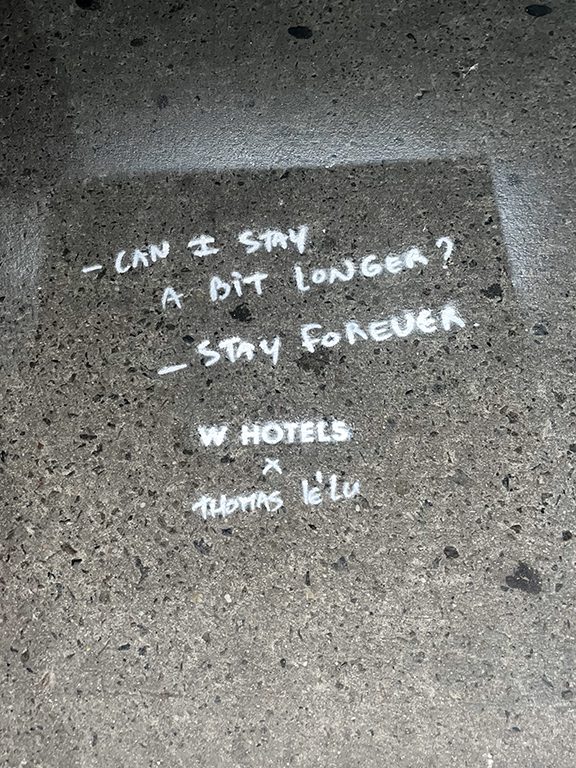
Stencil and chalk art campaigns create street-level imagery that feels like it belongs to the city while clearly communicating a brand message. These campaigns work best in neighborhoods with heavy foot traffic and a cultural affinity for street art: Williamsburg, the Lower East Side, SoHo, and the areas around Union Square. Chalk installations are temporary and weather-dependent, which actually adds an urgency element that some brands find valuable. “See it before it rains” is a real consumer driver in New York.
Projection Advertising
Building projection turns a public facade into a temporary advertising surface after dark. We have run projection campaigns on blank walls in the Meatpacking District on Gansevoort Street, on the sides of buildings in Times Square’s side streets where the projection stands out against the ambient glow, and on waterfront structures in DUMBO that are visible from multiple angles. Projection campaigns are striking precisely because they are unexpected. A blank building wall that suddenly shows moving imagery stops pedestrians in a way that traditional signage has stopped stopping for years.
Projection campaigns require equipment setup, location scouting for sightlines and clearance, and timing coordination around foot traffic patterns. Evening events, cultural openings, and weekend nightlife hours produce the highest audience density for projection work.
Ambient Street Installations
Ambient installations are physical objects or structures placed in public spaces that create a branded environment without necessarily looking like advertising at first glance. A custom piece of furniture on a public plaza that happens to carry a brand mark. A branded structure that functions as a useful shelter or resting point before revealing itself as a campaign element. These campaigns work because people engage with them before they know they are engaging with a brand.
Popup Retail and Experience Points
The popup as a form of street advertising combines physical retail with experiential brand communication. A branded popup on the corner of Spring Street and Crosby in SoHo is advertising, retail, and experience in one footprint. We plan and produce popup builds from conception through installation and staffing, with full permit management for the NYC sidewalk or plaza spaces involved.
Where We Run Street Advertising Campaigns in NYC
Location strategy in street advertising is not about picking famous neighborhoods. It is about picking the specific blocks, at the specific times of day, where the specific consumer the brand is trying to reach is already moving. Here is how we think about it.
SoHo and Nolita: Retail Corridors With Purchase Intent
The stretch of Broadway from Houston to Canal, and the cross streets cutting east and west through SoHo and Nolita, form one of the most commercially valuable pedestrian environments in North America. On a Saturday afternoon, the foot traffic on these blocks includes fashion shoppers with high disposable income, tourists with open wallets, and local residents who define street-level cultural awareness for the rest of the country. Street advertising in this zone reaches a consumer who is already in buying mode and already primed for visual stimulation from storefronts and gallery windows.
We run mural campaigns, street team operations, and popup builds in SoHo and Nolita for fashion, beauty, food, and consumer goods brands. The key is creative quality: SoHo pedestrians are sophisticated visual consumers. Generic design gets ignored. Genuinely interesting work gets photographed and shared.
Williamsburg and Bushwick: The Creative Market
Williamsburg’s Bedford Avenue corridor and the blocks radiating from it on North 6th, North 7th, and Grand Street in Brooklyn attract a demographic that is 18 to 40, creative-adjacent, digitally native, and influential online. This is the market where street art credibility matters, where community authenticity is valued above slickness, and where a campaign that feels genuine earns organic advocacy from people with real social followings.
Bushwick has a denser street art environment, particularly along Wyckoff Avenue and the blocks of the Bushwick Collective mural zone. Campaigns in this area benefit from the existing foot traffic that the art district generates. Any brand-funded mural in Bushwick is surrounded by non-commercial art on all sides, which raises the creative bar considerably but rewards brands that clear it.
Midtown: Volume Over Curation
Midtown is not the right environment for subtle or nuanced street advertising. It is the right environment for high-volume, high-visibility campaigns targeting a broad consumer base with a clear, simple message. The sidewalks around Grand Central on Lexington and 42nd, the pedestrian crossings on 5th Avenue between 42nd and 59th, and the corridors around Times Square on 7th Avenue and Broadway move more people per hour than almost any comparable urban space in the world.
In Midtown, we favor brand ambassador-led street campaigns, popup builds in high-visibility corner positions, and walking billboard programs that can move through the commuter flow. Murals in Midtown require excellent real estate positioning to compete with the ambient visual noise of the neighborhood.
Lower East Side: Culture and Nightlife Intersection
The blocks around Orchard Street, Rivington Street, and Delancey in the Lower East Side occupy a specific cultural moment: that’s where New York’s underground culture has historically surfaced, where nightlife and art intersect, and where the consumer is young, culturally aware, and suspicious of obvious advertising. Street campaigns here need to earn their place. A mural that looks commissioned feels corporate. A mural that looks discovered feels right.
We have produced some of our most organically successful campaigns in the Lower East Side by focusing on artistic quality first and brand integration second. The brand is present but it does not dominate. The result is a piece that people want to photograph regardless of the brand, which means the brand travels in their photographs to audiences that a conventional ad would never reach.
Street Advertising Costs in New York: 2026 Pricing
Street advertising pricing varies widely by format. Here is a straightforward breakdown of what campaigns cost and what drives the variation.
Street Advertising Format
Cost Range (NYC)
Duration / Notes
Street mural (hand-painted, medium scale)
$8,000 to $25,000
Location-dependent, includes artist and production
The most common question we get about pricing is: what format gives us the most reach for the money? The honest answer is that it depends on the brand goal. For long-duration visibility, murals outperform all other formats per dollar over time. For direct consumer contact, street team campaigns produce more measurable interactions per dollar. For overnight cultural impact, projection campaigns have a multiplier effect when they hit on the right evening with the right visual content.
Comparing Street Advertising to Traditional Outdoor
A 14-by-48-foot billboard on the West Side Highway runs $15,000 to $40,000 per month. You get a static image visible to vehicles moving at 30 to 50 miles per hour. You get no interaction. You get no data. You get no social amplification unless you create it separately. A $15,000 street advertising campaign from us, running a combination of mural placement, street team operation, and projection build in a Brooklyn or Lower Manhattan neighborhood, gives you: direct consumer contacts, organic social amplification, content assets from the field, and a measurable audience of engaged pedestrians who spent two to fifteen seconds with your brand rather than one glance from a moving vehicle.
What Makes Street Advertising Work: The Creative and Execution Variables
Every campaign format has creative requirements that determine whether it performs. Here is what we have learned from running these campaigns at street level in New York.
Design for the Environment, Not the Brief
The most common failure in street advertising is applying a design built for digital or print to a street context. A banner ad resized to a mural format looks like a banner ad on a wall. A social media graphic printed on a sandwich board looks like a social media graphic on a sandwich board. Street advertising design needs to account for viewing distance, environmental light, surrounding visual competition, and the one to three seconds of attention it will receive from a pedestrian in motion.
We work with our clients on creative specifically for street formats. That sometimes means pushing back on designs that come in from the agency and arguing for something that will actually work on the block, more than look good in a mock-up presentation.
Timing and Weather
Street advertising is an outdoor discipline. Weather matters. We monitor forecast windows before any campaign launch and build flexibility into schedules for rain days, extreme heat that drops foot traffic, and seasonal shifts in pedestrian patterns. A mural activation planned for outdoor foot traffic that runs during a cold rain week loses 40 to 60% of its potential impression count. We plan around this, not through it.
Consistency Over Single Moments
The brands that see the strongest results from street advertising in New York are not the ones that run one great campaign and declare victory. They are the ones that run street presence as an ongoing channel alongside their other marketing activity. A mural in Williamsburg, followed three months later by a projection campaign in SoHo, followed by a street team program in Midtown, builds a pattern of street presence that compounds in brand awareness over time. Single moments get one news cycle. Consistent presence gets a reputation.
Frequently Asked Questions
What is street advertising?
Street advertising refers to any brand communication placed or delivered at street level in urban public spaces. It includes street murals, brand ambassador campaigns, street team marketing, chalk and stencil art, building projections, ambient installations, and popup retail experiences. The defining characteristic is ground-level proximity to pedestrians rather than elevation above traffic.
Is street advertising effective in New York City?
Yes, for the right brands and with the right creative execution. New York’s pedestrian density, strong street art culture, and high organic social media activity from pedestrians make it one of the most effective markets for street advertising in the country. A well-placed, visually compelling street campaign in a high-traffic New York neighborhood can generate organic social reach far exceeding i
How much does street advertising cost in NYC?
Costs range from $3,000 for a single-day chalk campaign to $60,000 or more for a large-scale branded street mural with full production and wall acquisition. Street team campaigns run $4,500 to $8,000 per day for a team of four. Building projection campaigns cost $6,000 to $18,000 for a single evening. Multi-format week-long street programs run $25,000 to $80,000.
Do you need permits for street advertising in New York?
Permit requirements vary by format and location. Some formats require no permits when executed correctly. Others require permits from the NYC Department of Consumer and Worker Protection, the NYC Parks Department, or Community Boards depending on scope and location. We assess and handle all permit requirements as part of our planning process. Never assume a street advertising format is permit-free
What neighborhoods are best for street advertising campaigns?
SoHo and Nolita for fashion, beauty, and lifestyle brands targeting high-income shoppers. Williamsburg and Bushwick for creative, younger demographics with strong social media reach. Midtown Manhattan for volume-oriented campaigns with broad consumer targets. The Lower East Side for culturally credible campaigns targeting nightlife and arts audiences. We recommend neighborhoods based on the brand’
How do street advertising campaigns generate organic social media reach?
New Yorkers photograph their city constantly. A visually striking street campaign, a mural, a projection, a compelling ambient installation, enters organic social media through the cameras of pedestrians who photograph and share it. We have tracked street campaigns generating five to thirty times their direct impression count in social reach through organic sharing. High-quality creative is the pr
A painted mural on a building wall can last weeks, months, or years depending on weather, wall condition, and whether the property owner maintains or removes it. Vinyl-applied murals last three to twelve months on average in New York’s climate. Chalk installations are weather-dependent and typically last two to seven days. We discuss duration expectations in detail during campaign planning so you