University students are forming brand relationships that will persist for decades. The habits established during college years, the products discovered through peer recommendation in a dormitory hallway or a campus dining hall, the services integrated into student life by someone who showed up and made them genuinely useful, those early brand relationships carry disproportionate weight in consumer psychology. A brand that becomes relevant to a student at 19 has a fundamentally different relationship with that person at 35 than one they encountered for the first time as an established adult consumer.
The challenge is that university students are among the most advertising-resistant audiences available. They are digital natives who have grown up filtering brand messages. Their trust is concentrated in peer networks, not brand communications. A campus poster that looks like a corporate advertisement is invisible. A peer who shows up in the dining hall with a product they actually use and recommends it in natural conversation is influential in a way that no amount of advertising budget can replicate.
University brand activation is the discipline of reaching this audience on their terms, in their spaces, through their social networks. It requires operational knowledge of specific campus environments, crew recruitment from within the student population, and formats that feel like participation rather than promotion. This guide covers how university brand activation works, what makes it effective, and how to build a program that reaches college audiences in a way they actually respond to.
What University Brand Activation Is Not
Before covering what works, it helps to be clear about what does not. Buying a banner on a campus media site is not university brand activation. Running a targeted digital ad to 18 to 24 year olds in a college zip code is not university brand activation. Sponsoring a campus organization event and putting a logo on a banner is not university brand activation. These are advertising formats that may have some value in a broader campaign. They do not create the in-person, peer-level engagement that actually moves university audiences.
Real university brand activation requires physical presence, human interaction, and genuine value exchange in the specific spaces where student life happens. The brand shows up in the quad at noon with something worth stopping for. The crew member who engages a student at the library steps is someone the student relates to. The poster on the bulletin board in the student union looks like something that belongs there rather than an intrusion. The distance between that and a banner ad purchase is not just tactical. It is the difference between being present in the student’s world and being background noise in it.
The Campus Peer Dynamic: Why Crew Matters More Than Budget
The most important determinant of university brand activation success is who is doing the activating. A well-budgeted activation staffed with professional brand ambassadors who are not students will consistently underperform a lean activation staffed by people who look, sound, and engage like peers. This is not a hypothesis. It is an observable pattern across hundreds of campus activations.
We recruit university brand activation crews from the student and recent graduate population in the target market. For campus activations at a specific university, we prioritize students who attend or attended that university. They know the campus geography from the inside. They know the social hierarchies that matter in each space. They engage fellow students without the conversational markers that trigger the “this is a brand rep” filter that most college students have developed.
Briefing Campus Crews
Campus crew briefings focus on natural engagement rather than scripted performance. We cover campaign objectives, product context, the specific talking points that provide genuine value to the student being engaged, and the physical geography of the activation day. What we deliberately avoid is scripted pitches or sales language. A campus crew member who sounds like they are delivering a corporate message is less effective than one who can have a natural conversation about what they are there to share.
University Activation Formats by Objective
Different university brand activation objectives require different formats. Building awareness across the student population requires high-volume, high-visibility activations in the peak traffic positions. Driving trial for a specific product requires sampling activations with enough crew depth to create a genuine experience at each trial moment. Building long-term brand relationships with the student population requires sustained presence across a semester or academic year through ambassador programs.
Single-Day Activation Events
Single-day activation events are the most common format for brands entering a new campus market or timed to a specific academic calendar moment like the start of semester or a major campus event. The format includes table activations in the central quad position, mobile crews working the dining hall approaches and major pedestrian corridors, and sampling or materials distribution at peak foot traffic moments.
Single-day events produce concentrated impact. They generate high daily contact volumes in a compressed window and are appropriate for campaigns with a specific message or offering that does not require sustained relationship building. For brands launching a new product, making a time-sensitive offer, or building initial awareness, the single-day format is efficient and measurable.
Semester-Long Ambassador Programs
Semester-long ambassador programs produce sustained brand presence in the campus environment across the full academic term. Ambassadors recruited from the student body maintain regular activation schedules, build genuine peer relationships that extend the campaign’s reach through their social networks, and generate ongoing word-of-mouth that compounds across the semester.
The key to effective ambassador programs is structured accountability. Ambassadors are given specific weekly activation requirements, documentation protocols, and performance benchmarks. The structure ensures that the program produces consistent output rather than sporadic activity. Ambassador programs that lack structure produce ambassadors who cash their stipend and post one photo a month.
Campus-Specific Geography: Where Activation Works
Every campus has high-value and low-value activation positions. Knowing which is which requires campus-specific knowledge that does not come from satellite maps or campus tour websites. The table position on the Quad that gets 400 student contacts per midday hour and the position 50 feet away that gets 30 contacts are not distinguishable from a planning document. They are distinguishable from field experience.
Dining Hall Approaches
Dining hall exterior approaches during meal periods are among the highest-concentration pedestrian positions on any campus with significant residential enrollment. The morning breakfast window between 7:30 and 9:30 generates a focused stream of residential students. The lunch window from 11:30 to 1:30 generates the highest single-day volume. Positioning crews at dining hall approaches during these windows produces engagement rates that are difficult to match in any other campus position.
The Central Outdoor Gathering Space
Every campus has a primary outdoor gathering space that functions as the social center during the academic day. The specific location varies: the Quad, the Diag, the Oval, the Mall, the Steps. Identifying the correct position within that space, which end has the highest through-traffic, which area has the natural social gathering density, is the difference between a table position that becomes a campus conversation point and one that goes unnoticed despite being in the right general area.
Student Union and Library Approaches
The approaches to student union buildings and main libraries are consistent high-traffic positions throughout the day. Students visiting these facilities are purposeful but not rushed in the way that students between classes are. The approach corridors and exterior areas support engagement in a way that midday quad positions do not always produce because the student is not moving toward a specific class time deadline.
Off-Campus Student District Activations
The off-campus commercial districts surrounding major universities are student-dominant environments that are accessible without any university coordination. Bar strips, coffee shop concentrations, the commercial blocks adjacent to campus housing, and the pedestrian corridors connecting campus to off-campus residential areas are all high-value activation zones that reach the student population in a more relaxed social environment than the campus itself.
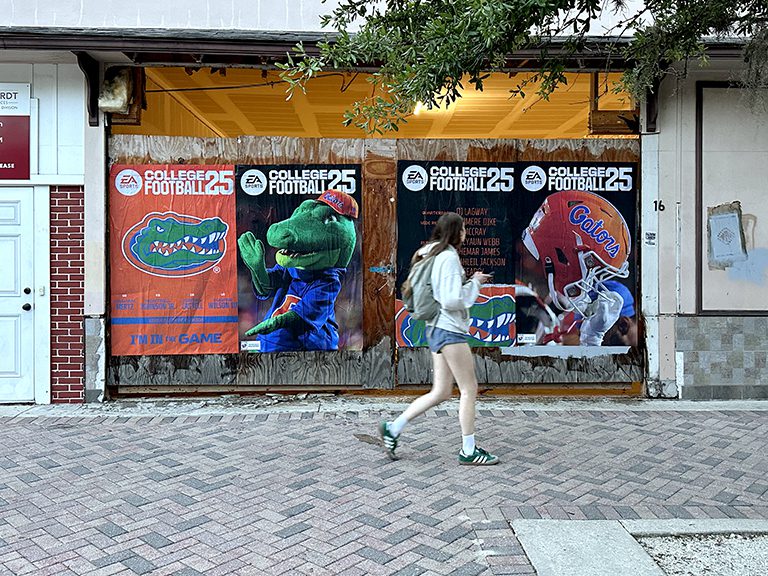
Off-campus district activations are particularly effective for brands targeting upperclassmen and graduate students who live off campus and are less present in the on-campus activation zones. Wheatpasting and poster campaigns in off-campus student districts create persistent visual presence across the weeks surrounding the activation. Sidewalk stencils on pedestrian routes between campus and student housing maintain ground-level brand presence without requiring any ongoing staffing.
Event-Based University Activations
Major university events create activation opportunities with concentrated audience density and elevated social energy. Game days at universities with major athletic programs bring large populations of students and alumni into outdoor public spaces that are fully accessible for activation. Homecoming weeks generate campus-wide social activity that creates opportunities across multiple days. Major annual campus events, concerts, festivals, and traditions create single-day peaks that are worth planning specific activations around.
Our guerrilla marketing services include event-based university activation programs that combine crew deployment with LED billboard truck presence in high-traffic zones during peak event periods. The combination creates a multi-format brand presence that reaches both the pedestrian and vehicle-borne audience around major campus events.
Product Sampling in University Settings
Product sampling is the highest-impact format for brands with a physical product to introduce to the university market. The trial moment in a peer context, when a fellow student offers you a sample of something and engages you naturally about what it is and why it is relevant, is one of the most effective brand experiences available. The social amplification effect in the campus environment means that a positive trial experience with a student who has genuine social connections spreads through peer networks in ways that off-campus sampling does not replicate.
Sampling programs in university settings require briefed crews who understand the product well enough to answer genuine questions, not just hand samples out passively. We build sampling activations around the trial moment: the crew member who offers the sample can explain what makes it worth trying, answer follow-up questions naturally, and send the student away with context that makes the product memorable beyond the sensory experience of the sample itself.
Measuring University Brand Activation
University brand activation measurement combines direct output tracking with qualitative field observation and, where applicable, digital conversion attribution. Standard output metrics include engagements logged by crew supervisors, materials and samples distributed by position and time window, and GPS-documented photo reports from every activation position. For ambassador programs, individual activation logs provide weekly performance tracking across the semester.
Where the campaign includes digital components, tracking codes on distributed materials, QR codes on posters, and ambassador-specific referral links provide direct attribution of digital conversions to campus marketing activity. The combination of field output data and digital attribution builds the evidence base that justifies continued investment and informs which formats and campus positions produce the best results for the specific brand and objective.
Timing University Activations to the Academic Year
The academic year structure creates clear high-value and low-value windows for university brand activation. Brands that time their campus programs around the peak moments in the academic calendar generate significantly better results than programs that run on a fixed corporate quarter schedule without regard for whether students are actually present and engaged.
Fall Semester Launch: The Premier Window
The fall semester opening, from move-in week through the first three weeks of September, is the highest-value window in the university marketing calendar. New students are forming brand relationships for the first time. Returning students are re-establishing routines. The campus community is fully assembled and socially active in ways that it will not replicate until the spring semester opening. Brands that launch campus programs in this window set the anchoring brand impression that will persist across the academic year.
Move-in week specifically is a window that most brands underuse. The logistical chaos of move-in creates genuine utility needs that brands can meet in ways that generate strong, memory-anchored brand associations. A brand that helps students settle in during a stressful move-in day is remembered differently than a brand that shows up with a sampling table in the quad a month later. The utility of the move-in window is not just practical. It is emotional. A positive brand interaction on move-in day carries an emotional charge that generic mid-semester sampling does not.
Measuring Brand Lift Among University Students
Beyond the direct output metrics of engagement counts and materials distributed, university brand activation programs benefit from brand lift measurement that tracks changes in awareness, familiarity, and purchase intent among the student population before and after the campaign. Brand lift studies in the university context are tractable through the research infrastructure that already exists at most major universities, including student panel surveys and market research programs that can serve as measurement platforms.
Pre-campaign brand awareness benchmarks, established through a brief survey of the target campus population before the activation program launches, provide the baseline against which post-campaign measurement can be compared. The difference between pre- and post-campaign awareness and purchase intent scores provides a direct measure of the activation program’s impact on the metrics that matter for long-term brand building, beyond the immediate output counts from activation days.
Building Alumni Relationships Through Current Student Programs
University brand activation programs that connect with students early in their college careers can build brand relationships that persist through the student’s transition to professional and adult consumer status. A student who had a positive brand experience as a freshman and carried that brand into their college social life for four years is a dramatically different consumer relationship than a student who encountered the brand once at a senior career fair. The investment in the freshman relationship pays dividends across the full four-year college career and beyond into the alumni phase.
Brands with alumni engagement goals can extend campus marketing programs through alumni networks, homecoming events, and alumni association channels that maintain the university brand community beyond the graduation point. The campus activation program that builds meaningful student relationships becomes the foundation for an alumni marketing program that reaches the same individuals in their post-graduation consumer and professional lives.
Post-Graduation Consumer Behavior and College Brand Formation
The consumer behavior patterns established during college have documented persistence into adult professional and family life. Research consistently shows that brand loyalties formed during the college years show higher retention rates than brand loyalties formed at any other life stage. The reasons are both psychological and practical: college is a period of high brand discovery and relationship formation, the peer social environment amplifies the influence of brand encounters, and the brands that become part of the student’s daily life during college are often the brands that the adult consumer continues to reach for when they are most convenient and comfortable.
For brands that sell products across a lifetime, the college acquisition cost-benefit calculation is compelling. Acquiring a college student as a loyal brand user generates 40-plus years of repeat purchase potential from a single activation investment. The cost per student of a well-executed campus activation is typically a fraction of the cost of acquiring the same customer through adult consumer marketing channels that compete against established brand loyalties rather than reaching a consumer who is actively forming new ones.
Selecting the Right Universities for a Campus Marketing Program
Not all universities are equal opportunities for campus marketing. The right campus selection for a given brand and campaign depends on the brand’s target consumer profile, the university’s enrollment characteristics, the campus culture’s alignment with the brand’s positioning, and the practical accessibility of the campus to field marketing programs.
Large public universities with high residential enrollment and active campus social cultures are the most efficient targets for most campus marketing programs because they concentrate a large audience in a bounded geographic footprint with predictable daily rhythms. Highly selective private universities may offer a more specific consumer profile but reach fewer students per activation day. Commuter universities with low residential enrollment require different approaches than traditional residential campuses. Technical universities with specific professional programs attract a student profile that differs substantially from a broad liberal arts institution. Matching the campus selection to the brand’s target consumer profile is the foundation of a campus marketing program that generates relevant reach, not just raw student contact numbers.
Frequently Asked Questions
What is university brand activation?
University brand activation is the process of building brand presence and engagement with the student population through in-person campaigns in campus and campus-adjacent environments. It includes street team deployments, product sampling, peer ambassador programs, event-based activations, and physical advertising in student districts.
Why do university students respond better to in-person activation than digital ads?
University students are among the most ad-resistant audiences available to any brand. Their trust is concentrated in peer networks. In-person activation with peer-native crews in campus spaces generates the peer-level engagement that reaches this audience where digital ads fail.
What makes a university brand activation successful?
Successful university brand activations are staffed by students or recent graduates who engage as peers, are timed to the academic calendar, are positioned in the specific spaces where student density is highest, and offer something genuinely useful or engaging rather than just branded visibility.
Can you activate at private universities?
On-campus activations at private universities require coordination with the university administration. Off-campus activations in the surrounding student districts are accessible without university permission and often reach the same student population.
How do you measure university brand activation results?
Measurement includes direct engagement counts, samples and materials distributed, ambassador activation logs, tracking code redemptions, and post-campaign brand awareness surveys when applicable. GPS-documented photo reports provide proof of field activity across all activation positions.
What is the cost of university brand activation?
Single-campus single-day activations typically range from $2,000 to $6,000. Multi-campus semester-long programs with ambassador management are scoped based on campus count and program requirements.