Arena advertising has two distinct landscapes that brand marketers often conflate. The first is the official in-venue sponsorship world: the naming rights, the jumbotron slots, the courtside signage, the concourse activations that are brokered through official team or venue partnerships. Those formats are legitimate and valuable for the brands that can afford them. The second landscape is everything that happens outside the building: the streets surrounding the arena, the pedestrian corridors the audience moves through, the transit approaches, the commercial zones that animate for hours before and after major events. That external geography is where field-level arena advertising operates, and it is accessible to any brand with the operational knowledge to use it.
American Guerrilla Marketing executes arena advertising campaigns in the external geography at major venues across the country. We have deployed street teams on the approach corridors around Madison Square Garden before sold-out concert nights. We have run LED billboard trucks circling Barclays Center during NBA playoff games. We have placed poster campaigns in the entertainment districts surrounding Crypto.com Arena in Los Angeles and TD Garden in Boston. The knowledge we bring to these campaigns is not theoretical. It is built from being in those specific places at specific times, understanding the pedestrian flow patterns, the transit exit concentrations, and the timing rhythms that determine where the audience is at any moment in the pre-event window.
This guide covers how external arena advertising works, which venue environments produce the strongest results for street-level campaigns, and what formats generate the most effective contact with the arena audience outside the building.
The External Arena Geography
Every major arena generates an extended commercial and social geography that activates in the hours before major events. This is not just the block surrounding the building. It is a zone that typically extends several blocks in every direction, encompassing the restaurants, bars, and transit hubs that serve the audience’s pre-event routine. Understanding the specific geography of that zone at each venue is the foundation of effective external arena advertising.
Transit-Dominant Approaches
In cities with strong public transit systems, the subway and commuter rail exits nearest the arena are the highest-concentration fan traffic positions in the external geography. The streams of fans emerging from these exits and walking toward the arena funnel through specific pedestrian corridors that create tight, high-density engagement opportunities for street team crews. At Madison Square Garden, the 34th Street Herald Square and 33rd Street subway exits generate the most concentrated foot traffic for events at the Garden. At Barclays Center, the Atlantic Avenue-Barclays Center station complex on the B/D/N/Q/R/2/3/4/5 lines is the primary fan arrival point. Knowing the specific exits and pedestrian routes at each venue is not general knowledge. It is operational knowledge built from repeated presence in those spaces.
Parking Approach Corridors
For venues with significant vehicle-borne audience, the approach corridors from major parking facilities to the arena create extended pedestrian flow zones that are effective for street team deployment. Fans who have parked and are walking toward the venue are moving at a pace that allows engagement. They are not rushing for a specific transit connection. They are in the pre-event mindset and receptive to promotional material that connects to the event they are about to attend.
Madison Square Garden: New York City
Madison Square Garden is the most complex arena advertising environment in the country. The building sits at the intersection of several major pedestrian and transit flows: the 34th Street corridor, Penn Station commuter rail arrivals, and the surrounding Midtown commercial district. On major event nights, the pedestrian density in the two-block radius around MSG reaches levels that are rivaled only by Times Square in the city’s commercial geography.
Key Positions Around MSG
The Seventh Avenue corridor from 31st to 35th Street is the primary fan pedestrian zone. The Penn Station subway entrances along 33rd Street generate significant foot traffic that converges with the 34th Street corridor. The Amtrak and NJ Transit arrivals from Penn Station add another distinct stream of fans arriving from New Jersey and regional commuter markets. Effective arena advertising at MSG requires understanding how these different arrival streams merge as they approach the Seventh Avenue entrance of the building.
Barclays Center: Brooklyn, New York
Barclays Center generates one of the most concentrated external advertising environments in the country because of its transit-dominant audience arrival pattern and its position at the geographic center of Atlantic Terminal. The Atlantic Avenue-Barclays Center station is one of the busiest in the Brooklyn subway system on event nights, and the pedestrian flow from the station platform to the arena entrance is a tight, high-density corridor. Our guerrilla marketing services team is based in Industry City Brooklyn, giving us particular familiarity with the Brooklyn event geography.
Crypto.com Arena: Los Angeles
The LA Live entertainment district surrounding Crypto.com Arena is one of the most developed arena districts in the country. The complex includes restaurants, bars, and entertainment facilities that extend the pre-event zone well beyond the arena building itself. The Figueroa Street approach and the LA Live plaza are the primary pedestrian zones, with vehicle traffic and rideshare pickup patterns that differ significantly from transit-dominant arenas in the East. LED billboard trucks working the Figueroa Street and Olympic Boulevard approaches during peak arrival windows reach both pedestrian and vehicle-borne audiences in the arena district.
Street Teams in Arena Districts
Street team deployment in arena districts follows the same operational principles as any venue district activation, with the scale and timing adapted to the specific arena geography. Crews are stationed at the highest-concentration pedestrian positions in the arrival window, briefed on the campaign message and talking points, and rotated through positions during the deployment period to maintain engagement momentum and prevent any single position from becoming stationary and passive.
The ideal arena district street team deployment begins 90 minutes before doors and runs through the 30 minutes following door opening, when the last wave of fans is still in the external geography. The crew rotates through the key pedestrian positions, adapting to how the crowd flow shifts as the event approaches and the audience concentrates toward the entry points.
LED Billboard Trucks at Arena Events
LED billboard trucks circling arena perimeters or working approach routes are among the most visible advertising formats available in the arena district context. A truck with a full-motion display moving through the vehicle and pedestrian traffic surrounding a major event creates high-attention brand presence that reaches both the audience arriving on foot and the vehicle-borne audience on approach routes. The dynamic display capability, the ability to show multiple creative executions in rotation, adapts to the event audience in a way that static formats cannot.
For major events at arenas in dense urban environments, a single LED truck working a defined loop around the arena perimeter during the 90-minute arrival window generates thousands of exposures from the combined vehicle and pedestrian traffic. The format is particularly effective for campaigns where the message has direct relevance to the specific event, because the audience is already in the event mindset when they encounter the display.
Poster and Print Campaigns in Arena Corridors
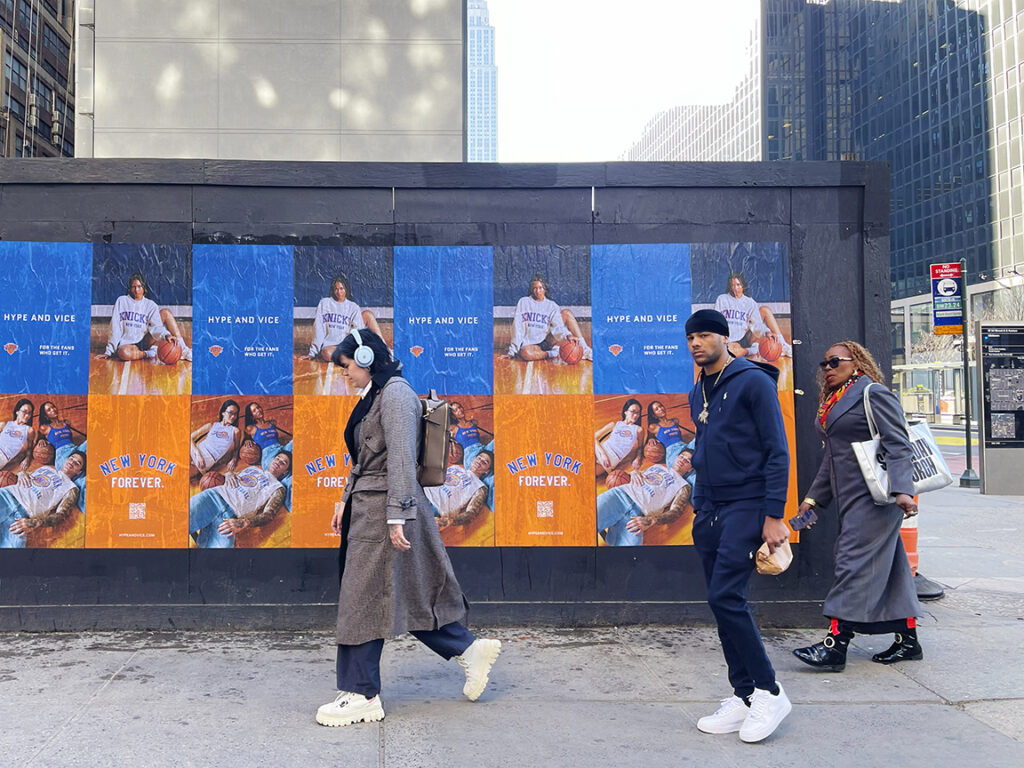
Advance poster campaigns in arena districts create physical brand presence that builds across the weeks before major events. The commercial blocks, bar and restaurant windows, construction boarding, and designated posting zones in the arena district carry poster campaigns that reach the local audience in the days and weeks before the event, as well as the event-day audience arriving for the show.
Our wheatpasting and poster campaigns in arena districts are placed based on pedestrian flow data and local knowledge of which surfaces carry the highest readership. A poster on the corner of a block that 10,000 people walk past in the two weeks before a major event generates more impressions than most digital placements at a fraction of the cost.
Sidewalk Stencils on Fan Approach Routes
Sidewalk stencils applied to the high-traffic pedestrian corridors around arenas create ground-level brand presence that reaches every person who walks the approach route before or after an event. Sidewalk stencils are encountered at foot level during natural walking, without requiring the audience to look up or pause. Applied to the specific approach routes from transit exits or parking areas to arena entrances, stencils generate unavoidable impressions from the entire audience using that corridor.
Timing Arena Advertising Campaigns
The timing framework for external arena advertising depends on the campaign objective. Advance awareness campaigns using posters and print materials launch two to four weeks before major events. Event-day activation with street teams and LED trucks runs in the 90-minute to two-hour arrival window. Campaigns targeting multiple events at the same arena can maintain continuous poster presence across a full event schedule, generating repeated impressions from the local population in the arena district as well as the event-specific audiences arriving for each show.
Measuring Arena Advertising Results
External arena advertising results are measured through materials distributed, crew engagement logs, GPS-documented photo reports, and LED truck impression estimates based on traffic counts in the deployment zone. For campaigns with digital components, tracking codes on distributed materials provide direct attribution of physical campaign activity to online conversions. Post-campaign field notes from crew supervisors document audience reception quality, which formats generated the strongest engagement, and which positions produced the most productive interactions.
Building a Multi-Event Arena District Campaign
The most cost-efficient arena advertising approach for brands that want sustained presence in a venue district is the multi-event campaign that establishes physical advertising in the district across a full event schedule rather than activating for a single night. An arena that hosts 100+ events per year, between professional sports home games, concerts, and entertainment events, creates an ongoing audience of fans and event-goers who move through the same geographic corridors repeatedly across the season. A poster campaign maintained in that geography across a full season generates cumulative impressions from both the event audience and the local population in the surrounding neighborhood.
Concert vs. Sports Event Audiences in the Same Venue
Major arenas host both sports and concert events in the same venue, and the audience profiles for these events often differ significantly. The fan who attends an NBA playoff game is a different demographic profile, in a different emotional state, and with different product receptivity than the fan who attends a major hip-hop concert in the same building two weeks later. A multi-event arena district campaign that remains consistent across both event types reaches both audience profiles with the same physical advertising presence. Brands that can speak to both audiences with a single campaign execution benefit from this multi-audience reach. Brands whose message is specific to one audience type may want to coordinate their street team activation specifically around the events that match their target audience, while maintaining poster presence across the full event schedule.
Arena District Commercial Zone Partnerships
The bars, restaurants, and retail establishments in the arena district are natural partners for brand activations targeting the arena audience. Point-of-purchase materials, branded coasters, table cards, or product placements in arena-adjacent commercial establishments reach the fan audience in the pre-game social gathering environment. These commercial partnerships require negotiation with individual business owners rather than the venue itself, making them accessible to brands that want to be present in the fan pre-game experience without the access requirements of official venue partnerships.
Commercial zone partnerships work best when the brand offers genuine value to the commercial partner: product that is stocked or served at the establishment, a promotional arrangement that benefits both the brand and the business, or a co-branded presence that is mutually advantageous. The most effective commercial partnerships are collaborative rather than transactional: the brand becomes a genuine part of the commercial establishment’s pre-game experience, not just a placard on the counter.
Arena Advertising for Non-Sports Events
Arena district campaigns targeting concert, entertainment, and non-sports events require different creative and crew briefing than sports-focused campaigns. The fan psychology of a major concert is different from the fan psychology of a playoff game. Concert audiences are often younger, more music-identified, and responsive to brand communications that connect to cultural credibility rather than sporting passion. Street teams working arena districts for major concert events need to understand the specific audience for the event and engage in ways that fit the cultural context of that specific fan community.
Major entertainment events, awards shows, large-scale theatrical performances, and cultural events that use arena venues attract premium adult audiences with high purchasing power and strong cultural engagement. Brands targeting this segment benefit from the controlled geography of arena district campaigns because the events concentrate their precise target audience in a defined physical zone in a way that digital advertising to the same demographic cannot.
Night-of-Show vs. Advance Campaign Timing
Arena advertising campaigns can operate in two distinct timing modes with different objectives and different operational requirements. Night-of-show campaigns focus on the game or concert day itself, with street teams and LED trucks deployed in the venue district during the arrival window. These campaigns reach the specific event audience with maximum relevance to the immediate occasion. Advance campaigns, running in the days and weeks before major events, build brand awareness with the local population in the arena district and establish a visual presence that the arriving event audience encounters as context for the arena geography rather than a targeted event-day impression.
The two modes serve different objectives and work best in combination. An advance poster campaign that builds for two weeks before a major event, followed by a street team deployment on event day, creates a compound impression that the event-day-only audience experiences as brand ubiquity: the poster they have been walking past for two weeks on their commute is now represented by a crew handing them something outside the arena. That compound experience is more memorable than either format alone and is the most cost-efficient approach to achieving strong brand recall from an arena advertising program.
Measuring Arena Advertising Impact
Arena advertising measurement outside the official sponsorship framework depends on the specific formats deployed. Street team activations produce direct output metrics: engagement counts, materials distributed by position and time window, GPS photo documentation. LED billboard truck programs generate impression estimates based on traffic count data for the approach routes during the deployment window. Poster campaigns produce impression estimates based on daily foot traffic counts for placement positions and campaign duration.
For campaigns that include promotional materials with tracking codes, redemption data ties physical campaign activity to digital conversions in a way that provides direct attribution. Brands that want to close the loop between arena district advertising and measurable commercial outcomes should build trackable elements into the physical materials distributed during the campaign so that the conversion data is available for analysis. The combination of output documentation and conversion tracking builds the evidence base for continued arena advertising investment and informs optimization of future campaigns at the same venues.
Frequently Asked Questions
What is arena advertising?
Arena advertising includes any brand marketing that targets the audience attending events at major arena venues. This covers both official in-venue sponsorship formats and external street-level campaigns in the venue district, approach corridors, and surrounding commercial zones that the arena audience moves through before and after events.
Can you advertise at arenas without an official sponsorship?
Yes. The public streets, pedestrian corridors, and commercial zones surrounding arenas are accessible without official venue sponsorship. Street teams, LED billboard trucks, poster campaigns, and sidewalk stencils all reach arena audiences without requiring official venue partnership.
What types of events produce the best arena advertising opportunities?
Major concerts with multiple sold-out nights, NBA playoff games, major boxing and MMA events, and large-scale entertainment events produce the strongest arena advertising opportunities. Events that draw audiences with extended pre-event dwell time in the venue district are ideal for street-level campaign formats.
How early should arena advertising campaigns be in place?
Advance poster campaigns in the arena district ideally launch two to three weeks before the event. Street team and LED billboard truck deployments happen on event day in the peak arrival window.
Which arenas have the best street-level advertising environments?
Arenas embedded in dense urban commercial districts with walkable approach routes produce the strongest environments. Madison Square Garden in New York, Crypto.com Arena in Los Angeles, the United Center in Chicago, TD Garden in Boston, and Barclays Center in Brooklyn all have high-density pedestrian approaches that support effective street-level campaigns.
How much does arena advertising outside the venue cost?
Single-event street team deployments start at $1,500 to $4,000. LED billboard truck programs in arena districts run $2,000 to $8,000 per event. Advance poster campaigns start at $1,500. Multi-format arena district campaigns for major events run $5,000 to $20,000 depending on scope.