Transit advertising is one of the most enduring categories in out-of-home media, and one of the most varied. The label covers everything from a bus shelter panel on a neighborhood commercial street to a full station domination at Grand Central Terminal — formats that share a connection to transit infrastructure but differ in almost every other dimension: cost, reach, format, audience, and creative requirements.
This guide covers the full transit advertising landscape: how the major formats work, what they cost, who they reach, and how they combine with guerrilla street-level formats to create campaigns that reach commuter audiences across the full daily journey. We run transit-integrated campaigns across 50+ U.S. markets from our base in Industry City, Brooklyn. The perspective here is practical and grounded in field experience.
If you’re evaluating transit advertising for an upcoming campaign, this guide gives you the framework to identify the right formats, set realistic budgets, and avoid common mistakes.
Bus Shelter Advertising: Street-Level Reach with Extended Dwell
Bus shelter advertising occupies a unique position in the transit landscape: it sits at street level, visible to both pedestrians and vehicular traffic, while also capturing the attention of riders waiting for buses with the extended dwell time that waiting creates.
Format Specifications and Inventory
Standard bus shelter displays are 47.5″ x 68.5″ in the dominant double-sheet format used across most U.S. markets. High-traffic markets like New York, Los Angeles, and Chicago also offer larger format “spectacular” placements at major intersections. Digital bus shelter screens, increasingly common in urban cores, allow for creative rotation and time-of-day targeting that static displays cannot provide.
Bus shelter inventory in most major markets is controlled by a small number of outdoor media companies: JCDecaux, Lamar, and Clear Channel operate the majority of major market bus shelter programs. Contracts are typically four-week minimums with multi-unit packages required for meaningful coverage in dense markets.
Audience and Context
Bus shelter audiences are genuinely mixed. In urban markets, they include transit riders, pedestrians who pass the shelter without using transit, and vehicle occupants who see shelter displays from the street. The pedestrian and vehicular reach is often understated relative to the transit rider audience — bus shelter placements on major commercial corridors can reach significantly more pedestrian and vehicle traffic than bus rider traffic, particularly in markets where bus ridership is lower relative to driving rates.
Pairing bus shelter placements with building-surface poster campaigns on the same commercial corridors creates a consistent message across multiple format exposures, building frequency among the pedestrian and vehicle audience that the shelter itself captures only partially.
Subway and Rail Station Platform Advertising
Station platform advertising is transit’s highest-frequency format for captive audiences. Riders waiting on platforms are physically stationary, not in transit, giving them both the time and the situation to absorb advertising messages more thoroughly than they would in motion.
Format Options by Station Type
Platform advertising formats vary by station infrastructure. Standard options include two-sheet (28×42″) and four-sheet (48×69″) poster placements on platform walls and columns, larger format placements on end-of-platform walls, and digital screens where infrastructure supports them. The specific inventory available varies by station — older infrastructure stations may only support standard poster formats, while renovated stations often include digital screen inventory at premium prices.
Dwell Time as the Core Advantage
Platform dwell time — the minutes a rider spends waiting for a train — is the primary value driver for station advertising. At a busy transfer station where trains run every 8-10 minutes, average dwell time can reach 4-6 minutes per trip, giving advertising placements extended exposure windows that most other OOH formats can’t match. Riders who commute through the same station daily see the same placements five or more times per week, creating frequency levels that drive message retention.
This dwell time advantage makes station advertising particularly effective for brand-building campaigns with complex messages that benefit from extended viewing time — a product feature story, a brand narrative, or a message that builds meaning through reading rather than immediate visual impact.
In-Car and On-Vehicle Advertising
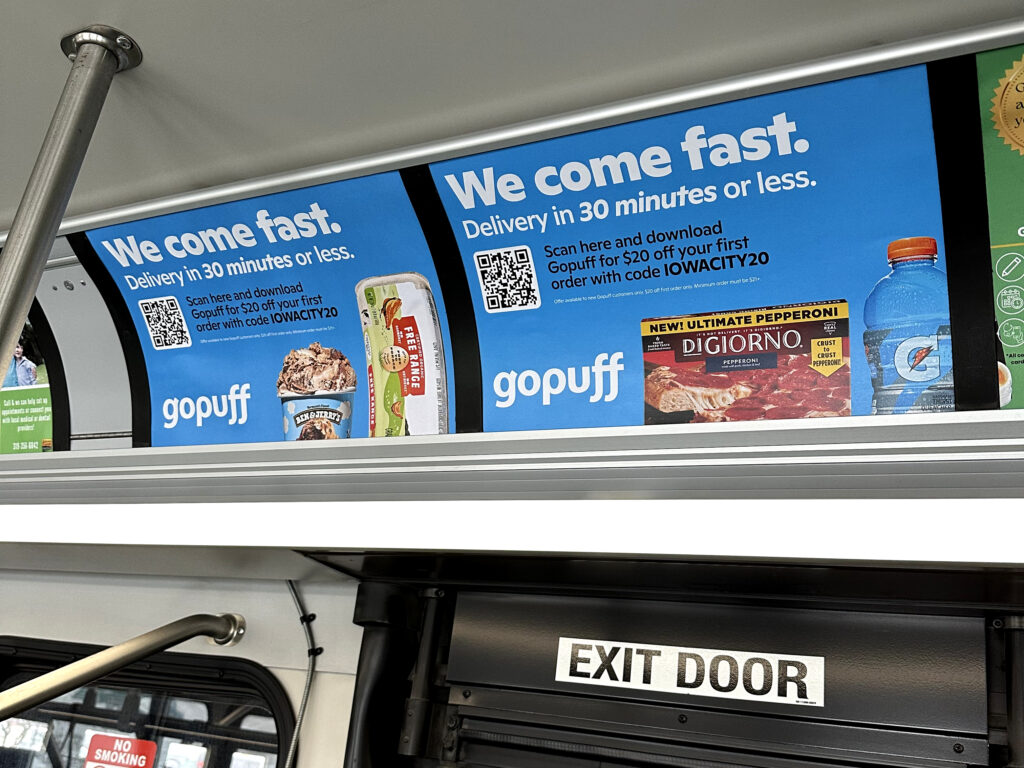
Interior car advertising — the panels above windows and along car ceilings in subway and rail cars — captures riders during transit rather than while waiting. The audience is larger than the platform audience at any given moment because the car carries its full load of riders through the entire route, but individual exposure time at any given moment is shorter than the extended dwell of a waiting platform audience.
Frequency Through Route Repetition
For commuters who ride the same route daily, in-car advertising exposure is highly repetitive. A car card visible during every morning and evening commute builds significant frequency over the course of a four-week campaign period — a daily commuter might encounter the same placement 40+ times over a single campaign flight. This frequency advantage makes in-car formats effective for message reinforcement and recall, even if individual exposure times are shorter than platform formats.
Bus Exterior Wraps
Full or partial bus exterior wraps turn the vehicle itself into a moving billboard. Wrapped buses reach pedestrians, vehicle occupants, and transit riders throughout their routes, generating impressions across the full route geography rather than at fixed locations. The format’s reach is harder to measure precisely than fixed-location placements but can generate substantial impression volume on high-frequency urban routes.
Station Dominations: Maximum Impact at Key Hubs
Station dominations — where a single brand takes over all or nearly all advertising surfaces in a target station — represent the premium tier of transit advertising. They create an immersive brand environment that no multi-advertiser station can replicate, and the share-of-voice at 100% creates visual impact that isolated placements in competitive advertising environments cannot match.
When Station Dominations Make Sense
Dominations make sense for campaign moments when maximum impact at a single location justifies the premium cost: product launches with a need for concentrated market impact, brand reintroductions targeting the commuter audience of a specific hub, or campaigns where the ambient scale of the message is itself part of the brand story. They’re a poor fit for brands that need geographic breadth rather than depth at a single point.
Cost and Availability
Station domination availability is limited by operator — not every station offers domination packages — and competitive demand is high at premium stations. At Grand Central Terminal in New York, Union Station in Washington D.C., or North Station in Boston, domination packages sell out well in advance for key calendar windows. Lead time of 6-12 weeks or more is typically required for domination planning.
Combining Transit Advertising with Guerrilla Formats
Transit advertising and guerrilla street-level formats are natural campaign partners. Transit reaches audiences inside the paid-access environment; guerrilla formats reach them as they approach, exit, and move through the surrounding neighborhood.
Building a Commuter Journey Campaign
A commuter journey campaign touches the audience at multiple points across the full daily commute: sidewalk stencils on the residential walk to the station entrance, platform advertising during the wait, in-car creative during the ride, station-adjacent poster placements as the rider exits at their destination station, and potentially a brand ambassador encounter at a key station entrance or destination location. Each format reinforces the others, building cumulative frequency and recall across the full commute arc.
Event-Adjacent Transit Campaigns
For brands activating around major events — sports games, concerts, conferences — transit-adjacent campaigns that deploy before, during, and after the event create consistent brand presence across the event attendance journey. LED billboard trucks routed between transit hubs and event venues capture transit-to-venue foot traffic during peak windows, adding mobile reach to fixed transit placements.
Frequently Asked Questions About Transit Advertising
What is transit advertising?
Transit advertising is any paid advertising placed in or around public transportation infrastructure — bus shelters, subway stations, rail platforms, train interiors, bus exteriors, and transit hubs. It reaches commuter audiences during their daily travel patterns with high frequency and dwell time advantages over most other OOH formats.
What are the main formats in transit advertising?
Main formats include bus shelter displays (at street level, high visibility to pedestrian and vehicle traffic), subway and rail station platform posters, interior car cards, station dominations, digital screens at high-traffic stations, bus exterior wraps, and commuter rail platform advertising. Each format has distinct cost structures, audience profiles, and creative requirements.
How do I choose the right transit advertising format?
Format selection follows audience behavior and campaign objective. Bus shelters reach pedestrian and vehicle audiences at street level. Platform posters reach waiting riders with extended dwell time. Car cards reach riding commuters for the duration of their trip. Station dominations create immersive brand environments for maximum impact at key hubs. Our team can help you match format to objective.
What’s the minimum budget for a transit advertising campaign?
Minimum budgets vary by market and operator. Bus shelter programs in secondary markets can start at $5,000-$15,000 for a four-week package. Subway advertising in major markets like New York typically requires $20,000+ minimum commitments. Guerrilla formats around transit environments can reach commuter audiences with lower minimum investments and often better cost-per-engagement for targeted campaigns.
Can guerrilla marketing reach transit audiences without a formal transit contract?
Yes. Poster placements on building surfaces adjacent to transit infrastructure, brand ambassador deployments at station entrances during peak commute windows, and sidewalk stencils on commuter routes all reach transit audiences without formal transit advertising contracts. These approaches work well for brands with smaller budgets or those that need more geographic flexibility than formal transit packages provide.
How effective is transit advertising compared to other OOH formats?
Transit advertising’s key advantage is dwell time — commuters waiting on platforms or riding in cars are captive audiences with extended exposure to advertising. The frequency advantage is also significant: daily commuters see in-route advertising five or more times per week. These characteristics make transit particularly effective for brand building and message recall campaigns.
Frequently Asked Questions
What is transit advertising guide?
American Guerrilla Marketing provides transit advertising guide services across 50+ U.S. markets. Every campaign is planned, scouted, executed, and GPS-documented by our field teams. We work with regional brands and Fortune 500 companies on campaigns that require real street-level execution and documented proof of performance.
How does AGM approach advertising guide?
Our process starts with a market consultation to understand your goals, target audience, and budget. We then scout locations, handle any required permissions or permits, coordinate production and installation with our local crews, and provide a full GPS-tagged photo report after the campaign runs.
What markets does American Guerrilla Marketing cover for advertising guide?
We operate in 50+ U.S. markets including New York, Los Angeles, Chicago, Miami, Houston, Atlanta, Seattle, Denver, Boston, and dozens of secondary markets. Contact us to confirm availability and pricing for your specific market.
How much does a advertising guide campaign cost?
Campaign pricing depends on market, format, quantity, and duration. We work with budgets ranging from targeted single-market runs to national rollouts across multiple cities. Use our RFP Builder or contact us directly for a custom quote based on your specific campaign requirements.
How do I get started with advertising guide through AGM?
The fastest way to get started is to submit your campaign details through our RFP Builder at americanguerrillamarketing.com, or contact us directly at [email protected] or (646) 776-2770. Our team typically responds within one business day with availability and initial pricing.