The most expensive real estate at a trade show is inside the building. Booth space, sponsorship packages, and official advertising placements all come at significant premiums, priced to capture the full value of the concentrated attendee audience the show organizer has assembled. What most exhibitors and non-exhibiting brands don’t realize is that the attendee audience spills far beyond the convention center walls, and the streets, hotels, transit corridors, and dining venues surrounding major trade shows are largely uncontested territory for brands willing to show up there.
Trade show street marketing is the practice of building brand presence in that surrounding environment, reaching the same attendees in the spaces where they’re not already being carpet-bombed with other agency messages. Our team at American Guerrilla Marketing runs campaigns around trade shows and conventions across the country, at the Javits Center in New York, McCormick Place in Chicago, the Las Vegas Convention Center, and dozens of other major venues. This is what we do, how it works, and why it generates the results it does.
The Logic Behind Convention Center Street Marketing
A major trade show concentrates thousands of qualified buyers in a specific geography for three to five days. The convention center itself is the obvious place to reach them, and show organizers price access to that reach accordingly. But the attendees don’t only exist inside the venue.
Where Trade Show Attendees Actually Spend Their Time
An average trade show day starts with a hotel breakfast or lobby coffee, proceeds through a walk or shuttle ride to the venue, includes lunch breaks outside the venue in nearby restaurants, wraps with cocktail hours and dinners at neighboring establishments, and ends with a return to hotels that may be blocks or miles away. Of a typical 14-hour day in a convention city, an attendee might spend six to eight hours inside the show venue. The remaining six to eight hours are spent in the surrounding environment.
That surrounding environment is where street marketing operates. Our guerrilla campaigns around conventions reach attendees during all of those off-floor hours, building the brand familiarity that makes show-floor encounters more productive and post-show follow-up more likely to convert.
The Uncontested Space Advantage
Inside the convention center, every exhibitor is competing simultaneously for the same attendee attention. Outside the venue, most of that competition disappears. A brand with street team presence at the hotel zone, posters on the blocks between the hotel district and the venue, and LED trucks routed through the convention district is operating in essentially uncontested territory. The cost-per-impression and the quality of engagement in that uncontested space are significantly better than anything achievable on the crowded show floor.
Trade Show Street Team Programs
Street teams are the highest-engagement format for trade show street marketing. A trained brand ambassador who can have a genuine conversation about the brand’s offering is worth far more than any passive impression medium at a trade show, because the quality of the human interaction generates the kind of trust and familiarity that moves someone from awareness to appointment.
Hotel Zone Activations
Official convention hotels are where the highest-value attendees spend their non-show hours. Hotel lobby zones, bar areas, and breakfast dining rooms are dense with senior decision-makers, buyers, and industry leaders. Our brand ambassadors are briefed for the specific audience profile of each show, with messaging calibrated for the level of engagement appropriate to the setting. Hotel lobby approaches are conversational and unhurried. Shuttle stop approaches are efficient and direct. The tactics fit the context.
Transit Hub Activations
Convention attendees concentrate at transit hubs. Taxi staging areas outside the venue, subway or light rail platforms, official shuttle pickup points, and rideshare staging zones all see high volumes of convention traffic during show hours. Our teams work these positions during peak transition times: morning arrivals, lunch-hour transit, and evening departures. Each location has a distinct engagement window and a distinct audience mood that we factor into the ambassador briefing.
Airport Programs
For the largest trade shows, we extend street team programs to the primary airports serving the convention city. Arrival terminal programs on the day before and the first day of the show reach the broadest possible cross-section of incoming attendees. Departure programs on the final show days and day after reach attendees in their most reflective state, when they’re processing the show experience and making follow-up priority decisions.
Wheatpaste and Poster Campaigns Around Convention Centers
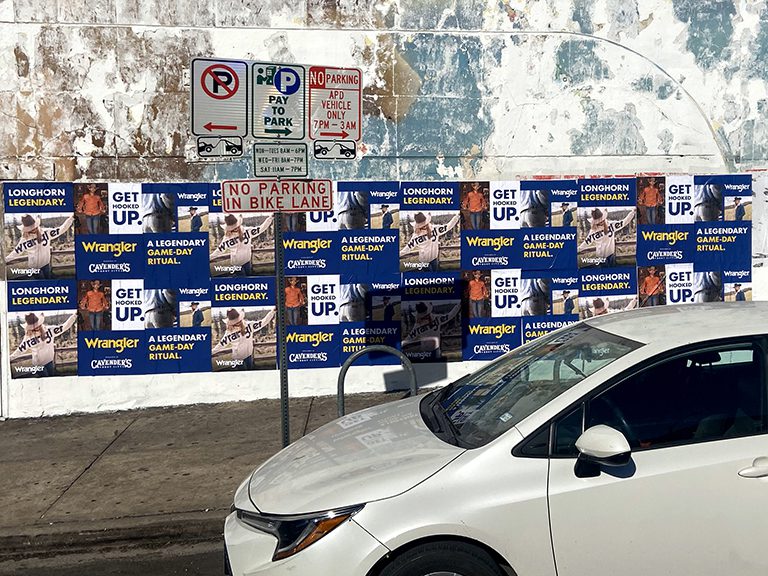
Poster campaigns in the convention neighborhood build awareness in the physical environment that attendees walk through repeatedly during the show. A wheatpaste campaign deployed two to three weeks before the show means that by the time the first attendees arrive, the brand is already part of the visual environment they’re navigating.
Neighborhood Coverage Strategy
We map the blocks surrounding the convention center and the official hotel district before every campaign, identifying the primary pedestrian corridors, the secondary streets with high dwell time, and the venue approach routes that see the highest attendee concentration. Poster placements are distributed across these zones to maximize repeated exposure frequency. An attendee walking from their hotel to the venue over three show days might encounter the same campaign creative four to eight times before they ever set foot on the show floor.
Convention-Specific Creative
Trade show poster creative needs to work efficiently. Attendees passing at a walking pace on their way to the venue have limited dwell time per impression. The most effective trade show area posters lead with a single, clear message and a specific call to action: booth number, event invitation, download prompt, or brand identifier. They’re not brand stories. They’re efficient attention-capturing devices that create familiarity and intent.
Multi-Week Saturation
For major industry shows that serve as annual gathering points for an industry community, we recommend poster campaigns that run for three to four weeks, not just during the show days. Industry journalists, analysts, and influencers who cover the show are often in the convention city for the full surrounding period. Building presence in the neighborhood before the main show week means those opinion-shaping voices are exposed to the brand in a non-crowded context before they’re overwhelmed by the show-floor environment.
Floor Graphics at Trade Shows
Floor graphics are an underused format around trade show venues. The blocks surrounding major convention centers see enormous pedestrian traffic during show days, and pedestrians look down when they walk. A floor graphic at a crosswalk, entrance approach, or hotel lobby area creates a brand touchpoint at eye-downward level that complements wall-height poster campaigns and stands out precisely because the format is less expected.
Where Floor Graphics Work
The most effective locations for floor graphics around convention centers are the crosswalks immediately outside venue entrances, the approach paths from official hotels to the convention center entrance, food court and restaurant approach corridors, and hotel lobby floors in the official conference properties. We use durable, weather-resistant, slip-resistant materials that meet local surface requirements and can handle the high foot traffic volumes these areas generate during show days.
Format Options
Standard floor graphic installations use adhesive vinyl printed with the campaign creative. For outdoor applications in high-pedestrian zones, we use materials rated for outdoor conditions and street-level foot traffic. Indoor hotel applications use lower-adhesion materials appropriate for polished floor surfaces. All floor graphic materials are designed for clean removal without surface damage.
LED Billboard Trucks at Conventions
Our LED billboard trucks are one of the highest-impact formats for convention-area campaigns because they’re mobile, highly visible, and completely unexpected in the convention context. A truck-mounted LED display driving through the convention district during show hours stands out against the static visual environment and generates strong social documentation from attendees who photograph it and share it online.
Routing Strategy
We route LED trucks through the primary convention corridors based on show timing. Morning coverage concentrates on the hotel-to-venue routes during peak arrival hours. Lunch coverage focuses on the restaurant and food zones where attendees congregate mid-day. Evening coverage routes through the dining and entertainment district where post-show socializing happens. Each routing phase has different messaging optimized for the attendee’s current context and intent.
Dynamic Content for Multi-Day Shows
For shows running three days or more, dynamic content allows us to evolve the messaging through the show. Day one: brand awareness and booth invitation. Day two: specific product or service highlight. Day three: event invitation or last-chance messaging. This content evolution keeps the campaign fresh for attendees who are in the convention city for the full show duration.
Running Street Marketing Without a Show Floor Booth
One of the most underappreciated applications of trade show street marketing is for brands that want to reach the trade show audience without paying for a booth or sponsorship. This is sometimes called “ambush marketing” or “non-exhibitor outreach.” The street marketing program around the convention reaches the same attendee population that booth holders are competing for on the show floor, without any of the show organizer’s cost structure.
Who Benefits from Non-Exhibitor Street Programs
Brands launching products in a market where the relevant trade show is already sold out of booth space. Challenger brands that can’t compete with established exhibitors’ booth budgets but can execute a strong street-level program. Companies that want to reach a trade show audience before they have an official presence at the show. All of these scenarios work well for convention area street marketing.
The Ethics of Non-Exhibitor Marketing
Running street-level marketing around a trade show without official participation is approved and legitimate, as long as campaigns operate in public spaces and don’t misrepresent official show affiliation. We don’t use show logos, imply official sponsorship, or create the impression of venue association that the brand doesn’t have. Our campaigns are straightforward brand presence programs that operate in the public spaces surrounding the venue, which are entirely appropriate territory for any brand.
Ready to Launch Your Campaign?
Convention Venues We Know and Work Around
Our experience running street marketing programs around major convention venues gives us operational knowledge that can’t be replicated from a map. We know which streets the McCormick Place shuttle uses. We know which hotel blocks see the highest attendee concentration around the Javits Center. We know where the Moscone Center attendees eat lunch and which Las Vegas hotel corridors handle the highest CES foot traffic. That specific knowledge is what makes our convention street programs operationally efficient from day one rather than requiring a location-learning investment on the client’s budget.
The venues we work around most frequently include: Javits Center (New York), McCormick Place (Chicago), Las Vegas Convention Center, Orange County Convention Center (Orlando), Moscone Center (San Francisco), Georgia World Congress Center (Atlanta), Walter E. Washington Convention Center (DC), Boston Convention and Exhibition Center, San Diego Convention Center, and others. If your show is at a venue not on this list, we can execute there. Our operational approach applies to any major convention venue in any major US city.
Trade Show Street Marketing Budgets: What to Expect
Clients regularly ask us for budget guidance before getting into a detailed scope conversation. Here’s an honest overview of what different levels of trade show street marketing programs cost and what they deliver.
Entry-Level Program: Street Team Focus
A focused street team program covering hotel zone activations and shuttle stop coverage for a three-day show typically runs $5,000 to $8,000, including ambassador recruitment, briefing, and supervision. This is the minimum viable program for exhibitors who want a human presence in the convention neighborhood without the production investment of a poster campaign. It generates direct engagement and appointment-setting at a cost-per-qualified-interaction that’s typically lower than any digital channel targeting the same professional audience.
Mid-Range Program: Street Teams Plus Posters
Combining a pre-show wheatpaste campaign with a during-show street team program adds the awareness-building layer to the engagement-generation layer. This combination, covering poster installation two to three weeks before the show and ambassador programs during show days, typically runs custom quote to $20,000 including production and crew. This is the program we recommend most frequently for exhibitors at major industry shows where standing out from the competition matters.
Full Program: Multi-Format Convention Takeover
Full convention programs that include wheatpaste, street teams, LED truck routing, floor graphics, and airport coverage run $25,000 to $50,000 depending on show duration, number of campaign zones, and production scope. These programs are appropriate for brands making major announcements at flagship industry events, companies entering a new market through a trade show launch, and exhibitors who want to demonstrate scale and seriousness to a professional audience that calibrates investment level as a signal of brand stability.
Integrating Trade Show Street Marketing with Your Broader Event Strategy
Street marketing programs around conventions are most effective when they’re integrated with the exhibitor’s broader event strategy rather than run as a standalone tactic. Here’s how that integration works in practice.
Coordinating Messaging Across All Channels
The street-level program should carry the same core message as the exhibit, the pre-show email campaign, and any social media activity surrounding the event. Attendees who encounter the brand across multiple channels in the convention context build a more coherent and durable brand impression than those who see inconsistent messaging across different touchpoints. We review exhibitor messaging before briefing any street team program to ensure the street presence is consistent with the on-floor communication.
Timing Street Programs to Amplify Key Moments
If the exhibitor is announcing a major product at a keynote session or hosting an evening event, we time the LED truck routing and street team concentration to peak around those specific moments. A brand announcement at 2 PM on day two of the show benefits from LED truck passes through the hotel district during the lunch hour immediately preceding, ensuring the brand is top-of-mind as attendees make their afternoon agenda decisions.
Using Street Documentation for Social Content
The photographic documentation from our street programs generates ready-to-use social content for the exhibitor’s channels during the show. A photo of the LED truck outside the convention center, posters in the surrounding neighborhood, and street team activations in the hotel zone all tell a story of brand presence that performs well on LinkedIn and Twitter during the show’s social conversation peak. We provide client-ready social imagery as part of every campaign documentation package.
What is trade show street marketing?
Trade show street marketing is the practice of running brand campaigns in the streets, hotels, transit corridors, and venues surrounding a trade show or convention, rather than limiting brand presence to the show floor. It includes tactics like street team activations at hotel zones and transit hubs, wheatpaste poster campaigns in the convention neighborhood, floor graphic installations in high-traffic zones near the venue, and LED billboard trucks routed through the convention district.
What trade show street teams do you provide?
We provide trained brand ambassadors for hotel zone activations, shuttle stop coverage, airport arrival and departure programs, lunch corridor distribution, and evening networking venue presence. Our street teams are briefed specifically for the convention context, with knowledge of the show, the exhibitor’s offering, and clear engagement protocols for both B2B and B2C attendee interactions.
What are floor graphics for trade shows?
Floor graphics are adhesive-based brand installations applied to high-traffic floor surfaces near convention centers. In the blocks surrounding major venues, floor graphics at crosswalks, entrance approaches, and hotel lobby areas create brand touchpoints at eye-downward level that complement wall-height poster campaigns. We use durable, weather-resistant, and aligned with site rules materials for all floor graphic installations.
Which convention centers and trade show venues do you work around?
We have run street marketing programs around the Javits Center (New York), McCormick Place (Chicago), Las Vegas Convention Center, Orange County Convention Center (Orlando), Moscone Center (San Francisco), Georgia World Congress Center (Atlanta), Walter E. Washington Convention Center (DC), and many others. Each venue has specific surrounding neighborhood dynamics that we know from direct operational experience.
Can trade show street marketing work for companies without a booth at the show?
Yes. Street marketing around a convention is one of the most effective ways to reach the attendee audience without paying for official sponsorship or booth space. Brands can build significant presence among the trade show audience through street-level programs in the surrounding neighborhood without any official show participation.
How does street marketing around trade shows compare to official show sponsorships?
Official show sponsorships provide sanctioned access to the venue interior, program placements, and logo positioning in official show materials. Street marketing provides unsanctioned presence in the surrounding neighborhood at a fraction of the cost. For brands that need to reach the show audience efficiently, street marketing around the convention often delivers better cost-per-impression and cost-per-qualified-engagement than premium official sponsorship packages.
Related: Wheatpasting & Poster Campaigns | Guerrilla Marketing Services | Sidewalk Stencils | LED Billboard Trucks | Brand Ambassador Agency
Ready to Launch Your Campaign?
Millie Phillips
Campaign Architect , American Guerrilla Marketing
Email: [email protected]
Office: (646) 776-2770
Official Wheatpaste Pricing
We only quote from AGM’s published rate cards or from a custom scope tied to the actual market, route, staffing plan, and production load.
- 24×36 wheatpaste campaign, 100 posters: $4,500
- 24×36 wheatpaste campaign, 200 posters: $5,500
- 48×72 wheatpaste campaign, 100 posters: $10,500
- 48×72 wheatpaste campaign, 200 posters: $13,500
- Optional maintenance for the final two weeks of a monthly run: $3,500
If your campaign needs a different city mix, custom fabrication, or rush timing, contact AGM for a quote built from the same rate-card logic.
How AGM scopes Trade Show Street Marketing: Campaigns Around Convention Centers
Every wheatpaste deployment plan starts with the same field questions. Where will the audience actually see the work, how long will the message stay in view, what kind of crew does the job need, and what proof will the client want after the run is live. We scope those answers before we talk about volume. That keeps the program grounded in real conditions instead of broad theory. For trade show street marketing: campaigns around convention centers, the planning work matters because one weak choice at the start can waste the whole run. A strong route, a realistic install pace, and a clean recap process are what make the campaign feel sharp in the street instead of rushed.
What changes performance in the field
Performance usually comes down to placement, timing, and repetition. The best campaigns do not chase every possible block. They pick the blocks, venues, walls, stations, storefronts, or pedestrian paths that line up with the right audience behavior. We watch how people move through a neighborhood, what side of the street they face, how long they dwell, and what else is competing for attention. For trade show street marketing: campaigns around convention centers, that means the visible details, sightline, lighting, install condition, and recap quality all matter. Good field work looks obvious after the fact, but it only feels obvious because the plan was tight before the crew ever rolled.
Budget and timing without guesswork
AGM does not pad numbers with vague ranges. We tie budgets to rate cards where a public rate exists, then fill in the rest with real production needs, staffing, route density, timing, and market conditions. That keeps the conversation honest. On trade show street marketing: campaigns around convention centers jobs, timing is often shaped by access windows, weather, production lead time, and how much documentation the client wants back. If a project is simple, the schedule stays simple. If it has many neighborhoods, many surfaces, or several city teams moving at once, the schedule expands because the work on the ground expands. That is a normal operations decision, not filler.
How we document results
Clients do not just need the work done. They need to know where it landed, how it looked, and whether the rollout matched the brief. Our recap process is built around timestamped photos, neighborhood notes, route summaries, and clear proof of completion. On trade show street marketing: campaigns around convention centers work, recap quality often decides whether a client books the next run. Clean reporting also helps the next wave because the team can see what held up, what drew the strongest response, and which placements deserve a second pass. The recap is not an afterthought. It is part of the product.
Common mistakes brands make with Trade Show Street Marketing: Campaigns Around Convention Centers
The most common mistake is chasing surface area without enough planning. Brands sometimes assume that more units or more neighborhoods always means better results. In practice, sloppy spread kills recall. Another mistake is forcing creative that is too dense for the setting. Street work needs clear hierarchy, strong contrast, and a message that makes sense at the distance where the audience sees it. A third mistake is underestimating production details. The stock, finish, weather window, shift timing, and recap expectations all shape the outcome. Strong campaigns respect the boring details because the boring details decide whether the visible work looks premium.
Why this topic matters to AGM clients
Clients hire AGM because they need people who understand street conditions, not just ad concepts. Trade Show Street Marketing: Campaigns Around Convention Centers is valuable when it turns a broad brand idea into something that holds up in a real place, in front of moving people, with real constraints. That is where execution matters. A page like this should leave you with a clear sense of what the work involves, what can go wrong, and what a disciplined rollout looks like. If the campaign needs city selection, route design, crew planning, printing, fabrication, staffing, reporting, or a combined package, AGM can scope it from one operating plan instead of handing the job off across five vendors.
Frequently Asked Questions
How early should a brand start planning?
For most campaigns, the smart move is to start planning at least two to four weeks before the launch window so production, routing, staffing, and reporting are all lined up.
What makes one market perform better than another?
Market fit depends on audience density, neighborhood behavior, route efficiency, and whether the creative belongs in that setting. The busiest city is not always the best city.
Can AGM bundle this with other services?
Yes. AGM often combines this work with supporting formats so the campaign has stronger repetition and cleaner reporting across the whole run.
How does AGM quote pages like this?
We quote from official rate cards where they apply, then scope the remaining production, staffing, and routing details to the actual job.