Trade shows are expensive. The booth, the travel, the staffing, the collateral, the shipping, the pre-show marketing emails that most exhibitors send and most attendees ignore. The average large-format trade show exhibit costs an exhibitor $50,000 to custom quote or more per event when everything is accounted for. Given that investment, the quality and volume of leads generated needs to be taken seriously. Yet a huge proportion of exhibitors treat lead generation as an afterthought, relying on badge scanners and hope rather than building a deliberate strategy for getting the right people to their booth.
Our team at American Guerrilla Marketing approaches trade show lead generation from the outside in. We build the street-level and ambient awareness programs that warm up attendees before they ever walk onto the show floor, so that by the time they encounter your booth, they’re not cold. They’ve seen your brand. They’ve been thinking about it. They have a reason to stop.
Why Most Trade Show Lead Generation Falls Short
The fundamental problem with conventional trade show lead generation is that it treats the show floor as the entire campaign. Exhibitors invest in a beautiful booth, hire booth staff, print collateral, and show up. Then they wait for foot traffic, hoping that the right buyers will happen to walk past and stop.
The Show Floor Competition Problem
On a major trade show floor, your brand is competing with dozens or hundreds of other exhibitors for exactly the same pool of attendees. The show floor is the highest-competition environment any marketer operates in, because all of your other agencies are physically present in the same room at the same time. Getting noticed among that noise requires either a massive exhibit footprint or the kind of pre-built familiarity that makes attendees specifically seek out your booth rather than stumbling across it.
The Agenda Problem
Most serious trade show attendees arrive with a plan. They know which sessions they’re attending, which exhibitors they want to visit, and roughly how they’re going to spend their time. If your brand isn’t already on their list before they arrive, you’re competing for discretionary attention that’s already heavily allocated. Pre-show marketing puts you on the list before the list is made.
The Badge-Scanner Problem
Lead capture through badge scanners at trade shows captures contact information but tells you very little about lead quality. A badge scan in the aisle is a fundamentally different interaction than a booth visitor who sought you out specifically, engaged with your demonstration for twenty minutes, and asked substantive questions about implementation. The quality metric matters as much as the volume metric, and quality starts with pre-built familiarity.
How Street Marketing Improves Trade Show Lead Generation
Street-level marketing around convention venues serves a specific function in the lead generation cycle: it builds brand familiarity with attendees during the windows before, around, and after the show floor, so that show floor encounters are warmer, more productive, and more likely to convert to qualified pipeline.
The Familiarity Effect
Research consistently shows that repeated brand exposure in multiple contexts accelerates trust formation and purchase intent. An attendee who has seen your brand on a poster walking from their hotel to the convention center, encountered your brand ambassador at the coffee line near the venue, and noticed your LED truck passing through the hotel district, approaches your booth with a qualitatively different relationship to your brand than someone who is seeing you for the first time on the show floor. The booth conversation starts further along the trust curve.
Pre-Floor Appointment Setting
Street marketing programs at hotel zones and pre-show evening events give brand ambassadors opportunities to engage with attendees before the show floor opens and convert those conversations into confirmed booth appointments. Getting specific attendees to commit to a meeting time before the floor opens is the highest-value pre-show activity available. It transforms passive awareness into scheduled pipeline-building interactions.
Stand-Out in a Crowded Environment
While most exhibitors are invisible to attendees until they’re standing on the show floor, a brand with a visible street presence in the convention neighborhood stands out precisely because it’s operating in a space where other agencies aren’t. The convention streets, hotel zones, shuttle stops, and evening dining corridors are largely uncontested territory for most exhibitors. We operate in that space.
Building a Trade Show Lead Generation Program: Before the Show
Pre-show lead generation starts weeks before the show opens. Here’s how we structure the pre-show phase.
Neighborhood Wheatpaste Campaign (2-4 Weeks Before)
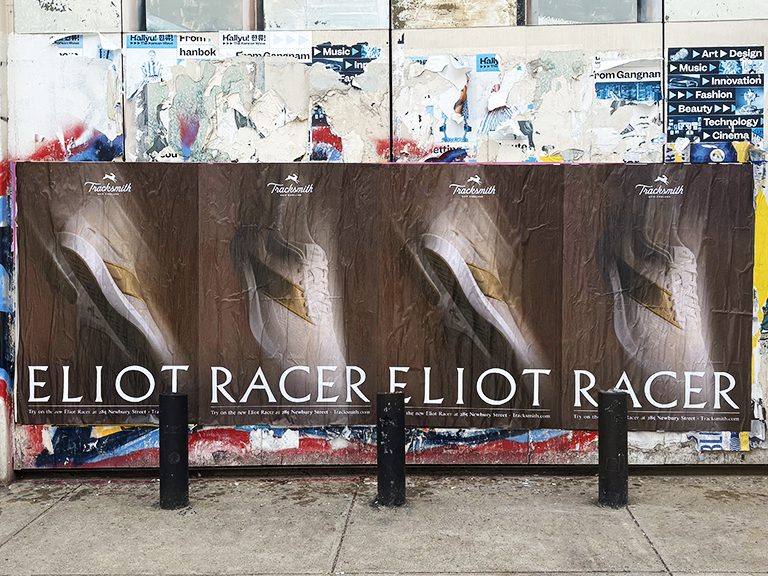
Two to four weeks before the show, we deploy guerrilla marketing materials in the convention neighborhood. Large-format posters go up on approved walls in the blocks surrounding the convention center and official hotel district. These installations build brand presence in the physical environment that attendees will be walking through during the show, so that by the time they arrive, the brand is already a familiar visual in the environment.
Pre-Show Email and Digital Coordination
Street programs work best when they’re coordinated with the exhibitor’s digital pre-show outreach. An email campaign that tells registered attendees to stop by a specific booth is more effective when the recipient has already seen the brand on a poster during their morning walk. The street presence makes the digital message land in a different context than a cold inbox appeal.
Hotel Zone Street Team Activation (Show Eve and Day 1 Morning)
Brand ambassadors at the primary conference hotel district in the evening before the show opens catch attendees in their most relaxed and conversational state of the entire event. Evening pre-show activations generate genuine conversations, direct appointment-setting, and brand introduction moments that carry into the following morning’s booth activity. Morning of Day 1, we position ambassadors at the major hotel-to-venue transit corridors for a second high-quality impression window.
On-Show Lead Generation: What Happens During Show Hours
During show hours, our programs shift to the outside-the-venue environment rather than the show floor itself.
Shuttle Stop Activations
Convention shuttle stops are natural waiting areas where attendees have two to ten minutes with nothing to do. Brand ambassador presence at shuttle stops during peak show hours, particularly morning arrivals and evening departures, generates low-pressure brand engagement moments that complement the exhibitor’s floor presence. Ambassadors at shuttle stops focus on awareness and appointment-setting rather than deep engagement.
LED Truck Routing Through the Convention District
Our LED billboard trucks can be routed through the convention district during show hours, passing through the pedestrian corridors between the venue and the hotel district, the lunch dining zones, and the evening restaurant corridors. Dynamic messaging allows us to adapt content to the show timeline: booth location and hours during show days, event or reception invitations for evenings, and follow-up messaging during post-show departure days.
Lunch Hour Zone Activations
The lunch break is one of the most overlooked windows in trade show marketing. For 60 to 90 minutes in the middle of each show day, thousands of attendees are outside the venue, in nearby restaurants and food zones, in a relaxed social state. Street team programs in the lunch zone dining corridors reach the full attendee population during this window. The non-show-floor context makes these interactions feel different from booth encounters, which can work to the exhibitor’s advantage for relationship-building conversations.
Post-Show Lead Generation: The Conversion Window
Post-show lead generation is about staying visible while purchase decisions are being made. Here’s how we approach the post-show phase.
Evening Networking Venues
Every major trade show has a set of official and unofficial networking events in the evenings. Cocktail parties, dinners, awards ceremonies, and informal bar gatherings all happen in the restaurant and entertainment district near the convention. Street team presence and sidewalk stencil programs in these evening zones keep the brand visible during the social interactions where professional relationships are genuinely formed and deal conversations begin.
Airport Departure Presence
The final hours before departing attendees fly home are a reflective period where they’re reviewing notes, triaging their contacts list, and making priority decisions about follow-up. Brand presence at the airport, either through collateral distribution at check-in areas or LED truck coverage on the route to the airport, keeps the brand present during this final in-market window.
Post-Show Poster Longevity
Wheatpaste installations around the convention neighborhood typically remain in place for two to four weeks after the show. For conferences that generate significant ongoing industry coverage and social discussion in the weeks following the event, these installations continue building awareness among the extended trade media and industry community even after the show closes.
Conference Lead Generation compared with. Trade Show Lead Generation
Conference lead generation has a different structure than trade show lead generation, though the underlying principles are similar. Conferences typically involve content programming, sessions, and workshops rather than an open show floor. The lead generation dynamic is less about driving booth foot traffic and more about building brand presence among a content-focused professional audience.
Sponsor Presence in Conference Markets
Conference sponsors have smaller on-site footprints than trade show exhibitors but often have significant branding in the conference hotel zones, event spaces, and surrounding neighborhood. Street-level programs around conferences reinforce sponsor visibility in the physical environment that attendees move through, complementing the on-site sponsor presence with neighborhood-scale brand coverage.
Session-Adjacent Activations
At conferences where sessions happen in multiple rooms across a venue or hotel complex, the corridors between sessions are high-traffic zones where attendees transition between agenda items. Street team programs positioned at these transition points reach the full attendee population multiple times per day in a low-pressure, between-session context.
Ready to Launch Your Campaign?
What Good Trade Show Lead Generation Looks Like
A well-executed trade show lead generation program that integrates street-level marketing with on-site exhibit strategy creates three measurable outcomes. First, attendee awareness entering the show is significantly higher. Second, booth conversations start further along the trust and familiarity curve, which means they reach substantive discussions faster. Third, post-show follow-up conversion rates are higher because the relationship was built across more touchpoints and contexts, not just a single show-floor encounter.
The brands that consistently generate the strongest trade show pipeline are not the ones with the largest booths. They’re the ones that are visible everywhere the attendees are, not just on the show floor. The show floor is where the deal conversation happens. The street, the hotel corridor, the shuttle stop, and the evening restaurant table are where the relationship that makes the deal possible gets started.
Building a Multi-Show Annual Lead Generation Program
Many of our trade show clients don’t attend a single show. They have an annual event calendar with four, eight, or twelve shows across the year. Building a consistent lead generation approach across all of those shows, rather than reinventing the strategy each time, is one of the most significant operational improvements we can help clients make.
Show-Level Strategy Templates
For clients with regular show schedules, we develop show-level strategy templates that define the standard pre-show, during-show, and post-show programs for different show types. A major industry flagship show gets a full pre-show wheatpaste plus hotel zone ambassador program. A regional trade show gets a street team and LED truck program without the poster component. A niche conference gets a focused evening activation program. Having these templates defined in advance means execution is faster and more consistent across the calendar, with budget allocation mapped to show priority rather than rediscovered each time.
Retainer Relationships for Consistent Execution
Clients running four or more shows per year benefit from retainer arrangements that provide priority access to our planning team, consistent crew relationships in each show’s host city, and pre-negotiated rates that reduce per-show planning time and cost. Retainer clients also benefit from our institutional knowledge of their brand, their audience, and what works for their specific campaign objectives, which accumulates across shows and improves execution quality over time.
Cross-Show Learning
Every show generates data that improves the next one. Which neighborhoods around the Javits Center generate the strongest engagement for a given brand’s audience? What time of day is most productive for hotel zone street team activations at McCormick Place? Does the morning arrival window or the evening return window generate better appointment-setting conversion? These questions get answered through systematic data collection across shows, and the answers compound into a program that performs better with each iteration.
The ROI Argument for Trade Show Street Marketing
Marketing directors and CFOs regularly ask for the ROI justification for trade show street programs. Here’s an honest account of how to build that case.
Cost-Per-Qualified-Impression
A standard pre-show wheatpaste campaign in the convention neighborhood generates 50,000 to 200,000 weekly exposures depending on scope and location density. At a campaign cost of $8,000 to $15,000 including production and deployment, the cost-per-thousand-exposures is competitive with or better than most convention sponsorship options. More importantly, these exposures are delivered specifically to the trade show attendee audience rather than to the general public, which makes the effective CPM against the target audience even more favorable than the raw numbers suggest.
Booth Traffic Attribution
Clients who ask booth visitors where they heard about the brand before the show regularly hear responses that reference the surrounding neighborhood: the posters near the hotel, the team at the shuttle stop, the truck they saw during lunch. This informal attribution data, while not statistically rigorous, consistently confirms that street-level programs are driving qualified traffic to the exhibit that wouldn’t have arrived through show floor discovery alone.
Comparing Shows With and Without Street Programs
The clearest ROI evidence comes from comparing the same exhibitor’s performance at two comparable shows, one with a pre-show street program and one without. Exhibitors who have made this comparison consistently report higher booth traffic, more pre-scheduled meetings, and better-qualified leads at shows where the street program ran. The difference is attributable to the pre-show awareness building that positions the brand favorably in attendees’ minds before they arrive.
What is trade show lead generation?
Trade show lead generation is the process of identifying, engaging, and converting event attendees into qualified prospects before, during, and after the event. It encompasses pre-show awareness and appointment-setting, on-floor booth traffic and engagement, and post-show follow-up sequences that convert booth contacts into active pipeline.
How does street marketing improve trade show lead generation?
Street marketing around convention venues reaches attendees before they enter the show floor, during their hotel and dining time outside show hours, and after the show closes. This expanded touchpoint coverage means that by the time an attendee encounters your booth, they’ve already seen your brand multiple times in the surrounding environment, creating familiarity that accelerates the booth conversation and improves lead quality.
What tactics does AGM use to drive booth traffic at trade shows?
We deploy wheatpaste poster campaigns in the convention neighborhood two to four weeks before the show, street teams at hotel zones and transit hubs during show days, LED billboard trucks routed through the convention district, and brand ambassador programs at evening venues where attendees gather. All programs are coordinated to drive awareness and interest before attendees reach the show floor.
What is conference lead generation compared with. trade show lead generation?
Trade shows typically have a public show floor with exhibitor booths where business relationships are formed through direct interaction. Conferences emphasize content programming with networking and smaller sponsor footprints. Our street marketing approach applies to both: we build awareness in the surrounding neighborhood and among attendees during the periods they’re outside the venue, which improves engagement quality for both trade show exhibitors and conference sponsors.
How do you measure the impact of street marketing on trade show leads?
We track exposures through verified footfall data at each installation and activation location. Clients can correlate street program activity with booth traffic trends during show days and compare lead quality metrics between shows with and without street programs. We also monitor organic social mentions of the campaign during the show period.
How early do we need to start planning for a major trade show?
For major shows, we recommend engaging us eight to twelve weeks before the event. This allows four to six weeks for strategy, creative development, and production, with the remaining time for pre-show deployment. For smaller regional shows, four to six weeks is typically sufficient.
Related: Wheatpasting & Poster Campaigns | Guerrilla Marketing Services | Sidewalk Stencils | LED Billboard Trucks | Brand Ambassador Agency
Ready to Launch Your Campaign?
Millie Phillips
Campaign Architect , American Guerrilla Marketing
Email: [email protected]
Office: (646) 776-2770
Official Wheatpaste Pricing
We only quote from AGM’s published rate cards or from a custom scope tied to the actual market, route, staffing plan, and production load.
- 24×36 wheatpaste campaign, 100 posters: $4,500
- 24×36 wheatpaste campaign, 200 posters: $5,500
- 48×72 wheatpaste campaign, 100 posters: $10,500
- 48×72 wheatpaste campaign, 200 posters: $13,500
- Optional maintenance for the final two weeks of a monthly run: $3,500
If your campaign needs a different city mix, custom fabrication, or rush timing, contact AGM for a quote built from the same rate-card logic.
How AGM scopes Trade Show Lead Generation: Converting Foot Traffic Into Pipeline
Every wheatpaste deployment plan starts with the same field questions. Where will the audience actually see the work, how long will the message stay in view, what kind of crew does the job need, and what proof will the client want after the run is live. We scope those answers before we talk about volume. That keeps the program grounded in real conditions instead of broad theory. For trade show lead generation: converting foot traffic into pipeline, the planning work matters because one weak choice at the start can waste the whole run. A strong route, a realistic install pace, and a clean recap process are what make the campaign feel sharp in the street instead of rushed.
What changes performance in the field
Performance usually comes down to placement, timing, and repetition. The best campaigns do not chase every possible block. They pick the blocks, venues, walls, stations, storefronts, or pedestrian paths that line up with the right audience behavior. We watch how people move through a neighborhood, what side of the street they face, how long they dwell, and what else is competing for attention. For trade show lead generation: converting foot traffic into pipeline, that means the visible details, sightline, lighting, install condition, and recap quality all matter. Good field work looks obvious after the fact, but it only feels obvious because the plan was tight before the crew ever rolled.
Budget and timing without guesswork
AGM does not pad numbers with vague ranges. We tie budgets to rate cards where a public rate exists, then fill in the rest with real production needs, staffing, route density, timing, and market conditions. That keeps the conversation honest. On trade show lead generation: converting foot traffic into pipeline jobs, timing is often shaped by access windows, weather, production lead time, and how much documentation the client wants back. If a project is simple, the schedule stays simple. If it has many neighborhoods, many surfaces, or several city teams moving at once, the schedule expands because the work on the ground expands. That is a normal operations decision, not filler.
How we document results
Clients do not just need the work done. They need to know where it landed, how it looked, and whether the rollout matched the brief. Our recap process is built around timestamped photos, neighborhood notes, route summaries, and clear proof of completion. On trade show lead generation: converting foot traffic into pipeline work, recap quality often decides whether a client books the next run. Clean reporting also helps the next wave because the team can see what held up, what drew the strongest response, and which placements deserve a second pass. The recap is not an afterthought. It is part of the product.
Common mistakes brands make with Trade Show Lead Generation: Converting Foot Traffic Into Pipeline
The most common mistake is chasing surface area without enough planning. Brands sometimes assume that more units or more neighborhoods always means better results. In practice, sloppy spread kills recall. Another mistake is forcing creative that is too dense for the setting. Street work needs clear hierarchy, strong contrast, and a message that makes sense at the distance where the audience sees it. A third mistake is underestimating production details. The stock, finish, weather window, shift timing, and recap expectations all shape the outcome. Strong campaigns respect the boring details because the boring details decide whether the visible work looks premium.
Why this topic matters to AGM clients
Clients hire AGM because they need people who understand street conditions, not just ad concepts. Trade Show Lead Generation: Converting Foot Traffic Into Pipeline is valuable when it turns a broad brand idea into something that holds up in a real place, in front of moving people, with real constraints. That is where execution matters. A page like this should leave you with a clear sense of what the work involves, what can go wrong, and what a disciplined rollout looks like. If the campaign needs city selection, route design, crew planning, printing, fabrication, staffing, reporting, or a combined package, AGM can scope it from one operating plan instead of handing the job off across five vendors.
Frequently Asked Questions About Trade Show Lead Generation: Converting Foot Traffic Into Pipeline
How early should a brand start planning?
For most campaigns, the smart move is to start planning at least two to four weeks before the launch window so production, routing, staffing, and reporting are all lined up.
What makes one market perform better than another?
Market fit depends on audience density, neighborhood behavior, route efficiency, and whether the creative belongs in that setting. The busiest city is not always the best city.
Can AGM bundle this with other services?
Yes. AGM often combines this work with supporting formats so the campaign has stronger repetition and cleaner reporting across the whole run.
How does AGM quote pages like this?
We quote from official rate cards where they apply, then scope the remaining production, staffing, and routing details to the actual job.
Frequently Asked Questions