Trade shows are the most concentrated professional audience environment in marketing. For three to five days, an enormous percentage of a specific industry’s buyers, decision-makers, media, and influencers are in one building, or one convention center campus, or one city neighborhood, moving between a predictable set of locations at predictable times. The opportunity to reach this audience with marketing that is tailored to the specific trade show environment and the specific professional audience attending it is genuinely distinct from any other marketing context, and it requires agencies that understand trade shows as a specific field, not general marketing firms that have been hired to apply standard campaign frameworks to a specialized context.
The distinction shows in results. A general marketing firm’s approach to trade show advertising typically concentrates on the booth itself: the booth design, the lead capture system, the collateral, and the in-booth experience. This approach treats the trade show as a venue rather than an environment. A trade show advertising agency understands that the most valuable advertising real estate at any trade show is not inside the booth. It is in the convention center entrance corridor where five thousand attendees funnel through every morning, in the hotel lobbies where the buyers are having breakfast before they walk to the show, and on the streets and transit routes that connect the hotels to the convention center, where the entire conference audience is accessible in a specific, predictable geographic window for four consecutive days.
This guide covers what a real trade show advertising agency does, where the highest-value activation environments are at major trade shows, and how our team plans and executes campaigns that produce results in the specific and demanding environment of professional trade show marketing.
The Trade Show Geography: Where the Audience Actually Is
Understanding the trade show as a geographic environment is the foundational skill that distinguishes effective trade show advertising from booth-centric thinking. Every major trade show generates a predictable geographic pattern of attendee movement that repeats, with variations, across every day of the show.
Convention center entrances concentrate the entire conference population at specific times. The morning registration rush from approximately 7:30 to 9:30 AM funnels every attendee through a small number of entry points. The lunch exodus from 12 to 1:30 PM reverses the flow. The end-of-day exit concentrates attendees again between 5 and 6:30 PM. These entry and exit windows are the highest-volume, most time-compressed brand ambassador activation opportunities at any trade show, producing thousands of direct interactions with qualified professional attendees in a two-hour window.
Hotel corridors and lobbies in the hotels adjacent to the convention center are where conference attendees spend the majority of their time outside the show floor. Breakfast in the hotel restaurant, coffee in the hotel lobby, the walk from the room to the elevator, the lobby bar after the show closes, all of these are environments where attendees are relaxed, accessible, and open to brand interaction in ways that the competitive noise of the show floor prevents. Brand ambassador programs in hotel lobby environments at major trade shows reach the buyer and decision-maker audience outside the competitive pressure of the booth environment.
The pedestrian routes between hotels and the convention center, particularly in cities like San Francisco (Moscone), Las Vegas (LVCC and Venetian Expo), and Chicago (McCormick Place), carry the entire conference audience along predictable corridors twice a day. OOH advertising and brand ambassador deployment along these corridors produces impression frequency that compounds over four or five show days, reaching the same audience multiple times across the conference window and building the awareness and familiarity that supports both booth traffic and post-show follow-up conversion.
Brand Ambassador Programs at Trade Shows
Brand ambassador programs at trade shows are our most consistently high-ROI format for the simple reason that they create direct professional contact with the exact buyers and decision-makers that exhibitors are spending tens of thousands of dollars in booth costs to reach. A brand ambassador at the convention center entrance who hands a qualified introduction, a promotional item, or a booth traffic incentive to a buyer arriving for the morning session delivers something the booth itself cannot: the first contact happens before the buyer enters the competitive noise of the show floor, when the agenda for the day is still open.
Our brand ambassador agency programs for trade show environments select and brief field staff specifically for the professional audience being targeted. Trade show brand ambassadors are not generic street team workers. They are briefed on the brand’s products, the key value proposition for the target buyer, and the specific interaction protocol that moves an attendee from initial contact to booth visit or lead capture. This specific, professional briefing is what distinguishes our trade show ambassador programs from generic promotional staffing.
OOH Campaigns in the Trade Show City
Out-of-home advertising in the trade show city, executed at the street level outside the convention center property, reaches the conference audience during all their non-show-floor time: travel between hotels and the venue, restaurant and entertainment outings, and the general pedestrian activity that accompanies four or five days in an unfamiliar city. The concentrated geographic area where most conference attendees stay creates an OOH micro-market where relatively modest advertising investment can achieve extraordinary frequency with the target audience.
Our LED billboard trucks are particularly effective at major trade shows because their mobility allows them to follow the conference audience across the micro-geography of the show city. A truck that runs the route from the convention hotel cluster to the convention center entrance during the morning rush, then loops through the restaurant district during lunch, then returns to the hotel cluster in the late afternoon captures the conference audience at multiple points in their daily movement pattern.
Static OOH placements near convention center entrances, in hotel lobbies (where permitted), and along the primary pedestrian corridors from hotel to venue build awareness through visual repetition that the compressed show schedule makes unusually efficient. When an attendee sees the same brand at the hotel entrance, on the walk to the convention center, at the convention entrance, and inside the hall, the frequency creates recall that pure digital advertising cannot replicate in the same time window.
Guerrilla Marketing at Trade Shows: The Outside-the-Hall Opportunity
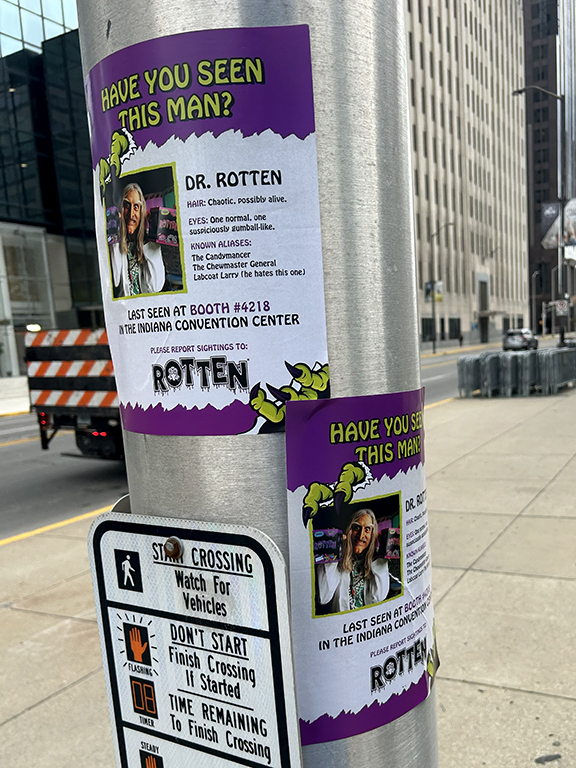
The most distinctive and highest-impact trade show advertising happens outside the hall entirely. While every exhibitor inside the convention center is competing for attendee attention with equal access to the show floor environment, the space outside the hall is largely uncontested. A brand that creates a presence in the convention center entrance plaza, in the approach corridors, or in the surrounding blocks of the convention district reaches the conference audience in an environment where competition for attention is dramatically lower than inside.
Our guerrilla marketing services for trade show environments include sidewalk stencil programs in convention center approach corridors, experiential activations in outdoor spaces adjacent to the convention center, and street team programs that intercept conference attendees at the moments when they are most accessible and receptive. These formats work precisely because they are unexpected: a conference attendee who has been navigating the saturated sensory environment of a major trade show floor is significantly more likely to engage with brand contact in the less competitive outdoor environment.
Event-Specific Campaigns: How We Adapt to Each Trade Show
Each major trade show has a distinct geography, a distinct attendee demographics, and distinct logistical considerations that require specific campaign adaptation. CES in Las Vegas operates across a sprawling multi-venue campus that requires different route coverage than Dreamforce in San Francisco’s compact convention district. SXSW in Austin operates across a city-wide footprint that requires neighborhood-level campaign strategy across multiple venue clusters. HIMSS or NRF in the Javits Center in New York City connects to the specific Manhattan west side geography that conference attendees navigate.
Our pre-campaign research for each trade show covers the specific geography of the convention center and its surrounding environment, the primary hotels where attendees concentrate, the pedestrian routes and transit connections that attendees use to move between accommodations and the venue, and the time patterns of attendee movement that determine optimal deployment windows for brand ambassador programs and OOH activations.
This event-specific research is the difference between a generic trade show marketing program and a campaign that is designed for the specific environment where it runs. The activation positions, the timing windows, and the interaction protocols that work at CES are different from what works at SXSW, which is different from what works at Dreamforce. Our field intelligence in each of these environments is built from direct experience executing campaigns at these shows, not from generic trade show marketing frameworks.
Pre-Show Advertising: Building Awareness Before Attendees Arrive
The most sophisticated trade show advertising programs begin before attendees reach the show city. Pre-show advertising targets the registered attendee list with digital advertising, direct mail, and targeted content that builds brand awareness and booth intent before the conference floor opens. When attendees who have already encountered the brand outside the show floor reach the convention center, the outdoor advertising and brand ambassador programs that greet them are reinforcing an existing awareness rather than creating a first impression.
Pre-show digital advertising using conference attendee targeting, either through the official show’s attendee marketing program or through LinkedIn and programmatic targeting of the relevant professional demographic, creates the first touchpoint in the sequence. Direct mail to registered attendees with booth location and a specific visit incentive creates a physical touchpoint that competes with less in the attendee’s pre-show preparation than a digital ad. Email outreach to registered attendees who match the brand’s target customer profile creates a direct line to the most qualified potential booth visitors before they arrive.
The combination of pre-show awareness building and on-site outdoor advertising creates a multi-touchpoint sequence that produces significantly higher booth visit conversion rates than either approach alone. An attendee who has seen the brand in pre-show digital advertising, received a direct mail piece with the booth number, seen the brand’s LED truck on the way from the hotel, and received a brand ambassador’s invitation at the convention entrance has encountered the brand five times before setting foot near the booth. That frequency converts to booth visits at rates that any single-touchpoint approach cannot match.
Documentation and Reporting for Trade Show Campaigns
Trade show advertising campaigns require the same GPS-tracked, photo-verified field documentation that we apply to all our market activations. For trade show clients who need to demonstrate campaign execution to internal stakeholders, the documentation provides verifiable proof of program performance: where the brand ambassador teams were deployed, what materials were distributed, what OOH positions were covered, and what interaction volumes were achieved across the show’s run.
For brands running trade show advertising alongside their booth investment, the field documentation allows comparison of the cost-per-contact achieved through street-level programs versus the cost-per-visitor achieved through the booth itself. This comparison consistently demonstrates that street-level programs reach significant volumes of the target professional audience at a lower cost-per-contact than booth-only trade show marketing strategies.
Frequently Asked Questions
What does a trade show advertising agency do?
A trade show advertising agency plans and executes the promotional campaigns that drive booth traffic, build brand awareness, and create competitive differentiation in and around trade show environments. This includes street-level campaigns outside the convention hall, brand ambassador programs at convention center entrances and hotel corridors, OOH advertising in the trade show city, and experiential activations that create brand presence beyond what a standard booth delivers.
What is the difference between a trade show advertising agency and a general marketing agency?
A trade show advertising agency understands the specific environment of trade shows: the concentrated professional audience, the compressed time window, the convention center geography, and the hotel and corridor environments where conference attendees spend time outside the show floor. A general marketing agency applies standard campaign frameworks to a specialized environment. The difference shows in results consistently across different shows and industries.
Does American Guerrilla Marketing offer trade show advertising services?
Yes. Our team plans and executes street-level trade show advertising campaigns at major US trade shows including CES, Dreamforce, SXSW, NRF, HIMSS, NAB, and dozens of others. We deploy brand ambassador programs at convention entrances, OOH campaigns in the surrounding city, and experiential activations that drive booth traffic and create brand presence beyond the show floor.
What trade show advertising formats produce the best results?
Brand ambassador programs at convention center entrances and in hotel lobbies near the venue produce direct face-to-face contact with conference attendees in the moments before they enter the show floor. Street-level OOH along the routes attendees travel between hotels and the convention center builds awareness through visual repetition. Experiential activations near the convention center create memorable brand moments that differentiate from the standard booth experience.
How far in advance should trade show advertising be planned?
Trade show advertising campaigns should be planned eight to twelve weeks before the show for major events like CES, Dreamforce, and SXSW. The concentrated demand for advertising, staffing, and activation space around major trade shows compresses availability rapidly as show dates approach. Brands that begin planning earlier secure better placement positions, more experienced field staff, and more favorable logistics.
What is the most common mistake brands make with trade show advertising?
The most common mistake is concentrating all trade show marketing investment inside the booth and the show floor. The average trade show attendee spends a fraction of their conference time on the show floor. The rest is in hotel rooms, hotel lobbies, conference session rooms, restaurants, and the pedestrian corridors between the hotel and the convention center. A brand that only markets inside the booth is invisible to the attendee during the majority of their conference time.
Can trade show advertising be integrated with digital lead generation?
Yes. Street-level trade show advertising integrates with digital lead generation through QR codes on OOH materials that drive to landing pages, brand ambassador programs that collect contact information with attendee permission, and event-specific social media campaigns that amplify street-level activation content to the broader conference community following the show on social media.