Street Branding: What It Is and How to Use It | AGM
Street branding is how brands claim physical territory in the urban environment. Done right, it creates cultural authority that no digital campaign can replicate. Here is what it actually involves.
Street branding is the practice of building brand identity through physical presence in the urban environment, through murals, outdoor graphics, ambient installations, experiential activations, and the accumulated presence that comes from a brand showing up consistently in the spaces where its target audience spends time. It is less of a single tactic and more of a strategic approach to brand building that treats the city itself as a medium.
The difference between a single street campaign and a real street branding strategy is cumulative presence. One poster placement creates an impression. A brand that consistently shows up across multiple formats, multiple neighborhoods, and multiple points in the consumer process builds something qualitatively different: cultural familiarity, neighborhood-level authority, and the sense that this brand actually belongs in the consumer’s world rather than interrupting it from the outside.
We are American Guerrilla Marketing. We have built street branding programs for brands in New York, Los Angeles, Chicago, Miami, and other markets that go beyond individual campaign placements and create a sustained identity in the physical urban environment. This piece is our complete guide to street branding: what it means in practice, the formats it uses, the neighborhoods where it is most powerful, and how to build a street branding strategy that actually compounds over time.
Street branding is more than outdoor advertising. Outdoor advertising treats the street as an inventory of surfaces to place messages on. Street branding treats the street as a community, a place with its own culture, visual language, and social dynamics, and asks how a brand can participate authentically in that community rather than simply renting space within it.
This distinction has real consequences for how campaigns are designed and executed. A brand running outdoor advertising buys placements based on impression counts. A brand running street branding chooses locations based on cultural fit, selects visual formats that align with the existing visual culture of specific neighborhoods, and builds campaigns over time that create cumulative familiarity rather than single-moment exposures.
The authenticity question is central to street branding in a way that it is not for conventional outdoor advertising. Urban consumers, particularly younger consumers in the neighborhoods where street culture is most active, are highly sensitive to brands that feel like they belong in their environment versus brands that feel like they are renting space they have not earned. A brand that shows up on a wall in Wynwood with a design that feels at home in the visual culture of that neighborhood creates a different response than a brand that puts a generic corporate graphic on the same wall. The difference is authenticity, and it is the core of street branding as a strategic practice.
The Core Formats of Street Branding
Brand Murals as the Anchor of Street Identity
Brand murals are the most powerful single format for building street brand identity. A well-executed mural in the right neighborhood becomes a fixed point of visual identity in the local environment, something residents and visitors alike associate with the block, the neighborhood, and the culture of that place. That association transfers to the brand.
The best brand murals in terms of cultural impact are not billboards painted on walls. They are genuine artistic expressions that happen to carry a brand identity. The artist matters. The visual language matters. The relationship between the mural and the neighborhood’s existing visual culture matters. When we design brand murals, we start with an understanding of the specific neighborhood’s visual history and work forward from there, rather than starting with the brand brief and trying to force it onto a wall.
Brand murals in the most active mural neighborhoods, Wynwood in Miami, the Arts District in LA, Wicker Park in Chicago, the Lower East Side in New York, the Mission in San Francisco, become social media content machines. Local residents document the mural when it is installed and continue to use it as a backdrop for photos over months or years. Visitors discover it and share it. The mural generates earned social content over its entire lifespan, creating a compound return on the initial production investment.
Large-Format Outdoor Graphics for Sustained Presence
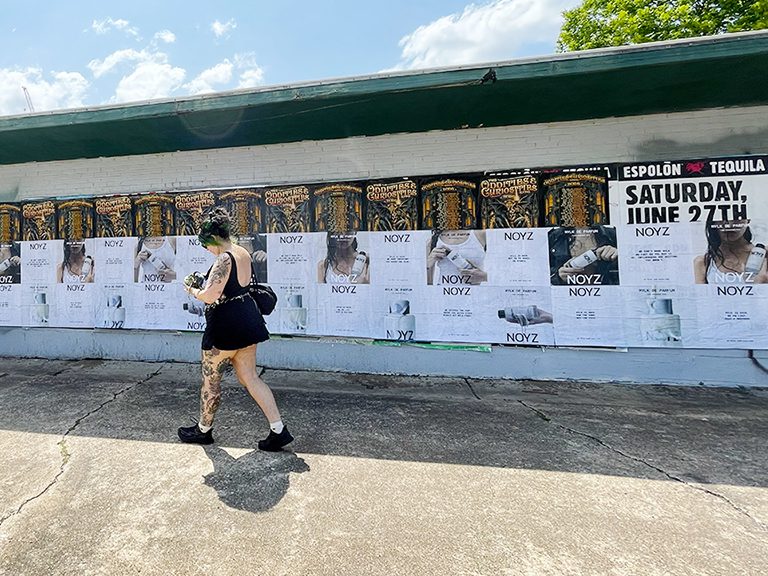
Large-format outdoor graphics on building walls, construction barriers, scaffolding wraps, and other prominent surfaces are the volume driver of a street branding program. Where murals are singular and permanent, large-format graphics are replaceable and updatable. They allow a brand to maintain consistent visual presence across multiple locations while rotating creative to stay fresh or to reflect seasonal campaigns, product launches, or cultural moments.
A street branding program might use murals as permanent anchors in the most culturally significant neighborhoods and large-format graphic placements to extend the brand’s visual footprint across a wider area. The murals provide cultural depth and earned media; the graphics provide breadth of coverage and campaign flexibility. The two formats work together to create a visual presence that is at the same time grounded and widespread.
Ambient Environmental Branding
Ambient branding uses elements of the everyday urban environment, street furniture, transit infrastructure, outdoor seating, utility surfaces, as vehicles for brand presence. A branded bicycle rack. A bus shelter interior transformed into a brand environment. A street-level graphic that integrates with the architecture of a specific intersection. Ambient branding works because it appears as part of the environment rather than an addition to it, which means the consumer encounters it as part of their normal urban experience rather than as an advertising placement.
The most successful ambient branding programs choose surfaces and locations with the same care that traditional media planners choose media channels. The surface itself, its placement, its daily audience, its relationship to the surrounding environment, is part of the brand statement. A brand that shows up on the bicycle racks outside a farmers market is making a different statement than a brand that shows up on the same bicycle racks in a financial district. Both could be right; the choice depends on what the brand is trying to say about itself and to whom.
Street Team Presence as a Brand Signal
Street teams are more than activation tools, in the context of street branding, they are a signal of brand presence in a neighborhood. A brand whose representatives appear regularly in a specific neighborhood, wearing brand colors, carrying brand materials, engaging with residents and visitors, creates a sense of active local engagement that passive visual placements cannot replicate. The brand is more than on the walls; it is on the street, with people.
For brands building a sustained street presence in a specific city, regular street team appearances in key neighborhoods function as a cadenced reminder that the brand is here, engaged, and present in the community. This is particularly effective for brands targeting communities where personal presence and direct engagement carry strong cultural weight, streetwear brands, music-adjacent brands, and lifestyle brands that position themselves as community participants rather than external advertisers.
Street Branding by City and Neighborhood Type
Neighborhood Type
Street Branding Formats That Work Best
Brand Categories That Fit
Key Locations
Arts district / mural neighborhood
Murals, large-format graphics
Creative, lifestyle, music, youth culture
Wynwood Miami, Arts District LA, Wicker Park Chicago
Streetwear / sneaker corridor
Murals, ambient graphics, sampling
Footwear, apparel, music, sports
Fairfax LA, Orchard St NYC, Milwaukee Ave Chicago
Young professional / financial district
Large-format graphics, sampling, street teams
Finance, tech, premium CPG
Brickell Miami, West Loop Chicago, SoMa SF
Tourist / high foot traffic pedestrian zone
Street teams, sampling, experiential
Consumer goods, entertainment, tourism
South Beach Miami, Times Square NYC, Magnificent Mile Chicago
Residential / community neighborhood
Murals, ambient, community partnerships
Local/regional brands, community-focused national brands
Jackson Heights NYC, Pilsen Chicago, Little Havana Miami
Street branding is long-term thinking: The most powerful street branding programs operate over months and years, not a single campaign cycle. Brands that commit to consistent presence in specific neighborhoods over extended periods build something that cannot be replicated by a one-time campaign: genuine cultural familiarity. When residents of a neighborhood have seen a brand’s visual identity on walls and in the streets across multiple seasons, that brand becomes part of their visual environment. That is the deepest form of brand awareness available.
Building a Street Branding Strategy
A real street branding strategy starts with a few fundamental questions.
First: which neighborhoods do we actually want to claim? Not the neighborhoods with the highest general foot traffic, but the neighborhoods where our target consumer lives, shops, and spends their social time. Street branding creates cultural association, and the association is shaped by the neighborhoods where the brand shows up. A brand that brands itself heavily in the streetwear districts of major cities is making a different statement than one that brands in the financial districts. Choose deliberately.
Second: what visual language will feel at home in those neighborhoods? This question requires understanding the existing visual culture of each target neighborhood and thinking about how the brand’s visual identity can engage with that culture authentically. This does not mean imitating the local visual style, it means understanding what visual quality and creative approach the neighborhood’s residents respond to, and ensuring the brand’s street presence operates at that level of craft and authenticity.
Third: what formats will we use and how will we rotate them? Murals provide permanence and cultural depth. Large-format graphics provide flexibility and coverage breadth. Street teams provide active presence and direct engagement. Ambient installations provide environmental integration. A strong street branding program uses a mix of these formats strategically, rotating campaigns while maintaining consistent visual identity across formats.
Fourth: what is the timeline? Street branding is a sustained investment. We recommend thinking in six-month to year-long cycles rather than single campaign windows. The cumulative effect of sustained presence is what creates genuine street brand authority.
What we tell new clients: Street branding is one of the most efficient long-term brand building strategies available for brands targeting urban consumers. It is less efficient as a short-term campaign tool. If you need immediate sales lift from a single campaign, there are better formats. If you want to build genuine brand authority in specific urban communities over time, street branding is where the return compounding happens.
How Street Branding Creates Neighborhood Authority
Neighborhood authority is what separates a brand that is known from a brand that belongs. In the neighborhoods where our target consumers live and spend their social time, authority comes from consistent presence over time, from being on the walls for multiple seasons, from showing up at local events, from the brand becoming part of the visual language that residents associate with their block and their community.
This is not something that a single campaign purchase can buy. It is built through repeated, quality touchpoints over extended time periods. The brand that has maintained a mural on a wall in Wicker Park for two years and rotated creative three times occupies a different cultural position in that neighborhood than the brand that placed one poster there for a month and moved on. Long-term commitment is legible to community members, and it is rewarded with a depth of brand association that short-term campaigns cannot produce.
Street Branding Versus Digital Branding
Street branding and digital branding are not in competition, they are complementary strategies that work best in combination. Digital branding reaches consumers on their devices, in the media environments they inhabit online. Street branding reaches them in the physical environments where they live, work, and socialize. The physical encounter creates a different kind of brand memory than the digital encounter because it is anchored in place and in the consumer’s actual physical experience of their neighborhood.
The alignment between street branding and digital branding is also direct: street installations generate social media content that extends the physical campaign’s reach into digital channels without additional media cost. A brand mural that gets photographed and shared a thousand times in a week is doing the work of a paid digital campaign on top of its physical presence. That amplification is a core reason why street branding is efficient relative to its cost.
Visual Design Principles for Effective Street Branding
Street branding has its own visual design logic that is distinct from the principles of print, digital, or broadcast design. Understanding these principles matters because the mistakes brands most commonly make in street branding are design mistakes, not strategy mistakes.
The first principle is scale. Everything in street branding should be designed at the scale at which it will actually be seen. A mural that is thirty feet wide needs to be designed at thirty-feet-wide viewing distance. That means significantly simpler compositions than a print piece, much larger type, fewer elements, and higher contrast between key visual components. Designs transferred directly from print or digital without adaptation for scale almost always fail in the physical environment. They look busy, illegible, or underpowered at the size they actually need to read.
The second principle is context. Every surface a street branding element occupies exists within a surrounding visual environment. A design that looks powerful in isolation on a white presentation background may disappear into a crowded visual environment on the actual wall where it will be installed. We scout every installation location before finalizing design specs, specifically to understand what colors, values, and visual elements will make the brand design pop against the surrounding context rather than blend into it.
The third principle is contrast and readability at speed. Pedestrians encounter street branding while moving. The design must communicate its essential message, typically: brand name or mark, and one supporting visual element or message, within the two to three seconds of a walking encounter. High contrast between foreground and background, a single dominant visual hierarchy, and a clear brand identifier at a size readable from fifteen feet are the baseline requirements for street-level readability.
The fourth principle is durability. Materials and finishes for street branding need to perform in outdoor conditions. A mural that fades in six months reflects badly on the brand it carries. Large-format graphics need UV-resistant inks, appropriate material weights for the wind and weather exposure of the specific location, and installation techniques that hold up over the planned campaign duration. We specify materials for each installation based on the specific environmental conditions of the location, not on a generic standard specification.
How Sustained Street Branding Campaigns Compound Over Time
One of the most underappreciated dynamics of street branding is the compound effect of sustained presence. A single campaign creates a moment. A sustained presence over months and years creates something qualitatively different: genuine cultural familiarity.
The mechanism is simple. A person who walks past a brand presence in their neighborhood once may notice it and forget it. A person who walks past that same presence every day for three weeks has encountered the brand enough times that it occupies a real position in their mental environment. A person who has lived with a brand’s presence in their neighborhood for six months experiences that brand as a genuine part of their local environment, something that is there, that has always been there, that belongs.
This familiarity is not the same as affinity, but it is the precondition for affinity. People prefer what they know. Brands that have built genuine physical familiarity in a neighborhood have a different relationship with residents than brands that appear on a digital ad and disappear. The street presence creates a baseline of recognition that makes every other marketing touchpoint, the digital ad, the retail encounter, the social media post, land with more weight.
The compounding dynamic also applies to earned social media content. A brand mural installed in a neighborhood generates a burst of social documentation at installation. But it keeps generating documentation over its entire lifespan, from the daily flow of people who use it as a backdrop, from visitors who discover it, from local accounts who feature it in neighborhood content. The monthly earned media value of a well-placed brand mural does not decline steeply after installation the way a digital ad’s performance typically does. It stabilizes at a steady rate that continues as long as the mural stands.
AGM Field Note: We have brand mural installations that have been generating consistent social media documentation for two and three years after installation. The initial production cost is long since recovered, and the mural is still producing earned exposures every week. That compounding dynamic is unique to the physical medium. No digital ad placement delivers compound returns on the original production investment over a multi-year horizon.
Street Branding Across Seasons and Campaign Cycles
A street branding program is not a single campaign, it is a system of campaigns that rotate and evolve over time. Managing that rotation well is the operational discipline that separates a high-performing long-term program from a series of one-off campaigns that happen to share a brand identity.
We advise clients to plan their street branding calendar in three-month blocks, with major refreshes at the beginning of each block and smaller additions and rotations within the block. This structure gives the program both consistency, the brand’s visual identity is present and recognizable year-round, and freshness, there is always something new for regular neighborhood residents to encounter and document.
Seasonal programming within the annual calendar takes advantage of the way foot traffic shifts with weather and cultural events. Summer is the season for maximum outdoor activation in northern markets. Fall brings back-to-school and fashion season energy in most major cities. Winter programming concentrates on the specific consumer moments that drive the heaviest foot traffic in cold-weather months, holiday retail, indoor event footprints, transit environments. Spring programs often benefit from the pent-up desire for outdoor activity that follows winter in northern markets.
Event programming layers onto the seasonal base by identifying the specific events in each market that concentrate the target audience and planning brand activations around those event windows. A brand that is consistently present in the visual environment of the neighborhoods its target audience calls home, and then concentrates additional activation energy around the specific moments when that audience is most concentrated and most engaged, builds presence and relevance simultaneously.
Frequently Asked Questions: Street Branding
How do you ensure brand consistency across a multi-neighborhood street branding program?
Brand consistency across a street branding program is maintained through a combination of visual standards documentation, centralized design oversight, and field quality control on every installation. We develop brand standards for the street context, which may differ from the brand’s existing identity standards in their adaptation to physical formats, and apply those standards consistently across all placements. Every installation is documented with GPS-stamped photography before client sign-off, and we correct any execution quality issues before the installation is considered complete.
Frequently Asked Questions
What is street branding?
Street branding is the strategic practice of building brand identity through sustained physical presence in urban environments. It goes beyond single campaign placements to create cumulative brand familiarity in specific neighborhoods through murals, outdoor graphics, ambient installations, and street team presence. The goal is for a brand to feel like it belongs in the visual environment of specific communities, not like it is interrupting that environment from the outside.
How is street branding different from a regular outdoor advertising campaign?
Outdoor advertising treats the street as an inventory of surfaces to place messages on, evaluated primarily by impression count. Street branding treats the street as a community with its own culture, visual language, and social dynamics, and asks how a brand can participate authentically in that community. Street branding involves more careful neighborhood selection, more attention to visual authenticity and cultural fit, and a longer time horizon than a single campaign.
What types of brands benefit most from street branding programs?
Brands targeting urban consumers who are culturally engaged, socially active, and resistant to conventional advertising benefit most. This includes streetwear and fashion brands, music and entertainment brands, food and beverage brands with strong lifestyle positioning, technology brands targeting young professionals, and any brand that wants to establish authentic credibility in specific urban communities. Large brands also use street branding to create the organic-feeling cultural presence that their scale otherwise makes difficult.
How long should a street branding program run?
The most effective street branding programs run for six to twelve months minimum, with some brands maintaining continuous street presence in key markets over multiple years. The compound effect of sustained presence, residents encountering the brand across multiple seasons, through evolving creative, in multiple formats, is what creates genuine neighborhood-level brand authority. We help clients design programs with appropriate rotation and refresh cycles to keep the presence dynamic without sacrificing continuity.
What cities are best for street branding programs?
Cities with strong urban pedestrian culture, active neighborhood identities, and high social media activity among residents are the most productive environments for street branding. New York, Los Angeles, Chicago, Miami, San Francisco, Portland, Austin, and Nashville are among the strongest US markets. The specific neighborhoods within each city matter as much as the city overall. We help clients select the right markets and the right neighborhoods based on their target audience profile.
Can street branding work for brands without a strong visual identity?
Street branding can actually help develop a brand’s visual identity in ways that conventional media cannot. The process of designing for the physical environment, asking what visual language fits this neighborhood, what scale and color and texture work on a wall, forces a specificity and craft in visual expression that can sharpen and strengthen a brand’s overall identity. We have worked with brands whose street branding program became a defining moment in their broader visual identity development.
What budget does a street branding program require?
A meaningful street branding program in one city with a mix of murals and rotating large-format graphics is priced based on scope, volume, and market. Programs that also include regular street team activations or ambient environmental elements are scoped accordingly. We build annual programs with specific deliverables and costs mapped against the campaign calendar.