Street Advertisers: Who They Are and What They Do | AGM
Street advertisers are the agencies, teams, and operators who bring brands into the physical environment of the city. Here is what real street advertising practice looks like from the inside.
Street advertisers are the practitioners, agencies, and field operators who execute brand marketing in the physical urban environment, the people and companies responsible for putting brand presence on walls, on sidewalks, in the hands of consumers, and in the neighborhoods where target audiences actually live and move. It is a field with a low barrier to entry and a high barrier to doing it well, which means the quality difference between operators in this space is enormous.
The term covers a wide range of practice. At one end, street advertising includes large outdoor advertising companies that own physical inventory, building walls, construction barriers, transit shelter posters, and sell access to brands that want placements in those locations. At the other end, it includes guerrilla marketing agencies and experiential marketing companies that design and execute custom street campaigns without relying on pre-owned inventory, finding and securing locations individually for each campaign.
We are American Guerrilla Marketing. We are street advertisers in the second, more operationally intensive category. We do not own a fixed inventory of surfaces that we sell to clients. We build each campaign around the specific audience, market, and objectives of the brief, then source and secure the locations that best serve those objectives. This piece is our account of what street advertising involves, how quality operators distinguish themselves from lower-quality alternatives, and what clients should expect and demand from a professional street advertising engagement.
Street advertising involves a specific set of operational capabilities that are distinct from conventional media buying or creative advertising. Here is what that work actually includes at a high level.
Location Sourcing and Scouting
Finding the right location for a street advertising campaign requires market knowledge that is earned through direct experience, not purchased from a data provider. The best walls, the surfaces with the highest foot traffic, the right visual sight lines, the right cultural context, and the right surrounding environment, are rarely the ones listed in any standardized inventory. They are known to operators who have spent years walking the streets of specific cities and building relationships with property owners and building managers in the neighborhoods where they work most frequently.
We scout locations in person for every campaign. A field lead walks the proposed area, photographs actual site conditions, counts foot traffic at different times of day, and documents the surrounding visual context that will affect how the installation reads to passersby. The data analysis tells us which blocks to prioritize; the field scout tells us which specific surfaces within those blocks are right for this specific campaign.
Production and Installation
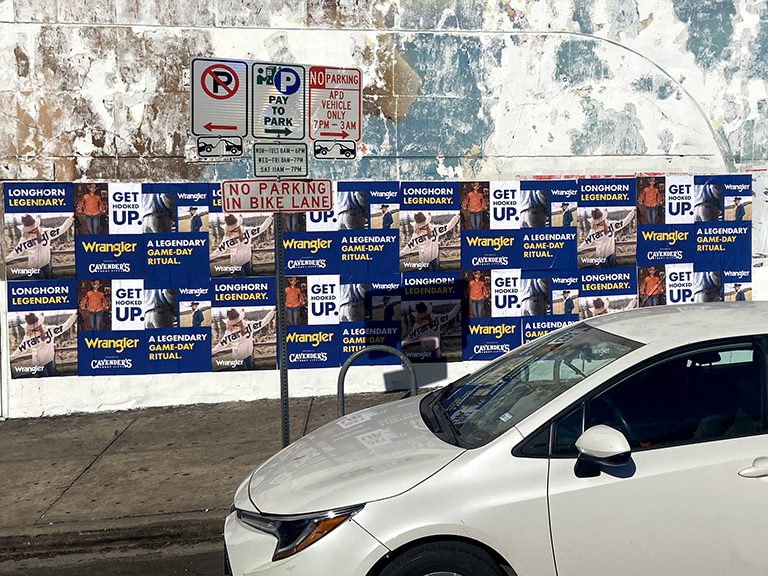
Street advertising production involves creating the physical materials that will be placed in the urban environment, posters, vinyl graphics, painted murals, printed banners, or other formats, and installing them at the selected locations. Each format has specific production requirements, and each location type has specific installation requirements. A building wall installation requires different materials and techniques than a construction barrier wrap. A painted mural requires different skills and timeline than a printed poster.
Quality production matters for street advertising because the physical material is what the consumer actually encounters. A poorly produced poster that fades, tears, or looks cheap in its environment reflects on the brand it carries. We quality-check all materials before installation and inspect every installation after completion before submitting it to the client as complete.
Field Team Management
Street advertising campaigns that involve any staffed component, street teams, sampling programs, brand ambassador activations, require field team management. This means recruiting, briefing, deploying, supervising, and evaluating the people who represent the brand in the physical environment. The quality of a street team is determined by the quality of the briefing and selection process that precedes the activation, and by the supervision and accountability structures that operate during it.
A field team , not an asset. Brand ambassadors who do not fully understand the product they are representing, who cannot answer the questions consumers will ask, and who have not been coached on the brand voice and interaction style they are expected to maintain will create brand experiences that range from unmemorable to actively damaging. We invest more time in pre-activation briefing than most operators, because we have learned that time spent in preparation is recovered many times over in field performance.
Documentation and Reporting
Professional street advertisers document everything. Every installation gets GPS-stamped photography at multiple angles on the day of installation. Every staffed activation gets time-coded field reports and daily interaction counts. The documentation serves three functions: it gives the client verification that the campaign ran as specified, it provides the evidence base for post-campaign reporting and optimization, and it creates a visual archive that can be used in internal decision-maker communications and future campaign planning.
We provide documentation to clients in real time throughout the campaign and deliver a full post-campaign report within five business days of campaign completion. The report includes all documentation, metric analysis, field observations, and our honest assessment of what worked and what we would approach differently on a future campaign.
Higher planning intensity; longer lead time than standard OOH
Sampling / street team companies
Specialize in staffed consumer activation; handle logistics and staffing
Product sampling, direct consumer engagement, event activations
Limited visual/ambient presence; focused on human interaction only
Mural / art-focused agencies
Specialize in large-scale painted murals and visual installations
Brand mural programs, cultural credibility, social content generation
Limited to visual/ambient formats; no staffed activation capability
What to look for: The most capable street advertisers are the ones who can execute across multiple formats, outdoor graphics, murals, street teams, sampling, and experiential, and who have genuine field experience in the specific markets where you need to run. An agency with deep New York expertise that sources local contractors in LA for your national launch is not a multi-market street advertiser. It is a New York agency with a logistics problem.
How to Evaluate a Street Advertising Partner
The quality differences among street advertising operators are substantial. Here is how to distinguish genuinely capable operators from those who are better at selling than delivering.
Start by asking for specific case studies with verifiable details. Good case studies name the actual campaign: the brand (or category if NDA-restricted), the specific neighborhood or street where the activation ran, the format used, the duration, and any measurable outcomes. Vague references to “campaigns in New York” or “major brand activations” without specifics are a signal that the case studies are either confidential for embarrassing reasons or are being exaggerated.
Ask specifically about their field team structure. Do they have standing relationships with brand ambassadors and field supervisors in the markets they claim to operate in? Or do they source local contractors through staffing agencies when a campaign comes in? The latter is not necessarily disqualifying, but it means the agency has less quality control over the consumer-facing side of the activation, which is exactly the side that determines whether the campaign succeeds or fails.
Ask to see actual documentation from past campaigns. The GPS-stamped installation photos, the daily field reports, the post-campaign reports. These documents exist for every campaign that a professional street advertising operator has run. An operator who cannot produce them, or who produces thin and poorly documented examples, is showing you what your campaign documentation will look like.
Finally, ask about market knowledge. A street advertising partner for Los Angeles should know the difference between activating on Abbot Kinney versus on the Third Street Promenade. One for New York should know the difference between Williamsburg on a Saturday afternoon versus a weekday lunch hour. One for Chicago should understand why the Wicker Park activation at the Milwaukee/North/Damen triangle is different from an activation on the Magnificent Mile. Specific market knowledge separates operators who have actually worked in a city from operators who have simply listed it in their capabilities document.
The Skills That Make Great Street Advertisers
Not everyone who claims to do street advertising is good at it. The skills that separate genuinely capable street advertising practitioners from operators who are just placing materials in public spaces include the following.
Market knowledge is the most foundational skill. Knowing which block on a given street generates the highest foot traffic at which time of day, knowing which property owners are open to brand installations and which are not, knowing the visual culture and audience profile of each major neighborhood in a given city, this knowledge is not googleable. It is built through years of direct field experience and continuous attention to the physical environment of the cities where you work. An operator without deep market knowledge in a specific city is guessing, and guessing wrong costs clients time, money, and often the campaign.
Creative judgment is the second critical skill. Street advertising is more than logistics. The visual execution of a street campaign, the design, the color, the typographic weight, the size relative to the wall, the relationship of the brand elements to the surrounding environment, determines whether the placement generates genuine attention or blends into the background noise of the urban visual environment. Good street advertisers have strong creative judgment about what works in the physical environment, which is distinct from what works on a screen or in a print publication.
Logistics management is the third skill, and arguably the one where the most campaigns fall apart. Getting the right materials to the right location at the right time, with the right crew, with appropriate weather contingency, with documentation in place, and with communication flowing properly between the field team and the client, this is genuinely complex operational work. The operators who make it look easy are the ones who have built airtight process around every step in the logistics chain.
Relationship management is the fourth skill. Street advertising depends on relationships: with property owners who control the best walls, with city officials who manage outdoor advertising regulations, with local business communities in neighborhoods where campaigns are active, with production vendors who can turn materials quickly when needed, and with the field staff who execute campaigns on the ground. These relationships are built over time and maintained through fair dealing and consistent quality. They are one of the most important assets a street advertising operator has, and they are the least visible from the outside.
Street Advertisers in the Digital Age
The rise of digital advertising has not diminished street advertising, it has amplified it. The key reason is that physical brand moments in urban environments generate social media content that extends the campaign’s reach far beyond the physical footprint. A striking brand mural in a photography-heavy neighborhood generates Instagram and TikTok content organically, without paid media, for as long as the mural exists. A street team activation that creates genuinely memorable consumer interactions gets documented and shared. The physical moment creates the digital content, and the digital content creates reach that no physical campaign alone could generate.
The most sophisticated street advertisers today design their physical campaigns with the digital amplification layer in mind from the beginning. They ask: where is the visual anchor that makes this installation worth photographing? What moment in this sampling activation is the one that a consumer will want to document and share? How do we design the physical experience to maximize the quality of the content it generates organically? These questions do not change the fundamental work of street advertising, but they shape how that work is designed and executed to maximize total campaign impact.
The compound effect: A well-designed street advertising campaign that generates strong social content effectively runs two simultaneous campaigns: the physical campaign that reaches everyone who walks past it, and the social campaign that reaches everyone who sees the content those people share. The physical-to-digital amplification multiplier varies by format and neighborhood, but for the most visually compelling installations in the most social-media-active neighborhoods, it can be substantial. This is one reason why the cost-per-impression calculation for street advertising consistently surprises clients who come from pure digital backgrounds.
How Professional Street Advertisers Approach Multi-Brand Programs
Some of our clients are not brands running a single campaign but agencies running campaigns on behalf of multiple brands simultaneously, or brand portfolios running multiple campaigns in the same markets at the same time. Multi-brand programs have specific operational requirements that are different from single-brand campaigns, and handling them well requires a level of internal organization that not all street advertising operators have.
The primary challenge in multi-brand programs is creative and competitive separation. A street advertiser running campaigns for two competing brands in the same market at the same time needs strict information barriers between the campaign teams and documentation systems for each client. We manage this through dedicated account teams with no overlap in personnel between competing brand campaigns. The creative materials, field staff briefings, and documentation for each brand are entirely separate from the first day of engagement through the final report.
Multi-brand programs also create efficiency opportunities that single-brand campaigns do not. When we are running campaigns in the same city for multiple brands in non-competing categories, we can share fixed overhead costs, field supervisor travel, equipment, and location scouting resources, in ways that reduce the per-campaign overhead for each brand without compromising campaign separation. We are transparent with clients about these efficiencies and pass the cost benefits through to them.
For agencies running campaigns on behalf of multiple clients, we function as a white-label field execution partner, executing the agency’s brief under their brand rather than ours. The field crews represent the agency’s brand standards. The documentation goes to the agency in whatever format they need to deliver to their client. We do the field work; the agency maintains the client relationship. This model works well when the agency has strong creative and strategic capabilities but limited field execution infrastructure.
What a Professional Street Advertising Brief Looks Like
Every campaign we execute starts with a written brief. The quality of the brief determines the quality of the campaign. Here is what a professional street advertising brief covers.
Brand and campaign background: what the brand is, what the campaign is trying to achieve, what the creative direction is (or what creative assets are available), and any brand standards that affect how the campaign can look and feel in the physical environment. This section gives the field team the context they need to make good judgment calls when situations in the field are not covered by the brief explicitly.
Target audience in behavioral and geographic terms: who the campaign is trying to reach, where that audience is in the specific markets where the campaign will run, and when they are most concentrated and most receptive. Not just a demographic description, but a physical map of where this audience actually is and when.
Format and scope: which specific street advertising formats are being used, the volume of each, and the geographic footprint, how many markets, which specific neighborhoods, and how many activation days or placement locations. The scope section sets the operational parameters that everything else is planned around.
Timeline: campaign start date, end date, any key dates within the campaign (product launch date, event date, review checkpoint), and any production milestones that need to hit specific dates. The timeline creates the planning structure that keeps production, staffing, and logistics aligned.
Success metrics: how we will know if the campaign worked, in terms that can actually be measured. Interaction targets for staffed campaigns, impression estimates for visual campaigns, social media content targets, downstream digital metrics, whatever the campaign is designed to move.
AGM Field Note: A brief that covers all of these elements allows us to provide a proposal within two to three business days that is specific, accurate, and genuinely responsive to the campaign’s actual requirements. A brief that is missing key elements, especially the audience description, the geographic scope, and the budget, produces proposals that are either too vague to act on or too far off-scope to be useful. The better the brief, the better the proposal, and the better the campaign.
What Separates Good Street Advertising Results From Average Ones
We have run campaigns in the same formats and roughly the same locations that produced dramatically different results. Here is what we have observed about what separates the top-performing campaigns from the average ones.
Top-performing street advertising campaigns have a tight brief. The campaign knows exactly who it is trying to reach, exactly where those people are, and exactly what it wants them to feel or do. When the campaign knows what it is for, every subsequent decision, location, creative, staffing, timing, can be optimized against that specific objective. When the brief is vague, every decision becomes a guess.
Top-performing campaigns have creative that was designed for the physical environment, not adapted from another format. A design that was created for digital and then printed large usually reads like what it is. Creative that was designed from the ground up for the specific scale, lighting, and viewing distance of the actual installation reads as intentional and confident. The design for a forty-foot building wall should be developed at forty-foot scale from the first sketch.
Top-performing campaigns have field teams that are genuinely invested in the brand they represent. This is a function of briefing quality and team selection. Brand ambassadors who understand the product, believe in it, and feel equipped to represent it create qualitatively different consumer interactions than ambassadors who received a thirty-minute orientation and a t-shirt. We invest heavily in pre-activation preparation because the quality of the human interaction is the quality of the campaign.
Frequently Asked Questions: Street Advertisers
What should a street advertising campaign cost?
Single-market campaigns are priced based on the formats selected and campaign scope. Street team activations start at $389.99 per 6-hour shift. Poster campaigns start at $4,500 for 100 standard posters. Multi-city and multi-format campaigns scale based on format mix and scope. We provide complete line-item budgets before any engagement begins.
Frequently Asked Questions
What is a street advertiser?
A street advertiser is a company, agency, or operator that executes brand marketing in the physical urban environment. This includes agencies that place outdoor graphic campaigns on walls and barriers, companies that run street team and sampling activations, specialists in brand murals, and guerrilla marketing agencies that execute across all these formats. The category includes large out-of-home advertising companies with fixed inventory and independent guerrilla agencies that custom-source locations for individual campaigns.
How do street advertisers find locations for campaigns?
Location-finding methods vary by operator type. Large OOH companies work from fixed inventory they own or lease under standing agreements. Guerrilla and experiential agencies typically combine market knowledge built from direct field experience with property owner relationships developed over time in specific neighborhoods. The best locations for a specific campaign are almost never the ones on a standardized rate card, they are the ones that fit the specific audience, creative format, and campaign objectives, and finding them requires the kind of market knowledge that only comes from years of working in the streets of specific cities.
What cities do you operate as a street advertiser?
We operate primarily in New York, Los Angeles, Chicago, Miami, San Francisco, Boston, Washington DC, and Las Vegas. We also have running field relationships in Atlanta, Houston, Seattle, Denver, Austin, and Nashville. New York is our home market with the deepest infrastructure and location relationships. For all other markets, we have built standing field partnerships over years of operating in those cities.
How long does a street advertising campaign take to plan and execute?
Timeline depends on format. Street team campaigns with existing creative materials can be launched in two to three weeks. Poster and outdoor graphic campaigns need three to five weeks for location scouting, material production, and installation logistics. Brand mural campaigns need six to ten weeks from brief to completion. Multi-format campaigns that combine several of these elements need the timeline of the longest element, typically six to eight weeks minimum. We tell clients the accurate timeline at the start so there are no surprises mid-campaign.
Can a street advertiser run a national campaign across multiple cities?
Yes, and this is one of our core competencies. Multi-city campaigns require a single campaign lead who maintains brand consistency and quality control across all markets at the same time. We have run concurrent campaigns in up to ten markets with unified creative, consistent execution standards, and single-point client reporting. The operational complexity is significant, but the campaign management infrastructure we have built over years of multi-market work makes it manageable at a professional level.
What types of brands work best with street advertisers?
Brands targeting urban consumers, particularly younger, more culturally engaged demographics, benefit most from street advertising. Consumer packaged goods, technology, fashion and apparel, music and entertainment, food and beverage, automotive, and financial services brands targeting urban professional audiences all use street advertising regularly. The category is less relevant for brands targeting primarily rural or suburban consumers, for whom different outdoor formats are typically more appropriate.
How do you ensure that a street advertising campaign meets brand safety standards?
Brand safety in street advertising is maintained through thorough pre-production review, clear brand standards documentation shared with every field team member, and real-time field supervision during activations. Before any installation or activation, we review the specific locations for surrounding context, what else is on the block, what is adjacent to the placement, are there any surrounding elements that could create problematic visual associations. We bring any potential concerns to the client before proceeding, not after the installation is up.