Street Level Advertising: Formats, Locations, and What Works | AGM
Street level advertising reaches consumers where they actually are, on the sidewalk, at the crosswalk, outside the subway entrance. Here is what the format actually involves and how to make it work.
Street level advertising is exactly what it sounds like: brand marketing that reaches consumers directly at ground level, in the physical environments they move through as part of their daily lives. This is not a billboard fifty feet above a highway. It is a brand presence that exists at eye level, in the pedestrian spaces, on the surfaces and in the corridors that people actually walk through, stop at, and spend time in every day.
This distinction matters enormously because the consumer experience of street level advertising is fundamentally different from elevated out-of-home placements. When a person encounters a brand at eye level, while they are on foot, moving at walking pace or slower, they have the time and proximity to actually process the message. They can read more than a headline. They can see visual detail. And if the format involves a person, a brand ambassador, a sampling team, a field crew, they can have a genuine human interaction with the brand.
We are American Guerrilla Marketing. Street level advertising is our primary operating territory. We have run campaigns at the base of buildings on the corner of 14th Street and Union Square West in Manhattan, along the sidewalks of Abbot Kinney Boulevard in Venice, California, in the pedestrian corridors around Millennium Park in Chicago, and in dozens of other urban environments where consumers move at human pace through branded space. This piece covers the full environment of what street level advertising involves: the formats, the best locations, the cost structures, and what to expect from the planning and execution process.
Street level advertising encompasses a wide range of formats. Understanding the full environment helps brands select the approach that fits their specific campaign objectives and budget.
Large-Format Outdoor Posters and Graphics
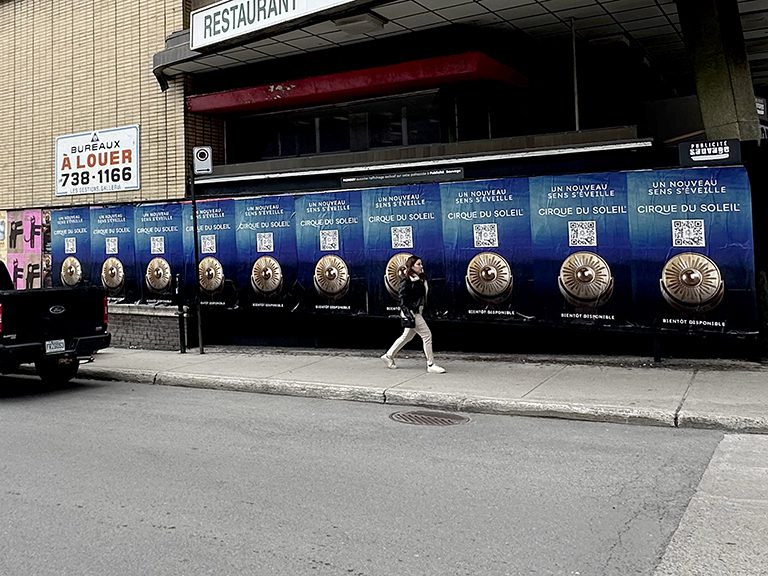
Large outdoor poster placements on building walls, construction barriers, scaffolding wraps, and other high-visibility surfaces at pedestrian level are one of the most durable and cost-effective street level formats. A well-placed poster on a high-traffic block creates thousands of exposures per day over the duration of the campaign with no ongoing staffing cost. The creative needs to work at a glance because the average pedestrian encounter with a street level poster is brief, but the cumulative impression count over a multi-week campaign can be substantial.
Construction barriers and scaffolding wraps are particularly valuable in dense urban markets because they appear exactly where high foot traffic concentrates, along active commercial streets where new development is constant. A scaffolding wrap on a major Manhattan avenue can generate millions of exposures over the course of a single month. The format is also more readable at street level than elevated placements because the consumer is at the same height as the creative.
Brand Murals and Wall Paintings
Brand murals are large-scale painted graphics on exterior building walls. They differ from poster placements in that they are permanent (for the duration of the lease or agreement with the property owner), visually distinctive, and generate earned social media content at rates that standard poster placements do not. A brand mural in the right neighborhood becomes a landmark that locals and visitors photograph and share over months or years, creating earned media value that extends far beyond what the initial production and placement cost can buy in conventional advertising.
In New York, brand murals in neighborhoods like the Lower East Side, Williamsburg, and DUMBO generate consistent social media content over extended periods. In Los Angeles, murals in the Arts District and on the Melrose and Fairfax corridor have similar properties. In Chicago, Wicker Park and Logan Square are strong mural markets. In Miami, Wynwood is the primary destination but is by no means the only option.
Street Team Activations
Street teams are the most direct form of street level advertising: trained brand ambassadors who engage consumers in person at locations where the target audience concentrates. A street team can distribute product samples, collect contacts, demonstrate a product, invite consumers to a pop-up experience, or simply create a positive brand encounter that generates awareness and goodwill.
The effectiveness of a street team is almost entirely determined by three factors: the quality of the team briefing, the precision of the location selection, and the energy and skill of the individual ambassadors. A poorly briefed team in the right location will underperform. A brilliantly briefed team in the wrong location will underperform. Both the people and the place have to be right at the same time.
Sampling Programs
Product sampling is one of the oldest and most effective street level advertising formats. It works because it creates a genuine exchange, the consumer receives something of value, and the brand receives a first-use experience, brand impression, and often contact information or social engagement. The effectiveness of sampling depends on the quality of the product, the design of the sampling interaction, and the precision of the location and timing.
We have run sampling programs at transit hubs, outside fitness facilities, at the entrance to event venues, along beach access points, and at dozens of other street level locations chosen because they concentrate the specific consumer profile for the product being sampled. Location specificity, more than high foot traffic, but the right audience at the right moment, is what makes sampling programs generate real results rather than just distributing product to everyone who passes.
Stenciling and Chalk Installations
Stenciled graphics and chalk-based street messaging are low-cost street level advertising formats that can create substantial impression volume in high-traffic pedestrian areas. These formats work best when the creative is simple, visually striking, and positioned where pedestrians naturally look down, crosswalks, subway entrance plazas, outdoor seating areas. They are temporary by nature, which can be a feature rather than a limitation: the time-limited nature creates urgency and an element of discovery.
Where Street Level Advertising Works Best
Location Type
Best Formats
Why It Works
Example Locations
Transit station entrances
Street team, sampling, posters
Highest pedestrian density in urban areas; predictable daily patterns
14th St/Union Square NYC, Magnificent Mile Chicago transit stops
Commercial pedestrian corridors
All formats
High foot traffic, shopping mindset, slower pedestrian pace
Lincoln Road Miami, Abbot Kinney LA, Milwaukee Ave Chicago
Event venue exteriors
Posters, murals, street teams
Concentrated audience in specific consumer categories
Barclays Center, United Center, Kaseya Center Miami
Construction barriers
Large-format poster/graphic wraps
Long-duration exposure, eye-level placement, adjacent to active foot traffic
Any major urban development corridor
Park and green space entrances
Sampling, street teams
Leisure mindset, slower pace, high receptivity to brand engagement
Millennium Park Chicago, Prospect Park Brooklyn, Piedmont Park Atlanta
Location is not optional: The single most important decision in any street level advertising campaign is where to place it. We have seen campaigns with excellent creative underperform because the location generated low foot traffic or the wrong audience profile. We have seen campaigns with modest creative outperform expectations because the location was precisely right for the target audience at the right time of day. We scout every location in person before making final recommendations.
Street Level Advertising vs. Elevated Outdoor Advertising
The traditional out-of-home advertising industry is built primarily around elevated placements, billboards along highways and elevated urban thoroughfares, transit shelter ads that rise above street level, large digital screens on the sides of buildings. These formats have real value for mass awareness campaigns, but they operate on fundamentally different consumer dynamics than street level advertising.
Elevated placements are designed to be seen from a distance, often from moving vehicles. The creative has to communicate in a fraction of a second because the viewer is moving at automotive speed. Message complexity is extremely limited. The consumer is passive and not in any special state of receptivity, they are in their car, thinking about where they are going.
Street level advertising reaches consumers who are moving at pedestrian pace or slower. They are in their environment, not moving through it at automotive speed. They have the time and proximity to engage with more complex creative, to interact with a person, to try a product, or to photograph an installation. The consumer encounter is qualitatively richer at street level than from a moving vehicle looking at an elevated billboard.
For brands targeting urban consumers who primarily move through the city on foot and by transit, street level advertising often delivers better quality exposures than elevated placements, even when the raw impression count of the elevated placement is higher. Quality of consumer contact matters as much as quantity for most marketing objectives.
Our recommendation: For brands that want to build genuine relationships with urban consumers, more than awareness, but real engagement and brand memory, street level advertising should be a core part of the media plan, not an afterthought. The formats are diverse enough to serve almost any campaign objective, and the quality of consumer contact they create is difficult to match through any other channel.
Planning a Street Level Advertising Campaign
A well-planned street level advertising campaign starts with a clear brief: who is the target consumer, where do they concentrate in the target market, and what do we want them to think, feel, or do as a result of encountering the campaign? Those three questions drive every other decision in the planning process.
Once the audience and objective are defined, we map the geographic footprint of where the target consumer is, which blocks, which transit corridors, which commercial districts, which event environments, and identify the locations where a street level placement or activation will reach the most appropriate concentration of that audience. This is not a generic foot traffic analysis. It is an audience-specific analysis that distinguishes between the blocks where the target consumer actually goes and the blocks where a different consumer profile dominates.
We then select the format or formats that best serve the campaign objective in the identified locations. For sustained visual presence over multiple weeks, a large-format poster or mural campaign is appropriate. For direct consumer interaction and sampling, a street team activation is the right format. For campaigns that need both visual presence and human interaction, a combination approach is often most effective.
Production, staffing, and logistics then need to be managed against the campaign timeline. Different formats have different lead time requirements. We communicate the realistic timeline for each format upfront so clients can plan their campaign launches without discovering late-stage production constraints. We have never launched a campaign by hiding a constraint we knew about and surfacing it at the last moment. The client knows the real timeline before we start production.
Cost of Street Level Advertising
Street level advertising costs vary significantly based on format, market, duration, and campaign complexity. Here are realistic ranges for the most common street level advertising formats in major US urban markets.
Large-format outdoor poster placement costs depend on wall size, location quality, market, and campaign scope. New York and Los Angeles are generally more expensive than secondary markets. Contact AGM for a custom quote based on your target locations.
Brand murals are priced by wall size, artist, complexity, and market. A small-to-medium mural in a secondary neighborhood runs at the lower end of the scale; a large, complex mural in a prime location in a major market runs significantly higher. Contact AGM for a project-specific quote.
Street team activations start at $389.99 per 6-hour shift for a standard team member (minimum 5 days), or $589.99 per shift for a premium team member (minimum 3 days). Extended campaigns and multi-market activations are scoped per project. Contact AGM for a custom quote.
Sampling programs have additional product logistics costs that vary based on the product itself. The activation staffing and management costs are similar to street team campaigns, with additional logistics for product transport, storage, and on-site handling.
Integrating Street Level Advertising With Digital Campaigns
Street level advertising and digital campaigns work best when they are designed as a unified system, not as parallel workstreams that happen to be running at the same time. The physical campaign creates a brand encounter in the real world; the digital campaign provides the follow-through that deepens the relationship. When they are designed together, the combined impact is significantly greater than either delivers independently.
The most direct integration mechanism is QR codes or short URLs embedded in street level creative. A brand mural with a QR code at the bottom creates a path from the physical encounter directly to a digital destination. A sampling program that includes a QR code on the sample package creates a path from product trial to purchase page. The key is making the digital destination worth going to, not just a landing page, but something that extends the brand encounter in a way that justifies the action of taking out a phone and scanning a code.
Geofenced digital advertising creates a digital layer around the geographic footprint of a street level campaign. A consumer who walks through a neighborhood where a brand has active poster placements and a street team can also be reached by a digital ad specifically designed to reinforce the street level message, served to their phone as they move through that geographic area. The physical placement builds the first impression; the digital layer reinforces it within minutes or hours of the physical encounter while the brand is still in the consumer’s recent experience.
Social media integration works through both organic and paid channels. On the organic side, we design street level campaigns with photography and sharing in mind, creating visual moments that people want to document and post. On the paid side, we advise clients to run social ad campaigns in the same geographic markets and consumer segments as the street level campaign, amplifying the physical presence with digital reach to the same target audience through a different channel. The consumer who sees the brand on the street and then sees it in their social feed is experiencing a multi-touchpoint campaign that builds faster toward recognition and preference than either channel alone.
Street Level Advertising for Seasonal and Event-Based Campaigns
Some of the most effective street level advertising campaigns we have run were tied to specific events or seasonal moments. Here is how event-based and seasonal campaigns work differently from evergreen brand campaigns, and how to get the most from them.
Event-adjacent campaigns intercept a concentrated audience in a specific location at a specific time. A brand that places a street team outside a major venue on event night, when 15,000 to 20,000 people are arriving and departing within a two-hour window, creates a consumer encounter density that no ordinary location generates on a typical Tuesday afternoon. The event footprint, the streets immediately surrounding a stadium, arena, or concert venue, is one of the highest-value street level advertising locations that exists because the audience is concentrated, engaged, and moving at a pace that allows brief but genuine brand interactions.
For event-adjacent campaigns, timing precision matters more than for most other street level formats. The activation needs to be in place and active when the audience arrives, needs to be staffed through the arrival and departure flow, and needs to be de-rigged efficiently after the crowd disperses. We have run activations outside Barclays Center in Brooklyn, the United Center in Chicago, and Kaseya Center in Miami that generated 5,000 to 12,000 direct interactions in a single evening specifically because the event footprint concentrated that audience in one predictable place at one predictable time.
Seasonal campaigns in outdoor markets benefit from audience behavior shifts. The summer foot traffic in the Williamsburg waterfront area is dramatically different from January. The weekend pedestrian density on Michigan Avenue in Chicago from April through October is higher than in the winter months. Designing campaign timing around the specific seasonal peak of the target neighborhood means the campaign runs when the audience is most present and most accessible.
AGM Field Note: We keep documented foot traffic data for the major neighborhoods where we work frequently, tracked across seasons and across different times of day and week. That data tells us not just where foot traffic is highest in absolute terms, but when it peaks for different audience profiles. A neighborhood that generates strong foot traffic from families on Saturday morning has a different peak than the same neighborhood on a Friday evening. We match campaign timing to the specific audience peak, not to the neighborhood’s general peak traffic window.
What Street Level Advertising Delivers That Digital Cannot
There is no digital equivalent to a brand presence in the physical neighborhood where a consumer lives. Digital advertising reaches people wherever they have their phone. Street level advertising reaches them in a specific place, at a specific time, in a physical environment they care about and identify with. That geographic and community specificity creates a different quality of brand encounter.
A person who encounters a brand on the walls of their neighborhood, on the sidewalks they walk every morning, through the hands of an ambassador they had a genuine conversation with at their local market, experiences that brand as part of their world. The brand is in their community, not in their feed. That community presence creates a quality of familiarity and belonging that no digital ad frequency can replicate.
Digital advertising also cannot be unskippable in the way that a brand mural on a commute route is unskippable. The consumer walks past it every day. They do not close it or skip to the next one. It is simply there, in the physical environment of their daily life. The cumulative impression count of a well-placed street level installation, for the specific people who walk past it repeatedly over the course of a campaign, represents a depth of brand exposure that paid digital channels struggle to match at any reasonable cost-per-impression.
The physical and digital work together most powerfully when the street level campaign is doing what only physical media can do, creating community presence and genuine surprise, while digital channels do what they do best, delivering follow-through content to audiences who have already encountered the brand in the physical environment.
Frequently Asked Questions: Street Level Advertising
What is the minimum budget for a street level advertising campaign?
Street team activations start at $389.99 per 6-hour shift. Poster campaigns start at $4,500 for 100 standard posters (24×36). Brand murals are quoted by project scope and scale. We provide honest budget estimates before any engagement begins.
Frequently Asked Questions
What is street level advertising?
Street level advertising is any brand marketing that reaches consumers in pedestrian environments at eye level, on sidewalks, at transit station entrances, along commercial corridors, at event venue exteriors, and in any other space where consumers move through the urban environment on foot. It includes large-format outdoor posters, brand murals, street team activations, sampling programs, stenciled graphics, and any other format that operates at the level where pedestrians actually are rather than elevated above them.
How is street level advertising different from traditional out-of-home advertising?
Traditional out-of-home advertising is typically elevated, billboards along highways and urban thoroughfares, elevated transit posters, large digital screens on building sides. Street level advertising operates at pedestrian height, in the environments where consumers walk and spend time on foot. The consumer experience is fundamentally different: street level allows more complex creative, more time for the consumer to engage with the message, and the possibility of direct human interaction through staffed activations.
What cities do you run street level advertising campaigns in?
We operate primarily in New York, Los Angeles, Chicago, Miami, San Francisco, Boston, Washington DC, and Las Vegas. We also run campaigns in Atlanta, Houston, Seattle, Denver, Austin, Nashville, and a range of secondary markets. Our deepest infrastructure is in New York, where we have the most location relationships and the longest-running field team. For all other markets, we have standing field partnerships that allow us to execute at a professional level.
How do you find good locations for street level advertising?
We use a combination of foot traffic data analysis and direct field scouting. Data analysis helps identify which corridors and locations have the highest concentration of the target audience at the relevant times of day. Direct field scouting, a team member physically walking every proposed location before finalizing the plan, captures the site conditions, visual context, sight lines, and surrounding competition that data alone cannot show. Both are required for good location selection.
How long does it take to plan and execute a street level advertising campaign?
For street team and sampling campaigns with existing creative assets, three to four weeks of lead time is workable. For poster campaigns involving new material production and location sourcing, four to six weeks is more appropriate. For brand mural campaigns, six to ten weeks is typical given the production process. We tell clients the accurate timeline for their specific format upfront rather than agreeing to a timeline that requires cutting corners on production or planning quality.
Can street level advertising target a specific demographic?
Yes. Location selection is the primary targeting mechanism for street level advertising. We choose locations based on the audience profile that concentrates there, more than on general foot traffic counts. A campaign targeting young professionals is placed in the commuter corridors and lunch-hour destinations where young professionals actually are. A campaign targeting fitness enthusiasts is placed near fitness facilities, running paths, and gym corridors. The precision of targeting is high when the location selection is done rigorously.
How do you document street level advertising campaigns for client reporting?
We provide GPS-stamped, time-coded photography of every installation and activation position. For staffed activations, we document daily interaction counts and provide real-time field reports. For all campaigns, we deliver a full post-campaign report within five business days of campaign completion. The documentation allows clients to verify that the campaign ran as specified and provides the evidence base for internal reporting and future campaign planning.