Street Ads: How Brands Win at Street Level in 2026
Street ads put your brand directly in the physical environment of the city. No algorithm. No scroll. Just your message at eye level in the specific neighborhoods where your audience lives, shops, and moves.
Street ads are the most direct form of urban advertising. They reach people where they already are, in the physical environment of the city, without competing for a slot in a media feed or a broadcast window. When we place a street ad in the right neighborhood at the right location, the audience encounters it as part of their environment. That is a fundamentally different kind of impression than what any digital format delivers.
We run street ad campaigns in New York, Los Angeles, Chicago, Miami, Austin, and dozens of other cities. We have placed thousands of street ads and tracked what they delivered. This guide reflects what we have actually learned from doing that work, not from theorizing about it. We will cover what street ads are, which formats work for which goals, which cities and neighborhoods deliver the best results, and what the process looks like when you hire an agency that knows what it is doing.
Street ads are advertisements placed at street level in urban environments. The category includes multiple formats, but they all share the same fundamental mechanism: they intercept the audience in the physical environment, at human scale, without requiring the audience to actively seek out the brand content.
The mechanism is the opposite of digital advertising. Digital advertising competes for attention within a content environment the audience is already engaged with: a social media feed, a search results page, a streaming service. The audience is there for the content, not the ads. Street ads do not compete with content. They are part of the environment the audience is moving through. The city is not a content platform. It is a physical space. A street ad in that space encounters a different kind of attention than a digital ad in a content feed.
That attentional difference is what makes street ads work for brand building in a way that digital formats often cannot replicate. The pedestrian who walks past a strong street ad on the corner of Broadway and Spring in SoHo encounters that brand in a physical, spatial way that creates a more durable memory impression than the same brand appearing in a scroll feed.
The Major Street Ad Formats
Large-Format Poster Placements
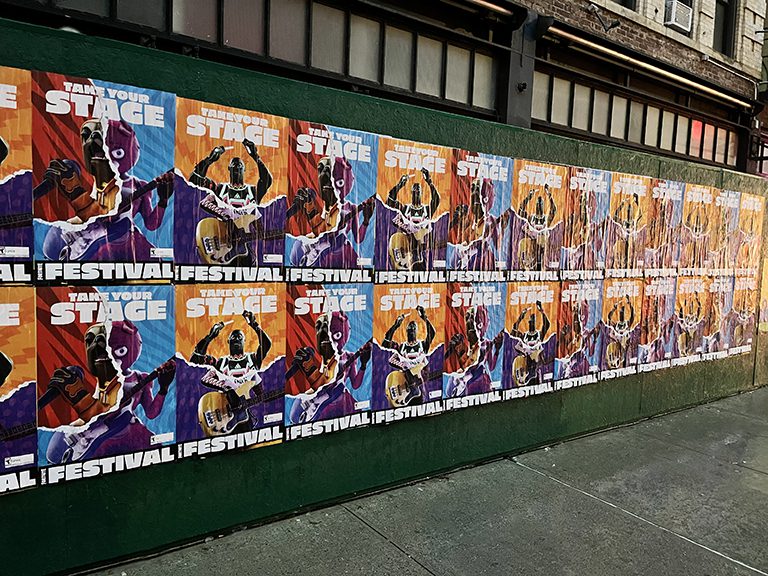
Large-format paper poster placements on permitted walls are the primary street ad format in most cities. They appear on the walls of commercial buildings, construction hoardings, and other vertical surfaces at pedestrian height. The scale ranges from single-sheet posters to multi-panel installations that cover entire building sides.
Poster placements are the workhorse of urban street advertising because they deliver consistent, high-volume daily exposures in high-foot-traffic locations at a cost that is accessible at most campaign budgets. They are durable over a campaign period, highly visible at pedestrian scale, and compatible with the visual culture of urban commercial neighborhoods where brands have been communicating through wall placements for decades.
Street Furniture Ads
Street furniture advertising appears on bus shelters, phone kiosks, newsstands, and benches. These placements are embedded in the pedestrian environment at regular intervals, which creates frequency of exposure for commuters and neighborhood residents who encounter the same pieces of street furniture repeatedly. The repetition builds recall in ways that single-exposure placements cannot.
Projection-Based Street Ads
Projection campaigns use specialized equipment to project large-scale branded visuals onto building facades, sidewalks, and other surfaces. They are inherently temporary and evening-focused, which makes them suitable for product launches, event marketing, and social amplification campaigns where a spectacular visual moment is more valuable than sustained daily exposures.
Ambient Street Ads
Ambient street ads transform existing elements of the urban environment into brand moments. They use the built environment as a creative partner rather than a neutral background. A pavement stencil campaign that appears at every transit entrance in a target neighborhood creates a feeling of omnipresence with a fraction of the production cost of traditional placements. An installation that uses existing street furniture or architecture as a creative element creates an encounter that feels discovered rather than imposed.
Street Ad Format
Best Campaign Goal
Audience Scale
Social Amplification
Typical Duration
Large-format poster
Brand awareness
High
Medium-High
2-4 weeks
Street furniture
Frequency and recall
Medium-High
Low-Medium
4-8 weeks
Projection
Launch moment, social
Medium
Very High
1-7 days
Ambient installation
Cultural credibility, press
Low-Medium
Very High
1-14 days
Pavement stencil
Event traffic, awareness
Medium
Medium
Days to weeks
Where Street Ads Work Best
Street ads work best in high-foot-traffic urban neighborhoods where the target audience is present in meaningful concentrations. The neighborhoods where a street ad campaign is most valuable are the ones where the brand’s target demographic actually spends time, not the ones that are generally considered desirable or well-known.
In New York, the corridors with the highest street ad value for most consumer brand categories are Broadway through SoHo, Bedford Avenue in Williamsburg, and the stretch of Lafayette Street through Nolita and the Lower East Side. Each of these corridors has high daily foot traffic from the audience most valuable to brands in fashion, food, entertainment, consumer goods, and lifestyle categories.
In Los Angeles, the Fairfax District on Fairfax Avenue between Melrose and Beverly is the strongest single corridor for youth culture and streetwear brands. Abbot Kinney in Venice serves a premium lifestyle audience. Sunset Boulevard through Silver Lake reaches the creative professional demographic. Each of these has a distinct audience and a distinct visual context that affects what kind of street ad creative will perform best.
In Chicago, the Milwaukee Avenue corridor through Wicker Park and Bucktown is the primary street ad zone for brands targeting the young creative professional demographic. The River North gallery and restaurant district works for premium lifestyle brands. Pilsen serves brands with arts and social justice positioning.
Location specificity matters at the block level: The difference between a strong street ad location and a mediocre one is often one block. We have measured foot traffic differences of 40 percent between adjacent blocks in the same neighborhood. We have seen placement locations that seemed equivalent on a map produce dramatically different impression volumes in the field. We scout every proposed location before it enters a campaign plan because the data is never a substitute for actually being on the block.
Street Ad Creative Principles
Street ad creative has to work in conditions that are completely different from studio production environments. The ambient light is variable. The viewing distance ranges from two feet to fifty feet. The viewer may be moving at walking pace or stopping to look. The surrounding visual environment is busy with competing graphics, architecture, and movement.
These conditions produce specific creative requirements:
High contrast. Your ad competes visually with everything else on the block. High contrast between the primary visual element and the background is the baseline requirement for visibility at distance and at speed.
Single message. Street ads that try to communicate multiple things communicate nothing. One message, clearly delivered. Everything else is visual noise that reduces the clarity of the primary communication.
Immediate brand identification. The brand must be identifiable within one second of viewing. Logo placement, color system, and visual style should accomplish this without requiring the viewer to read anything.
Scale awareness. Creative that looks polished at 8.5 by 11 often looks amateur at 10 by 40 feet. Design at scale, not at print preview size.
Photographic reward. If the creative can be designed to reward a second look with something that motivates photography, the organic social amplification from consumer documentation multiplies the campaign’s effective reach significantly.
Street Ads and the Social Media Amplification Dynamic
The single most important change in street advertising over the past decade is the relationship between physical street ads and organic social media content. A strong street ad in the right location generates organic social posts from consumers who encounter it, photograph it, and share it with their networks. That organic sharing creates a second wave of exposures that extends the campaign’s reach far beyond the people who physically walk past the placement.
We design street ad campaigns with this dynamic explicitly in mind. We choose locations that are already high-documentation zones: the blocks where people regularly stop to photograph the environment, the walls that have a history of being photographed by people passing through. We design creative that rewards documentation: visual elements that look good in a phone photograph, a scale relationship between the ad and its surroundings that makes the combination visually interesting, and a concept or visual surprise that gives the viewer a reason to share it beyond just seeing a brand name on a wall.
When a street ad generates strong organic social documentation, the impression multiplier can be enormous. We have run campaigns where the organic social exposures generated by consumer photography exceeded the direct placement exposures by five to ten times. That multiplier is not accidental. It is designed into the campaign from the beginning.
Planning and Budgeting a Street Ad Campaign
Street ad campaigns vary significantly in cost depending on the market, the format, the number of placements, and the production quality level. Here is a realistic breakdown for the most common campaign configurations.
A single-neighborhood poster campaign in a major city like New York or Los Angeles, running for two to four weeks with five to fifteen placements, typically costs $8,000 to $20,000 including production, installation, and documentation. This is the entry-level configuration for a meaningful street ad presence in a high-value urban market.
A multi-neighborhood campaign covering two or three key zones in one city, running for three to six weeks, typically costs $25,000 to $60,000 depending on the specific neighborhoods and the number of placements in each. This range allows for a sustained presence that builds frequency with the target audience across multiple areas of the city.
A multi-city campaign covering three or more markets at the same time, with coordinated placement schedules and documentation packages, typically runs $60,000 to $150,000 and above. This configuration makes sense for national brands, major product launches, and campaigns where simultaneous multi-city presence is essential to the strategy.
The production quality principle: Street ads compete with the visual quality of the urban environment they appear in. In SoHo, the walls have a history of high-quality creative work. In the Fairfax District, the visual standards are set by a community that evaluates creative work as part of its cultural identity. In those environments, production quality below the prevailing neighborhood standard reads as low-budget regardless of the brand’s actual scale. We set production quality requirements for each market based on what the neighborhood standard actually is.
Street Ad Format Comparison: Choosing the Right Option
Most campaigns we run use more than one street ad format. But the decision about which formats to combine starts with understanding what each one does well and where it falls short. Stacking formats without a strategic reason for each one produces a more expensive campaign, not a more effective one.
Format
Typical Duration
Cost Range (NYC)
Best For
Limitations
Sidewalk stencil
7 to 21 days
From $2,855 (5 stencils)
Saturation, approach routes, event windows
Fades with foot traffic and weather
Large-format poster / wheatpaste
2 to 6 weeks
$6,000 to $18,000
Visual brand, sustained awareness
Surface dependent, weather vulnerable
Mural
3 to 24 months
$15,000 to $60,000
Long-term presence, social landmark
Wall sourcing, longer lead time
Projection
1 to 5 nights
$10,000 to $40,000
Launch moment, maximum visual impact
Weather dependent, single-night reach
Street team
1 to 5 days
$5,000 to $20,000
Direct engagement, sampling, trial
Time and weather dependent
Street Ad Timing: Aligning Campaigns with Audience Behavior
When a street ad runs matters almost as much as where it runs. An installation that appears two weeks after a product launch has missed the window when the campaign would have the most impact. A street team deployment on a Tuesday afternoon in a neighborhood where the target audience does not arrive until Thursday evening reaches the wrong people at the wrong time. Timing is a dimension of location strategy that most brands underinvest in.
The most effective street ad campaigns in our experience are timed to one of three windows: the approach window before a major event or launch, the saturation window during the peak of a campaign, or the residual window after a campaign’s primary media has run and the brand needs physical presence to maintain top-of-mind awareness.
Approach window timing works by placing street ads in the path of the target audience in the days before they are making a decision. A stencil campaign that appears on the approach routes to a venue in the week before a show, or on the sidewalks near the retail locations where a new product will be available a week before its release, catches the target audience when their attention is already moving toward the relevant moment. The ad does not have to create interest from scratch. It amplifies interest that is already developing.
Saturation window timing concentrates the campaign’s impression weight in the two-week window when a launch is getting its maximum media support from all other channels. The street ad presence reinforces the campaign at the physical level while digital and earned media reinforces it online. The audience encounters the campaign on their phone and on their sidewalk in the same 48-hour window. That multi-channel encounter creates a stronger memory impression than either channel alone would produce.
Residual window timing extends campaign impact beyond the primary campaign period at low cost. A mural or a poster run that was part of the launch campaign continues generating exposures for weeks or months after the paid media spend has ended. The physical presence of the street ad keeps the campaign alive in the target geography without requiring ongoing media investment. This is one of the strongest return-on-investment arguments for including street ads in a broader campaign rather than running them independently.
AGM Field Note: The timing gap we see most often is brands that call us after the launch has already happened. They have a product in market, the paid media has run, and now they want street ads to maintain presence. Street ads in that position are playing catch-up rather than creating the pre-launch momentum that the format does best. The ideal time to start a street ad campaign is two to three weeks before any other channel launches.
Street Ads vs. Digital Ads: When to Choose Street
The question of when to prioritize street ads over digital ads comes up in almost every briefing conversation we have. The honest answer is that the two channels are not interchangeable, and the decision should be based on specific campaign goals and audience characteristics rather than a general preference for one channel over the other.
Choose street ads when you need to reach a geographically concentrated audience whose physical location is predictable and whose digital ad filtering habits are well-developed. Young urban consumers between 22 and 35, who grew up with digital advertising and have developed strong ad-ignoring behaviors across social and display channels, are a primary street ad audience. They encounter physical advertising with less developed filtering because they are less habituated to it as a constant presence in their environment.
Choose street ads when the campaign’s creative concept has a physical dimension that digital cannot carry. A brand message that works because of its scale, its surface, its three-dimensionality, or its integration with a specific urban environment cannot be translated into a banner or a social card without losing the quality that makes it effective. Some creative ideas are street ideas. Trying to run them in digital formats produces a diminished version that satisfies neither channel’s requirements.
Choose street ads when organic social documentation is a campaign goal in itself. A strong street ad placement in the right location generates user-created content that reaches social audiences who were never in the physical presence of the ad. That organic amplification is only available through physical formats. Digital ads do not generate user documentation the way a striking physical installation does.
Frequently Asked Questions About Street Ads
Frequently Asked Questions
What are street ads?
Street ads are advertisements placed at street level in urban environments, reaching pedestrians, cyclists, and commuters in the physical spaces they move through daily. They include large-format poster placements, street furniture advertising, building projections, pavement stencils, and ambient installations that intercept the audience in their physical environment.
How effective are street ads?
Street ads are highly effective for building brand awareness in specific urban geographies. They are unskippable, reach people in a physical context where attention quality is higher than in digital environments, and generate organic social media content when the creative is strong enough to motivate documentation.
What types of street ads work best?
The most effective street ad types depend on the campaign goal. Large-format poster placements work for broad neighborhood awareness. Projections work for high-social-amplification events. Ambient installations generate press coverage and organic social content. Ambassador programs create direct consumer interaction and product trial.
How much do street ads cost?
Street ad costs range from $3,000 for a small single-neighborhood poster placement to $100,000 or more for a comprehensive multi-city campaign. The cost depends on the market, the format, the number of placements, and the duration of the campaign.
Where are street ads most effective?
Street ads are most effective in high-foot-traffic urban neighborhoods where the target audience is concentrated. In New York, SoHo, Williamsburg, and Harlem are among the most valuable markets. In LA, the Fairfax District, Venice, and the Arts District are primary zones. In Chicago, Wicker Park, Logan Square, and River North deliver the strongest results.
How do street ads integrate with social media?
Street ads generate organic social media content when they are visually strong enough to motivate documentation. A striking street-level ad in the right neighborhood will be photographed and posted by consumers who encounter it, extending the campaign’s reach far beyond the direct audience at the placement location.
How long should a street ad campaign run?
Most effective street ad campaigns run for two to four weeks. This duration builds frequency with the target audience while staying within a budget range that allows for quality creative and production. Shorter campaigns have less time to build documentation momentum. Longer campaigns may benefit from format rotation to maintain freshness.
Call us at (646) 776-2770 or email [email protected]. We plan and execute street ad campaigns in New York, Los Angeles, Chicago, Miami, Austin, and cities across the US. We start with your audience and your market, then build the placement strategy, production, and documentation plan.