Sports fans are not just a demographic. They are a community defined by shared passion, collective rituals, and a loyalty structure that extends from the team to the brands that participate genuinely in the fan experience. A brand that shows up at a playoff game and hands out samples to the fans queued outside the arena on a cold April night is not just running a sampling activation. It is participating in a ritual that fans will remember because the game itself will be remembered. The brand association formed in that moment carries an emotional weight that no media placement can manufacture.
Sports fan activation is the practice of deliberately creating those moments: the in-person, face-to-face engagement with fan communities in the specific spaces and moments that define their experience as fans. It is not about buying space inside the venue or on the broadcast. It is about showing up where fans actually are, in the tailgate lot, in the venue district streets, in the transit corridors and bar strips that bookend the game day, with something that has genuine relevance to what they are there to experience.
American Guerrilla Marketing executes sports fan activations across the full range of sporting event environments. We have deployed crews in the tailgate zones at NFL venues, worked the pedestrian approaches to NBA arenas on playoff nights, and run sampling activations at college football game days at major programs across the country. The operational knowledge we bring to sports fan activation is specific to the fan environment: how fans move, where they concentrate, how they respond to different engagement formats in different moments of the game-day experience.
The Psychology of Fan Community Engagement
Understanding why sports fans respond differently to brand engagement than general consumers requires understanding the psychology of fan community membership. Fan identity is a powerful component of personal identity for many sports fans. They are not just people who watch the games. They are people for whom the team is a meaningful element of who they are. That identity investment creates an audience that is simultaneously highly emotionally engaged and highly discerning about what belongs in their fan world.
Brands that treat the fan community as a generic audience segment to be reached, rather than as a specific community to be engaged on its own cultural terms, generate the defensive brand skepticism that is the baseline response to most marketing. Brands that demonstrate genuine understanding of the fan culture, that show up with something that fits, that engage crew who can talk naturally about the team or the sport in question, earn a different response. The fan who feels like a brand gets it is a fan who is open to what the brand has to offer.
Fan Zone Activations: The Pre-Event Community Space
Fan zones, the outdoor pre-event programming areas that many major sporting events create around their venues, are purpose-built community spaces that concentrate fan audiences in high-energy, socially engaged outdoor environments. They are among the most activation-friendly environments in sports marketing because the audience is stationary, social, and already in a participatory mindset from the entertainment programming that surrounds them.
Official Fan Zone Access vs. Adjacent Public Zones
Official fan zones with controlled access require either official sponsorship or coordination with event organizers for brand activation rights. Adjacent public zones, the streets and public spaces surrounding official fan zone areas, are accessible without authorization and often carry significant fan traffic from attendees who circulate between the controlled zone and the surrounding area. We identify which portions of the pre-event geography are publicly accessible and build activation plans around those positions where authorization is not required.
Fan Zone Engagement Formats
Fan zone engagement works through formats that fit the social energy of the space. Give-away activations with items that have fan context, branded items related to the sport or the event, generate higher engagement than generic promotional materials. Sampling programs with immediate consumption products work naturally in a crowd that is already eating and drinking in the outdoor social space. Interactive elements that create photo moments or social sharing opportunities extend the reach of the fan zone engagement beyond the people physically present.
Tailgate Culture and Brand Participation
The tailgate is the purest expression of fan community culture in American sports. It is a ritual that fans plan, travel, and commit significant time to. The social dynamics of a tailgate setup are specific: the territory staked out in the lot, the cooking and drinking rituals, the group composition that has often been gathering in the same parking section for years. A brand that enters the tailgate zone needs to offer something that enhances this ritual rather than interrupting it.
Products That Fit the Tailgate
Products that fit the tailgate context have immediate relevance to what fans are doing: food and beverages that complement the existing tailgate consumption, grilling accessories or condiments that insert naturally into the cooking ritual, or beverages that serve as a natural complement to whatever the fan is already drinking. The insertion of a genuinely useful product into the tailgate ritual creates a positive brand association that is reinforced by the positive memory of the game day itself.
Crew Behavior in Tailgate Environments
Tailgate zone crew need to move through an established social environment with cultural competence. The tailgate is not a neutral space where anyone can walk up and start a transaction. It is a social territory with its own norms. Our tailgate crew are briefed to approach tailgate groups with genuine interest in the group’s experience, not with a sales pitch. The conversation starts with the game. The brand engagement follows from it if the fan is receptive. Crews that try to make a commercial interaction out of every approach generate resistance. Crews that participate genuinely in the social environment before introducing the brand generate engagement.
Street Teams in Fan Districts
The commercial districts adjacent to major sports venues, the bar strips, the restaurant blocks, and the pedestrian corridors that fans populate before games, are active environments for street team fan activation. The fans in these zones are in a pre-game social state: excited, engaged with their group, and already thinking about the game. They are receptive to materials and engagement that connects to what they are looking forward to.
We position game-day street teams in fan districts based on specific knowledge of how traffic flows through the venue-adjacent commercial zone for the specific team and venue. The game-day pedestrian geography is specific. The bar that fills first, the block that the transit arrivals walk through, the commercial corridor that is most active in the 90-minute window before gates open: these are positions we know from being in those specific places on game days.
Physical Brand Presence in Fan Corridors
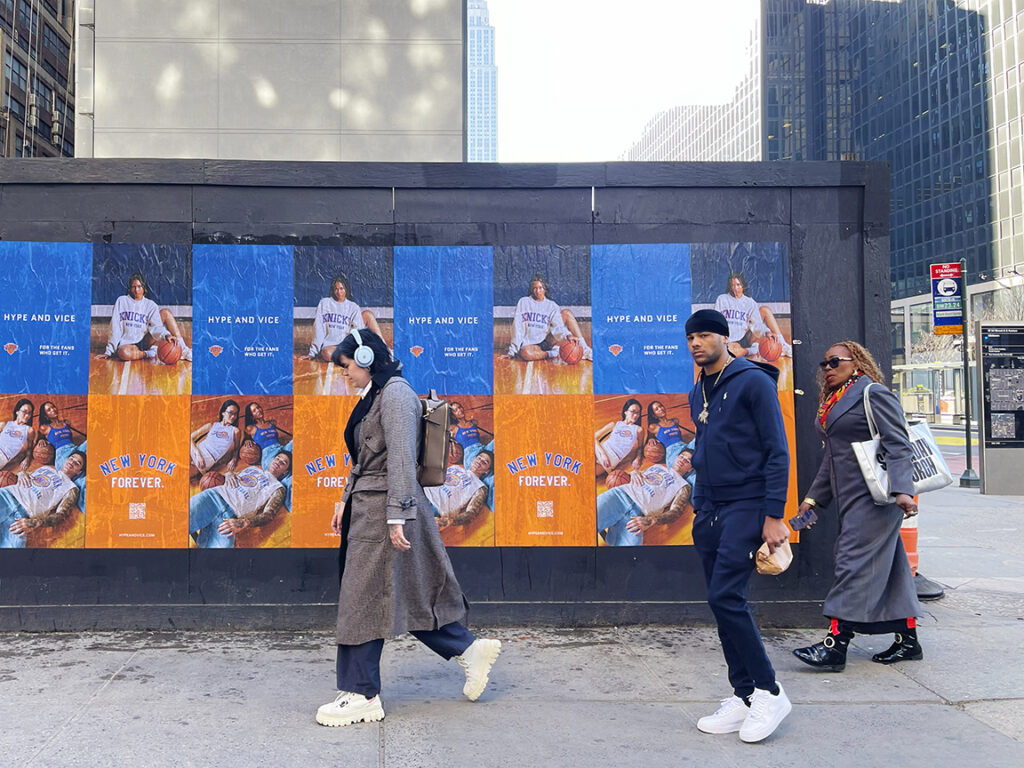
Physical advertising in fan corridors creates sustained brand presence in the spaces that fans move through every game day, not just on single activation days. Wheatpasting and poster campaigns in the blocks surrounding major venues create a brand presence that fans encounter every time they arrive for a home game. For venues with long home schedules, a poster campaign maintained across the season generates dozens of repeat impressions from the same season-ticket audience.
Sidewalk stencils on the approach corridors to major venues create ground-level brand presence that reaches every pedestrian on game day. The stencil is unavoidable. Every fan who walks the approach route encounters it. For venues with established pedestrian approach corridors, stencils applied across a season create a brand presence that becomes part of the environmental texture of attending games at that venue.
LED Billboard Trucks Targeting Fan Traffic
LED billboard trucks in sports venue approach zones reach the vehicle-borne fan audience during the concentrated game-day arrival window. The approach routes to major stadiums and arenas carry high-volume, slow-moving traffic in the hours before major events. A truck with a full-motion display working these routes during peak arrival generates sustained high-visibility impressions from a captive audience. Creative executions that reference the specific game or event create attention levels that generic outdoor advertising cannot match in the same context.
Building Fan Community Relationships Across a Season
The most effective sports fan activation programs are not single-event executions. They are sustained programs that build cumulative brand presence across a season, creating repeated touchpoints with the regular fan audience that establish the brand as a genuine part of the game-day experience rather than an occasional visitor to it.
Season-long fan activation programs accumulate something that single-event programs cannot: recognition. By the third or fourth home game of a season, the fans who have encountered our client’s activation at multiple games begin to recognize the crew, the brand, and the activation format as part of the game-day environment. That recognition converts from passive awareness to active brand engagement. Fans who recognize the brand as a regular presence at the games they attend are in a fundamentally different relationship with it than fans who encountered it once at a single event.
Digital-Physical Integration in Sports Fan Activation
Sports fan activation produces the strongest results when the physical field campaign is integrated with digital touchpoints that extend the engagement beyond the in-person moment. Promotional codes distributed during game-day activations, QR codes on physical materials, and exclusive digital offers tied to physical campaign engagement all create digital conversion pathways from the fan activation to measurable online outcomes.
Second-Screen Integration
Sports fans are among the highest second-screen users of any audience segment. They watch games with a phone in hand, following live stats, social commentary, and team-specific content simultaneously with the broadcast. Brand activations that can connect the in-person physical engagement to a second-screen element create a digital engagement layer on top of the physical activation that extends the brand’s presence into the fan’s full game-day media consumption. A promotional code that unlocks exclusive digital content, or a physical give-away that drives a social media interaction, bridges the physical and digital dimensions of the fan’s game-day experience.
Fan Activation at Championship and Marquee Events
Championship games, marquee matchups, and marquee regular-season events create heightened fan activation opportunities because the fan emotional investment is at its peak and the media coverage of the surrounding event geography creates amplification potential that routine game days do not offer. The Super Bowl host city, the NBA Finals host venues, major playoff series in contested division races, these moments concentrate not just the regular fan base but the broader sports cultural audience that follows the storyline even without being regular attendees.
Championship event activations require more advance planning and more creative ambition than regular season game-day programs. The competition for fan attention is higher. The media presence creates both an amplification opportunity, a strong activation may be covered by the sports media that is on-site for the game, and an elevated execution standard requirement. Brands that execute championship event activations need the operational capability to perform at the highest level on the biggest stages in the sports calendar.
Building Fan Community Brand Loyalty
The ultimate goal of sustained sports fan activation is not just awareness or trial. It is the establishment of the brand as part of the fan community’s identity markers, the brands associated with supporting the team, being at the games, and participating in the fan ritual. That level of brand community integration is rare and valuable, and it is built through consistent, authentic presence in the fan environment over time rather than through any single activation.
Brands that have achieved genuine fan community integration, that are recognized as “part of the game day experience,” occupy a brand position that is extraordinarily durable and difficult to dislodge by competitors. The fan who associates a brand with the good times of their team’s season, the tailgates, the playoff wins, the shared emotional peaks of being a sports fan, is not a brand switcher. They are a brand loyalist whose connection to the product is rooted in memory and identity rather than rational preference. That is what sustained sports fan activation, executed with authenticity and operational discipline across a full season and beyond, can build.
Regional Sports Fan Communities and Local Brand Building
Sports fan communities have strong regional identities that create local brand building opportunities for regional brands that want to own the fan relationship in their home market. A regional brand that becomes the unofficial fan brand of a local professional team, through consistent game-day presence, authentic community engagement, and genuine sponsorship of the fan experience rather than just media buying, can achieve a level of local brand loyalty that national brands struggle to replicate through scale alone.
Regional sports brand activation programs work through the same field activation formats as national programs, but with a community relationship dimension that is particular to local brands in local markets. A locally owned brand that shows up consistently at the home games is participating in the same community ritual as the fans. That shared local identity creates a brand connection that external brands, no matter how well-resourced, cannot replicate from the outside.
Brand Representation Through Fan-Created Content
Sports fans are prolific content creators. The social documentation of game-day experiences, the fan photography and video from tailgates, arena approaches, and post-game gatherings, creates an enormous volume of organic content that circulates through fan community social networks. Brands that create activation experiences worth documenting, whether through visually distinctive setups, impressive give-away items, or genuinely memorable engagement moments, earn inclusion in this fan-generated content without paying for it.
The value of appearing in fan-generated social content is substantial because the content is distributed through networks with high sports fan concentration and carries the credibility of an organic fan recommendation rather than a brand communication. A branded item that appears in a hundred fans’ game-day Instagram posts is reaching an audience of engaged sports fans through peer-to-peer recommendation, the most effective form of consumer communication available. Designing fan activations to create content-worthy moments is as important as designing them to deliver samples or materials efficiently.
Multi-Team and Multi-Sport Fan Audience Programs
Brands targeting the broad sports fan audience rather than a specific team’s fan base benefit from multi-team and multi-sport programs that activate across multiple venue geographies and fan community contexts within the same city or market. A city with an NFL team, an NBA team, and an MLB team offers three distinct sports fan communities with overlapping but not identical audience profiles. A brand that activates consistently at all three venue districts across a sporting year reaches a broader sports fan audience than any single-sport program while maintaining the geographic efficiency of working in a single metro market.
Multi-team programs require understanding the specific fan community culture of each sport and building activation approaches that fit each culture rather than applying a single format across all three. The tailgate format that works at the NFL stadium requires significant adaptation for the NBA arena game day. The community feel of the MLB park district differs from both. Building sport-specific activation approaches within a unified brand campaign is the standard of multi-sport fan marketing that generates authentic engagement rather than generic sports association.
Frequently Asked Questions
What is sports fan activation?
Sports fan activation is the process of engaging sports fan audiences directly through in-person campaigns at and around sporting events. It encompasses fan zone programs, venue district street teams, tailgate sampling, product trial campaigns, and physical marketing in the spaces where fan communities gather before, during, and after games.
Why are sports fans valuable for brand activation?
Sports fans combine intense passion, brand loyalty, concentrated physical presence, and extended pre-event dwell time into an audience profile that is nearly impossible to replicate in other marketing contexts. Brands that engage fan audiences authentically earn associations that persist long after the campaign ends.
What is the difference between fan activation and venue advertising?
Venue advertising is passive: the brand is displayed to fans. Fan activation is active: the brand creates a direct engagement through human interaction, sampling, give-aways, or experiences. Activation creates a deeper impression than passive exposure.
Which fan communities respond best to in-person activation?
NFL fans with established tailgate traditions respond strongly because of the extended pre-game dwell time and social group dynamics. College football fan communities are deeply community-rooted and respond well to brands that engage within the specific cultural context. NBA and NHL playoff audiences in urban markets are highly engaged during peak playoff periods.
Can small brands do sports fan activation effectively?
Yes. Sports fan activation scales from multi-market season-long programs to single-game activations at a local venue. A small brand running a four-person street team at a home game or sampling at the tailgate zone can generate significant local fan engagement at accessible costs.
How do you measure sports fan activation results?
Results are measured through direct engagement counts, samples and materials distributed, GPS-documented photo reports, crew supervisor field notes on audience response quality, and where applicable, promotional code redemptions that track conversion from fan activation to purchase.