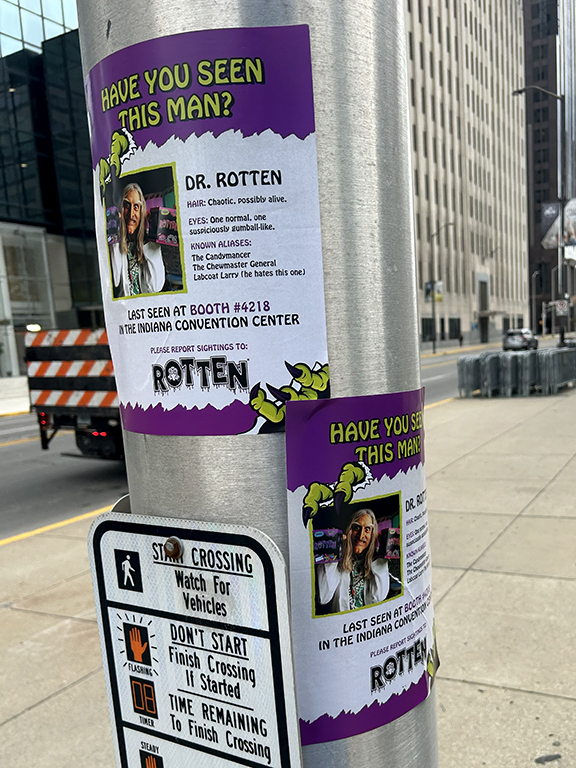
The trade show floor is one of the most competitive brand environments in marketing. Every exhibitor is trying to attract attention in a space where every booth is competing for the same walking audience. Outside the convention hall, the competitive landscape is different. The surrounding hotel district, the restaurant and bar corridor where attendees go for dinner and after-show socializing, the transit approaches that carry the audience between their hotels and the convention center, these are environments where a well-placed poster campaign has far less competition and far more visual impact than anything inside the building.
Trade show poster campaigns are a format that is underused relative to their actual effectiveness. The convention attendee audience is physically concentrated in a defined geographic zone for three to five days. They move through predictable corridors between the convention center, their hotels, and the surrounding commercial area multiple times per day. Each transit through that corridor is another impression opportunity for a brand whose posters are established in the right positions. The cumulative impression frequency across a multi-day convention, from the same audience, creates brand recall levels that most other marketing formats have to spend significantly more to achieve.
Our team at American Guerrilla Marketing has executed poster campaigns targeting convention and trade show audiences in multiple major convention markets including New York, Las Vegas, Orlando, Chicago, and Las Vegas. We know the specific geographies of these convention zones, which hotel approaches carry the most attendee foot traffic, where the poster density is low enough that a campaign stands out rather than disappearing into visual clutter, and how to place a campaign in a way that maximizes the number of individual impressions per attendee across the convention schedule.
Why Physical Posters Work in the Convention District
The convention district is a temporary environment. The businesses and pedestrian flows that define it during a major trade show are different from what that same geography looks like on a non-event week. The attendee audience arrives in force, concentrates in specific hotels, moves through specific corridors, and inhabits specific social zones that are shaped by the convention schedule and the geography of the convention venue. A brand that plants physical presence in that temporary environment reaches an audience that is paying attention to it in ways that they are not paying attention to digital advertising on the same devices they are using to follow convention programming and manage their schedules.
Physical advertising in the convention district also reaches a specific demographic profile that is often valuable beyond the direct trade show engagement: decision-makers, executives, and industry professionals who are not the typical street-level advertising audience but who are physically accessible in a defined geographic zone for the duration of the convention. The B2B audience that is impossible to reach with street-level advertising in their normal daily geography becomes accessible in the convention district because the convention has concentrated them there.
Convention District Geography: Where Posters Work
The convention district geography varies significantly by city and venue. Understanding the specific geography of each major convention market is essential for placing a poster campaign that actually reaches the attendee audience rather than the general city population.
Las Vegas: The Convention Strip Geography
Las Vegas hosts more major trade shows and conventions than any other U.S. city. The Las Vegas Convention Center, the Venetian Expo, Mandalay Bay, and the MGM Grand all host major trade show activity. The Las Vegas convention geography is unusual because the attendee population is concentrated on the resort corridor that is simultaneously a major tourist destination. The pedestrian approaches between the major convention hotels, the Las Vegas Boulevard sidewalks connecting the major hotel-casinos, and the Convention Center Drive corridors are the primary poster placement zones for Las Vegas convention campaigns.
Chicago: McCormick Place and the South Loop
McCormick Place on the lakefront generates a convention attendee geography that is distinct from downtown Chicago. The hotel cluster along East Cermak Road and South Michigan Avenue connects to the convention campus via a series of pedestrian corridors and the shuttle route along Martin Luther King Jr. Drive. Our wheatpasting and poster campaigns targeting McCormick Place conventions cover the hotel approach corridors, the South Loop restaurant zone, and the Michigan Avenue luxury retail strip that convention attendees frequent during exhibition breaks.
New York: Javits Center and the Midtown West District
The Jacob K. Javits Convention Center on Manhattan’s West Side is a unique convention geography. The convention center is accessible primarily by taxi, rideshare, or the 34th Street-Hudson Yards subway stop. The surrounding hotel cluster in the Midtown West and Hell’s Kitchen neighborhoods provides the primary poster placement geography. The 34th Street corridor from the Hudson Yards development east to Times Square and the Ninth Avenue restaurant strip are the highest-traffic zones for Javits convention attendee poster campaigns.
Orlando: Orange County Convention Center
Orlando’s Orange County Convention Center is surrounded by the International Drive hotel and commercial corridor, one of the most concentrated convention hotel geographies in the country. The I-Drive corridor between the convention center and the major convention hotels, including the Rosen, Hyatt, and Hilton properties on the south end of I-Drive, generates predictable pedestrian and shuttle traffic that creates consistent poster impression opportunities across the full convention schedule.
Hotel Corridor Placement Strategy
The hotels immediately surrounding a major convention venue are the highest-value poster placement environment in the convention geography. Attendees stay in these hotels, walk through their lobbies, and use their bars and restaurants. While interior hotel placement requires property coordination, the exterior hotel frontage, the sidewalk approaches, and the commercial blocks immediately adjacent to the hotel entrances are typically public space.
Morning Departure and Evening Return Windows
The most valuable impression windows for hotel-adjacent poster placements are the morning departure window, when attendees leave for the convention center, and the evening return window, when they come back for dinner, drinks, and the evening social programs. Posters on the pedestrian routes between the hotel and the convention center reach the entire walking attendance population twice per day during these windows. The same attendee sees the poster in the morning context of anticipating the day’s programming and again in the evening context of processing what they experienced. That double impression in a single day generates recall levels that single-impression formats cannot match.
Transit Approach Poster Placements
For convention venues with significant transit access, the transit approach corridors, the blocks between the transit exit and the convention center entrance, are high-value poster placement zones. Attendees arriving by transit move through these corridors on every convention day. They are alert, oriented toward their destination, and moving at a pace that allows reading a well-designed poster format.
Transit approach placements work best in defined corridor positions where the audience’s sightlines are consistent and the poster can be positioned for optimal viewing from the walking direction. We site these placements based on the specific geometry of each transit approach in each convention market.
Combining Poster Campaigns with Street Teams
Poster campaigns work most effectively for trade show targeting when combined with active street team deployments in the convention district. The poster campaign creates passive brand presence that builds across the full convention schedule. The street team creates active engagements in specific windows, reinforcing the brand impression from the posters with direct human contact and material distribution.
The combination is particularly effective in the morning arrival window, when street teams positioned at the convention center approach engage the audience that is also encountering the poster campaign in the same corridor. The brand that is both physically present on the walls and represented by a crew member who approaches and engages creates a layered impression that is significantly more memorable than either format alone. Our full guerrilla marketing services suite includes integrated poster and street team programs for major conventions and trade shows.
Print Specifications for Trade Show Poster Campaigns
Trade show poster campaigns use standard wheat paste poster formats: 24×36 inch and 27×40 inch are the most common sizes. Print specifications for outdoor weather-exposed placements require heavier paper stock, typically 80 to 100 lb text weight minimum, with a thick, UV-resistant ink application that maintains legibility in variable lighting conditions. Paste formulations for commercial district placements use wheat paste or methylcellulose paste that bonds strongly to rough concrete and brick surfaces.
Design specifications for trade show poster campaigns prioritize legibility at distance over information density. The convention district audience is moving. They have seconds to process a poster in their peripheral vision before it is behind them. Bold typography, high-contrast color, and a single clear visual hierarchy are the design principles that produce readable, memorable trade show posters. Brands that try to fit booth messaging into a street poster format consistently underperform brands that design for the outdoor viewing context.
Documentation and Reporting for Trade Show Campaigns
Every poster campaign we execute includes installation documentation: GPS-tagged photography of each placement, documenting the location, the surface, the surrounding context, and the estimated daily foot traffic based on our knowledge of each specific position. Post-campaign documentation covers the campaign’s condition and visibility at the conclusion of the convention, providing a record of the full impression period.
For clients running trade show campaigns as part of a broader convention marketing program including street teams and other field formats, we provide a consolidated campaign report that covers all formats together with aggregate impression estimates and engagement counts from each component of the program.
Multi-Convention Poster Campaign Programs
Brands that attend or target multiple trade shows across a convention season benefit from multi-convention poster programs that establish brand presence in each convention district with consistent creative and optimized logistics across the full convention calendar. Centralized creative production for a multi-convention program ensures brand consistency across markets while local installation teams handle the market-specific placement in each convention city.
Convention Calendar Planning for Physical Campaigns
Building a multi-convention poster program begins with mapping the full convention calendar relevant to the brand’s industry and target audience. Major industry trade shows tend to concentrate in specific seasonal windows: technology conferences in spring and fall, healthcare conventions in fall, financial services conferences in fall and winter, consumer products trade shows in January and August. Understanding the full calendar and identifying the highest-value events for physical campaign investment allows brands to allocate poster campaign resources to the moments that matter most for their specific business objectives.
Poster Campaign Integration with Exhibitor Marketing
Brands that are exhibiting on the trade show floor benefit most from poster campaigns in the surrounding district when the external campaign coordinates with the on-floor messaging. Convention attendees who see the brand’s poster in the hotel corridor, encounter the brand’s street team at the convention center approach, and then visit the brand’s booth on the show floor experience a layered brand presence that creates a disproportionately strong impression relative to any individual format. The external poster campaign creates contextual expectation: the brand is already present in the attendee’s visual environment before they arrive on the show floor, which changes how the booth encounter reads when it happens.
This coordination requires intentional creative alignment between the external campaign and the on-floor presence. Poster design that introduces the same visual identity, key message, or campaign concept that the booth executes in more depth creates a coherent campaign narrative across both the street-level and on-floor contexts. The attendee who says “I keep seeing that brand everywhere” at a convention is responding to exactly this kind of layered presence, and that impression of pervasive brand visibility is worth significantly more than any single format can achieve on its own.
Guerrilla Approaches for Non-Exhibiting Brands at Trade Shows
Brands that want to reach a convention audience but are not exhibiting on the show floor have an even stronger case for external poster and street marketing campaigns, because the external campaign is their only physical presence in the convention environment. For a brand that wants to reach the healthcare technology conference audience without paying for exhibit space, a well-placed poster campaign in the convention district hotel corridors and transit approaches, combined with a street team in the morning arrival window, can generate brand impressions and direct engagements with the same professional audience that exhibitors pay tens of thousands of dollars to access through the show floor.
The convention district marketing approach for non-exhibiting brands represents a guerrilla marketing strategy in the most classic sense: generating genuine brand presence through creative positioning in the surrounding environment rather than buying access through official channels. This approach requires more operational sophistication than purchasing an exhibitor package, but it offers cost efficiency and creative flexibility that official exhibition cannot match. Our guerrilla marketing services include convention district programs specifically designed for non-exhibiting brands that want strategic access to convention audiences without the exhibitor fee.
Evaluating Convention Poster Campaign ROI
Return on investment for convention poster campaigns is measured differently than direct response advertising. The poster campaign generates impressions and brand awareness, not direct conversions. The measurement framework needs to align with the campaign objective: convention awareness programs are measured through brand recall surveys, booth traffic increases attributed to external campaign exposure, and lead volume correlations between poster campaign markets and control markets where no external campaign runs.
For brands with measurable post-convention follow-up processes, lead quality tracking from convention contacts can provide a comparison between markets where external poster campaigns ran and markets where they did not. Brands that find higher lead quality or higher post-convention conversion rates from markets where external campaigns ran have evidence of the campaign’s contribution to the commercial outcomes of the convention investment. This ROI evidence builds the case for sustaining external convention campaign investment across future events on the convention calendar.
Frequently Asked Questions
How do poster campaigns work at trade shows?
Poster campaigns targeting trade show audiences place brand advertising in the physical spaces that convention attendees move through outside the show floor: hotel corridors, restaurant and bar zones in the convention district, transit approaches to the convention center, and the pedestrian corridors between hotels and the venue. This creates brand impressions across multiple daily encounters with the same attendee audience.
Do you need official trade show permission to run a poster campaign?
Poster campaigns on the public streets and commercial zones surrounding trade show venues do not require official event permission. Internal hotel placement and official convention center zone placement require coordination with the property. The most effective trade show poster campaigns focus on the high-traffic public geography surrounding the convention venue.
When should poster campaigns go up before a trade show?
For major trade shows and conferences, poster campaigns should be placed three to five days before the event opens. This allows the campaign to be established in the convention district geography before the attendee population arrives.
What poster sizes work best in trade show environments?
Standard 24×36 inch and 27×40 inch formats are most effective for trade show poster campaigns. These sizes are legible from typical pedestrian viewing distances and appropriate for the standard posting surfaces in commercial and hotel district environments.
What makes a trade show poster campaign design effective?
Effective trade show poster designs communicate the brand, message, and call to action in under three seconds of viewing. Bold, minimal design with strong visual hierarchy, clear branding, and a single prominent message outperforms dense, information-heavy designs.
What does a trade show poster campaign cost?