Sports audiences are one of the most commercially engaged and brand-loyal audience segments available. The intensity of sports fandom, the passion that fans bring to their team and to the events they attend, creates an environment where brands that show up authentically in the fan context form associations that persist in ways that traditional advertising rarely achieves. A brand that becomes part of how fans experience a great playoff run, a sold-out concert at the arena, or the tailgate tradition before a home opener has earned a different place in the consumer’s mental landscape than a brand encountered through a 30-second spot.
Sports brand activation is how brands build that authentic presence in the sports audience’s world without necessarily buying a stadium naming rights deal or a broadcast partnership. It is the work that happens on the ground, in the streets surrounding venues, in the parking lots before games, in the transit corridors that funnel fans toward the building. The sports audience is physically accessible in these spaces in concentrated, predictable patterns that make field-level activation extraordinarily efficient compared to reach-based advertising formats.
Our team at American Guerrilla Marketing has executed sports brand activations at venues and sporting events across the country. NFL stadium game days, NBA playoff nights at major arenas, college football weekends at flagship programs, and major professional sporting events across markets including New York, Los Angeles, Chicago, Dallas, and beyond. This guide covers the full operational landscape of sports brand activation: what formats work in which environments, how campaigns are staffed and executed, and how results are documented and measured.
Understanding the Sports Fan Geography
Sports brand activation depends on understanding how the fan audience is distributed in physical space across the event day. The fan does not appear only at the moment they walk through the arena doors. They appear in the venue district for hours before game time, in the tailgate zone if the venue has one, in the transit corridors that feed the arena, in the surrounding commercial zone where they gather for pre-game food and drinks. The brand that understands this extended geographic footprint can reach the audience at multiple touchpoints without requiring access to the venue itself.
The Arrival Curve
Every sporting event generates an arrival curve: the pattern of when fans appear in the venue geography across the pre-event window. NFL games generate an early, extended arrival curve with fans in the parking lot hours before kickoff. NBA games generate a shorter, later arrival curve with most fans arriving 30 to 60 minutes before tip-off. Understanding the arrival curve of the specific event type determines when and where street-level activation is most productive.
Game-Day Street Team Activations
Street team deployments on game days position crews in the highest-concentration pedestrian zones of the venue district during the arrival window. Effective game-day street teams are placed at the choke points in the fan pedestrian geography: the transit exits where arriving fans emerge, the cross streets between the transit zone and the arena entrance, the commercial blocks along the most-traveled fan approach routes.
Transit Exit Positioning
For arenas in transit-accessible urban markets, the subway or commuter rail exits nearest the venue are the most efficient single positions for game-day street team deployment. The fan traffic emerging from these exits is concentrated in time and space, moving in a single direction with a known destination. Crews positioned at these exits can engage a large percentage of the arriving fan audience in a tight window without dispersing across a wide geographic area. We know the specific exit locations and pedestrian flows at Madison Square Garden, Barclays Center, TD Garden, and United Center from repeated game-day activations at each venue.
Commercial Zone Deployment
The bars and restaurants in the surrounding commercial zone that fill with fans in the pre-game hours are a secondary deployment environment for game-day street teams. Crews working the commercial zone around venues like Wrigleyville in Chicago, the Fenway Park neighborhood in Boston, or the Power and Light District in Kansas City reach fans in a more relaxed social state than the transit corridor approach audience. The commercial zone deployment is effective for campaigns where the engagement needs more time than a brief handoff in a pedestrian stream allows.
Tailgate Zone Brand Activation
For venues with significant parking infrastructure and established tailgate cultures, the tailgate zone is a primary brand activation environment. NFL stadiums are the premier tailgate marketing environments because the pre-game window is long, the audience has committed extended time to the parking lot experience, and the social density of the tailgate culture creates group trial dynamics that amplify the impact of individual brand engagements.
We deploy tailgate zone activation crews with sampling product, promotional materials, and branded give-aways that have relevance in the outdoor tailgate context. The format works best for food and beverage brands that fit naturally into the eating and drinking culture of the tailgate, and for brands that can offer a genuine utility or entertainment value in the outdoor social environment. Tailgate activations are one of the few marketing formats where the audience has nowhere to go and hours to spend. That dwell time is an asset that most advertising formats have to fight for.
Fan Zone and Pre-Event Festival Activations
Many major sporting events, particularly playoff games, championships, and marquee regular-season matchups, include official fan zone programming in outdoor public spaces near the venue. These fan zones create outdoor gathering environments with entertainment programming, food and beverage vendors, and sponsor activations that draw fans hours before the event. The fan zone is a secondary geography from the tailgate zone and the venue district street team zone, and it creates its own activation opportunities for brands that navigate the access and positioning correctly.
Public Fan Zone vs. Sponsored Fan Zone Access
Many fan zones are set up in public spaces, plaza areas, and blocked-off streets around venues. Public access zones allow street team activations and give-away programs without official authorization. Sponsored sections within fan zones require coordination with the event or venue. Our team identifies which portions of the fan zone geography are publicly accessible and builds activation plans accordingly.
LED Billboard Trucks on Sports Venue Approach Routes
LED billboard trucks are among the most visible sports brand activation formats available for brands working the vehicle-borne portion of the game-day audience. A truck with full-motion display capability working the primary approach route to a major stadium or arena during the peak vehicle arrival window generates sustained impressions from a slow-moving, captive audience. The scale of the display, the motion capability, and the proximity to the event make LED truck advertising in sports venue approach zones one of the highest-attention outdoor formats available.
Our LED billboard truck programs for sports events are timed to the specific event arrival window, positioned on the highest-volume approach routes, and can incorporate game-day creative that makes the brand presence relevant to the specific event. A creative execution that references the game taking place tonight creates a different level of attention than a generic brand message, even on a high-visibility platform.
Physical Advertising in Sports Venue Districts
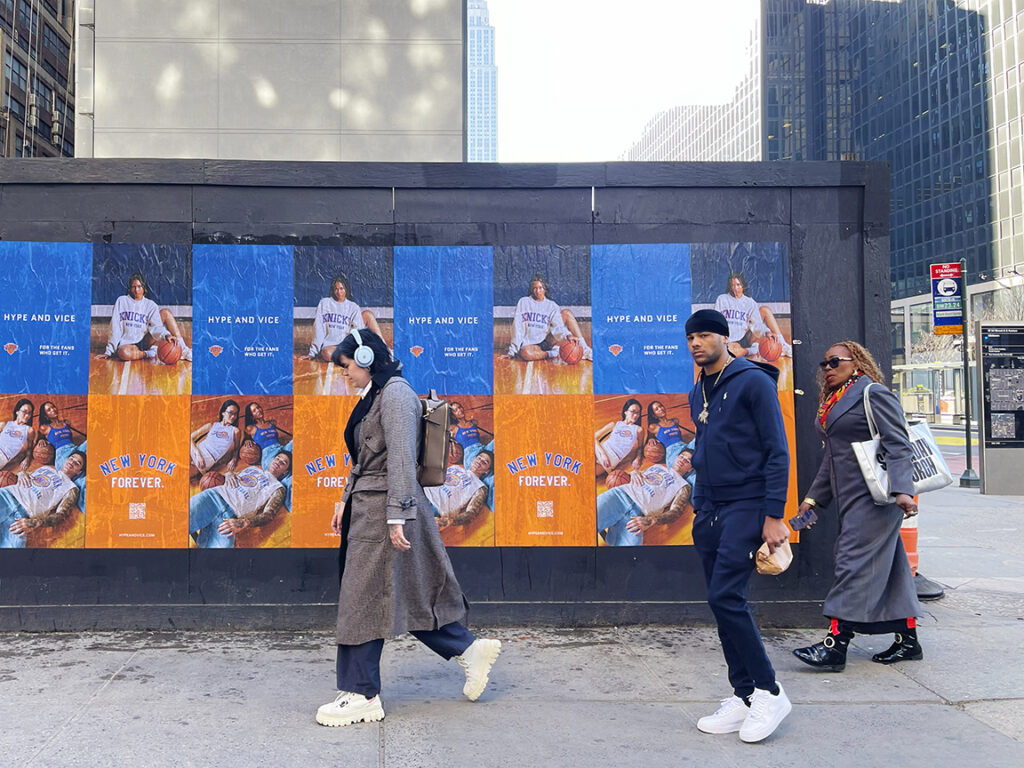
Beyond field crew programs, physical advertising in sports venue districts creates sustained brand presence that extends across multiple game days and builds cumulative awareness with both the event audience and the local population that occupies the venue district geography year-round. Wheatpasting and poster campaigns in venue districts placed before the season or before a major event create visual brand presence that the audience encounters across multiple visits to the neighborhood. Sidewalk stencils on the fan approach corridors create ground-level brand presence that persists across the full campaign window.
The combination of advance physical advertising with game-day field crew activation creates a layered sports brand activation that reaches the audience in multiple contexts: as they move through the venue district in the days before the game, as they arrive on game day, and as they engage directly with brand crew in the peak pre-event window. The layered presence is more memorable than any single format alone.
Sampling Programs for Sports Brand Activation
Product sampling in sports environments is most effective when the sample has genuine relevance to the fan experience. Food and beverage products that complement the game-day eating and drinking culture generate higher trial rates than categories that feel out of place in the sports context. Snack products, energy and functional beverages, and new food and drink formats are natural categories for sports event sampling. Personal care and lifestyle products need a stronger contextual hook to fit naturally in the game-day sampling environment.
We execute sampling programs at sports events with briefed brand ambassador crews who create genuine engagement at each trial moment. The sample handoff is a product experience, not a passive distribution. The brand ambassador who engages the fan, asks about their day, and creates a brief moment of connection around the trial makes the product encounter memorable in a way that a passive sample table does not.
Season-Long Sports Brand Activation Programs
The most effective sports brand activation programs are not single-event executions. They are season-long programs that build cumulative brand presence in the venue district across the full team schedule, create consistent touchpoints with the regular game-day audience, and establish the brand as a genuine part of the sports fan experience rather than an occasional visitor to it.
Season-long programs for NFL teams typically cover eight to nine home games with consistent activation formats and rotating creative. NBA programs cover 41 home games with a lighter per-game footprint but high cumulative frequency. The repetition builds brand recognition with the season-ticket and regular-attendance audience that creates the most durable brand associations of any sports marketing format.
Measuring Sports Brand Activation Results
Sports brand activation measurement combines direct output metrics with contextual field observation. Materials distributed, samples delivered, engagement counts logged by position, and GPS-documented photography from all deployment positions are the standard output metrics. For campaigns with promotional codes or QR-linked materials, digital redemption data provides direct attribution. LED truck impression estimates are based on traffic volume data for the approach routes during the deployment window.
For season-long programs, cumulative measurement across the full game schedule builds a performance database that allows optimization across the season. Which game matchups produce the highest fan engagement? Which approach positions generate the most materials distribution? Which crew positioning sequences produce the best coverage of the arriving audience? These questions are answerable with data from a systematic measurement program that treats each game as a data point in a season-long analysis.
Sports Brand Activation for Brand Categories Beyond the Obvious
The categories with the most obvious sports brand activation opportunities are food, beverage, and lifestyle brands with direct sports relevance. But the sports venue environment is accessible to brand categories that are less obviously sports-adjacent, and the concentration of valuable audience segments in the sports geography creates opportunities for B2B brands, financial services, insurance, healthcare, and other categories that can connect their brand to the fan experience through creative activation approaches.
Financial Services and Sports Audiences
Sports audiences at major professional venues skew toward mid-to-high income professional households that represent the core target for many financial services brands. The game-day environment does not create an obvious financial services activation moment, but brands in this category can build presence in the sports geography through premium give-away activations, sponsorship of fan zone programming, and street team deployments with high-value promotional offers that create genuine engagement incentives. Financial brands that can connect their offer to the game-day occasion, exclusive fan offers, team-specific account benefits, or event-specific promotions, generate stronger engagement than generic financial brand messaging in the sports context.
Healthcare and Wellness Brands
Healthcare and wellness brands, including over-the-counter products, sports medicine brands, and wellness services, have natural relevance to sports audiences because the sports culture is inherently health-conscious. Active recovery products, sports nutrition brands, and wellness services targeting athletic and health-engaged consumers find receptive audiences in sports venue districts, particularly at venues that attract health-conscious fan demographics like running events, cycling races, and fitness-adjacent sports.
Sports Brand Activation at Non-Traditional Events
Sports brand activation extends beyond the traditional professional and college sports calendar. Endurance events like marathons, triathlons, and obstacle races; recreational sports leagues and tournaments; and sports-adjacent cultural events including athletic clothing launches, shoe culture events, and sports media festivals all create concentrated sports audience engagement opportunities. These non-traditional sports events often have smaller official marketing budgets and less sponsor clutter than major professional events, which creates more visible space for brand activations in their surrounding geography.
Marathon expo areas and pre-race corrals for major endurance events concentrate a health-conscious, athletically engaged audience in a defined geographic zone for extended periods. The psychological state of pre-race participants, focused, high-energy, and brand-receptive in categories relevant to athletic performance, creates strong sampling and engagement conditions for brands in sports nutrition, athletic apparel, recovery, and performance categories.
Seasonal Planning for Year-Round Sports Brand Activation
Building a year-round sports brand activation calendar requires mapping the sports event schedule in target markets across the full year and identifying the events that create the most valuable activation opportunities for the specific brand and objective. Different seasons bring different sports dominance: NFL and college football in fall, NBA and NHL in winter and spring, MLB across the spring and summer, with major golf and tennis tournaments, NASCAR races, and special events creating year-round peaks on top of the regular season schedules.
Year-round sports brand activation programs that move through the sports calendar, activating at the highest-value events in each season in each target market, build cumulative presence with the sports fan audience that no single-event campaign can match. The fan who has encountered the brand at a fall football tailgate, a winter basketball game, and a spring baseball park district activation across a 12-month calendar is in a different relationship with that brand than the fan who encountered it at one event. The compounded recognition builds into the brand loyalty that makes sports marketing one of the highest-return formats for brands with the resources and commitment to sustain it.
Frequently Asked Questions
What is sports brand activation?
Sports brand activation is the practice of building brand presence and engagement with sports audiences through in-person field campaigns at and around sporting events. It includes street teams in venue districts, sampling programs targeting sports fans, tailgate activations in stadium parking areas, LED billboard trucks on approach routes, and poster campaigns in fan corridors.
How does sports brand activation work without official team sponsorship?
Sports brand activation without official sponsorship focuses on the public geography surrounding venues and events. Street teams, sampling, outdoor advertising, and LED trucks in public spaces reach sports audiences without requiring official team or league authorization.
What are the best formats for sports brand activation?
Tailgate sampling activations work best at NFL and college football games. Street team deployments work best at urban arenas with walkable approach corridors. LED billboard trucks work across all venue types. Poster and print campaigns work as advance awareness formats in the weeks before events.
Which sports fan audiences are most receptive to brand activation?
NFL and college football fans are particularly receptive because of the long pre-game window and established tailgate culture. NBA and NHL playoff audiences in urban arenas are highly engaged during peak playoff moments. Major league baseball fan districts are active across a long season with daily event frequency.
How long before a game should sports brand activation begin?
Advance poster campaigns should launch one to three weeks before major events. Game-day street team and sampling activations begin 90 minutes to two hours before doors open. LED billboard truck campaigns run during the 60 to 90 minute peak arrival period.
What does sports brand activation cost?
Single-game street team activations range from $1,500 to $4,000. Tailgate sampling programs run $3,000 to $10,000 per event. LED billboard truck programs run $2,000 to $6,000 per event. Season-long programs are structured with custom pricing.