Snipe Advertising: Precision Outdoor Poster Campaigns That Work | AGM
Snipe advertising puts your message at eye level on the streets where your audience walks every day. Small format. High frequency. Maximum neighborhood saturation. Here is how it works and what it costs.
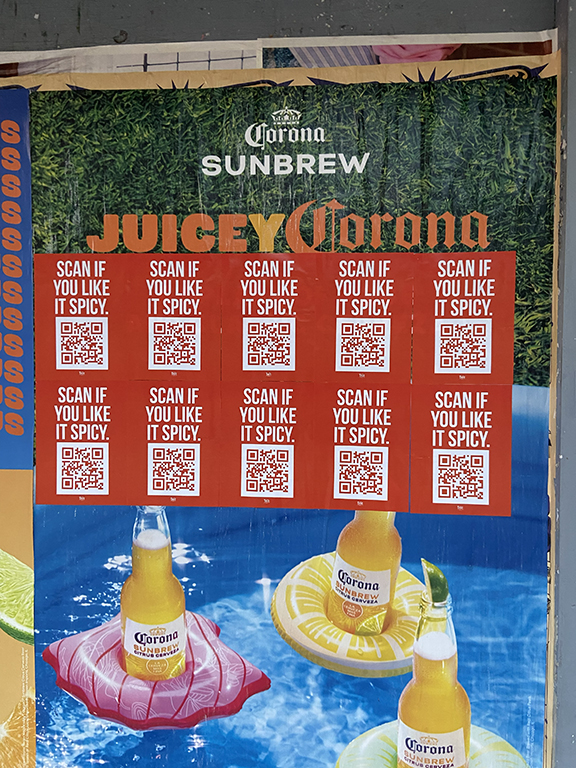
Snipe advertising is a street-level outdoor format that places small printed posters directly in the path of pedestrian traffic. Snipes go on construction barriers, utility boxes, scaffolding columns, and other high-traffic street surfaces at walking eye level. The reader does not have to look up or across the street. The poster meets them exactly where they are moving.
The format works because of frequency and proximity. Snipes are not trying to deliver complex brand narratives. They are trying to put a specific message in front of a specific pedestrian audience repeatedly over the course of a campaign run. Someone who walks past a snipe on their morning commute sees it again on their lunch break and again on their way home. By the third or fourth exposure in a single week, the message has registered. That is how snipe advertising builds neighborhood presence.
At American Guerrilla Marketing, snipe campaigns are one of our core street-level formats. We have placed snipes across all five boroughs and know which neighborhoods, corridors, and surface types produce the best combination of longevity and pedestrian exposure. We build fully customized placement maps per campaign, scout locations before execution, and handle all production and placement logistics. This guide covers how the format works, how to design for it, how to scope a campaign, and what our campaigns cost.
A snipe is a small-format printed poster, typically 9 by 12 inches (standard) or 11 by 14 inches (jumbo). It is affixed to a street-level surface using wheatpaste or adhesive and positioned at walking eye level so pedestrians encounter it naturally in their field of vision without looking up or changing their line of sight.
The placement philosophy for snipes is density within a defined corridor. Rather than placing one snipe per block across a large geographic area, effective snipe campaigns concentrate placements in the specific streets, intersections, and pedestrian corridors where the target audience moves most frequently. Saturation within a tight target area produces more repeated exposure per target individual than diffuse placement across a wider area. Repeated exposure is what builds familiarity, and familiarity is what drives the action a snipe is trying to prompt.
Snipes are a direct-response format at the neighborhood level. They work best when the message is simple, the call to action is clear, and the design is bold enough to register in the two to three seconds a pedestrian has to process the poster while walking past it. They are not designed to communicate complex messaging. They are designed to put a name, a proposition, and an action in front of a moving audience, over and over, until the combination of familiarity and relevance prompts a response.
Standard and Jumbo Snipe Formats
We offer two snipe formats, each suited to different placement environments and campaign objectives.
Standard 9×12 Snipes
Standard snipes measure 9 by 12 inches. This format fits tight placement surfaces — utility boxes, construction barrier panels, scaffolding columns, and street furniture. The smaller footprint allows placements in locations where a larger format would be impractical or unavailable. Standard snipes are ideal for dense urban environments where surface space is limited and the primary goal is saturation density within a specific corridor. The format is read comfortably by a pedestrian at a normal walking pace from a distance of two to four feet.
Jumbo 11×14 Snipes
Jumbo snipes measure 11 by 14 inches. The additional surface area creates more visual weight and allows for a larger headline that reads at greater distances — six to eight feet — making the format more effective on wide sidewalks, major intersections, and high-clearance construction barriers where pedestrians are moving faster and have a wider visual field. Jumbo snipes are preferred for high-foot-traffic corridors in commercial districts, transit hubs, and major street-level retail areas.
Campaign Pricing
Snipe campaigns are priced by format and quantity. Placement maps are fully customized per client based on target neighborhoods, scouting results, and campaign objectives. Final placements vary based on location access, surface availability, and targeting priorities established during the planning phase.
Format
Quantity
Campaign Price
9×12 Standard Snipes
400 placements
$3,500
9×12 Standard Snipes
800 placements
$5,500
11×14 Jumbo Snipes
400 placements
$6,500
11×14 Jumbo Snipes
800 placements
$7,500
All campaigns include scouting, placement, and full client reporting. Contact us for custom quantities, multi-market campaigns, or campaigns combining snipe formats with other street-level placements. Clients may provide print-ready artwork or work with our design team prior to production.
AGM Field Note — Why Quantity Matters: A snipe campaign’s effectiveness scales with repetition. At 400 placements concentrated in a targeted neighborhood corridor, a regular commuter will encounter the snipe multiple times per week across multiple locations on their daily route. At 800 placements across two neighborhoods or a denser concentration in one, the frequency per individual increases substantially. We recommend the 800-placement tier for campaigns with a defined conversion objective rather than pure awareness goals. The additional placements do not just double the reach — they multiply the per-person frequency in a way that drives response rates.
Designing for the Snipe Format
Snipe design is governed by a set of practical constraints that differ significantly from print or digital design. The viewer is in motion. The viewing distance is two to eight feet. The viewing time is two to four seconds. The visual environment is cluttered with competing information — street signs, storefronts, other posters, traffic. Every design decision needs to be made with these conditions as the primary constraint.
Headline: Five Words or Fewer
The headline on a snipe needs to communicate the core proposition in five words or fewer. At walking speed and snipe scale, a viewer can process five short words in the available viewing time. More text than that does not get read — it gets categorized as “too much to bother with” and skipped. “NYC’s best pizza slice. $2.” works. “Award-winning artisanal pizza crafted from local ingredients in our Brooklyn kitchen.” does not. Every word that does not earn its place on a snipe costs you the attention of people who would have responded to the shorter version.
Contrast and Visibility
High contrast is non-negotiable on a snipe. Black on yellow, white on black, red on white — combinations that hold contrast in variable outdoor lighting and against the visual noise of the street environment. Pastel palettes, gradient backgrounds, and low-contrast color combinations disappear on the street. The snipe needs to stand out from its physical surroundings, not blend into them. Test designs by reducing them to a small scale on screen and verifying that the headline is still instantly readable. If it is not, increase the contrast.
A Single Clear Call to Action
Snipes should have one call to action, not three. A URL, a phone number, a QR code — choose the primary response mechanism and make it the clearest element on the poster after the headline. Multiple calls to action create decision paralysis in a two-second viewing window. The viewer who might have scanned a QR code decides not to when they also have to process a URL and a phone number and a social media handle. One action. Clear. Large enough to read from four feet away.
Brand Identity Elements
A logo or brand mark can be included but should not compete with the headline or the call to action for visual priority. The brand element should be legible and recognizable at snipe scale but subordinate to the message the viewer needs to receive. A common mistake is to center the design around a logo that means nothing to someone seeing the brand for the first time, at the expense of a headline that would have communicated something useful.
Placement Strategy: Where Snipes Go and Why
Snipe placement is not random. Every location in a campaign is chosen for a specific combination of foot traffic volume, pedestrian dwell, surface type, and longevity potential. We scout every neighborhood before placing a campaign to identify the specific surfaces and corridors that maximize these factors for the client’s target audience.
Construction Barriers
Construction barriers are among the best snipe surfaces in New York City. They are typically 8 feet tall or taller, street-facing, and situated at exactly the pedestrian traffic level. The flat wooden or plywood surface holds paste well and the panels are large enough to accommodate multiple side-by-side placements for emphasis. Construction barriers also tend to stay in place for months, which gives snipe placements on these surfaces exceptional longevity compared to more transient street furniture.
Utility Boxes and Signal Cabinets
Street-level utility boxes and signal cabinets are prime snipe surfaces in commercial neighborhoods. They are at eye level, on sidewalk corners with high pedestrian cross-traffic, and they face multiple directions giving each placement visibility from multiple approach angles. A single utility box at a busy corner can function as a mini-billboard that gets seen by everyone who crosses that intersection on foot throughout the day.
Scaffolding
Scaffolding provides extensive linear surface area along high-foot-traffic streets. A scaffolded building on a busy commercial block creates a long corridor of potential snipe placements that pedestrians walk past at close range. Multiple placements along a scaffolding run create frequency on a single block, ensuring that even fast-moving pedestrians encounter the message more than once.
Targeting by Neighborhood Corridor
Our placement maps are built around pedestrian corridors — the specific streets and routes that the target audience uses most. For a food and beverage brand targeting Williamsburg, the placements concentrate on Bedford Avenue, Grand Street, and the blocks between them where foot traffic is densest. For a fitness service targeting Astoria, the corridor focus shifts to 30th Avenue and Ditmars Boulevard. The corridor strategy produces more per-individual frequency than scattering placements broadly across the neighborhood.
AGM Field Note — Scout Before You Place: We never go straight to execution without scouting. A location that looks ideal on a map may have access issues, surface problems, or competing poster saturation that makes it a poor choice in practice. The scouting phase also lets us identify high-value locations that are not obvious from a satellite view — a laundromat-adjacent utility box, a scaffolding run on an unusually high-traffic side street, a construction barrier at a transit entrance. The scout is where the campaign quality is actually built.
Snipe Advertising Versus Other Street-Level Formats
Understanding where snipes fit relative to other street-level formats helps clarify when they are the right choice and when a different format or a combination of formats makes more sense for a specific campaign objective.
Snipes versus large-format outdoor posters: Large outdoor posters operate at a scale that creates visual dominance over a wider area and attracts attention from drivers and pedestrians at greater distances. Snipes create saturation at close range along specific pedestrian corridors. Large outdoor posters are awareness-building at a broad scale. Snipes are awareness-building at a neighborhood-density scale. They serve complementary rather than competing functions.
Snipes versus hand-to-hand flyer distribution: Flyer distribution puts physical materials into people’s hands on a specific day. Snipes stay in place and accumulate exposure over a two-to-four week run. Distribution creates a contact spike on distribution day. Snipes create a sustained presence that builds frequency over time. For campaigns where repeated exposure matters more than a one-day contact volume surge, snipes produce better long-term results than a single distribution event.
Snipes versus community board pull-tab posters: Pull-tab posters target people in browse mode at stationary community board locations. Snipes target people in transit mode on the street. Pull-tab posters capture readers who have time to read and respond immediately. Snipes build awareness and familiarity through repeated transit-mode exposure. Combining both in the same neighborhood creates awareness through snipe saturation and converts interested pedestrians through pull-tab boards when they arrive at dwell locations.
Campaign Timeline and Execution
A standard snipe campaign runs from initial brief to placement in two to three weeks. The first week covers campaign planning, neighborhood scope confirmation, and artwork production or review. The second week covers scouting and placement map finalization. Execution takes one to two days for campaigns of 400 to 800 placements in a concentrated neighborhood area. We provide post-placement reporting with location documentation and a summary of the campaign as placed versus the planned map.
For campaigns combining snipes with other formats — distribution, larger poster placements, community board campaigns — the planning timeline is coordinated to ensure all formats go live within the same window. A coordinated multi-format launch in the same neighborhood produces compounding familiarity effects that a staggered rollout does not.
Who Uses Snipe Advertising
Snipe campaigns work well for brands, events, services, and businesses whose target audience is concentrated in specific New York City neighborhoods and who benefit from repeated visual contact with that audience. Entertainment brands running album drops, event launches, or film releases use snipes to build neighborhood-level buzz before a launch date. Consumer brands entering a new market use snipes to establish visual presence in target neighborhoods without the cost of traditional outdoor advertising. Local businesses use snipes to build recognition in their immediate trade area. Artists and musicians use snipes to drive attendance at venue performances or gallery openings in the neighborhoods where their audience lives.
The common thread across all of these use cases is audience concentration. Snipes are most cost-effective when the target audience is geographically concentrated in identifiable neighborhoods. The more focused the target geography, the more per-individual frequency a snipe campaign generates at a given quantity level. For brands with a genuinely national or broad urban reach, other formats scale better. For brands with a defined neighborhood-level target, snipes are one of the highest-frequency street-level tools available.
Snipe Advertising Results: What to Expect from a Campaign
Understanding what snipe advertising can and cannot do prevents misaligned expectations and helps you evaluate results accurately. Snipe campaigns build awareness and familiarity through repeated pedestrian exposure. They are not a direct-response format that generates immediate measurable conversions the way a QR code campaign or a phone number response mechanism does. Their role in the campaign mix is to create the neighborhood-level recognition that makes every other format in the campaign more effective.
The primary output of a snipe campaign is increased brand recognition and recall within the target neighborhood. Residents who walk past a snipe placement on a repeated schedule — daily commuters, regular shoppers, local workers — accumulate exposure over the campaign window. By the end of a two-to-three week run, many of these residents can recognize the brand name, recall the core offer, and feel some degree of familiarity with what is being advertised even if they have not yet acted on it.
Secondary outputs include direct responses. Some viewers stop, read the call to action, and visit the URL or scan the QR code on the spot. Others remember the brand name and search for it later. A QR code on the snipe provides a direct measurement mechanism for this secondary response: QR scans from snipe placements are trackable per location if unique codes are used. The ratio of QR scans to total placements gives you a read on how many people are moving past the awareness stage to direct digital engagement.
For a 400-placement snipe campaign in a concentrated NYC neighborhood running three weeks, a realistic expectation is significant neighborhood-level brand recognition growth combined with 50 to 200 trackable direct engagements (QR scans, URL visits from the campaign window). The primary value, however, is the awareness buildup that compounds with other campaign formats running simultaneously in the same area.
Snipe Advertising for Different Campaign Objectives
Snipe campaigns are versatile across a range of campaign objectives. The format adapts to different messaging needs, audience targets, and timing windows. Understanding the range of objectives snipes serve well helps clarify where they fit in a broader campaign strategy.
Event Launches and Announcements
Snipes are highly effective for building pre-event buzz and driving attendance awareness for concerts, art openings, film releases, product launches, and recurring venue events. The concentrated neighborhood saturation of a snipe campaign creates a sense of visible momentum in the weeks before a launch date. Residents see the poster repeatedly on their daily routes and the cumulative exposure generates conversation and social awareness that extends beyond the poster itself. Time the snipe deployment to hit two to three weeks before the event for maximum buildup effect.
Brand Entry into New Neighborhoods
Consumer brands entering a new neighborhood market use snipes to establish visual presence without the lead time and cost of traditional outdoor advertising. A snipe campaign in Astoria for a brand that is opening a location on 30th Avenue creates neighborhood familiarity with the brand name before the doors open. When residents walk past the new storefront, the snipe campaign has already introduced the name. The first time is no longer actually the first time.
Service Business Awareness
Local service businesses use snipes to build name recognition in the specific neighborhoods they serve. A cleaning service, a personal training studio, a local contractor, a neighborhood restaurant — any business that depends on proximity for customer acquisition benefits from repeated visual presence on the streets where potential customers live and move. Snipes in the target neighborhood create the low-level familiarity that increases trust when a resident is ready to choose a service provider in the category.
Coordinated Campaign Amplification
One of the most effective uses of snipes is as an amplifier for coordinated multi-format campaigns. When snipes run simultaneously with hand-to-hand distribution, community board pull-tab posters, and digital advertising targeting the same geographic areas, the formats compound each other’s effectiveness. The snipe familiarity makes the distribution flyer feel familiar. The distribution flyer makes the community board poster feel expected. The community board poster makes the digital retargeting ad feel like a confirmation of something already known. Each format at a lower budget becomes more effective when the snipe campaign has pre-loaded neighborhood recognition.
Post-Campaign Assessment: What to Measure
After a snipe campaign runs its full duration, a structured post-campaign assessment provides data that improves every subsequent campaign. The assessment covers placement survival rate, geographic coverage accuracy, QR code engagement if tracked, and any qualitative market feedback collected during the campaign window.
Placement survival rate is the percentage of placements that were still visible and intact at the end of the campaign window. In high-competition neighborhoods where competing campaigns and weather conditions reduce poster longevity, survival rates below 60 percent are common. A survival rate below 40 percent indicates either poor surface selection, higher-than-expected competitor activity, or weather conditions that should be factored into the next campaign’s timing.
Geographic coverage accuracy compares the planned placement map to the actual executed placements. Scouting sometimes reveals that specific planned surfaces are not accessible on execution day — a construction project has ended and the barrier panels are gone, a utility box has been freshly painted and cannot be posted on, or a property manager has restricted a surface that was previously available. Coverage gaps identified in the post-campaign assessment inform the next campaign’s scouting phase with specific areas to find replacement surfaces.
QR code engagement data, if unique codes were used per location cluster, provides the closest available proxy for direct response from the snipe campaign. Sorting QR scan rates by geographic cluster identifies which neighborhoods generated the most direct digital engagement, which is a useful input for prioritizing neighborhood focus in the next campaign cycle. High scan rates in specific neighborhoods are a signal that the audience there is engaged and worth further investment.
Qualitative market feedback includes any organic social media mentions, word-of-mouth references from clients or prospects, or direct inquiries that mention the poster campaign. Tracking these signals during and after the campaign window provides anecdotal evidence of awareness generation that the quantitative metrics may undercount.
Frequently Asked Questions
What is snipe advertising?
Snipe advertising is a street-level outdoor advertising format that uses small-format printed posters placed at eye level on high-traffic surfaces in targeted urban neighborhoods. Snipes are typically 9 by 12 inches or 11 by 14 inches and are placed on construction barriers, utility boxes, scaffolding, and other pedestrian-level surfaces in high-foot-traffic corridors.
What size are snipe posters?
Standard snipes are 9 by 12 inches. Jumbo snipes are 11 by 14 inches. The standard format fits tight placements on utility boxes and construction barriers where larger formats would be impractical. Jumbo snipes carry more visual weight and are easier to read at passing walking speed, making them the preferred format for wide sidewalks and high-foot-traffic corridors.
How much does a snipe advertising campaign cost?
AGM snipe campaigns start at $3,500 for 400 standard 9×12 snipes and $5,500 for 800 standard snipes. Jumbo 11×14 snipe campaigns start at $6,500 for 400 placements and $7,500 for 800 placements. Placement maps are fully customized per client based on target neighborhoods, scouting results, and campaign objectives.
How long do snipe posters stay up?
Snipe poster longevity depends on weather, location type, and surface. In typical NYC conditions, well-placed snipes last two to four weeks before showing significant wear. Construction barrier placements tend to stay up longer than exposed street furniture placements. We scout locations specifically for longevity as well as foot traffic density when building placement maps.
What neighborhoods does AGM cover for snipe advertising?
We run snipe campaigns across all five New York City boroughs. Common target neighborhoods include SoHo, the Lower East Side, Williamsburg, Bushwick, Astoria, Crown Heights, Harlem, Washington Heights, and the South Bronx, among others. Placement maps are custom-built per campaign based on the client’s target demographic and geographic focus.
What is the difference between snipe advertising and larger outdoor poster formats?
Snipes are small-format placements at street level, optimized for close-range pedestrian viewing. Larger outdoor formats operate at greater visual scale and reach viewers from farther away. Snipes create saturation within a tight pedestrian corridor. Larger formats create visual dominance over a broader area. Both serve different functions and can be combined in a layered neighborhood campaign.
How do you design an effective snipe poster?
Effective snipe design requires contrast, brevity, and a clear call to action. Use a high-contrast color combination, a headline of five words or fewer, and one clear action for the viewer: visit a URL, scan a QR code, or call a number. Snipes are read in motion, so every element must communicate in two to three seconds at pedestrian walking pace.
Can snipe advertising be combined with other outdoor formats?
Yes. Snipes work well alongside hand-to-hand flyer distribution, larger outdoor poster placements, and community board campaigns. Snipes handle neighborhood saturation at street level while other formats create awareness at different scales and through different modes of audience engagement. Combining formats in the same target area amplifies overall campaign frequency.
How are snipe placement locations chosen?
We scout neighborhoods in advance of every campaign to identify high-foot-traffic surfaces, assess placement quality and longevity, and map a route that maximizes saturation in the target area. Placement maps are reviewed with clients and tailored to their specific neighborhood focus and demographic target. Final placements vary based on scouting conditions, access, and campaign targeting priorities.
How do I get started with a snipe campaign?
Call us at (646) 776-2770 or email [email protected] with your target neighborhood, campaign timeline, and any design files or messaging you have. We will scope the campaign, build the placement map, and walk you through production and execution. Clients can provide print-ready artwork or work with our design team on the creative.