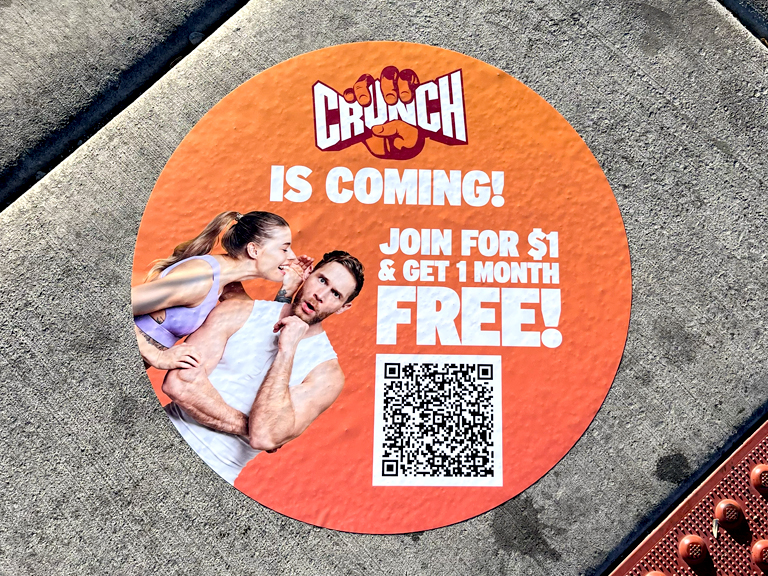
Sidewalk Decal Advertising: A Complete Brand Guide
Custom vinyl graphics installed directly on sidewalks, plaza floors, and transit exits. Full color, photo quality, slip-resistant — and seen by millions of feet every week in New York City.
Every day, tens of thousands of people walk out of the 34th Street Penn Station subway exits and look at the ground. It is a reflex — they scan for obstacles, check for wet surfaces, navigate around other people. That moment of downward attention is something most outdoor advertising formats cannot reach. Billboards are up. Bus shelters are to the side. But sidewalk decals are right there underfoot, impossible to miss from a natural walking sightline.
That is the core case for sidewalk decal advertising: the format occupies space that other outdoor formats do not compete for, and it does so with full-color, photo-quality vinyl graphics that hold up under real foot traffic for one to four weeks. We have installed sidewalk decals at subway exits, retail plaza entrances, trade show floors, event approach walkways, and stadium plazas across New York City and beyond.
This guide covers what sidewalk decals are, how they differ from chalk or paint stencil formats, where they work best in New York, what AGM’s official pricing looks like, and what you need to know about design and surface specs before you start a campaign.
A sidewalk decal is a custom-printed vinyl graphic applied directly to a flat ground surface — sidewalk pavement, plaza tile, trade show concrete, retail entry flooring. The decal is produced using large-format digital printing technology, which means you can print virtually any artwork at high resolution: full-color logos, photography, typographic layouts, illustrated graphics, QR codes, directional arrows, or any combination.
The vinyl substrate is the part that makes or breaks a sidewalk decal campaign. We use a laminated vinyl specifically rated for floor and pavement applications. The laminate is slip-resistant — this is not optional, it is a safety requirement — and it is rated for the level of foot traffic typical of the surfaces where we install. A slip-resistant laminate does not just protect pedestrians; it also protects the printed graphic underneath from abrasion, extending the visual life of the decal under heavy traffic conditions.
Installation uses an adhesive backing engineered for temporary outdoor applications. The decal bonds firmly enough to stay in place through normal pedestrian traffic and standard weather conditions, but it comes up cleanly when the campaign window closes without leaving adhesive residue on the surface. The removal process is fast and leaves the pavement in the same condition it was in before installation.
How Sidewalk Decals Differ from Stencil Formats
Sidewalk decals and chalk or paint stencils are both ground-level advertising formats, but they are fundamentally different products that produce different creative results and serve different campaign goals.
Chalk stencil formats apply chalk-based paint or powder through a cut stencil, leaving a single-color impression on the pavement surface. The results are typically monochromatic — white, a brand color, or a limited two-color layout. Chalk stencils are lower cost and faster to produce, but they cannot carry full-color photography, color photography, or complex multi-color artwork. They are also less durable — chalk-based applications weather faster and cannot match the physical durability of a laminated vinyl under sustained foot traffic.
Sidewalk decals, by contrast, are produced digitally and can carry any artwork that can be printed: a product photograph, a full-color illustration, a gradient, a typographic layout with brand-accurate Pantone-matched color. The vinyl laminate protects the printed surface and extends its life significantly compared to chalk-based applications. The visual quality of a sidewalk decal is closer to what you would expect from a print ad in a magazine than from a hand-applied street format.
The trade-off is production cost and lead time. Stencils can be cut and applied faster. Decals require print production, lamination, and die-cutting, which adds to the production window. For campaigns where visual fidelity matters — product launches, brand partnerships, premium retail activations — the difference in output quality justifies the additional production investment.
Design guidance: Sidewalk decals can carry any print-quality artwork. That said, bold graphic layouts with strong color contrast and legible typography at reading distance (about 3 feet from standing height) tend to perform best in terms of pedestrian attention. Overly complex artwork with fine detail can get lost underfoot. We review all artwork files before production and flag any concerns before we go to print.
Official AGM Sidewalk Decal Pricing
Below is our current standard pricing for sidewalk decal campaigns. All rates are per-campaign and include decal production, installation, and removal at the end of the campaign window. Pricing is based on quantity, since production costs per unit decrease at scale.
Quantity (Decals)
Campaign Price
5 decals
$2,904
10 decals
$3,404
15 decals
$3,904
20 decals
$4,998
30 decals
$6,373
40 decals
$7,477
50 decals
$8,709
60 decals
$9,995
70 decals
$10,982
80 decals
$11,974
90 decals
$13,149
100 decals
$14,466
150 decals
$20,391
200 decals
$25,916
Rush production (72-hour turnaround): Add 50% to the standard campaign price.
These rates cover standard campaign windows and single-market installations. Multi-city rollouts, extended campaign periods, or specialty surface applications (such as interior trade show floors or unique architectural surfaces) may carry different pricing. Contact us to discuss your specific project scope.
Where Sidewalk Decals Work Best in New York City
New York City is our primary market for sidewalk decal installations, and we know the city’s pedestrian geography in detail — which exits carry the highest daily counts, which plazas draw the right demographics, which approach routes concentrate your target audience in a specific window. Here is a breakdown of the locations we use most frequently and why.
Subway Station Exits: The Highest-Volume Ground in the City
Subway exits are our most-requested surface type for sidewalk decals. The geometry of a subway exit is ideal for this format: hundreds or thousands of people emerge from a single staircase onto a narrow landing, look down to navigate the transition from stairs to sidewalk, and pass directly over whatever is on the ground at that landing point. That moment of downward focus is consistent, predictable, and concentrated.
The numbers at major Manhattan stations are substantial. The 34th Street Penn Station complex handles over 60,000 daily riders across its various entrances and exits. Times Square subway exits collectively serve more than 300,000 daily pedestrian movements. Union Square is one of the top five busiest stations in the system. Canal Street draws a mix of tourists, commuters, and shoppers moving between Lower Manhattan and TriBeCa.
A well-placed decal at a busy subway exit is one of the most efficient impression-per-dollar formats in New York outdoor advertising, full stop. The audience is captive, the viewing angle is direct, and the location is specific enough to reach a defined geographic and demographic segment.
Herald Square
Herald Square — the intersection of Broadway, 6th Avenue, and 34th Street — is one of the city’s highest pedestrian volume zones. The combination of Macy’s flagship, the convergence of multiple subway lines, Penn Station foot traffic, and the general commercial density of Midtown West creates a sustained pedestrian flow throughout the day. The plaza areas and sidewalk sections around the square are strong decal surfaces, particularly for retail, fashion, and mass consumer brands targeting a broad NYC demographic.
Flatiron Pedestrian Zone
The Flatiron district — particularly the pedestrian plazas on Broadway between 22nd and 26th Streets — draws a mix of tech workers, media professionals, tourists visiting the Flatiron Building, and shoppers on the Ladies’ Mile corridor. The plazas have wide, flat tile surfaces that are excellent for decal installation. The neighborhood demographic skews younger and more affluent than the Times Square / Midtown tourist corridor, making it a strong location for brand activations targeting those audiences.
DUMBO, Brooklyn
DUMBO has become one of Brooklyn’s most visited neighborhoods, drawing significant foot traffic from the Brooklyn Bridge Park waterfront, the Manhattan Bridge arch area, and the concentration of tech companies, creative agencies, and retail that has settled in the neighborhood’s converted warehouse buildings. The cobblestone streets are not suitable for decals (the uneven surface prevents good adhesion), but the smoother pavement around the main commercial blocks and the brick plazas near the waterfront work well. DUMBO campaigns tend to perform well for brands targeting creative, design-aware, and tech-adjacent audiences.
Barclays Center Plaza
The plaza surrounding Barclays Center in Prospect Heights is a natural activation zone. Before concerts, basketball games, and major events, the plaza concentrates the event audience in a defined outdoor space. Decals on the plaza approach and in the main pedestrian areas catch audience members who are already primed for entertainment and brand experiences. This location works particularly well for music, entertainment, and sports-adjacent brands.
Williamsburg Waterfront
The Williamsburg waterfront — particularly the areas around the East River State Park and the adjacent commercial corridor along Kent and North 6th Street — draws a younger, culturally active Brooklyn crowd. The foot traffic here is less about pure volume and more about demographic precision. For brands targeting 18-34 urban consumers with interests in music, food, fashion, and street culture, Williamsburg waterfront placements reach that audience in a context where they are relaxed, engaged, and receptive.
Retail Plaza Entrances and Trade Show Floors
Beyond the street-level locations above, sidewalk decals work exceptionally well on controlled interior surfaces like trade show floors and retail plaza entry areas. These environments offer the advantage of a known, predictable audience — trade show attendees are already pre-qualified for whatever category the show represents — and surfaces that are typically in better condition than outdoor pavement. For brands activating at industry trade shows or retail partners with high-volume entrance plazas, this format delivers dense impression concentration in a contained geography.
Surface Requirements and Design Specs
Not every surface is suitable for sidewalk decal installation. The adhesive and the laminate require a reasonably smooth, clean substrate to bond correctly and deliver clean visual results. Here is what you need to know before committing to a specific location.
Surface Types That Work
Smooth poured concrete, brick pavers with tight grout lines, asphalt, and interior tile plazas are all suitable surfaces. The key requirement is that the surface be relatively flat and free of deep cracks, gaps, or significant texture that would prevent the decal from lying flush. A decal that cannot lie flat will lift at the edges faster, reducing durability.
Surface Types to Avoid
Metal grates — the kind common at New York subway entrances — are not suitable for decal installation. The grate pattern prevents adhesion and creates a hazard when the vinyl lifts between the bars. Heavily textured or grooved concrete (sometimes used for traction on ramps or near curb cuts) limits adhesion quality. Very rough asphalt with loose aggregate also creates bonding problems. Our team scouts and assesses surfaces before installation, so if a location has a problematic surface, we flag it early and propose alternatives.
Slip-Resistance Requirement
All decals installed by AGM use a slip-resistant laminate. This is not optional and it is not something we compromise on. The laminate’s coefficient of friction must meet the minimum standard for the surface type it is installed on. We specify slip-resistant laminate on every order, and we do not accept substitutions from production vendors. If you are sourcing decals from a provider that does not explicitly confirm slip-resistant laminate, ask about it before installation.
File Specs for Production
For best print quality at decal size, we need vector artwork (AI, EPS, or PDF with embedded fonts) or high-resolution raster files (300 dpi minimum at final print size). RGB color mode is fine for general use; if Pantone-matched brand color accuracy is critical, provide Pantone coated values alongside your artwork and we will match to the closest available print equivalent. File submission instructions are included in our project onboarding documentation.
Use Cases: What Brands Use Sidewalk Decals For
Sidewalk decals are a format that crosses a wide range of brand categories and campaign objectives. Here are the use cases we see most frequently and what makes the format work for each.
Product Launches
A product launch needs attention at the moment of introduction. Sidewalk decals near key retail locations, transit exits in target neighborhoods, and approach routes to launch events place the brand message in front of the exact audience you need to reach during the critical window around go-live. The format works because it is unexpected and location-specific — it tells the audience that this launch is relevant to them, here, now.
Retail Foot Traffic
Brands with retail locations use sidewalk decals to drive walk-in traffic. A decal on the approach pavement to a store entrance, or on the plaza in front of a retail partner’s location, provides a directional nudge to passing pedestrians. The combination of brand mark and directional graphic (an arrow or a “just ahead” indicator) converts foot traffic into in-store traffic at a measurable rate. We have run retail foot-traffic campaigns for national brands and independent retailers alike.
Event Directional and Festival Branding
Large events use sidewalk decals to brand the approach route and provide wayfinding. A festival or conference that draws attendees to an unfamiliar location benefits from branded directional decals on the approach sidewalks — they serve a practical navigation function while simultaneously reinforcing event branding. This use case typically requires a higher quantity of decals spread across multiple blocks, which is why quantity pricing scales efficiently in our rate table above.
Stadium and Arena Approach
The approach walkways to major sports and entertainment venues are among the most valuable real estate in outdoor advertising during event windows. When 20,000 people are all walking the same two blocks to get to their seats, any brand message on that approach is seen by virtually every one of them. We run decal campaigns on stadium approach routes for sports and entertainment brands, sponsors, and activation partners.
Lifespan and Maintenance
Under typical New York City conditions — high foot traffic, variable weather, standard maintenance sweeping — a slip-resistant vinyl sidewalk decal holds strong visual quality for one to four weeks. Several variables determine where within that range a specific campaign lands.
Foot traffic volume is the primary factor. A decal under 60,000+ daily pedestrian movements wears faster than one under 10,000. For very high-volume locations, we recommend planning for a one-to-two week primary display window and scheduling replacement if the campaign runs longer. We offer replacement installation as part of extended campaign packages.
Weather matters primarily through the accumulation of moisture under the decal edges. Heavy sustained rain can work under the edge seal and begin lifting the perimeter. For outdoor installations during high-rain forecast periods, we use perimeter edge sealing to extend adhesion. In winter, freeze-thaw cycles on outdoor concrete can affect adhesion — we factor seasonal conditions into our installation approach and timing recommendations.
Indoor surfaces — trade show floors, retail interior plazas — are not exposed to weather and typically hold much cleaner and longer than outdoor installations. For indoor campaigns, a two-to-four week window without degradation is standard.
How to Start a Sidewalk Decal Campaign with AGM
Our process starts with a conversation about your campaign goals, target geography, and timeline. From that conversation, we recommend specific locations based on foot traffic data, surface suitability, and audience demographics. We provide a production and installation timeline, handle all site approvals and coordination, and give you a single point of contact from artwork submission through final removal.
AGM manages all site approvals and coordination before installation. Our team handles the pre-installation process in every market we work in, so you do not need to navigate that on your own.
Ready to get started? Reach out at (646) 776-2770 or [email protected]. Tell us your city, your target audience, your campaign window, and your budget range, and we will come back with specific location recommendations and a detailed proposal.
Frequently Asked Questions
What is sidewalk decal advertising?
Sidewalk decal advertising uses custom-printed, slip-resistant vinyl graphics applied directly to sidewalk, plaza, or floor surfaces. Unlike chalk stencils, decals are full-color, photo-quality prints on a durable laminated substrate that can hold up under sustained foot traffic for one to four weeks.
How much does a sidewalk decal campaign cost?
AGM’s standard pricing starts at $2,904 for 5 decals and scales to $25,916 for 200 decals. Rush production (72-hour turnaround) adds 50% to the standard rate. Pricing covers production, installation, and removal. Contact us for multi-city or extended-campaign pricing.
How long do sidewalk decals last?
Most outdoor installations remain visually strong for one to four weeks depending on foot traffic volume, weather, and surface type. Indoor surfaces (trade show floors, retail plazas) typically last longer because they are not exposed to weather. For extended campaigns, we offer replacement installation as part of the package.
Are sidewalk decals slip-resistant?
Yes. Every decal AGM installs uses a slip-resistant laminate. This is a non-negotiable specification. We specify slip-resistant laminate on every order and do not accept substitutions from production vendors.
What surfaces can you install sidewalk decals on?
Smooth poured concrete, tight-grain brick pavers, asphalt, and interior tile plazas are all suitable surfaces. Metal grates, heavily textured concrete, and rough aggregate asphalt are not suitable. Our team scouts surfaces before installation and flags any issues early.
What is the best location in NYC for sidewalk decal campaigns?
High-volume subway exits — 34th Street Penn Station (60,000+ daily), Times Square (300,000+ daily), Union Square, and Canal Street — are our most-used surfaces for reach. For demographic precision, DUMBO, Williamsburg waterfront, and Flatiron pedestrian plazas offer strong audience targeting. We recommend locations based on your specific campaign objectives and target audience.
How does sidewalk decal advertising differ from chalk stencils?
Chalk stencils apply chalk-based paint through a cut template — single color, limited detail, faster to produce. Sidewalk decals are digitally printed vinyl — full color, photo quality, more durable. Decals are better for campaigns where visual fidelity and color accuracy matter. Stencils are better for high-volume, lower-cost ground-level presence.
What file format do you need for production?
Vector files (AI, EPS, or PDF with embedded fonts) or high-resolution raster files at 300 dpi minimum at final print size. For Pantone-matched color accuracy, provide Pantone coated values alongside your artwork file. We review all files before production and flag any issues before going to print.
Do you handle site approvals and coordination?
Yes. AGM manages all site approvals and coordination before installation. You do not need to navigate that process yourself. Our team handles it in every market we work in.
Can you run sidewalk decal campaigns outside New York City?
Yes. While New York is our primary market, we run campaigns in Los Angeles, Chicago, and other major US markets. Contact us with your target city and we will tell you what we can do there.