
November 3, 2026
Projector Rental for Advertising: What You Get
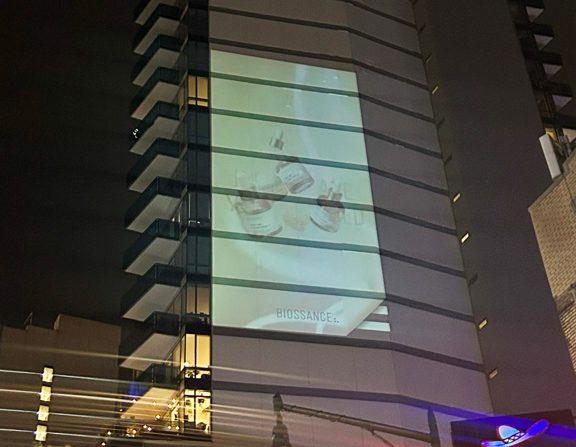
Most people who call us about projector rental for advertising have already looked at a rental catalogue, seen a lumen number, and decided that number is the whole job.
It isn’t. It isn’t close.
A projector is one item on a list of about fourteen things that have to be right before a logo lands clean on a wall at nine at night. The lens is one. The wall is another. Power is another. The person standing next to the rig for four hours is another. Permission to be where you are standing is the one that kills more campaigns than any optical spec ever has.
I have spent a lot of nights on sidewalks with a rig, a generator, and a client on speakerphone asking why the image looks grey. The answer is almost never the projector.
This page is what I would tell you on that call, written down in advance. How far out to book. What the rental actually covers and what it never covers. What permission looks like for projection and why the answer is rarely a clean yes or no. What goes wrong. What we talk clients out of.
If you are trying to decide between renting a projector and hiring a crew who brings one, read the whole thing. The decision is not about the box.
What a projector rental actually includes, and the gap nobody warns you about
A rental house hands you a projector. Sometimes a lens. Sometimes a road case.
What you do not get, unless you ask for it specifically and have the vocabulary to ask correctly:
The gap is operational. You can rent every item above from somewhere. You cannot rent the judgement that decides, at 8:40pm, that the wall you surveyed in daylight has a sodium streetlight washing the lower third of it and the entire image needs to move up nine feet and shrink.
That is what we actually sell. The projector is a tool we happen to own.
Booking timelines: how far out you need to call
Here is the honest sequence, working backwards from the night you want an image on a wall.
Four to six weeks out is comfortable for a multi city run. That gives us time to scout surfaces properly, approach property owners, get written permission where we can get it, confirm power, and build a creative file that suits the surface rather than fighting it.
Two to three weeks out is workable for a single city with a flexible surface list. We can scout, we can get permissions moving, we can build creative. What we lose is the ability to be picky. You take the surfaces that say yes.
Under ten days is possible and we do it, but you are buying a narrower set of options. Property owner approvals do not move fast. Building managers answer email on their own schedule. If a surface requires a sign off from a leasing company in another state, ten days is not enough and we will tell you that rather than let you find out on the night.
Under 72 hours is a different product. At that point we are projecting on surfaces where we already have a relationship or where the permission question is simpler, and the creative has to be something that works without a custom fit.
The thing people underestimate is creative turnaround. A projection file is not a social asset. It is built for a specific surface at a specific aspect with specific contrast behaviour. If your wall has three windows in it, the artwork needs to route around them or accept them. If the brick is dark red, the colour that looked right on your monitor will not survive. Budget real days for that, not an afternoon.
Scouting: why daylight photos lie
We scout twice. Once in daylight to understand the surface, once after dark to understand the light.
Daylight tells you texture, colour, obstructions, window count, mortar depth, whether the wall is painted or raw, whether there is scaffolding, whether there is a tree that will be in full leaf by your run date.
Night tells you the truth. Night tells you where the streetlights are, which ones are sodium and which are LED, whether the building across the road has an illuminated sign throwing a wash, whether a retail unit at ground level leaves its interior lights on all night, whether headlights sweep the lower portion of the wall every time a car turns.
A wall that looks perfect at two in the afternoon can be unusable at nine at night because of one light fitting. I have walked away from surfaces for exactly that reason.
The second thing night scouting gives you is the projection position. You need a place to stand that has line of sight, acceptable angle, somewhere to put a generator, and does not block a doorway, a fire exit, a loading bay, or a bike lane. That spot is frequently not where you want it to be. Sometimes the only workable position is across a road, which means a longer throw, which means a different lens, which means a different projector.
Scouting is where the campaign is actually won. Everything after it is execution.
Surface truth: what holds an image and what eats it
Projection has no adhesive, no substrate, no cure time. What it has instead is a brutal dependence on what it lands on.
Smooth light coloured concrete is the best surface we work with. It holds detail, it holds colour, it does not scatter.
Painted brick in a light colour is close behind. Raw red brick is a different conversation. The mortar lines break up fine detail and the colour absorbs a lot. Logos survive. Small type does not.
Glass curtain wall is mostly a no. The image passes through and you light up somebody’s office. Some glass has enough reflective coating to carry a ghost of an image, and that can be a deliberate effect, but do not plan a campaign around it.
Dark surfaces eat everything. Dark grey, dark brown, black painted brick. You can throw enormous brightness at them and still get a muddy result. We will tell you to pick a different wall rather than sell you a bigger projector.
Wet surfaces behave strangely and sometimes beautifully. Rain on concrete increases specular reflection, which can make an image look sharper from one angle and vanish from another.
Fog and light haze are a gift. Humid nights make the beam itself visible, which adds a volumetric quality that reads well on camera.
On weather generally: light rain is workable with proper covers, heavy rain is not, and wind is the real enemy. Wind moves the rig, and a projection that drifts two feet during a loop looks broken. Sustained wind above a moderate breeze is when I start talking about rescheduling.
Permission, ordinance and the grey area
This is the section people skip and then call us about at 9pm.
Projection Advertising sits in a grey area. It does not fit neatly into the sign categories most municipalities wrote their codes around, because nothing is physically attached to anything. Some jurisdictions treat a projected advertisement as a sign regardless. Some treat it as a temporary display. Some have no explicit treatment at all and the question falls to whoever is on shift. Enforcement is inconsistent between cities, and inconsistent within the same city depending on the district and the night.
What I will not do is give you a blanket ruling on where projection stands in your city. Nobody can make that statement across a country this size, and anyone who offers one is guessing on your behalf.
What I will tell you is how we reduce risk, because that part is concrete:
We seek permission from the property owner of the surface. Projecting onto a building you have an agreement with changes the entire character of the conversation if anyone asks questions.
We prefer private surfaces. Private walls with a cooperative owner are the backbone of a clean projection run.
We operate from positions we are entitled to occupy. Where the projection position is on private property, we have the owner’s say so. Where it involves a sidewalk, we deal with whatever the local process is for occupying that space, and that process varies enormously.
We document. Written permission, scout photos, timestamps, the crew lead’s contact details. If someone in uniform walks up at 10pm, we have paperwork, not a story.
We leave nothing. Projection’s one genuine advantage over physical formats is that removal is instantaneous. We power down, we pack the rig, and within twenty minutes the surface is exactly as we found it. That is a real argument when you are asking a property owner for a yes.
We brief the crew to stop. If an official asks us to shut down, we shut down. We do not argue on the sidewalk. We move to the next surface on the list, which is why the list always has more surfaces on it than the night requires.
None of this is legal advice. Talk to your own counsel about your own campaign. What I am describing is operational practice, not a position on any municipality’s code.
Crew reality: who is actually standing there
A single surface projection with a generator runs with two people minimum. One on the rig and the image, one on power, sightlines, and the public.
Two is a genuine minimum, not a preference. One person cannot simultaneously watch the frame, watch the generator, watch for someone walking into a cable, and talk to a curious member of the public or a building security guard. I have seen one person crews and they are stressful and they produce worse images because nobody is standing back far enough to see the whole wall.
A mobile run, where the rig moves between three or four surfaces in a night, runs with three. Driver, operator, and someone handling setup and teardown at each stop.
Timing: we are typically on site around dusk to position and focus while there is still enough ambient light to see what we are doing, dark enough by roughly an hour after sunset to judge the image properly, and running through the hours that matter for the audience you want. For bar and restaurant districts that is late. For a commuter corridor it is early evening. For a venue, it is whatever time doors open and the hour after.
Teardown is twenty to forty minutes depending on cable runs. Generators get cooled and secured. Nothing gets left overnight, ever.
A realistic night is five to seven hours of crew time for two to four hours of actual projection. That ratio surprises people. The setup and the scouting and the packdown are most of the job.
What goes wrong, and when we push back
The client wants dense creative. Small type, fine detail, a paragraph of copy. On brick, at distance, at night, that is unreadable. We push for a mark, a short line, and a single idea. If the brief has a QR code on it, we want it big and we want it on the smoothest part of the surface, and we still expect fewer scans than a client hopes for because people photograph projections more readily than they scan them.
The client picks the wall from a photo. Usually a wall they like architecturally. Usually glass, or dark, or covered in windows, or facing a street with no viewing distance. We go and look, and then we have an honest conversation.
The client wants a 20 second video loop. Projection audiences are in motion. They catch two to four seconds. A long edit means almost nobody sees the end. We build short loops and we build them to read from a single glance.
The client wants to skip permission. This is the one where we hold the line hardest. We seek property owner permission. That is not a negotiable part of how we work, and it is the single biggest thing separating a campaign that runs its full schedule from one that gets shut down on night one with your money spent.
The client books one surface. One surface is one point of failure. Weather, a shut down, an unexpected event in the street, a generator fault. We build a list with alternates and we move.
The client wants projection to carry a whole campaign. This is the honest one. Projection is a spike. It is spectacular, it photographs well, it generates content, and it is gone when we power down. It is not persistence. If your goal is a neighbourhood that still remembers you in three weeks, projection alone will not do it. We pair it with Wheatpasting & Poster Campaigns, because posters sit on the street for days and weeks after the rig has gone home, and the two together give you the spike and the residue. Projection makes the moment. Posters keep it.
What drives scope up or down
No numbers here, but the levers are worth knowing because they are what any serious conversation will be about.
Surface count per night. Three surfaces in one night is a mobile operation with a bigger crew and tighter timing than one surface for four hours.
Throw distance. Longer throws need more output and specialised lenses. A long throw across a plaza is a different rig than a short throw from a van.
Power situation. A surface with building power you are permitted to use is simpler than one requiring a generator, fuel, and distro.
Permission complexity. A single owner who says yes in a day is cheap in time. A building with a leasing agent, a facilities manager, and an out of state owner is expensive in time regardless of anything else.
Run length. Consecutive nights amortise the scouting and permission work. One night carries all of it alone.
Creative build. Surface fitted artwork and animation takes real design hours. Supplied flat artwork that happens to work takes none.
Crew hours and call time. Late finishes and multi city travel change the staffing picture.
Documentation and capture. If you want proper photography and video of the activation, that is another person and a different set of decisions about position and timing.
Renting the box versus hiring the crew
If you already have an operator, a scout, a power plan, permission, and a tested file, renting a projector is a sensible transaction and I would not try to talk you out of it.
If you do not have those things, what you are renting is a problem with a lens on it. The failure modes are not exotic. The lens is wrong for the distance. The generator is undersized and the image flickers. The wall is darker than it looked. Nobody secured permission and a security guard ends the night in the first twenty minutes. The file plays at the wrong aspect and you spend an hour on the pavement trying to fix it on a laptop in the cold.
I am not neutral here, obviously. But the test is simple. Ask yourself who is going to make the call when something is wrong at 9pm. If the answer is nobody, you need a crew, not a rental.
Frequently asked questions
How far in advance should I book a projection campaign?
Four to six weeks is comfortable for a multi city run and leaves room to scout surfaces, secure property owner permission and build creative that fits the wall. Two to three weeks works for a single city if you are flexible on surfaces. Under ten days is possible but you lose choice, because owner approvals move on their own schedule.
Can I project onto any building I like?
Practically, no. The surface has to be light enough and smooth enough to hold an image, free of heavy ambient light, and viewable from a reasonable distance. Beyond the optics, we seek permission from the property owner. Projection sits in a grey area that varies by municipality, so a cooperative owner and documented permission matter more than any technical spec.
Where does projection advertising stand with local rules?
It is a grey area rather than a yes or no. Municipal sign codes were mostly written around physical signage, so treatment of projected advertising varies by city and enforcement is inconsistent. We reduce risk by working with property owner permission, favouring private surfaces, documenting everything and powering down if asked. Speak to your own counsel about your specific campaign.
How many people are on site during a projection?
Two is the absolute minimum for a single surface with a generator: one on the rig and image, one on power, cables and public contact. A mobile night moving between three or four surfaces runs with three, including a driver. One person crews exist and they produce worse images, because nobody is standing back far enough to judge the whole wall.
What happens if it rains on the night?
Light rain is workable with covers, and wet surfaces sometimes read sharper because of increased reflection. Heavy rain is not. Wind is the real problem, because it moves the rig and a drifting image looks broken. We build alternate surfaces into the plan and we would rather move a night than deliver a poor one.
How long does the image stay up after the crew leaves?
It does not. Projection exists only while the rig is running, which is both its advantage and its limit. Removal is instant and the surface is untouched. If you want something still working on the street days later, pair the projection with a poster campaign so you get the spike on the night and physical presence afterwards.
Request a campaign quote
Tell us the city, the dates, what the campaign is for, and roughly how many surfaces you want hit. We will tell you honestly whether projection is the right format or whether something else does the job better.
If you already have a wall in mind, send a photo. We will go and look at it after dark before we say yes to anything.
Request a campaign quote and we will come back with a surface list, a timeline and a crew plan, not a catalogue page.

Ready to Run Your Campaign?
Call us or email us. We’ll tell you exactly what we can do in your market and what it costs.
Related Service
Explore similar advertising solutions offered by American Guerrilla Marketing.
American Guerrilla Marketing — Los Angeles
Street-level campaigns in Los Angeles and nationwide. Wheatpasting, LED trucks, street teams, and more.
(646) 776-2770
Related Articles
-
Experiential Marketing Agency: How It Actually Works
November 4, 2026
-
Birmingham Projection Advertising: How It Runs
November 4, 2026
-
Street Team Marketing: Where It Works and Where It Fails
November 4, 2026
-
Projection Advertising From a Vehicle: How It Works
November 4, 2026
-
Scottsdale Projection Advertising: How It Runs
November 3, 2026