
November 4, 2026
Birmingham Projection Advertising: How It Runs
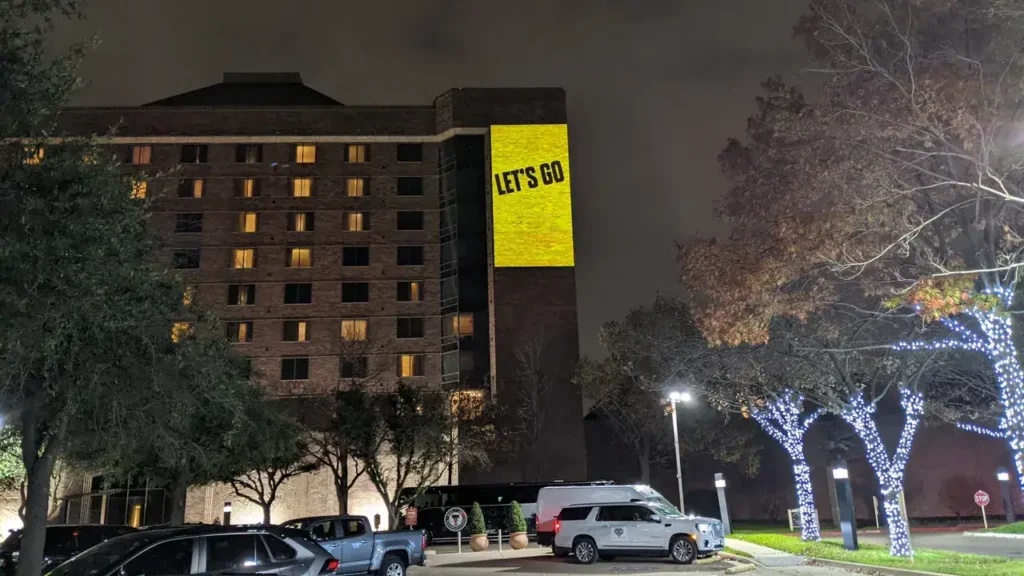
Projection is the format clients ask for when they want something that feels big without feeling permanent. Nothing is glued to anything. When the generator goes off, the wall is a wall again.
That cleanliness is real, and it is why projection sits differently in a grey-area conversation than paste does. But the format is also the least forgiving one we run, because it depends on four things at once, and Birmingham complicates at least three of them.
You need a dark enough environment. You need a flat, light, unobstructed surface. You need distance between the projector and that surface. And you need air that is not full of water.
Birmingham gives you one of those reliably, two of them in specific places, and fights you on the fourth for a good part of the year.
This page is about where projection actually works in this city, how the humidity and the seasonal dark hours change the plan, how we handle permission for throwing light onto a building that is not ours, and the Birmingham projection briefs we turn down.
The Birmingham surfaces and corridors that can carry a projection
Projection is the only format we run where the building across the street matters more than the building you are standing next to. You are not buying a wall, you are buying a sightline.
2nd Avenue North downtown is the best projection geometry in the city. The avenue runs between I-65 and 26th Street through Central City and Fountain Heights, it carries an 80-foot right of way, and it runs one-way with three traffic lanes. That 80 feet is the number that matters. Throw distance is the constraint that kills most urban projection plans, and a right of way that wide lets you place a projector on one side and fill a façade on the other at a usable image size. The alley-and-loft character also means there are set-back positions and side approaches to work from, and because the avenue is the default downtown walking route, the audience is already there.
The one-way three-lane configuration helps too. Traffic comes from a known direction, which makes vehicle staging and sightline protection a solvable problem rather than a guess. It also punishes error: a wrong turn downtown costs a full block loop, which matters when you are repositioning a loaded vehicle at 1am.
Avondale is the opposite case and clients consistently get this wrong. The Avondale Entertainment District runs along 41st Street South between 5th Avenue South and 2nd Avenue South. Three blocks, dense, excellent for poster and ground work precisely because it is tight. Tight is bad for projection. Short throw distance means a small image or an extreme angle, and an extreme angle means keystone distortion and a picture that looks cheap. The crowd Avondale delivers is genuinely good. The geometry usually is not.
Lakeview has a similar problem in a different flavour. Bars and restaurants are packed tightly, crowds move on foot between venues, and the ambient light from venue frontage is high. Projection competes with that light and generally loses on a Friday.
Pepper Place is interesting for a different reason. The converted Dr Pepper syrup plant runs to over 350,000 square feet of open-air retail, chef-led restaurants and workspace, and much of that environment is privately controlled. Private control is the single most valuable thing in a projection permission conversation. The limitation is that the audience here is daytime and weekend, and projection needs dark.
The Historic Theatre District downtown, anchored by the Alabama Theatre and the Lyric, has the architecture people imagine when they ask for projection. It also sits in the part of the city that gets the most scrutiny, and it carries heavy marquee and venue lighting. Beautiful, difficult, and permission-first.
Sloss Furnaces is a venue environment with industrial surface character, and Sloss Music & Arts Festival runs on that site. Any work there is a venue conversation, not a street conversation.
Humidity, haze and the Birmingham air
Here is the part nobody puts in a projection proposal.
Birmingham is humid subtropical, with rainfall spread fairly evenly across all twelve months rather than concentrated into a wet season. There is no dry booking period. Winter relative humidity sits around 79%.
Moisture in the air does two opposite things to a projected beam, and which one you get depends on how much of it there is.
A light haze can actually make the beam path visible and give the install a theatrical quality, which some brands like. Heavier moisture scatters the light before it reaches the wall, and scattering costs you contrast. A projection that looked crisp at 9pm can look washed and soft at 1am as the dew point closes in, without a single setting changing. In the warm months the pre-dawn hours carry the heaviest dew load in this city, which is one more reason we tend not to run Birmingham projections late into the night.
Rain ends the night outright. Not because the image fails first, but because the equipment comes in. Projectors, generators and cabling do not go out in Birmingham rain, and with precipitation possible in any month, every Birmingham projection booking needs a stated weather contingency and a backup night built into the schedule. Spring is typically the wettest stretch and also carries real convective storm risk. The National Weather Service office covering Birmingham runs dedicated severe weather and storm spotter programmes for the area. We never schedule a single irreplaceable spring projection night here.
Surface moisture matters less for projection than for paste, which is one genuine advantage of the format in this climate. Damp downtown brick is the most common cause of adhesion failure in Birmingham, and projection simply does not care whether the wall is wet. In a soggy week, projection may be the only format in our catalogue that still performs, and that is a legitimate reason to choose it here.
What the wall surface does matter for is texture and colour. Birmingham's downtown stock is heavy on brick and older masonry. Brick is dark, absorbent and textured, and all three cost you image quality. A pale rendered or painted façade will hold an image far better than raw red brick, and part of our site survey is simply walking the corridor after dark with a test source to find out which walls behave.
Darkness hours, the Birmingham calendar and when to run
Projection is the only format we sell where the time of sunset dictates the entire production schedule.
In the deep summer the usable dark window starts late. That pushes the whole operation back, which collides with crew hours, with venue closing times, and with the dew load. In winter, dark arrives early. Early dark means you can run a projection into an evening crowd rather than a 1am empty street, and that is worth a great deal.
Clients almost always assume summer is the right season for outdoor work. For projection in Birmingham, the autumn and winter dark hours are frequently the better buy, and the mild Birmingham winter means crew conditions are workable in a way they would not be in a northern market. Winters here are mild and rainy with short cold spells, which is uncomfortable but operable.
Against that, the city's calendar:
Sidewalk Film Festival, late August, a full week in the Historic Theatre District, with the 28th edition running 24 to 30 August 2026. Nationally ranked, and it concentrates a cultured out-of-town audience into a small number of downtown blocks for seven days. For projection this is tempting and genuinely difficult. The audience is ideal, the architecture is ideal, and the district is at its most crowded, most lit and most operationally congested exactly when you want to be setting up equipment. Festival weeks invert access in this city. The theatre district becomes the most valuable and the least accessible part of Birmingham simultaneously.
Autumn generally is the metro's densest festival stretch, with the local press routinely counting thirty-plus fall festivals. Magic City Classic is one of the largest crowd draws the city produces. Earlier sunsets plus crowds is the combination projection wants.
The Mercedes Marathon in winter brings route closures that matter for equipment vehicle access as much as for audience.
UAB term structure sits underneath everything downtown. The campus abuts the southern core rather than sitting on a suburban ring, so student movement and downtown movement overlap. An October evening projection downtown reaches a materially busier street than the same projection in the summer gap.
Permission for projected light in Birmingham
I will be careful here, because this is a grey area and the honest answer is that it varies.
Projection does not attach anything to a surface, which genuinely changes the conversation. But it is still advertising placed onto a building you do not own, viewed from a street you do not control, usually with equipment and a vehicle occupying space. Several separate permissions can be in play at once: the owner of the surface being lit, the owner or controller of the position the projector sits in, and whoever governs the public space in between.
Birmingham's written posture on signage is not vague. The city's zoning sign regulations explicitly address signs attached to trees, utility poles and streetlights, or placed on public property, except where authorised by ordinance of the city council. The sign ordinance also defines Areas of Special Aesthetic Concern with tighter restrictions, which is the usual signal that historic and showcase corridors receive more scrutiny than ordinary commercial frontage. The downtown theatre blocks and designated historic fabric sit squarely in that more-scrutinised category.
Enforcement character here is episodic rather than constant. Posted roadside signage has been a recurring public complaint, and at least one city councillor has publicly campaigned against signs going up along roadways without permitting or notification, with the coverage framing it as a long-standing issue. That pattern, attention arriving in waves rather than through steady patrol, applies to street-level activity generally. For projection specifically, the bigger practical factor is not patrol at all. It is that a projector, a generator and a crew on a downtown street are extremely visible, and the person most likely to ask what you are doing is the building owner or a venue manager.
Which is why our answer in this market is simple. We ask first. We get written permission from the property owner whose wall is being lit, we agree the projector position with whoever controls that ground, and we document both before the vehicle is loaded. Construction hoarding and scaffolding get treated as the contractor's and owner's property, with the same conversation.
Permission also upgrades the campaign rather than merely protecting it. A cooperating owner will let you put the projector where the geometry actually works, rather than where you can get away with standing. On a corridor like 2nd Avenue North, access to a private set-back position is often the difference between a clean rectangle and a distorted one.
Crew reality on a Birmingham projection night
Projection is the heaviest format we run per site, and Birmingham's layout makes that weight more expensive.
The city's walkable pockets are separate from each other, so crews drive between districts rather than walking a continuous route. For paste work that means a few vehicle hops. For projection, where each setup involves a projector, power, rigging and sightline management, it means that every additional district is effectively a separate production. A client asking for projection in downtown and Avondale and Lakeview on the same night is asking for three productions, not one route.
Our standard recommendation in Birmingham is to pick one corridor and work it properly. Usually that is 2nd Avenue North, because the 80-foot right of way gives us throw distance and the one-way grid makes staging predictable.
The night runs roughly like this. Arrive after the usable dark has arrived rather than before, because there is nothing to align against in daylight. Stage the vehicle with the one-way traffic direction, not against it. Set up, align, correct for the façade's real geometry rather than the geometry in the survey photo, and run. Downtown empties substantially outside event nights, which gives a quiet late window with good vehicle access, though a quiet street also means a smaller live audience, so the hour is a trade between operational ease and viewers.
Lakeview and Avondale run the opposite pattern, busy late on weekend nights and quiet midweek. For projection the crowd is the point, so unlike paste work, weekend nights there are not automatically the wrong answer. They are just harder, and the ambient light is worse.
The weather call is made on the day, not in the plan. In a humid week we will tell a client the contrast will suffer and offer the backup night. That conversation goes better before the booking than after.
What goes wrong, and what we talk Birmingham clients out of
Asking for projection in Avondale. The three blocks of 41st Street South are too tight for throw distance. We steer this to 2nd Avenue North for the image, and offer poster or ground work in Avondale for the crowd, because that is what each district is actually good for.
Picking a wall from a daytime photo. Red brick looks great at noon and swallows a projection at midnight. Dark, absorbent, textured surfaces cost contrast. We survey after dark with a test source, and sometimes the answer is that the client's preferred building cannot carry it.
Booking a single irreplaceable night in spring. With rain in every month, spring as the wettest stretch, and real convective storm risk, a single-night spring projection with no contingency is a bet the client should not be making.
Running late into a humid summer night. The dew load thickens the air in the pre-dawn hours and the image softens. Earlier is better in Birmingham summer, which argues for autumn and winter dark hours instead.
Trying to project through Sidewalk week in the theatre district. The most valuable and least accessible week in the city, in the most scrutinised blocks. If a brand wants to own that audience, there are better-placed surfaces and better-timed installs than a projection fighting for kerb space during the festival.
Treating projection as a permission-free format. Nothing is glued down, which is not the same thing as nobody minding. We ask the owner first, every time, and we will not run a Birmingham projection onto a building whose owner we have not spoken to.
When an LED truck is the better answer than a projection
Sometimes the honest recommendation is that the client does not want projection at all. They want a bright moving image in front of a crowd, and Birmingham's geography makes that a different vehicle.
Projection is fixed. It needs one good wall, one good position and one good night. LED Trucks and Mobile Billboards do not care about surfaces, do not care about throw distance and do not care whether the façade is dark red brick. In a city whose pedestrian density is split across four or five separate pockets with car-dependent distance between them, a mobile screen can visit all of them in one night, which a projection setup cannot.
The specific Birmingham case for a truck is strong on event nights. Magic City Classic traffic, a crowded Lakeview weekend, the approach routes around a downtown event, a festival perimeter where the interior is closed to you. Those are all conditions where a projection has nowhere to stand and a truck has somewhere to drive.
The case against it is that a truck passes and a projection stays. If you want dwell time on a single façade in front of a stationary audience, the projection wins. If you want reach across separated districts on one night, the truck wins.
We will tell you which one your brief actually describes, and occasionally the answer is both on different nights.
Frequently asked questions
Do you need a permit for projection advertising in Birmingham?
It is a grey area and it depends on the surface, the projector position and the specific site. Birmingham’s zoning sign regulations address signs placed on public property except where authorised by the city council, and the ordinance defines Areas of Special Aesthetic Concern with tighter restrictions. Our approach is written property-owner permission for the lit façade plus agreed access for the projector position, documented before the night.
Where in Birmingham does projection actually work?
2nd Avenue North downtown is the best geometry in the city, because the 80-foot right of way gives genuine throw distance and the one-way three-lane layout makes staging predictable. Private environments such as Pepper Place and venue sites like Sloss Furnaces work where permission and darkness allow. Avondale’s three-block strip is usually too tight.
Does Birmingham humidity affect projection quality?
Yes. Light haze can make the beam visible and look striking, but heavier moisture scatters light and costs contrast, so an image can soften as the dew point closes in. Winter humidity sits near 79%, and warm-month pre-dawn hours carry the heaviest dew load. We usually run earlier rather than later in summer for that reason.
What time of year is best for a Birmingham projection?
Autumn and winter, for most briefs. Earlier sunsets mean the usable dark window opens while people are still out, instead of starting late in summer. Autumn is also the metro’s densest festival stretch, with thirty-plus fall festivals and Magic City Classic. Mild Birmingham winters keep crew conditions workable.
What happens if it rains on the booked night?
The equipment stays in. Projectors, generators and cabling do not run in rain, and Birmingham gets precipitation in all twelve months with spring the wettest stretch and real convective storm risk. Every booking here should carry a stated contingency and a backup night rather than depending on one irreplaceable date.
Can you project onto any building downtown?
No. Surface colour and texture decide image quality, and Birmingham’s downtown stock is heavy on dark, absorbent, textured brick that swallows contrast. Pale rendered or painted façades hold an image far better. We survey candidate walls after dark with a test source rather than choosing from daytime photographs, and sometimes a preferred building simply cannot carry it.
Request a campaign quote
Tell us the audience, the date and what you want people to feel when they see it. We will walk the corridor after dark, tell you which Birmingham façades can actually hold an image, what the weather risk looks like around your window, whose permission we need, and whether projection or a mobile screen fits the brief better.
If the building you have in mind will not carry it, you will hear that from us before anything is booked.
Request a campaign quote with your dates and target audience, and we will come back with a Birmingham-specific plan.

Ready to Run Your Campaign?
Call us or email us. We’ll tell you exactly what we can do in your market and what it costs.
Related Service
Explore similar advertising solutions offered by American Guerrilla Marketing.
American Guerrilla Marketing — Los Angeles
Street-level campaigns in Los Angeles and nationwide. Wheatpasting, LED trucks, street teams, and more.
(646) 776-2770
Related Articles
-
Street Team Staffing and Training: A Field Guide
November 5, 2026
-
Guerrilla Warfare Marketing: How It Actually Works
November 5, 2026
-
Experiential Companies: How It Actually Works
November 5, 2026
-
Experiential Branding: How It Actually Works
November 5, 2026
-
Projection Advertising Minneapolis: Corridors and Permits
November 5, 2026