
November 3, 2026
Billboard Truck Rental: A Field Guide From the Crew
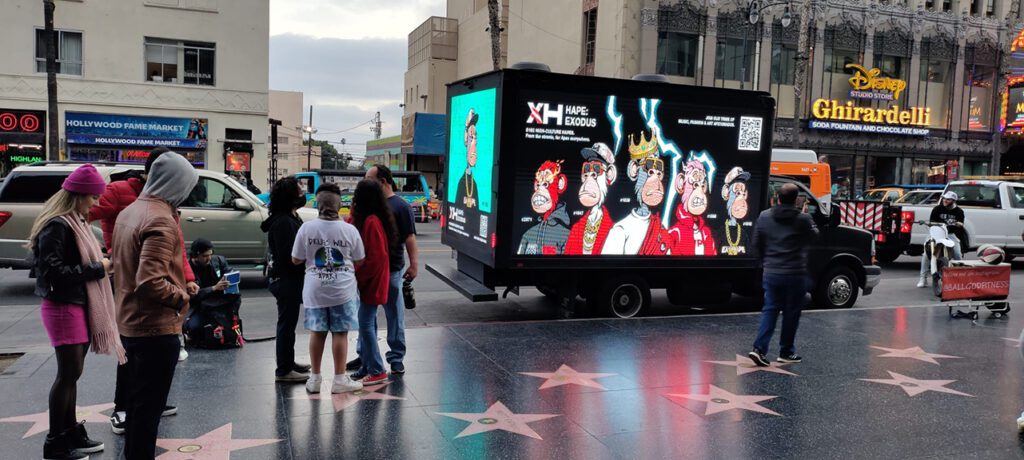
Most people who ask about billboard truck rental have a picture in their head of a truck with a big ad on the side driving around a city all day. That picture is roughly right and almost completely useless for planning a campaign.
The things that decide whether a mobile billboard works are route, hours, dwell, screen type and the driver. Not the truck.
I have spent a lot of nights in the cab and a lot of mornings arguing with clients about routes, so this is the version of the explanation I give on the phone. What the equipment actually is, what a day looks like, where these things genuinely work, what the weather and the traffic do to you, and what we talk people out of.
No theory. If something is uncertain I will say so.
Two different vehicles, often sold under one name
"Billboard truck" covers two quite different machines and people conflate them constantly.
The first is a static panel truck. A box truck or purpose-built chassis carrying printed vinyl faces, usually two sides and sometimes a rear. The artwork is physically printed and mounted. It is bright in daylight, it costs nothing to run beyond the vehicle, and it looks like outdoor advertising because it is outdoor advertising.
The second is an LED truck. A digital screen, usually on both sides and the back, running motion content from a controller in the cab. It is dramatically better after dark, it can run multiple creatives in rotation, and it can change content mid-route.
They are good at different jobs.
Static panels win in daylight-heavy campaigns, long runs with one message, and markets where you want the thing to look like a billboard rather than a screen. The print is sharp, it never glitches, and there is no power draw.
LED wins after dark, when you need motion, when you are running several messages, or when the campaign wants to react to something during the day. In a dark downtown corridor an LED truck is the brightest object on the street and nothing else competes with it.
If somebody quotes you a "billboard truck" without telling you which of the two they are putting on the road, stop and ask. The difference changes everything about when you should run it.
What a rental day actually involves
A rental is not just a truck. It is a truck, a driver, a route, a content file and a documentation process. Here is how a day runs with us.
The driver does a pre-trip inspection before anything else. Tyres, lights, screen or panel condition, mounting hardware, generator fuel if there is one. On an LED unit the screen gets powered up and checked for dead modules before it leaves the yard, because a dead block of pixels in the middle of a logo is the kind of thing nobody notices until a client sees a photo.
Content gets loaded and played through in full. Every creative, start to finish. Files get corrupted, aspect ratios get wrong, and the time to find that out is in the yard.
Then the route. We run to a planned route with timed waypoints, not a general area. The driver has the corridors, the loop order, the dwell positions and the hours. If there is a venue or an event tied to the campaign, the loop timing is built around when that crowd moves.
Through the day the driver sends timestamped photographs from agreed positions. That is the proof of play for mobile. There is no automated log that means anything on a truck, so it is photographs, GPS trace and a driver log.
At the end, the truck goes back, the screen or panels get checked again, and the day's documentation is compiled.
A standard day is eight to ten hours of road time. Longer than that and you are into a second driver, because hours of service rules exist and fatigue on a large vehicle in a dense city is not a corner anyone should cut.
Route design is the whole job
This is where campaigns are won and lost and it is the part clients spend the least time on.
A truck driving continuously is a truck nobody reads. At twenty-five miles an hour on a clear road, a pedestrian gets a glance. The value is in dwell: sitting in heavy traffic, waiting at long lights, parking legally in a high-footfall position where people are standing still.
So a good route is built around congestion rather than avoiding it. We want the slow corridors at the slow times. That feels wrong to clients until they see the photographs.
Loop length matters too. A tight loop in a dense corridor means the same audience sees the vehicle several times in an afternoon, which is how frequency gets built. A sprawling route across a whole metro covers more ground and builds no frequency at all.
Real examples of corridors that work. In New York, the stretches around Herald Square, lower Broadway in SoHo, and the approaches around Madison Square Garden before and after events. In Los Angeles, Sunset through West Hollywood, Melrose, and the surface streets around downtown venues, because LA foot traffic is pocketed and the driving corridors between pockets are where people actually are.
Chicago works along Michigan Avenue and the loop around the venues on the near west side. Miami along Collins Avenue and Ocean Drive in South Beach, and around Wynwood in the evening. Austin on and around Congress Avenue. Nashville on Broadway, which is slow-moving and dense with pedestrians for most of the evening, which is close to ideal.
Event-adjacent running is the strongest use of the format. A stadium, an arena, a convention centre, a festival. The crowd arrives and leaves on foot through predictable streets at predictable times, moving slowly, with phones out.
The constraint is that event authorities frequently restrict vehicle access in the immediate perimeter. So the position is the approach, not the door, and that approach needs to be scouted in advance rather than guessed.
Crew, timing and what nights look like
Most mobile billboard work runs one driver per truck. For event work or a campaign where we need someone outside the vehicle handing something out or steering people, we add a street team member or two and that changes the permission picture, because a parked vehicle with staff distributing is a different proposition to a vehicle driving a route.
Daytime runs are usually ten in the morning to six in the evening, built around lunch congestion and the evening peak.
Night runs on LED units start around dusk and go to midnight or later. That is when the screen is at its best. The brightness differential between an LED face and an unlit street after dark is enormous, and in a bar or venue corridor the truck becomes the thing people photograph.
We will usually recommend the night window for LED and the day window for static panel. Clients often want the opposite because daytime feels safer. Running an LED truck at noon in direct summer sun is the least impressive version of that product, and I say so.
Multi-day campaigns get route rotation. Same corridors, different loop order and different dwell positions, so the vehicle is not sitting in the same spot every afternoon. Repetition of the message is the goal, repetition of the exact parked position just annoys whoever works in that building.
Weather, screens and the things that go wrong
Trucks are more weather-resilient than anything we paste or stick to a wall, but they are not immune.
Heat is the main enemy of LED. Screens generate their own heat and direct summer sun on a south-facing panel stacks on top of that. Units have thermal management, and in genuinely extreme heat a screen will dim itself to protect the hardware. That is the correct behaviour and it still means your creative is less bright at two in the afternoon in Phoenix in July than the mock-up suggested. Plan around it or run at night.
Rain is mostly fine for both formats. Screens are built for outdoor use. The real rain problem is pedestrian behaviour: people walk faster, look down, and do not photograph anything. A wet afternoon is a weak afternoon regardless of the equipment.
Cold affects LED less than people expect, but it affects generators and it affects the driver. Long static dwell in deep cold with the screen running means fuel planning.
Wind matters for static panel trucks more than LED. Large flat vinyl faces catch crosswind on highway sections, which is a driving consideration rather than an advertising one, and it is why we keep panel trucks off exposed high-speed sections where we can.
Vinyl on static panels fades. Sun exposure over a long run will shift colour, and deep solid colours and strong reds go first. On a short campaign it is irrelevant. On a long run we plan a reprint rather than let the artwork drift.
Mechanical failure happens. Trucks break. Any operator who tells you otherwise is new. What matters is whether there is a replacement unit available and what the policy is on a lost day. Ask that question before you book, not after the truck is on a flatbed.
What actually drives the scope of a booking
I cannot talk numbers here, but I can tell you exactly which levers move a mobile campaign from small to large, because clients ask and the honest answer is useful.
Vehicle type. An LED unit is a different class of equipment to a printed panel truck. Screens, controllers, power and the technical check before every run all add operational weight.
Hours on the road. An eight-hour day and a fourteen-hour day are not the same booking. Past a certain point a second driver enters the picture, and that is a step change rather than a gradual increase.
Number of vehicles. Two trucks working a corridor in opposite loop directions is a noticeably different presence to one. Clients who want saturation are usually asking for a second unit without realising it.
Run length. Consecutive days are more efficient than the same number of days scattered across six weeks, because the vehicle, the driver and the route knowledge stay in place.
Market. Running in a city where we already have equipment and drivers is straightforward. Running somewhere we have to position a vehicle to is a different planning exercise involving transit days.
Event tie-ins. Event windows mean scouting, perimeter restrictions, and sometimes a street team alongside. More planning, more people.
Creative changes mid-campaign. Trivial on LED. On a printed panel truck it means a reprint and a rewrap, which is a production job, not a settings change.
If you tell an operator which of those levers you are willing to move, you will get a far more useful plan back than if you just ask what a truck involves.
Permissions, ordinances and the grey area
Mobile advertising sits in a grey area and the rules are genuinely inconsistent across the country.
Some municipalities restrict or discourage vehicles whose primary purpose is advertising. Some regulate parking of advertising vehicles specifically. Some treat it as ordinary commercial vehicle traffic. Some have rules about brightness or motion on illuminated displays near residential streets or in particular districts. Enforcement varies by city, by district within a city, and by who is on duty.
I am not a lawyer and this is not legal advice. The honest position is that it depends on the municipality, the specific streets, and whether the vehicle is moving or parked.
How we reduce risk. We route through corridors we have run before and know the character of. We keep moving where parking an advertising vehicle is discouraged. Where we want a long static dwell, we use private property with the owner's permission, a lot, car park, forecourt or venue apron, which takes the public-space question off the table entirely. We keep the vehicle legal, insured, and driven by someone who is not going to argue with an officer.
And we tell clients when a city is a difficult market for this format rather than taking the booking and hoping.
What we talk clients out of
Covering a whole metro with one truck. A single vehicle cannot blanket Los Angeles. It can own a corridor. Clients who ask for metro-wide coverage with one unit are buying a thin layer of nothing. Pick the corridor that matters.
Too much copy. The most common creative failure by a distance. People are reading this from across a traffic lane, often in motion. A short line, a clear brand mark, and one action. If a creative needs more than about two seconds to parse it will not be parsed at all. We send artwork back.
Fine detail and thin type. It dies on an LED pitch and it dies on a panel at distance. Big simple shapes, high contrast.
Running the whole campaign on a weekday daytime. Unless the audience is an office crowd at lunch, the strongest hours are evening and weekend, and event days beat everything.
Treating the truck as the entire campaign. This is the big one. A truck is a moving impression with no residue. It passes, and then it is gone. On its own, in a corridor with nothing else from the brand, it reads as a one-off.
That last point is where I usually suggest pairing. Wheatpasting & Poster Campaigns in the same corridors gives the truck something to reinforce. Posters hold position on permissioned hoardings and private walls twenty-four hours a day, and the truck comes through the same blocks at peak hours. Same artwork, two formats, and the corridor starts feeling saturated at a staffing level nobody could achieve with vehicles alone.
Sidewalk Decals & Stencils do a similar job at ground level near a venue or doorway if the campaign has a destination.
Booking one day. Mobile works on frequency. One day is a photograph for the internal deck. Several days across the right windows is a campaign.
How to brief a mobile billboard properly
Tell the operator the audience and where that audience physically is at what hour. Not the city. The corridor and the time.
Tell them the one action you want. Not five messages.
Tell them the dates that matter and why, especially if there is an event, a store opening, a premiere or a conference driving it.
Ask them for the route in advance, with waypoints and dwell positions, and ask whether anyone has driven it. Ask what the documentation deliverable is. Ask what happens if the truck breaks.
Then let them build the route. The operator who runs that city every week knows which light cycle is three minutes long and which block empties out at four. That knowledge is most of what you are hiring.
Frequently asked questions
What is the difference between an LED truck and a static billboard truck?
A static truck carries printed vinyl faces, which look sharp in daylight, need no power, and cannot change. An LED truck carries digital screens that run motion and multiple creatives and are far stronger after dark. Static suits long daytime runs with one message. LED suits night work, events, and campaigns rotating several messages.
How long does a typical rental day run?
Eight to ten hours of road time with a single driver, including pre-trip inspection, content checks, the routed loop with timed dwell positions, and documentation. Going beyond that means adding a second driver rather than extending one. Night LED runs usually start around dusk and continue to midnight or later.
Can the truck park outside a specific venue or event?
Sometimes, and it depends entirely on the location. Event authorities often restrict vehicle access in the immediate perimeter, so we typically work the approach streets rather than the door. For long static dwell we prefer private property with the owner’s permission, which removes the public-space question altogether.
Is mobile billboard advertising allowed everywhere?
No, and it is a grey area rather than a simple yes or no. Rules vary by municipality and cover things like parking of advertising vehicles and illuminated display behaviour in certain districts. Enforcement is inconsistent. We are not lawyers. We route through corridors we know and use permissioned private property for extended dwell.
How many creatives should we supply?
For a static truck, one. For an LED truck, two or three at most for a single campaign window. More than that and no individual message gets enough exposure in any one loop. Keep each one to a short line, a clear brand mark and one action, readable in about two seconds from across a traffic lane.
What proof do we get that the campaign ran?
Timestamped photographs from agreed waypoints through the day, a GPS route trace, and a driver log covering hours, positions and dwell times. There is no meaningful automated impression log on a vehicle, so anyone handing you a precise impression figure for a truck is modelling it rather than measuring it.
Request a campaign quote
Tell us the city, the corridor, the hours that matter and what the campaign has to do. We will come back with a route, the right vehicle type for those hours, and an honest read on whether a truck is the right format at all.
If it is not, we will say so and suggest what is. Request a campaign quote.

Ready to Run Your Campaign?
Call us or email us. We’ll tell you exactly what we can do in your market and what it costs.
Related Services
Explore similar advertising solutions offered by American Guerrilla Marketing.
American Guerrilla Marketing — Los Angeles
Street-level campaigns in Los Angeles and nationwide. Wheatpasting, LED trucks, street teams, and more.
(646) 776-2770
Related Articles
-
Used LED Billboard Truck for Sale: Buyer Guide
November 3, 2026
-
LED Advertising Truck for Sale: What Owning One Actually
November 3, 2026
-
LED Truck Advertising Day Rate: How Scope Gets Set
November 2, 2026
-
New York Mobile Billboards: LED Truck Advertising NYC 2026
September 12, 2026
-
Truck Side Advertising: Formats, Costs & How It Works (2026)
September 12, 2026