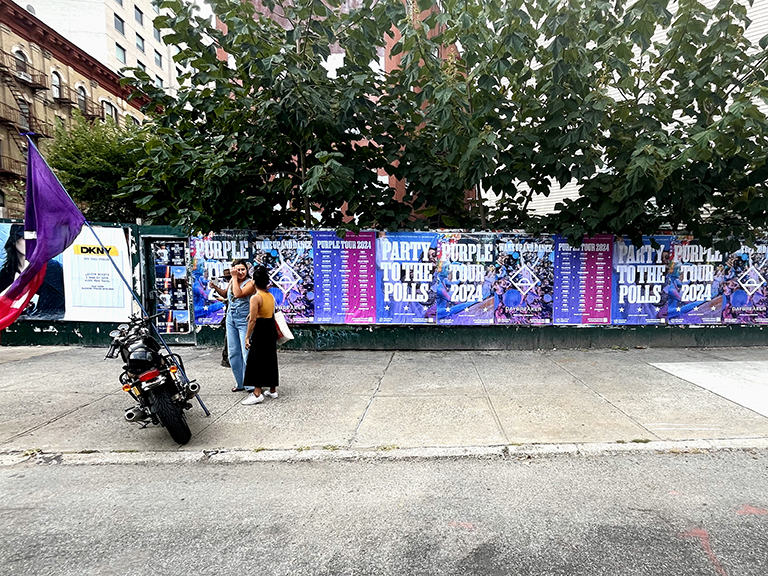
Focus keyword: wheatpaste posting strategy
Search intent: Marketers and art directors comparing wheatpaste campaign methods, looking for a decision framework, not just definitions.
Choosing the wrong wheatpaste posting strategy is more expensive than most brands realize, not because the format is costly, but because poster printing, crew time, and campaign setup costs are largely fixed regardless of method. The method determines whether those fixed costs generate outcomes or generate impressions with no story to tell. We’ve run wheatpaste campaigns across more than 500 activations in 50+ cities. The campaigns that fail aren’t usually failures of execution, they’re failures of method selection.
This guide breaks down every major wheatpaste strategy, compares each against competing outdoor formats, and gives you the framework to choose correctly before a single poster gets printed.
There are four primary methods for executing a street poster advertising or wheatpaste campaign. Each has a distinct cost structure, reach profile, measurement profile, and ideal campaign type. Most brands that struggle with the format are using the wrong method for their actual goal, not the wrong format.
Understanding each method is the foundation of any serious campaign plan.
The full market blitz is simultaneous saturation of a defined geographic market in a 48–72 hour installation window. Think 150–500+ locations installed across a city while the creative is still fresh. Maximum coverage. Maximum energy. Maximum buzz.
We run blitzes most often for entertainment clients with date-specific campaigns, album releases, film and TV premieres, gaming launches, festival activations. The format was built for this scenario: a movie opening on a specific date doesn’t benefit from a campaign that gradually builds over six weeks. It needs the market to feel like the brand is everywhere at once in the 10 days before.
In campaigns we’ve run for entertainment clients in New York, a 200-location blitz across Williamsburg, the Lower East Side, and SoHo generated measurable brand search lift within four days of installation. QR tracking on a streaming platform campaign showed 2,400 unique scans in the first 72 hours, with the highest concentration on the Williamsburg Bridge pedestrian walkway and the Wythe Avenue corridor between North 7th and North 12th Streets.
When brands use the blitz model for awareness goals without a conversion mechanism. Without location-level QR tracking, a blitz generates impressions and nothing measurable. Every blitz campaign we run includes a QR code on every poster, unique URL parameters by location cluster, and a monitoring window that captures scan data in the first critical week.
Instead of maximum market coverage, the corridor strategy concentrates placements in 3–5 high-density pedestrian corridors, 10–25 locations per corridor rather than 2–5 per zone. Depth over breadth.
The logic is frequency. Brand memory builds through repeated exposure more effectively than through single impressions at scale. A person who walks Fairfax Avenue past your campaign three times a week for four weeks has a fundamentally different brand relationship than someone who passed one of your blitz posters on a side street once.
We deploy corridor strategy most often for fashion, food and beverage, lifestyle brands, and tech companies targeting early-adopter demographics. In Chicago, we’ve run corridor campaigns down Milwaukee Avenue through Wicker Park that achieve 10–15 poster touches within a six-block stretch, the frequency equivalent of a two-week transit campaign at a fraction of the cost.
We evaluate corridor candidates on four criteria: pedestrian count during target audience active hours, demographic composition of the surrounding blocks, enforcement history for the specific corridor, and surface quality of available walls. A wall that looks great on a site visit may be in a corridor with aggressive removal cycles, local crew knowledge catches that before investment is made.
High-performing corridors we work regularly:
– Wythe Avenue, Williamsburg (Brooklyn), creative and nightlife, 18–35
– Fairfax/Melrose, Los Angeles, streetwear, entertainment, youth culture
– Milwaukee Avenue, Wicker Park (Chicago), creative community, independent retail
– Abbot Kinney, Venice (Los Angeles), wellness, premium consumer, tourism
– East 6th Street, Austin, tech-adjacent, nightlife, out-of-towners
– East Nashville, Nashville, tourism, entertainment, young professional
– Wynwood, Miami, creative, hospitality, international visitor
The refresh cycle involves repeated installation at a consistent set of locations over an extended period, 4 to 16 weeks. As posters degrade or get covered, crews replace them. The brand maintains fresh presence in key locations throughout the campaign window.
This is the method we recommend for brands that need sustained local market presence rather than a moment: restaurants, gyms, salons, retail businesses with a geographic service area, and brands running always-on awareness in competitive markets. After installing refresh campaigns in markets like Nashville and Austin for hospitality clients, we consistently see foot traffic lift that sustains across the full campaign period rather than peaking in week one and fading.
A refresh cycle requires printed inventory in reserve, crew availability on short notice for replacement runs, and a location monitoring system that identifies which sites need attention. Without these systems, the “refresh” campaign becomes a one-time installation with a hopeful waiting period. We manage inventory, monitoring, and replacement as part of the campaign scope, this is one of the primary operational advantages of professional execution.
For pricing on refresh cycle campaigns by market, contact AGM directly, rate structures vary based on market, location count, poster size, and replacement frequency. See americanguerrillamarketing.com/contact.
Small-batch, high-precision placement, 20–75 posters in locations chosen for specific reasons. Either proximity to a specific venue or event, or documented presence of a specific audience type at that location.
We use by-the-poster execution in two contexts. First, as supplemental placement alongside a larger campaign, adding 25 high-value precision locations to a blitz that couldn’t access them through the primary buy. Second, as a standalone tactic for event-specific campaigns, conference presence, or highly targeted audience environments.
Before running a brand’s first full-market campaign, we often recommend a by-the-poster test run. Thirty precisely chosen locations with solid QR tracking tells us which neighborhoods, which surface types, and which visual contexts drive the most engagement for that specific brand and creative. That intelligence makes the subsequent full campaign meaningfully more effective.
Billboards reach vehicular audiences moving at 35–65 mph. Average dwell time is 2–4 seconds per impression. The format works for simple, high-contrast messages where a single visual idea can be absorbed in under 3 seconds.
Wheatpaste reaches pedestrians at walking pace, average dwell time of 10–45 seconds in appropriate environments (bus stops, walk-signal points, narrow pedestrian corridors). That dwell time supports more complex communication: a complete message, a QR scan, a photograph. For brands targeting urban pedestrian audiences, the pedestrian dwell environment isn’t just preferable, it’s the only one where the full campaign message can be absorbed.
The location comparison: A single billboard face on I-440 in Raleigh might generate 50,000 daily impressions. A wheatpaste campaign across 40 pedestrian locations in the Glenwood South and Cameron Village corridors reaches a smaller absolute audience, but with 10–20x the per-impression attention and meaningful demographic targeting. The right format depends on the campaign goal.
Transit advertising (bus shelter panels, subway car cards, station domination) reaches captive audiences with guaranteed dwell time. It’s highly effective in high-transit markets, New York, Chicago, Boston, Washington D.C., San Francisco.
We view transit and wheatpaste as complementary, not competing. Transit captures the in-vehicle impression; wheatpaste captures the street-level environment the same rider walks through. Brands that run both in the same market wrap the audience’s commute experience end-to-end, consistently outperforming either format in isolation.
DOOH offers real-time creative flexibility, programmatic buying, and immediate deployment. It’s the fastest-growing segment of outdoor advertising and brings capabilities the physical format can’t match.
What it doesn’t offer: cultural authenticity. A digital screen looks like bought advertising, because it is. A well-executed wheatpaste campaign in Bushwick or the Arts District in Los Angeles looks like it belongs to the neighborhood. That perceived authenticity generates organic photography and social sharing that DOOH cannot replicate regardless of creative quality.
The brands getting the most from their outdoor budgets in 2026 are running DOOH for programmatic reach and wheatpaste for cultural penetration. The formats complement each other.
Most industry content treats this as a binary: legal or illegal. The operational reality is more detailed. In most cities, wheatpaste on private property with owner authorization is fully legal. In some cities, there are designated legal posting zones managed by third parties. In most markets, there are also surfaces where unpermitted posting occurs in varying degrees of enforcement tolerance.
We operate with market-specific knowledge of all three environments in every city where we work. For corporate clients, publicly traded companies, and regulated-industry brands, we recommend permitted placement that provides full legal certainty and documentation suitable for case studies. For other clients, we provide an honest briefing on the enforcement environment in specific markets before any campaign commitment.
Agencies with no local crew relationships often rely on generic surface access without understanding enforcement patterns at the block level. In New York, a wall on Bedford Avenue has a meaningfully different enforcement history than one on Metropolitan Avenue two blocks away. That distinction is invisible to agencies operating without crew knowledge, and it affects how long your campaign stays up.
We’ve operated in these markets long enough to know which surfaces and which corridors provide durable campaign presence. That knowledge is part of what the campaign investment buys.
QR conversion rate: Unique scans per location per week, benchmarked against estimated pedestrian flow for that location. Compare across locations to identify your highest-performing environments.
Social documentation rate: How often is organic content, photos, Stories, posts, surfacing from your campaign locations? In markets like Williamsburg, Wynwood, and the Arts District, high-quality campaigns generate organic social documentation. Low documentation rates in these markets signal a design problem or a placement problem.
Foot traffic lift: For retail and hospitality clients, foot traffic data from platforms like Placer.ai provides before/during/after comparison at the zip code and block level.
Brand search volume: Four-week campaigns in concentrated markets often show measurable branded search lift. Track via Google Search Console during and after campaign periods.
From day one, every campaign should have: unique QR parameters per location cluster, GPS-tagged installation documentation from AGM’s crew, and a tracking spreadsheet that links location IDs to scan data. This structure enables post-campaign analysis that identifies your highest-performing environments, which directly informs the next campaign’s location strategy.
In a pedestrian environment, you have approximately 3 seconds of first contact attention. Your hierarchy must deliver: stop signal → core message → action. In that order. With no compromise on any level.
One message per poster. Not three. One.
– Blitz posters: Maximum legibility over design complexity. These are seen once, from variable distances, in a high-noise visual environment. Bold. Simple. Unmissable.
– Corridor posters: Can support more design sophistication because the audience sees them multiple times. The second and third impression can carry more information than the first.
– Refresh cycle: Plan creative evolution. What’s the progression across 8–12 weeks? Audience frequency creates the opportunity for a narrative, not just a repeated static impression.
– By-the-poster: Highest contextual specificity. These can reference the specific environment, venue, or audience they’re placed for.
Q: What’s the most cost-effective wheatpaste method for a first campaign?
By-the-poster precision placement gives you the clearest data for the lowest investment. We recommend starting with 30–50 precisely placed posters with QR tracking to understand which locations and design approaches work before scaling. Contact AGM for current pricing: americanguerrillamarketing.com/contact.
Q: How long does a wheatpaste campaign take to set up?
For a blitz campaign, lead time from final creative approval to installation is typically 5–7 business days for printing and logistics. Refresh cycle campaigns require similar setup time but operate on an ongoing schedule. Rush execution is available in most markets.
Q: Can I run wheatpaste alongside a digital campaign?
Yes, and we recommend it. QR-tracked wheatpaste that drives to a digital destination creates a physical-to-digital conversion loop that outperforms either channel in isolation. Many of our clients run coordinated campaigns that use wheatpaste placements to drive QR engagement that feeds into social retargeting audiences.
Q: What markets does AGM operate in?
We operate crews in 50+ markets nationally including New York, Los Angeles, Chicago, Miami, Atlanta, Austin, Nashville, Philadelphia, Boston, Denver, Seattle, Portland, Detroit, and many more. Multi-market simultaneous campaigns are a routine part of our operations.
Q: How do I track whether my wheatpaste campaign is actually working?
Start with QR codes on every poster with location-specific UTM parameters. Layer in social monitoring (Mention, Brandwatch, or Instagram location search) for organic documentation. For retail or hospitality, foot traffic platforms provide before/after comparison. Brand search volume via Search Console captures top-of-funnel awareness lift.
Q: What’s the difference between a wheatpaste blitz and a street poster advertising buy from a media company?
Street Poster Advertising buys through media companies typically provide a fixed inventory of permitted locations, consistent documentation, and a predictable rate card. A blitz from an operator like AGM provides more location flexibility, neighborhood-specific placement intelligence, and real-time campaign monitoring. Contact us to discuss the right structure for your campaign.
Q: Does AGM handle poster printing or only installation?
We focus on installation, placement strategy, and documentation. Most clients handle printing directly or through their existing print vendors. We can provide print specifications and vendor recommendations for any market.
We’ve executed wheatpaste and street poster campaigns for entertainment, fashion, food and beverage, tech, and DTC brands in 50+ markets. Our crew infrastructure, market knowledge, and GPS-tagged documentation standards are available for campaigns of all scales.
Contact us to start planning: americanguerrillamarketing.com/contact
Learn more about our wheatpaste campaigns: americanguerrillamarketing.com/wheatpasting-poster-campaigns/
Frequently Asked Questions
Posting Strategy Showdown Cracking The Code For Killer Marketing generates better results when placement, timing, creative, and local execution all work together. These questions cover the details brands usually need before launch, during rollout, and while evaluating performance.
How do I choose the right posting strategy for a campaign?
Start with the audience, the geography, and the action you want people to take. A route should be built around behavior, not just around where walls happen to be.
What is better: one dense neighborhood or broad city coverage?
One dense neighborhood usually wins when the budget is limited because repetition creates stronger recall than scattered one-off impressions.
When should a campaign use a short blitz?
Use a blitz when timing matters, such as an opening, release, event, or launch window. Concentrated visibility can create urgency fast.
When does a longer posting run make sense?
Longer runs make sense for brands trying to build familiarity over time or support a sustained local presence rather than a quick spike.
How important is route order in a posting plan?
It matters because people experience streets in sequences. A smart route clusters placements where the same audience is likely to encounter more than one piece.
Should a posting strategy include digital support?
Often yes. Physical visibility paired with geo-targeted digital follow-up can improve recall and give the campaign a clearer response path.
What role does local knowledge play in route building?
Local knowledge is critical because the best streets on paper are not always the best streets in practice. Foot patterns, enforcement, and wall quality all vary block by block.
How should a brand test two posting strategies?
Keep the creative similar, change the route logic, and compare response by market or neighborhood. That makes the learning clearer.
What budget mistake hurts posting strategy most?
Spending too much on print quantity without enough thought on placement quality. Better routes beat bigger stacks of paper.
What makes a posting strategy feel strong in the field?
Density, consistency, and relevance. When the audience sees the message repeatedly in the right places, the campaign starts to feel deliberate and bigger than it is.
Related Pages and Articles
How to Brief a Wheatpaste Campaign: What Your Agency Needs to Know
Before a single poster goes up, your installer needs a clear brief. A vague brief leads to wall selection that doesn’t match your audience, sizing that doesn’t fit the locations, and a timeline that slips. Here is what a solid campaign brief covers:
- Campaign objective: awareness, event promotion, product launch, or brand reinforcement
- Target audience: age range, neighborhood, lifestyle markers
- Geography: specific neighborhoods, not just city names
- Timeline: install date, duration, any hard deadlines
- Budget range: so the installer can recommend the right format and quantity
- Visual assets: final print-ready files or lead time for design
A good brief takes 30 minutes to write and saves weeks of back-and-forth. AGM provides a campaign brief template to every new client at the start of the planning process.
Street Poster Advertising vs. Digital OOH: When to Choose Each
Digital out-of-home (OOH) gets a lot of attention, but it is not always the right choice for a street-level campaign. Here is a direct comparison to help you decide.
Street poster advertising works best when: you need neighborhood-level density, you want a tactile, physical presence that stands out from screens, your budget is under $15,000, or the message benefits from permanence over 2 to 4 weeks.
Digital OOH works best when: you need to change creative weekly, you are running a time-sensitive promotion, or you need to reach commuters at specific transit nodes rather than neighborhood residents.
Many of AGM’s most effective campaigns combine both: street poster advertising for deep neighborhood saturation and targeted digital OOH for high-traffic intersections. The two formats complement each other rather than compete. See our overview of guerrilla marketing strategy for more on multi-channel approaches.
Measuring Results From a Street Poster Campaign
One of the most common objections to street poster advertising is that it’s hard to measure. In reality, it’s no harder to measure than most brand awareness tactics, and the attribution methods have improved significantly.
Common measurement approaches include:
- Foot traffic lift: Compare in-store or venue visits during the campaign period vs. control periods
- QR code scans: Print a unique QR code on posters to track direct digital responses
- Search volume lift: Monitor branded search queries in your target market during and after the campaign
- Social mentions: Track organic social posts from people photographing your posters
- Survey-based brand recall: Run a pre/post awareness survey in the campaign geography
AGM provides geo-tagged photo documentation of every installation, giving you the baseline you need for any measurement approach.