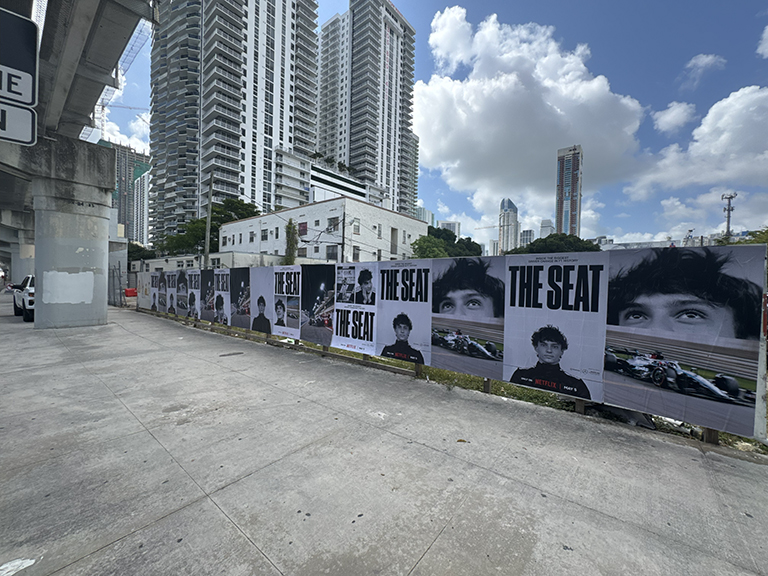
Sidewalk stickers can be one of the cleanest ways to put a brand directly in the pedestrian path, but only when the campaign is planned with discipline. Most weak sidewalk sticker campaigns fail for the same reason. The client loves the idea of people literally walking over the message, but nobody stops to ask whether the surface is approved, whether the route actually carries the right audience, whether the creative can be read in motion, or whether the sticker is being used for the right job. When those basics are ignored, the format turns into expensive clutter.
This article is for brands, event marketers, retailers, agencies, and local operators thinking about using sidewalk stickers, also commonly called sidewalk decals or floor decals, as part of a street-level campaign. The short answer is that sidewalk stickers work best when they do one of three jobs: point people somewhere, repeat a simple brand message in a high-foot-traffic area, or add visual coverage around an event, retail launch, or campaign corridor. They are not a magic fix for weak positioning and they are not a substitute for a real media plan.
At AGM, we treat sidewalk sticker advertising as a support format with real upside, not as a gimmick. When it is paired with the right street route, the right timing, and one or two stronger companion tactics, it can be memorable and highly practical.
What Sidewalk Stickers Actually Do Well
Sidewalk stickers are strongest when the audience is already moving on foot and the message can be captured in one quick look. That means the format does well in shopping districts, nightlife corridors, downtown event routes, near venues, near transit entry points, and around conventions or pop-up activations where people are already flowing toward a known destination.
The best campaigns use sidewalk decals to reinforce an existing decision. If someone is already walking toward your retail block, your venue, your activation, or the event district, a well-placed decal can sharpen recall and help guide the last few steps. That is a far more reliable use than asking a sidewalk sticker to do the whole sales job by itself.
They also work well when the campaign needs repetition. One billboard gives a large single exposure. A cluster of sidewalk decals along a pedestrian route gives a series of smaller reminders that build memory through frequency. That can be useful for product launches, nightlife promotions, ticketed events, app downloads, limited-time retail, food and beverage openings, and awareness pushes tied to a narrow calendar window.
Where Sidewalk Stickers Tend to Work Best
Not every street is worth it. The strongest locations usually have these traits: reliable foot traffic, enough dwell or slowing behavior for a person to notice the message, clean enough surfaces for the production to sit correctly, and a route that actually matches the audience.
Retail Corridors
Retail streets are one of the best uses because people are already in browse mode. They are comparing, scanning, deciding, and paying attention to the environment. A sidewalk sticker outside or near the retail cluster can help a brand stay visible without fighting for overhead space.
Venue and Event Routes
For concerts, sporting events, conferences, festivals, and pop-up activations, sidewalk stickers can help guide pedestrians from one familiar landmark to the next. In these situations, the message should stay simple. A strong icon, a short phrase, and a clear direction usually beat a cluttered design.
Transit Approaches
Transit-adjacent pedestrian zones can work when the walkway is genuinely heavy and the audience fit is real. The catch is that transit environments often have tougher permission issues, more surface wear, and less dwell. This is why route planning matters so much.
Nightlife Districts
Nightlife corridors can perform well for bars, launches, music, beverage brands, entertainment, and late-hour food. Here the tone can be a little more aggressive visually because the district itself is louder. The placement still needs to be selective. Too much noise can flatten the result.
When Sidewalk Stickers Are the Wrong Choice
The format is a bad fit when the audience is mostly in cars, when sidewalks are too broken or inconsistent for clean placement, when a brand needs a long message to be understood, or when the campaign goal is deeper education rather than top-of-mind recall. It also performs poorly when clients expect it to create trust on its own. A sidewalk decal can attract attention. It usually cannot carry a complicated conversion by itself.
It is also the wrong choice if the route has weak foot traffic or the city environment is too messy for the decal to stay visible long enough to matter. Sometimes a client asks for sidewalk stickers because they sound edgy, but the better answer is posters, street teams, or a mixed route with stronger media support.
Creative Rules That Make Sidewalk Decals Work
The design rule is simple: one glance, one idea. If the pedestrian has to stop and decode a paragraph, the creative is wrong. Good sidewalk sticker creative usually includes a very short headline, a visual shape that reads from above, high contrast, and either a direct directional cue or a clean brand identifier.
QR codes can work, but only if the setting supports a pause. If people are moving quickly, the QR code becomes decorative. If the route includes waiting, lineup behavior, or natural bottlenecks, then the scan can make sense. Even then, the landing page has to be fast and specific.
Color matters more than some clients expect. Pale or low-contrast layouts often disappear against real-world concrete, gum marks, street dirt, and shadow. Strong contrast and large type are safer. Clean icon-led work often beats a mini flyer dropped onto the ground.
Location Planning Matters More Than the Sticker Itself
The best AGM sidewalk decal campaigns start with a route walk. We want to know what a person sees before they see the sticker, what they see after it, where the path narrows, where it opens, and where they slow down. A single well-placed sticker near a curb cut, queue point, corner turn, or storefront approach can do more than five weak placements spread randomly across a block.
That is why location-specific thinking matters even for a format that looks simple. A decal outside a theater district bar route behaves differently than one near a convention center, a campus edge, or a shopping strip. We plan around that behavior instead of pretending every sidewalk is the same.
Pair Sidewalk Stickers With the Right Companion Tactics
Sidewalk stickers usually get better results when paired with at least one supporting format. Posters can build visual ownership farther out from the destination. Street teams can convert curiosity into action. A small pop-up or event footprint can give the route an actual payoff. Mobile support can widen awareness beyond the pedestrian zone. The point is to use the decal as part of a sequence, not as an isolated trick.
For example, an event campaign might use posters in the surrounding neighborhood, sidewalk decals on the final approach, and a staffed team near the entrance. A retail launch might use decals to draw foot traffic from the main shopping line toward the store while a sampling team works the block. A nightlife concept might use decals plus posters plus social capture over one heavy weekend. Those combinations make far more sense than a standalone ground graphic with no support.
Operational Issues Brands Ignore at Their Own Risk
Permissions come first. Surface use, property control, municipal rules, event overlay restrictions, and property owner approval all matter. Good campaigns do not rely on wishful thinking here. The cleaner and more permission-aware the campaign is, the easier it is to keep the work visible and documented.
Surface quality also matters. Rough pavement, heavy cracks, standing moisture, extreme heat, or constant street washing can all reduce performance. Production should match the environment. Timing matters too. If the route is due for construction work, if weather is about to shift hard, or if street cleaning will wipe the zone, the plan needs to adapt before installation.
Another issue is scale. Clients often think bigger always means better. In reality, too many decals can make the route feel messy and lower the perceived quality of the brand. The better move is selective saturation in the right path.
What Brands Usually Get Wrong
The first common mistake is treating sidewalk stickers as a novelty instead of a media unit. The second is forcing too much copy into the design. The third is placing them where there is foot traffic but not the right foot traffic. The fourth is skipping the route logic entirely. The fifth is expecting a ground graphic to fix a weak offer.
The strongest campaigns are usually not the loudest ones. They are the ones where the message is obvious, the path is correct, the execution is clean, and the rest of the campaign supports what the sticker started.
How We Use Sidewalk Stickers in Real Campaign Planning
At AGM, we use sidewalk decals when the brand needs directional momentum, repeated pedestrian impressions, or final-approach visibility. We like them for event lead-ins, retail support, convention weeks, nightlife pushes, sports windows, and promotional corridors with proven footfall. We are less excited about them for broad city awareness without a route strategy.
If the client needs stronger educational storytelling, posters or staffed engagement may carry more value. If the client needs a citywide hit, mobile and poster combinations may make more sense. If the client needs local pedestrian reinforcement near a destination, sidewalk decals can be a strong part of the mix.
Do Not Guess the Pricing
Sidewalk sticker campaign pricing depends on quantity, production, route length, market, property rules, surface conditions, install timing, and documentation scope. If the exact campaign scope is not already covered by official AGM rates, the right answer is contact AGM for a quote. That is better than publishing fake ranges that later break the plan.
How to Measure Whether the Campaign Actually Worked
Measurement should be defined before install, not after. For some campaigns, success means traffic to a storefront or event. For others, it means scans, offer redemptions, social capture, or repeated exposure around a route with known pedestrian movement. The mistake is asking a format built for visibility to behave like a long-form sales funnel without any support.
AGM usually looks at a few simple signals. Did the route map hit the intended audience zones. Did the creative remain visible and readable. Did the campaign produce the scans, foot traffic, or field interactions expected from the route. Did the supporting tactics carry people forward after the first impression. Those questions tell a clearer story than vanity metrics alone.
Photo documentation matters too. A well-documented decal campaign helps a brand review placement quality, surface conditions, timing, and whether future routes should be tightened or expanded. That is one reason we treat the format as media rather than as decoration.
How Sidewalk Stickers Change by City
A sidewalk decal route in Manhattan should not be planned the same way as a route in Miami, Chicago, or Austin. Dense business districts move fast. Entertainment corridors behave differently at night than they do at noon. Tourist-heavy areas can create volume but weak intent. Campus routes often reward simpler calls to action because the audience is younger, moving in groups, and used to tuning out clutter.
That city-specific thinking is why location planning matters even on a page that is not tied to one market. The same format does not carry the same value everywhere. The best routes are built around the local pace, the surface reality, the event calendar, and the brand’s true audience.
A Simple Sidewalk Sticker Planning Checklist
Before moving ahead, we like to confirm five things. First, the route has real foot traffic from the correct audience. Second, the install surfaces are appropriate for the production and the time window. Third, the message can be understood in one glance. Fourth, there is a clear next step, whether that is a direction, a scan, a storefront, or an event entrance. Fifth, the format is being paired with at least one other tactic if the campaign needs more than basic awareness.
That checklist sounds simple because it is. But it saves clients from forcing decals into campaigns that really need a different tool. A lot of bad street work starts with excitement about the format and ends with disappointment because nobody challenged the route or the role the decal was supposed to play.
Where Brands Usually See the Best Return
The best return usually comes from campaigns where the walking route is short, obvious, and full of likely customers. Think entertainment districts before a show, shopping streets near the store, convention routes leading to an activation, or nightlife blocks where people are already moving in groups. In those settings, the decal acts like a sequence of reminders instead of a one-off novelty.
That is also why the format can punch above its size. A person may only look at each decal for a second, but if they see the same message four or five times in the correct path, the campaign starts to feel much bigger than the production itself.
Frequently Asked Questions About Sidewalk Stickers
Are sidewalk stickers good for advertising?
Yes, when the goal is pedestrian visibility, route reinforcement, or event support. They work best in high-foot-traffic zones where the audience is already moving toward a destination or browsing a district on foot.
What is the difference between sidewalk stickers and sidewalk decals?
In most campaigns, people use the terms the same way. Both refer to branded graphics applied to a walking surface. The real difference is not the word. It is the material, permission, and route strategy behind the install.
Do sidewalk stickers work better than posters?
Not automatically. Posters usually carry more visual authority from distance. Sidewalk decals are better for close-range repetition and directional support. Many good campaigns use both together.
Can sidewalk stickers drive event attendance?
Yes, especially on the final pedestrian approach to a venue, convention activation, or nightlife event. They are strongest when paired with posters, teams, or another touchpoint that broadens awareness before the route begins.
What kind of brands benefit most from sidewalk sticker campaigns?
Retail, food and beverage, entertainment, nightlife, event promoters, experiential activations, and app or product launches with strong foot-traffic relevance tend to be the best fit.
How should the artwork be designed?
Keep it short, high-contrast, and obvious in one glance. A single message, a strong visual cue, and a clear action outperform crowded layouts almost every time.
Does AGM handle planning and placement strategy?
Yes. AGM can help determine if the format fits the objective, map the route, recommend companion tactics, and structure the campaign so the decals support a real outcome rather than acting as decoration.
Related Pages and Articles