Most advertising gets ignored. People have developed sophisticated psychological filters for the constant stream of commercial messages they encounter across every digital surface, and those filters work well. Scroll past the ad. Skip the pre-roll. Tune out the banner. The result for brands is that an enormous percentage of media spend generates effectively zero impression in the people it technically “reaches.”
Street-level advertising doesn’t have a scroll button. When someone rounds a corner and encounters a floor-to-ceiling poster graphic plastered across a building facade, or looks up from their phone to find an LED billboard truck stopped at the same light they’re waiting at, the physical presence of the creative creates a genuine sensory experience that the brain processes differently than another digital impression. That distinction: physical presence versus digital pixels: is why street-level campaigns consistently outperform digital advertising for brand recognition and recall.
But not all street advertising works. Weak creative in the wrong location is as ignorable as a display ad. Here’s what makes the difference between street-level advertising that gets noticed and remembered, and the kind that blends into the visual noise of the city.
The Core Principle: Interrupt the Pattern
People walking through a city are operating on autopilot for a significant portion of their journey. They’re navigating a route they’ve walked dozens or hundreds of times. Their peripheral vision is handling most of the navigation work. The creative that breaks through is the kind that generates what psychologists call a “pattern interrupt”: a stimulus that doesn’t fit the expected background of the environment and therefore forces conscious attention.
Scale Creates Interruption
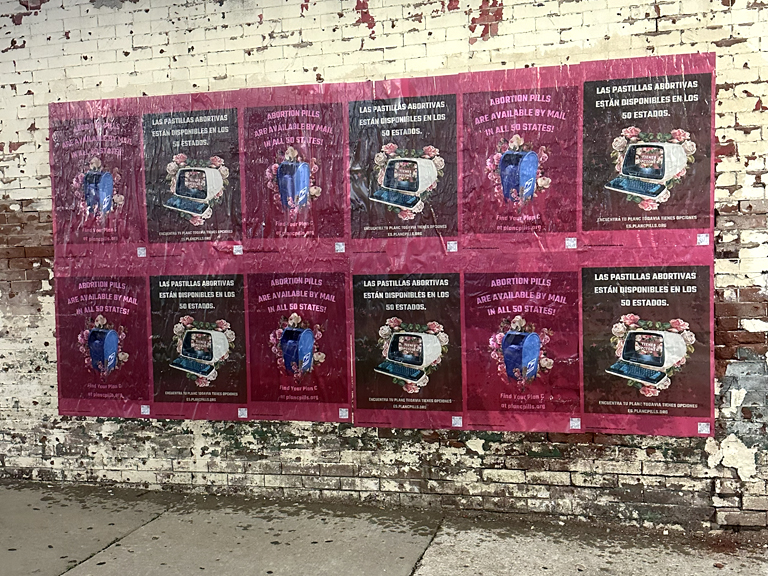
One of the most reliable pattern interrupts in street advertising is scale. A large-format poster that covers an entire building facade is unexpected in a way that a standard-size street poster is not. The brain registers unusual scale as something worth paying attention to. Our large-format wheatpaste campaigns operate on this principle: size creates the interruption that gets the brain to switch from autopilot to conscious attention.
Location Surprise Creates Interruption
Creative placed in unexpected locations: a stencil on a sidewalk where someone looks down during a crosswalk wait, a poster around a corner that appears suddenly as someone turns: leverages the element of surprise to create engagement. Sidewalk stencil campaigns work partly because pedestrians don’t expect to encounter brand messaging underfoot. That unexpectedness generates a conscious reaction.
Movement Creates Interruption
Our LED billboard trucks generate interruption through movement. A static billboard on a building becomes part of the visual landscape and eventually becomes invisible to regular passersby. A truck-mounted LED display moving through traffic is never in the same place twice, maintains a level of novelty that static installations cannot, and creates presence in locations that have no permanent advertising infrastructure.
Creative Principles for Street-Level Advertising
Street advertising operates under constraints that indoor or digital media doesn’t. Viewing time is measured in seconds, often fractions of seconds. Distance ranges from a few feet to a city block. Lighting conditions are uncontrolled and vary dramatically throughout the day. Creative that doesn’t account for these constraints fails regardless of the underlying concept.
Readability at Distance and Speed
The fundamental test for any street creative: Can it be read and understood in two seconds at thirty feet? If the answer is no, the creative needs to be simplified. Headlines need to be short: ideally six words or fewer. Type size needs to be significantly larger than print advertising conventions suggest. Background-to-foreground contrast needs to be high enough to work in direct sunlight and overcast conditions alike.
Single-Idea Execution
The most effective street advertising communicates one idea. Not two ideas. One. The brand, the message, the reason to respond: unified into a single visual communication that registers in the available viewing window. Campaigns that try to communicate multiple messages simultaneously end up communicating none of them effectively to the passing audience.
Context-Relevant Creative
Street advertising that acknowledges where it is: that references the neighborhood, the local context, the audience who passes it daily: consistently outperforms generic national creative dropped into a local environment. When campaign creative feels like it was made for the specific place and specific people who encounter it, it creates a sense of recognition and relevance that generic creative simply cannot replicate.
Choosing the Right Locations
Creative quality is half the equation. Location quality is the other half. A brilliant execution in the wrong location reaches nobody who matters. Location selection requires understanding pedestrian flows, audience composition, repeat traffic patterns, and physical viewing conditions.
High Foot Traffic Is Not Enough
A location that moves 50,000 pedestrians per day but gives each of them only a 0.5-second viewing window is less valuable for most campaigns than a location that moves 10,000 pedestrians but includes a crosswalk wait that gives each person fifteen seconds of involuntary dwell time. Dwell time: the amount of time a viewer is naturally stopped or slowed in front of a creative element: is often more valuable than raw traffic count.
Repeat Audience Value
A campaign placed on a commuter route that the same 8,000 people walk five days a week generates five exposures per person per week rather than a single impression. By week three, that audience has seen the creative fifteen times. Brand recognition at that frequency is dramatically higher than a campaign in a high-volume location with no repeat traffic. Our location scouting process specifically identifies high-repeat-exposure surfaces alongside high-volume ones.
Competitive Visual Environment
A campaign placed in a low-clutter visual environment: a residential neighborhood or a transitional block between commercial districts: gains share of attention that the same creative couldn’t achieve on a Times Square-style wall covered with competing imagery. Sometimes the right location is deliberately chosen for its relative visual quiet rather than its raw traffic numbers.
The Role of Brand Ambassador Teams
The most powerful street-level campaigns combine physical installations with human interaction. Brand ambassador teams deployed in the same environments as poster and stencil campaigns create a layered experience that transforms passive visual exposure into direct human brand contact.
How Ambassadors Extend Campaign Impact
An ambassador stationed near a poster installation can engage pedestrians who pause at the creative, answer questions, provide samples or branded materials, and create the kind of memorable personal interaction that purely visual campaigns cannot produce. The combination of high-quality physical creative and trained human brand representation creates a campaign ecosystem that operates at multiple levels of audience engagement simultaneously.
The Formats That Generate the Highest Recall
Not all street advertising formats produce equal results on the brand recall metrics that matter for long-term marketing effectiveness. Here’s a clear-eyed look at what the evidence from our campaigns across 50+ markets shows about which formats produce the most durable brand impressions.
Large-Format Poster Campaigns
Our large-format poster campaigns consistently generate strong brand recall when three conditions are met: the creative is visually strong, the location has genuine pedestrian density, and the campaign runs long enough for repeat impressions to accumulate. Single-impression recall from a poster campaign is modest: comparable to other media. But repeat-impression recall from a campaign visible on a daily commute route for three to four weeks is substantially higher, because memory consolidation of advertising stimuli is an active process that requires multiple encounters to complete. The campaigns that deliver the strongest recall are the ones built for repeat exposure in high-frequency environments.
LED Billboard Trucks
LED truck advertising generates unusually high recall relative to impression count because of the novelty effect: a moving illuminated display in an environment where most advertising is static creates a stimulus that the brain flags as worth attending to. In markets where we’ve measured aided and unaided brand recall for campaigns using LED trucks, the per-impression recall rates are consistently among the highest of any street-level format we deploy. The limitation of LED trucks is geographic reach: a truck following a defined route reaches a specific audience corridor rather than a distributed neighborhood: which is why we typically deploy them in combination with fixed-location formats for comprehensive market coverage.
Brand Ambassador Activations
Human-to-human brand contact through brand ambassador activations produces the highest per-contact brand recall of any format we deploy. The reason is neurological: social interactions activate a different and deeper encoding process than passive visual exposure. A person who had a brief, positive interaction with a brand ambassador is significantly more likely to remember the brand than a person who saw the same brand on a poster they walked past. The limitation is scale: ambassador activations are labor-intensive and reach smaller absolute numbers than mass formats. For brands where depth of impression matters more than breadth of coverage, ambassadors are an underutilized tool.
Psychology of Attention in Street Advertising
Understanding why certain street advertising gets noticed and why most of it doesn’t requires understanding some basic principles about how the human attention system works in public environments. People in cities are not actively looking at advertising. Their attention is distributed across navigation, social interaction, phone use, and the passive monitoring of their environment for things that matter. Advertising gets into that attention system only when it crosses a threshold that makes the brain register it as worth interrupting the current task to process.
The Novelty Response
The human brain has a strong automatic response to novelty: stimuli that don’t fit the expected pattern of an environment are processed preferentially over stimuli that blend in. This is why the most effective street advertising consistently uses unexpected elements: unexpected scale, unexpected location, unexpected color, unexpected content: to break through the ambient noise of a visually saturated urban environment. The brain doesn’t filter novelty out; it’s wired to flag it. Creative that exploits this mechanism doesn’t need to compete for attention through sheer visibility; it earns attention through genuine surprise.
Emotional Encoding and Brand Memory
Research on memory formation consistently shows that emotional responses during an experience significantly enhance the encoding of that experience into long-term memory. Street advertising that generates an emotional response: amusement, surprise, recognition, or even mild irritation: is processed differently and remembered more durably than advertising that generates no emotional reaction at all. This is why campaigns that make people laugh, or that present something genuinely unexpected, or that reference something the audience cares about emotionally, outperform informationally-correct but emotionally neutral campaigns across nearly every brand category.
The Role of Physical Context in Brand Association
Memory is context-dependent. Impressions formed in specific physical environments are more easily recalled when the person is in similar environments later. A brand impression formed on someone’s morning commute to work is more likely to be recalled during subsequent commutes, shopping trips, and other routine activities than an impression formed in the home while watching television. This context-dependency effect makes street advertising in specific neighborhood and commuter environments unusually effective for brands trying to build recall with consumers in the exact contexts where purchase decisions get made.
Working with an Execution Partner: What the Agency Relationship Looks Like
For most brands commissioning street-level advertising campaigns, the execution partner relationship is as important as the creative and location strategy. The quality of campaign execution: the precision of placement, the quality of installation, the completeness of documentation: is entirely determined by the operational infrastructure of the agency executing the campaign. Understanding what to look for in that relationship helps brands make better choices about who they work with.
What Good Execution Infrastructure Looks Like
An agency with genuine execution infrastructure in your target markets has established field crew relationships in those cities, proven location scouting and permit management processes, standardized documentation protocols that produce verifiable post-campaign reporting, and a coordination system that handles the logistics of multi-location or multi-city deployments without requiring constant client oversight. AGM maintains this infrastructure across 50+ U.S. markets: developed over years of executing campaigns for brands across every major industry category.
How to Evaluate Campaign Documentation Quality
The most reliable way to assess whether an execution partner actually delivers what they promise is to look at the documentation they provide for past campaigns. GPS-tagged photos with timestamps, location-specific metadata, and contextual shots that verify placement in the claimed environment are the minimum standard. Post-campaign reports that include specific location lists with documentation for each location, impression estimates with methodology explanations, and honest assessment of any locations where execution fell short of plan: these are the signs of an agency with real operational transparency rather than one that delivers whatever report sounds good regardless of what actually happened in the field.
Building a Campaign Strategy That Compounds Over Time
The most effective street advertising campaigns aren’t designed as one-time media buys. They’re designed as the first installment of an ongoing presence-building program in specific markets with specific audiences. Understanding how to build a street advertising strategy that compounds in effectiveness over time changes how brands should think about the initial campaign investment.
Market Depth vs. Geographic Breadth
Brands often face a strategic choice between deploying a modest campaign across many cities or a concentrated campaign in fewer markets. For street-level advertising, we consistently find that concentration delivers better brand recognition outcomes than breadth. A campaign that dominates a specific neighborhood’s visual environment for four to six weeks generates deeper recognition with that neighborhood’s audience than the same budget spread across ten different cities creates in any of them. For brands building urban market presence, concentrating initial investment in two or three priority markets and owning those markets thoroughly before expanding is typically more effective than thin coverage across many markets simultaneously.
Creative Consistency and Evolution
Campaigns that maintain consistent core visual identity across multiple deployments in the same markets build on each previous campaign’s recognition foundation. The audience in a neighborhood that has seen a brand campaign three times in eighteen months has a fundamentally different relationship with that brand than an audience that saw one campaign eighteen months ago. Creative can evolve while maintaining the core identity markers that make it recognizable as the same brand, and this evolution over time rewards repeat-exposure audiences with a sense of the brand’s ongoing presence and investment in their neighborhood.
Documentation and Measuring Results
Street advertising has historically suffered from measurement challenges. How do you know how many people actually saw the campaign? How do you demonstrate ROI? AGM’s approach addresses this through GPS-tracked installation documentation, impression estimates based on verified pedestrian traffic data for each location, and where applicable, digital lift measurements that track changes in branded search volume, social mentions, or conversion metrics during campaign windows.
What Our Post-Campaign Reports Include
- GPS-tagged photo documentation of every installation
- Location-specific foot traffic estimates from verified sources
- Campaign duration and condition monitoring data
- LED truck route maps with deployment schedule and estimated impressions
- Brand ambassador shift logs and interaction summaries
Contact our team through our contact page to discuss how these measurement frameworks apply to your specific campaign objectives and budget.
Frequently Asked Questions About Effective Street-Level Advertising
What makes street advertising more effective than digital ads?
Street advertising exists in the physical world where people can’t scroll past it, skip it, or block it. When someone encounters a compelling street-level ad on their daily route, it registers in a way that digital impressions don’t. The physical presence creates a genuine sensory experience: especially for large-format, surprising, or unexpected creative executions that leverage scale, location, and movement to interrupt audience autopilot.
What are the most effective formats for street-level advertising?
Large-format poster campaigns in high-foot-traffic corridors, LED billboard trucks on dense urban routes, sidewalk stencils at transit-adjacent locations, and brand ambassador activations at audience chokepoints are the formats that consistently generate strong brand recognition and recall in street environments. Multi-format campaigns outperform single-format approaches for most objectives.
How do you choose locations for street advertising campaigns?
The best street advertising locations combine high pedestrian foot traffic with natural pause points: subway station exits, street corners with crosswalk wait times, transit shelter adjacency, and building facades in commercial corridors with regular repeat audiences. Locations with both high volume and repeat exposure build recognition fastest and generate the best return per dollar of campaign investment.
Does street advertising generate social media sharing?
Yes, significantly: but only for campaigns with strong creative. A visually compelling, unexpected, or culturally relevant street execution gets photographed and shared at high rates by people who encounter it. This organic social amplification dramatically extends campaign reach beyond those who see it in person, making creative quality directly tied to earned media value.
How long does it take to plan and launch a street advertising campaign?
Timeline depends on format and scale. A focused street poster campaign in a single market can move from brief to installation in three to four weeks with creative assets ready. LED truck campaigns and multi-city deployments require more lead time: typically 45-90 days from initial brief to launch: for logistics, permitting, and coordination across markets.
Frequently Asked Questions
What is street art that slays how to make your ads unmissable and get people hooked?
American Guerrilla Marketing provides street art that slays how to make your ads unmissable and get people hooked services across 50+ U.S. markets. Every campaign is planned, scouted, executed, and GPS-documented by our field teams. We work with regional brands and Fortune 500 companies on campaigns that require real street-level execution and documented proof of performance.
How does AGM approach people hooked?
Our process starts with a market consultation to understand your goals, target audience, and budget. We then scout locations, handle any required permissions or permits, coordinate production and installation with our local crews, and provide a full GPS-tagged photo report after the campaign runs.
What markets does American Guerrilla Marketing cover for people hooked?
We operate in 50+ U.S. markets including New York, Los Angeles, Chicago, Miami, Houston, Atlanta, Seattle, Denver, Boston, and dozens of secondary markets. Contact us to confirm availability and pricing for your specific market.
How much does a people hooked campaign cost?
Campaign pricing depends on market, format, quantity, and duration. We work with budgets ranging from targeted single-market runs to national rollouts across multiple cities. Use our RFP Builder or contact us directly for a custom quote based on your specific campaign requirements.
How do I get started with people hooked through AGM?
The fastest way to get started is to submit your campaign details through our RFP Builder at americanguerrillamarketing.com, or contact us directly at [email protected] or (646) 776-2770. Our team typically responds within one business day with availability and initial pricing.