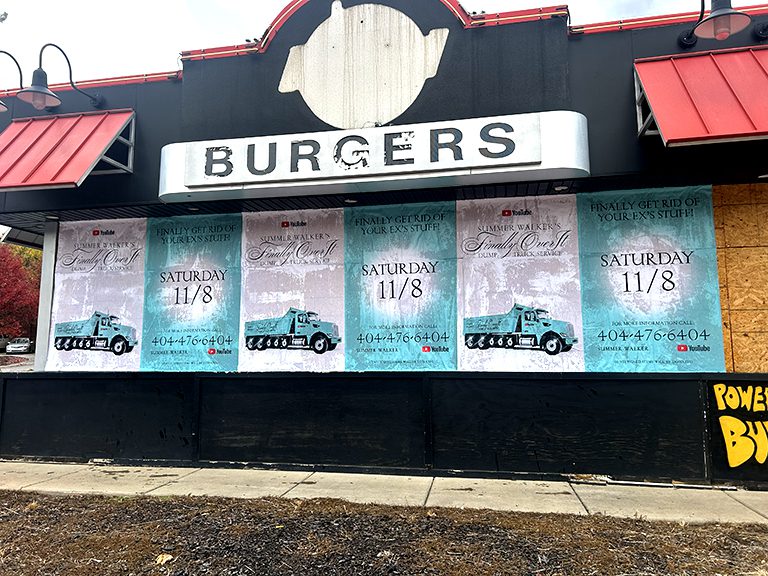
Podcasts are invisible in the physical world. The audio format creates no billboards, no posters, no physical presence in the neighborhoods where listeners live, commute, and socialize. That invisibility is a structural disadvantage in brand building. A streaming music service, a media publication, or a consumer product brand can place visual brand identity in the physical environment and build recognition through repeated, passive exposure. A podcast has no equivalent channel — unless it deliberately builds one.
Street-level marketing is how audio-first brands create the physical presence they otherwise lack. A wheatpaste campaign in Williamsburg, Silver Lake, or Capitol Hill — neighborhoods with high podcast listener densities and strong visual culture receptivity — reaches potential listeners in their physical environment at a moment when they are not already in an audio consumption state. The impression plants a seed that algorithmic discovery and word-of-mouth can later activate.
This guide covers why podcast brands need physical marketing, what formats produce results, how to target the right neighborhoods and events, and what effective podcast street campaigns look like from brief to execution.
Why Physical Presence Matters for Audio Brands
The podcast discovery problem is real. With more than four million podcasts available across major platforms, discovery through in-platform recommendations and social media is intensely competitive. Most new listeners find podcasts through word-of-mouth from friends, colleagues, and social connections — which means that creating real-world awareness in the social environments where those conversations happen is a genuinely effective growth tactic.
Physical campaigns in the neighborhoods where podcast listeners live create the brand recognition that makes word-of-mouth more effective. When a colleague mentions a podcast name and the listener has already seen the podcast’s visual identity on a poster in their neighborhood, the name resonates with an existing memory anchor. That recognition accelerates the conversion from mention to subscribe.
Physical campaigns also generate social media amplification. Podcast audiences — particularly the educated, tech-engaged demographics that drive early adoption of new podcasts — are active social media users who document their environments. A striking wheatpaste poster in a neighborhood they frequent becomes photographable content that they share, extending the campaign’s reach into their social networks organically.
Where Podcast Listeners Live: Neighborhood Targeting
Podcast listeners are not evenly distributed across urban demographics. The format skews toward educated, professional, urban audiences with significant commute times where listening occurs naturally. In geographic terms, this means podcast listener density is highest in the walkable, transit-connected, creative and professional neighborhoods of major cities: Williamsburg and Park Slope in Brooklyn, Silver Lake and Silverlake in Los Angeles, Capitol Hill in Seattle, Wicker Park in Chicago, South End in Boston, Shaw in Washington DC, and Mission in San Francisco.
We build wheatpaste campaign targeting for podcast clients by mapping the target listener profile to the neighborhood demographics in each market. Rather than blanketing a city, we concentrate placements in the two to four neighborhoods in each market where the target audience is most dense. The result is campaign impression quality — reaching the right audience — rather than raw impression volume from broad geographic coverage.
Commuter-corridor campaigns complement neighborhood placements by reaching the podcast listener audience during the exact time when they are most likely to add a new show to their queue: the morning commute. Transit station exits, bus stop approaches, and pedestrian crossings near subway entrances in the neighborhoods adjacent to major employment centers reach commuters at high frequency during the window when podcast listening habits are formed.
Wheatpaste Campaigns for Podcast Brands
Wheatpaste poster campaigns are the most effective street-level format for podcast brand building because they create high-visibility, high-frequency impressions in neighborhood environments where the target audience spends time. The format allows large-scale brand visual identity — show art, host imagery, key tagline — to occupy the physical world of the target listener.
Podcast wheatpaste campaigns need strong visual design to work. Show cover art that is distinctive and compelling at a distance is an asset; generic cover art that blends into the visual environment of a busy wall does not create the impression quality required to justify the campaign investment. We review all podcast creative before production and provide honest assessments of whether the existing design will perform at street scale.
Our wheatpaste poster campaigns for podcast clients typically include the show name, a QR code linking to the listen page, and a single compelling visual or host image. The QR code provides a direct measurement pathway — scans during the campaign window are attributable to the street campaign with high confidence. We track QR scan rates as part of campaign reporting when clients implement this element.
Event Marketing for Podcast Brands
Events are the highest-conversion environment for podcast brand marketing. Certain event categories concentrate podcast listener audiences at extraordinary density: SXSW (tech, media, and podcast culture), PodFest and other podcasting industry events, book festivals, tech and startup conferences, comedy festivals, and university events. A street team or wheatpaste campaign timed to coincide with a relevant event in a target city reaches a prequalified listener audience at maximum concentration.
Our brand ambassador agency deploys street teams at podcast-relevant events with briefings focused on the show’s content, host, and best-episode starting points — the conversation starters that turn a distribution into a subscription. A team member who can genuinely describe why someone should listen to episode one is dramatically more effective than a team member handing out a card with a QR code and nothing else to say.
For podcasts with live event components — live recordings, panel appearances, or branded event activations — we coordinate wheatpaste and street team campaigns in the surrounding neighborhood during the event period to extend the physical brand presence beyond the event venue itself. The result is a campaign that creates awareness both inside the event (through ambassador presence) and in the surrounding neighborhood (through wheatpaste and stencils on approach routes).
LED Trucks on Commuter Routes
The overlap between podcast listening audiences and commuter demographics is high. Commuters on public transit — subway, bus, light rail — are among the most intensive podcast listeners because their commute is specifically the time they consume audio content. An LED billboard truck operating on the surface streets adjacent to major transit station exits during morning commute hours reaches this audience at the exact moment they are entering or exiting the podcast listening window.
Our LED billboard truck routes for podcast campaigns are built around the transit station exit corridors for the stations serving the neighborhoods with the highest target listener density. A truck operating the 9th Avenue corridor from 23rd Street south in Manhattan during 7:30 to 9:30 a.m. reaches thousands of transit commuters per hour during the morning commute. The same audience that hears a podcast recommendation from a friend and then encounters the show’s visual identity on a street-level campaign is significantly more likely to subscribe than one reached by only one channel.
Targeting by Show Category
Different podcast categories have different audience geographic profiles, and campaign targeting should reflect those differences.
True crime podcasts have broad demographic appeal but with particular concentration among women aged 25 to 45. Neighborhood targeting in residential areas with above-average female professional populations, combined with event campaigns at relevant cultural events (book clubs, literary festivals, film festivals), reaches this core audience more efficiently than generic urban targeting.
Business and finance podcasts skew toward professional commuter demographics. Financial district adjacencies, business district lunch corridors, and transit stations serving employment centers in each market are the highest-value campaign zones for this category.
Comedy and culture podcasts skew toward the young adult entertainment audience concentrated in the entertainment and nightlife neighborhoods of major cities — the same zones where our core guerrilla marketing infrastructure is strongest. Nightlife corridor placements in Williamsburg, Silver Lake, Wicker Park, and Capitol Hill reach this audience in its natural habitat.
Technology and startup podcasts skew toward the tech worker demographics concentrated in specific neighborhood clusters in each market: SoMa in San Francisco, Silicon Alley in Manhattan, South Lake Union in Seattle, and Kendall Square in Boston. Our guerrilla marketing campaigns in these zones reach the exact audience profile that drives early adoption and word-of-mouth for tech-focused shows.
Cross-Channel Integration with Digital Podcast Marketing
Street campaigns for podcast brands work best when they are integrated with the show’s digital marketing program. The campaign creative should use the same visual identity, the same show art, and the same tagline as the show’s digital ads — so that a potential listener who encounters the brand on a poster and then sees it again in a social media ad has a coherent, recognizing brand experience rather than two disconnected impressions.
For shows with digital retargeting campaigns running in the target markets, the street campaign creates the initial physical awareness that makes the digital retargeting significantly more effective. Potential listeners who have already seen the show’s visual identity in their neighborhood will recognize the brand in their digital feed — and that recognition increases click rates and conversion rates on the digital campaign. The physical campaign essentially warms the audience for the digital program.
Campaign Timing: Launch vs. Growth vs. Sustained Presence
Podcast brand marketing campaigns serve different objectives at different stages of a show’s growth. At launch, the objective is establishing the show’s visual identity in the target markets before listener word-of-mouth has had time to build. A launch campaign that places the show’s visual presence in key neighborhoods two to four weeks before the first episode creates an awareness foundation that makes the launch’s social media and digital campaign land on primed ground.
For established shows seeking growth in specific markets, targeted campaigns during high-listener-density event windows — SXSW, podcast conferences, relevant cultural events — create bursts of qualified listener acquisition in specific geographies. For shows building toward sponsorship or advertising revenue milestones, documenting market presence through campaign photography and impression estimates provides evidence of reach that supports advertising rate negotiations.
Campaign Documentation and Reporting
All podcast brand marketing campaigns are documented with geo-tagged photography at each placement location, placement logs with timestamps and surface descriptions, and a post-campaign report delivered within 48 hours of completion. For campaigns that include QR code tracking elements, we compile QR scan data as part of the post-campaign documentation. Street team programs include hourly activity logs, distribution counts by zone, and supervisor field notes that capture qualitative audience observations alongside quantitative data.
For clients comparing campaign performance across multiple cities or campaign windows, we maintain campaign archives that allow for period-over-period comparison. A podcast brand that runs a wheatpaste campaign in New York in Q1 and wants to compare performance against a Q3 campaign in Los Angeles can work from standardized reporting formats that make the comparison meaningful. That consistency of measurement across markets and time periods is the foundation for data-driven campaign investment decisions over the long term.
Podcast Show Launches vs. Growth Campaigns vs. Rebrand Campaigns
Podcast brands need different street campaign strategies at different stages of their growth. A show launching its first season needs a campaign that establishes visual brand recognition in the target markets — placing the show’s visual identity in front of the audience before the first episode releases so that when the launch is announced, the brand is already part of the neighborhood’s visual landscape. The teaser approach — show name, striking visual, and launch date, without additional information — generates curiosity before the campaign needs to sell anything.
A show with an established listener base that is growing more slowly than its content quality deserves needs a different approach: a targeted campaign in specific markets where listener density is lower than the show’s content quality should merit, paired with event-specific activations at the conferences or cultural events where the target listener is most concentrated. The objective is not establishing the brand — it is reaching the qualified audience that the show’s recommendation algorithms have not yet served the show to.
A podcast network or show undergoing a rebrand — new name, new visual identity, new show positioning — uses street campaigns to announce the change physically in the markets where the existing audience lives. For rebrand campaigns, the street presence validates the rebrand’s seriousness and reach in a way that social media alone cannot. A rebrand that shows up on the walls of Williamsburg or Silver Lake signals that the brand has the resources and market presence to make a real transition, not just a logo refresh.
Building Long-Term Physical Presence for Podcast Brands
Single-campaign street activations for podcast brands create awareness spikes. Sustained physical presence builds brand authority. The most successful podcast brands we have worked with treat street-level marketing as a recurring program rather than a one-time investment, running two to four targeted campaigns per year in their key markets to maintain continuous visual presence in the neighborhoods where their listener audience lives.
Recurring campaigns also allow for creative evolution that mirrors the podcast’s content development. A show that has launched a new season or introduced a new host benefits from updated street creative that signals the change to the audience. A show with a major guest announcement can deploy a targeted campaign in the guest’s home city or industry hub. A podcast that has achieved a major award or milestone can deploy the recognition as street campaign creative in their key markets. Each of these campaign moments creates a news hook that gives the physical campaign a social media reason-to-share beyond the standard brand awareness objective.
The cumulative effect of sustained street presence in the right neighborhoods over six to twelve months is qualitatively different from a single campaign’s impact. Audiences who see a podcast’s poster three or four times in their neighborhood over a year develop a sense of the brand’s permanence and credibility that a one-time campaign cannot achieve. That accumulated recognition changes the conversion dynamic: the audience that has seen the brand multiple times is significantly more likely to act on a word-of-mouth recommendation than an audience encountering the brand for the first time.
Frequently Asked Questions
Why do podcast brands need physical marketing?
Podcasts compete in an audio-only discovery environment where algorithmic recommendations and social media are the primary growth channels. Physical street-level marketing creates a complementary awareness channel that reaches potential listeners in their daily environment — on their commute, in their neighborhood, at events — at a moment when they are not already consuming another audio brand.
What street marketing formats work best for podcast brands?
Wheatpaste poster campaigns in neighborhoods that over-index for podcast listeners create strong visual awareness. Street team programs at podcast-relevant events create direct listener recruitment. LED billboard trucks on commuter routes reach audiences during the moments they are most likely to add a podcast to their listening queue.
Which cities have the strongest podcast listener density for street campaigns?
New York, Los Angeles, San Francisco, Seattle, Austin, and Chicago have the highest podcast listener densities and the strongest street-level campaign infrastructure. Boston and Washington DC are strong secondary markets. These six cities account for a disproportionate share of highly engaged podcast listeners.
How do you target podcast listeners with street campaigns?
Podcast listener audiences tend to be concentrated in specific neighborhood types: urban, walkable, with above-average educational attainment and household income. We target campaigns in neighborhoods that over-index for these audience profiles in each market — and near events like tech conferences, book fairs, and music festivals that attract high podcast consumption audiences.
What does a podcast brand street marketing campaign cost?
A two-city wheatpaste campaign (New York and Los Angeles) runs $12,000 to $22,000. A four-city campaign covering the top podcast markets runs $28,000 to $55,000. Event-specific activations at major conferences or festivals are scoped individually based on the event and format mix.
Can street marketing help launch a new podcast?
Yes, particularly for podcasts with a specific geographic audience base or a niche that maps to urban demographics. A launch campaign that places the podcast’s visual identity in the neighborhoods where the target listener lives creates an awareness foundation before the first episode releases.
How does podcast street marketing measure ROI?
Primary measurement is directional — tracking download spikes, subscription increases, and social media mentions during and after the campaign window. We document campaigns with geo-tagged photography and placement logs. For campaigns tied to specific episodes or events, download tracking in the target markets during the campaign period provides the most direct attribution data.