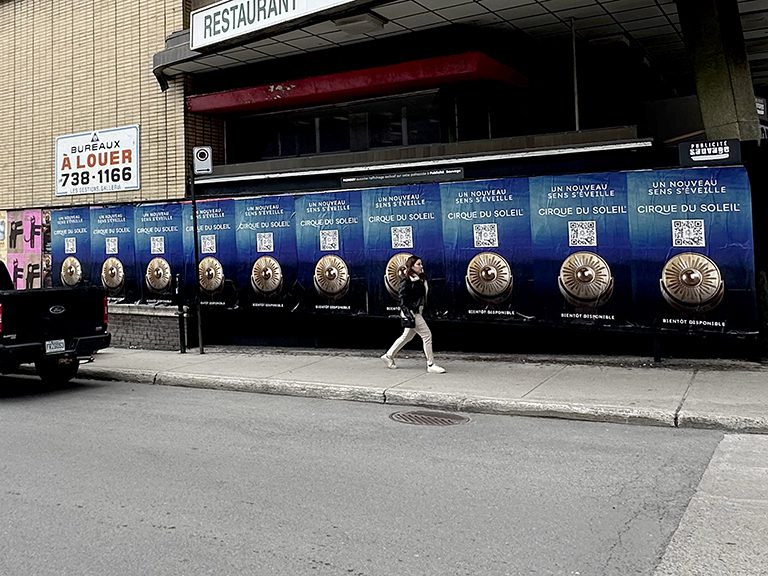
There is no single “normal” poster size. That is the first and most important thing to understand. The normal size of a poster depends entirely on where it is going and what it needs to do. A normal poster for a concert venue is not the same size as a normal poster for a street campaign. A normal poster for a research conference is not the same as one for a retail window.
We have run poster campaigns in virtually every context imaginable. Bars in the East Village. Construction walls in Midtown. College campuses in Brooklyn. Corporate lobbies in Tribeca. Each environment has its own normal. This guide maps them all.
If you surveyed the printing industry and asked what a normal poster size is, the overwhelming answer would be 24 x 36 inches. This is the general-purpose standard. It is the size that frames are built around, that print shops produce most efficiently, and that the majority of marketing campaigns default to when no other constraint is present.
At 24 inches wide and 36 inches tall, this poster is about the height of a six-year-old child. It is visually substantial. It reads from street distance. It fits in standard frames available at any home goods store. It is the baseline, the reference point, the size against which all others are measured.
That said, “normal” varies by context. Here is how the industry breaks it down:
Context
Normal Size
Why This Size?
Street / Outdoor Marketing
24 x 36 in
Visible from pedestrian distances, manageable to place
Entertainment / Film
27 x 40 in
Industry standard one-sheet for theaters
Event / Venue Interior
18 x 24 in
Fits interior walls, readable at 5-10 feet
Small Venue / Bar / Cafe
11 x 17 in
Affordable, manageable, fits bulletin boards
Academic / Conference
36 x 48 in
Detail-heavy content, standing viewing distance
Retail Display
18 x 24 in
Standard retail window and floor display size
Normal Poster Sizes for Street Campaigns
In street marketing, normal means 24 x 36. This is not an arbitrary default. It is the result of decades of practical experience with what works in outdoor urban environments.
The logic is straightforward. A pedestrian walking at normal pace has about two to three seconds of view time on a poster as they pass. In that time, the poster needs to register, communicate, and potentially prompt action. A poster that is too small does not register fast enough. A poster that is too cluttered with information cannot be processed in the available time.
At 24 x 36, a well-designed poster with a strong image and a single bold headline registers in under a second. The message lands. The brand is absorbed. That is the goal of street placement, and 24 x 36 accomplishes it consistently.
For campaigns that want more visual weight, 27 x 40 is the next step up. It is noticeably larger than 24 x 36 and commands more wall space. For campaigns with the budget to go there, the additional size generates additional attention, particularly in cluttered visual environments like a busy commercial corridor.
Street Campaign Size Rule
At 24 x 36 inches, your poster is competing with every other visual element in the urban environment. Bold design, high contrast, and a single clear message outperform cluttered layouts at any size. Go bold. Go simple. Go large.
Normal Poster Sizes for Events
Event posters serve two functions: advance promotion and day-of presence. Advance promotion posters go up in surrounding neighborhoods, bars, coffee shops, and partner venues. Day-of presence posters go at the venue entrance and inside.
For advance promotion in bars and coffee shops, 11 x 17 is the standard. These are interior environments where the viewing distance is short and the competition for wall space is high. An 11 x 17 fits on a typical venue wall without demanding excessive real estate. It is affordable to print in volume for wide distribution.
For outdoor advance promotion around the venue and in nearby neighborhoods, 18 x 24 or 24 x 36 is normal. This is street-facing work that needs to compete with other visual noise. Go bigger for outside.
For day-of venue presence, 18 x 24 works well inside most venues. At the entrance or on an A-frame sign out front, 24 x 36 or larger creates more of an arrival moment for attendees.
Normal Poster Sizes for Retail
Retail is a distinct context. The viewer is not a pedestrian passing at pace. They are a shopper moving through an environment specifically designed for their attention. Viewing distances vary from 2 feet at a counter display to 15 feet across a floor.
For window displays visible from the street, 18 x 24 is the most common. It reads from across the sidewalk but does not overwhelm the window. For larger storefront windows at flagship locations, 24 x 36 or even larger may be normal.
Inside the store, the size drops. Point-of-sale posters near checkout areas are often 11 x 17 or 11 x 14. They are read from an arm’s length away. End-cap display posters might run 18 x 24. Feature wall displays can go up to 24 x 36.
Normal Poster Sizes for Music and Entertainment
The entertainment industry has one of the most clearly defined “normal” poster sizes of any sector: 27 x 40 inches, the one-sheet. This standard developed through the movie industry and has been adopted broadly across entertainment marketing.
Concert posters and music promotions often run at 18 x 24 or 24 x 36 for general street campaigns. For venue display and collector-oriented prints, 27 x 40 is the prestige format. Band posters printed at 27 x 40 with premium stock and a numbered print run are a distinct product from a general marketing poster, even if they serve a similar promotional function.
Festival campaigns often use 24 x 36 for general outdoor placement and 18 x 24 for indoor venue placements. The multi-size strategy is standard for major events with both outdoor and indoor placement needs.
Multi-Size Campaign Strategy
Most effective campaigns use two or three sizes. A flagship street size like 24 x 36, a venue interior size like 18 x 24, and sometimes a collector or premium size like 27 x 40. Each size fills a different placement slot in the campaign. Design them as a family, not as isolated pieces.
Why “Normal” Is Not One-Size-Fits-All
The concept of a normal poster size is context-dependent for practical reasons. Different environments impose different constraints. Different audiences have different viewing behaviors. Different budgets allow different scale.
A campaign targeting the Lower East Side neighborhood in Manhattan might run 24 x 36 on construction walls along Delancey Street, 18 x 24 inside partner bars along Rivington, and 11 x 17 on interior venue boards at small galleries. All three sizes are “normal” for their specific placement within the same campaign.
The error most clients make is picking one size and applying it everywhere. That approach misses the nuance of how people move through and experience different environments. Match your poster size to your placement environment, not to a universal standard.
How Normal Poster Sizes Relate to Printing Economics
The reason certain sizes became normal is largely economic. Standard sizes fit standard paper roll widths. They minimize waste on the press. They allow print shops to produce them efficiently. The more a size is requested, the more optimized the production becomes, and the lower the cost per unit.
This is why printing an 11 x 17 costs less than a 13 x 20 even though the 13 x 20 is not dramatically larger. The 11 x 17 is a standard size with optimized production. The 13 x 20 is custom cut and costs more to produce.
For marketing purposes, staying with standard sizes almost always makes economic sense. The difference in visual impact between 13 x 20 and 18 x 24 is modest. The cost difference can be significant. Design your campaigns around standard sizes whenever possible.
Running a Multi-Size Poster Campaign: What It Looks Like in Practice
Knowing what each poster size does in theory is one thing. Knowing how to run a campaign that uses multiple sizes effectively in the same market is another. Here is how we approach a real multi-size campaign from planning through execution.
The process starts with a placement audit. Before we order a single poster, we survey the specific locations where we want the campaign to appear. We measure available wall space, note the typical viewing distance from where most people will see each location, and identify any size constraints imposed by the location itself, whether that is a door frame, a display fixture, or a landlord’s rule about maximum poster size.
From that placement audit, we build a placement map that assigns a specific size to each location based on what will actually fit and what will perform best at that viewing distance. A construction wall on a wide sidewalk gets 24 x 36 or larger. A bar restroom bulletin board gets 11 x 17. A retail window gets 18 x 24. Each location gets the size that is right for it, not a uniform size applied everywhere regardless of fit.
Then we calculate quantities by size. The total quantity of each size is the number of locations receiving that size multiplied by the number of times we plan to refresh the poster at each location during the campaign run. A two-week campaign that refreshes each outdoor location twice a week needs four times the number of 24 x 36 posters as there are outdoor locations on the placement map.
Design is developed for all sizes at the same time from a single creative brief. The hierarchy, the key message, and the brand identity elements are consistent across sizes. The specific layout adapts for each format. Elements that need to be larger at smaller sizes, like phone numbers or event dates, are proportionally adjusted across the size family. We do not simply scale the same file to different sizes and call it done.
Production orders for all sizes are placed together to simplify logistics. Everything arrives in a single shipment. The campaign materials go out to placement crews sorted by location, with each location’s bundle containing the right size and quantity for that specific placement. That last-mile organization saves significant time in the field and reduces the mistakes that come from crews managing unsorted materials at volume.
Chicago and New York: Multi-Size Campaign Environments
Two of the most active poster campaign markets in the country are Chicago and New York, and both reward the multi-size approach in different ways.
In Chicago, the outdoor activation season runs from May through September. The city’s wide sidewalks and dense commercial corridors on Michigan Avenue, Milwaukee Avenue through Wicker Park, and Fulton Market in the West Loop all support 24 x 36 outdoor placements well. The same campaigns typically use 11 x 17 inside bars and coffee shops along those same corridors. A coordinated campaign that places 24 x 36 outdoors and 11 x 17 indoors in the same neighborhood creates saturation that is hard to ignore. A consumer who walks past a 24 x 36 on their way to work and then sees 11 x 17 on the bar wall where they stop for a drink after work has encountered the campaign twice in two different contexts on the same day.
In New York, the density of placement options means that multi-size campaigns can create a level of brand presence that approaches full market saturation in specific neighborhoods. SoHo, Williamsburg, and the Lower East Side all have layered placement environments. Construction walls on the main corridors take large format. Smaller venues and interior placements take smaller formats. The right multi-size strategy in these neighborhoods generates impression frequency that no single-size campaign can match.
Can I mix portrait and environment orientations across a campaign?
Yes, but only intentionally. Mixing orientations can create visual variety that is interesting, or it can create inconsistency that undermines brand coherence. If a environment orientation serves a specific placement, use it for that size. Keep other sizes in portrait if that fits their locations better. The design system should be flexible enough to work in both orientations while maintaining brand recognition across the campaign.
Frequently Asked Questions
What is the normal size of a poster for street marketing?
For street marketing, 24 x 36 inches is the normal and most widely used size. It provides the scale needed for pedestrian visibility and is produced efficiently by most print shops.
What is the normal poster size for events?
Event posters typically use 11 x 17 for indoor small venue placement, 18 x 24 for retail and larger venue interiors, and 24 x 36 for outdoor street promotion. Most event campaigns use at least two sizes.
Is 18×24 a normal poster size?
Yes. The 18 x 24 inch poster is a standard size widely used in retail, event promotion, and interior venue marketing. It sits between the small 11 x 17 and the large 24 x 36 in the standard size range.
What size poster is considered a full-size poster?
In common usage, “full-size” often refers to 24 x 36. Some people use it to describe 27 x 40. There is no official definition, but either of these sizes would be recognized as full-size by most people in the printing and marketing industries.
What is the normal poster size for a bar or coffee shop?
In bars and coffee shops, 11 x 17 is the most common size. It fits comfortably on bulletin boards and wall spaces in these environments and is affordable to print in the quantities needed for venue distribution.
What is the difference between a small and large poster?
Small posters typically range from 11 x 17 to 18 x 24 inches. Large posters start at 24 x 36 and go up. The distinction affects where you can effectively place them, how much they cost to print, and how visible they are at various distances.
Should I print one size or multiple sizes for a campaign?
Multiple sizes. Most effective campaigns run two or three sizes to serve different placement environments. A single-size campaign limits your placement options and misses opportunities in environments that favor different dimensions.