Poster width and height define the physical space your marketing message occupies. Get both dimensions right and your campaign has the foundation it needs. Get them wrong and you are printing posters that do not fit where they need to go, do not read from the right distances, and do not return the results you expected.
We work with poster dimensions daily across campaigns in New York City and other major markets. The relationship between width and height, and between those dimensions and the visual environment where the poster lives, is fundamental to how we plan every job. This guide covers all of it.
Width and height are the two fundamental dimensions of any poster. Their relationship defines orientation. When height exceeds width, the poster is in portrait (vertical) orientation. When width exceeds height, the poster is in environment (horizontal) orientation. When they are equal, the poster is square.
Most standard marketing posters are in portrait orientation. The 11 x 17, 18 x 24, 24 x 36, and 27 x 40 all have greater height than width. This reflects the reality of the wall spaces where posters typically live: walls are generally taller than they are wide, or at least provide more vertical space than horizontal space for poster placement.
environment orientation exists and is used for specific applications: wide retail displays, transit advertising environments, banner-style signage, and certain venue applications. Any standard poster size can be produced in environment by swapping the width and height dimensions.
Width and Height at 11 x 17 Inches
At 11 inches wide by 17 inches tall, the small standard poster is roughly the size of a large magazine opened flat. This width fits a standard bulletin board slot. This height fits within the range of typical wall spaces in bars, cafes, and small venues.
The 11 x 17 has a close-to-2:3 aspect ratio. This is a common ratio in photography (it matches the aspect ratio of 35mm film), which makes photography-heavy designs particularly natural at this size. The width of 11 inches is just wider than a standard sheet of paper (8.5 inches), making it feel like a step up from a document without demanding the wall space of a true large-format poster.
Design for 11 x 17 means designing for close viewing. Your headline can be smaller than a street poster headline. Your body copy can carry more detail. But typography hierarchy still matters. Lead with the most important information at the largest size.
Width and Height at 18 x 24 Inches
Eighteen inches wide by 24 inches tall. The 18 x 24 has a clean 3:4 aspect ratio. This proportionality makes it easy to design for. The 3:4 ratio is balanced and visually comfortable. Design elements feel natural in this space.
At 18 inches wide, this poster is significantly wider than a piece of paper and fills a retail window or interior wall display with authority. At 24 inches tall, it has enough vertical space for a strong headline, a supporting image, and basic event or product information without feeling cramped.
For retail environments, 18 x 24 is the sweet spot between presence and practicality. It is large enough to compete with surrounding visual content but small enough to fit in most standard retail display locations.
Width vs. Height: Which Matters More?
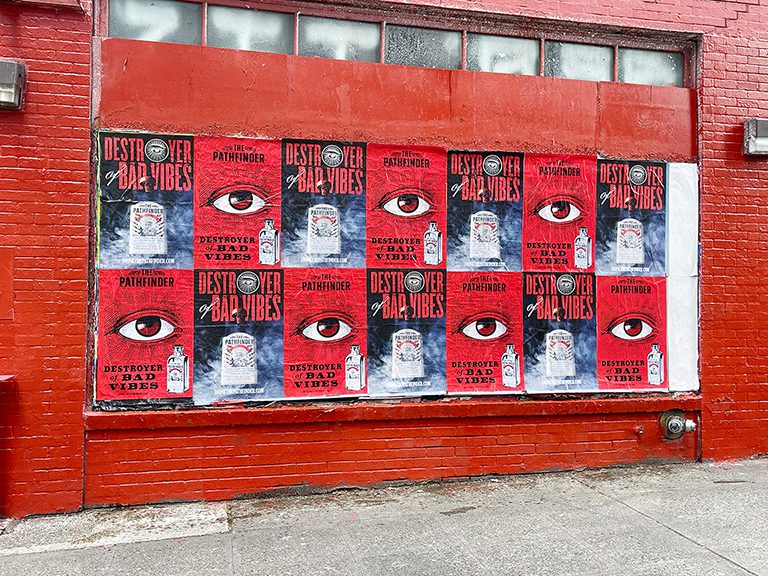
On most poster walls, height determines visual impact more than width. A poster that is tall stands out in a field of shorter elements. On a construction wall covered in posters of similar width, the taller poster draws the eye. This is one reason the 27 x 40 one-sheet has such strong visual presence: its unusual height makes it stand out.
Width and Height at 24 x 36 Inches
Twenty-four inches wide by 36 inches tall. The 2:3 aspect ratio. This is the primary street marketing poster size. At 24 inches wide, it fills about two feet of wall space horizontally. At 36 inches tall, it extends three feet up the wall. Combined, it covers 864 square inches of surface area.
On a construction wall in SoHo or a retail exterior in the Flatiron District, a 24 x 36 poster commands its space. Pedestrians passing at normal walking pace have the visual field to absorb the full poster width in their peripheral vision while the height registers their eye position naturally at chest-to-head height.
The 2:3 ratio is also particularly photogenic. Wide-format portrait photography fills a 24 x 36 naturally. This is part of why it became the default: it works as well for image-led design as for text-led design.
Width and Height at 27 x 40 Inches
The one-sheet at 27 x 40 does not reduce to a clean standard ratio. 27:40 is the proprietary ratio that resulted from theater lobby display case dimensions rather than from any mathematical or photographic standard. What matters is the resulting visual presence: a 27 x 40 poster is noticeably taller than a 24 x 36, which gives it a slightly more imposing physical presence.
At 27 inches wide, the one-sheet is three inches wider than a 24 x 36. Those three inches add real design room, particularly for the horizontal elements in a poster (wide-format image bands, horizontal text rows, bottom credits). At 40 inches tall, it has an additional four inches of vertical space over the 24 x 36, valuable for additional information elements or for more breathing room around the primary visual.
Width and Height at 30 x 40 and 36 x 48 Inches
Both the 30 x 40 and 36 x 48 use the 3:4 aspect ratio. The 30 x 40 is the quad sheet, used in certain transit and venue contexts. The 36 x 48 is the extra-large standard, used for conference presentations, large venue walls, and premium outdoor placements.
At 30 inches wide, the quad sheet is the widest of the common entertainment poster formats. At 36 inches wide (3 full feet), the extra-large is a physical presence that is hard to overlook. The height of 40 inches and 48 inches respectively make both of these formats floor-to-just-above-head-height in terms of their vertical span when placed at typical poster installation height.
Production Note on Large Formats
At 36 x 48 and above, you are in wide-format printing territory. Not every print shop handles these sizes as routine jobs. Lead times are longer. Handling requires more care. File setup may differ from standard offset printing. Plan for these factors when scheduling large-format poster production.
Designing to Specific Width and Height Dimensions
When you set up a design file for a poster, you set the document dimensions to the poster’s width and height, plus bleed. Here is the setup for each standard size:
Poster Size
Design File Width
Design File Height
Resolution
11 x 17 in
11.25 in
17.25 in
300 DPI
18 x 24 in
18.25 in
24.25 in
200-300 DPI
24 x 36 in
24.25 in
36.25 in
150-200 DPI
27 x 40 in
27.25 in
40.25 in
150 DPI
36 x 48 in
36.25 in
48.25 in
100-150 DPI
Each file size with bleed is 0.25 inches larger in each dimension than the trim size (0.125 inch bleed per edge). This is standard practice. Always confirm with your specific print vendor as bleed requirements can vary.
How Width and Height Affect Typography
Poster dimensions directly determine how large your type needs to be to read at your expected viewing distance. As width and height increase, the minimum legible type size does not necessarily increase proportionally, because viewing distance also typically increases with poster size.
At 11 x 17 (close viewing): a headline at 48-72 points reads well at 5 feet. Body copy at 10-12 points is readable at 2-3 feet.
At 18 x 24 (mid-range): a headline at 72-96 points reads at 8-10 feet. Body copy at 14-16 points is readable at 4-5 feet.
At 24 x 36 (street scale): a headline at 100-150 points reads at 15-20 feet. Body copy is generally not used because viewers do not have time to read it at street pace.
At 27 x 40 and larger: headline type of 150+ points reads at 25+ feet. The poster functions as a visual signal, not a reading exercise.
What poster width and height is best for street campaigns in NYC?
24 inches wide by 36 inches tall (24 x 36) is the standard for NYC street campaigns. This provides sufficient visual presence at pedestrian distances, fits most placement locations, and prints economically in the quantities needed for meaningful coverage.
Frequently Asked Questions
What are the width and height of a standard poster?
The most common standard poster in the US is 24 x 36 inches (24 wide by 36 tall). Other common standards include 11 x 17, 18 x 24, and 27 x 40 inches.
Is width or height listed first in poster dimensions?
In the US, width is listed first by convention. So 24 x 36 means 24 inches wide by 36 inches tall. However, some vendors list differently, so confirm orientation when ordering to avoid confusion.
What is the aspect ratio of a 24×36 poster?
A 24 x 36 poster has a 2:3 aspect ratio (24:36 simplifies to 2:3). This is a common photographic aspect ratio, which makes portrait photography a natural fit for this format.
How does width affect a poster’s visibility from a distance?
A wider poster captures more horizontal visual field, which helps it register faster in peripheral vision. However, height tends to have a larger impact on initial visibility because human eye movement is predominantly horizontal and taller objects stand out in fields of shorter elements.
What happens if my poster width or height is non-standard?
Non-standard dimensions work but cost more. Print shops charge for custom paper cutting. Standard display hardware may not fit. Frame options are limited. Staying within standard dimensions saves money and simplifies production.
Can I change a poster from portrait to environment without reprinting?
Not physically. A printed poster cannot be rotated to change its orientation. However, you can design and print the same poster in both orientations if your campaign requires horizontal placement. This requires a separate file and separate print run.
What is the pixel count for a 24×36 poster at 150 DPI?