Size for Posters: How to Pick the Right Format for Your Campaign
We choose poster sizes based on where the poster is going, who is seeing it, and how much budget we are working with. This guide walks through every major format and when each one earns its place in a campaign.
We choose poster sizes based on where the poster is going, who is seeing it, and how much budget we are working with. This guide walks through every major format and when each one earns its place in a campaign.
Picking the wrong size for a poster campaign wastes money and impact. A poster too small disappears into the visual noise of a busy street. A poster too large for the available wall surface creates installation problems and wastes paper. Getting the size right is not complicated, but it requires knowing the options and what drives the choice.
We have been running outdoor poster campaigns since before most current campaign tools existed. Our crews work neighborhoods across the United States. In New York, we know the difference between a Lower East Side wall section and a Midtown construction barrier. In Los Angeles, we know the difference between a Venice boardwalk bulletin board and a Melrose Avenue building wall. Size decisions get made based on real-world knowledge of the surfaces, more than design preferences.
This guide covers the main poster sizes, when to use each one, and what determines the right choice for a given campaign.
Most poster campaigns in the United States use one or more of these five core sizes. They are standard because print shops stock them, equipment is calibrated for them, and display hardware is built around them. Starting with a standard size keeps costs predictable and production fast.
11×17 inches: Small format for venues, indoor boards, and high-volume low-cost outdoor deployment
18×24 inches: The standard workhorse for street-level outdoor campaigns
24×36 inches: The large-format standard for high-impact outdoor and retail display
27×40 inches: The cinema one-sheet for theater lobby display
40×60 inches: Oversized format for building walls and major outdoor locations
Beyond these, there are custom sizes for transit advertising, specialty display, and building-scale campaigns that require panel work. We handle those regularly, but they involve custom production processes and pricing separate from standard campaign work.
How to Match Poster Size to Location
The location drives the size decision more than anything else. Before we finalize a poster size for any campaign, we know the target surfaces. Here is how we think through it.
Utility Poles and Light Posts
Vertical cylindrical surfaces have narrow usable width. Most standard utility poles in urban environments have a visible face width of about 12 to 14 inches. An 18×24 portrait poster wraps slightly but stays legible. An 11×17 is a cleaner fit on the pole face without wrapping. For pole campaigns in neighborhoods like the Mission District in San Francisco or Pilsen in Chicago, we use 11×17 for quantity and flat-face installation.
Flat Building Walls
Building walls are the best surfaces for large posters. A flat, clean wall section in a high-foot-traffic area is where 24×36 or larger formats earn their investment. We target ground-floor walls on side streets adjacent to busy corridors. The Bowery in Manhattan. Abbot Kinney in Venice. Rush Street in Chicago. These surfaces accommodate 24×36 and 40×60 posters comfortably and get high viewer exposure.
Construction Hoarding
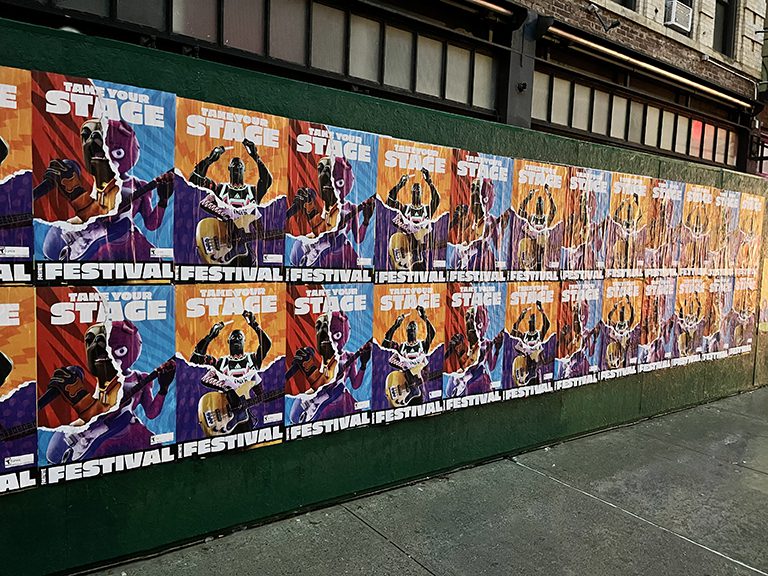
Construction barriers are temporary walls that appear during building projects in dense urban areas. They are often flat, clean, and at eye level along the sidewalk. A single construction barrier panel is typically 4 feet wide by 8 feet tall. That accommodates two 18×24 posters side by side or a single 24×36 with room to spare. For large hoarding sections, we tile 18×24 or 24×36 posters to create a larger visual impact across multiple panels.
Retail Windows and Doors
Window placement favors sizes that fit the glass without obstructing the interior view or the product display inside. In our experience, 11×17 or 18×24 work well for window placement in retail environments. Both sizes are substantial enough to read from the sidewalk while leaving the retail display visible on the sides.
Field Rule: Measure Before You Print
We always scout target locations before finalizing a poster size. Even when we know a neighborhood well, surfaces change. A wall that was clear last month may have permanent signage or HVAC equipment added. We confirm available dimensions and orientation before the print file goes to the shop. Remeasure. Every time.
Poster Size vs. Campaign Budget
Budget shapes size decisions as much as location does. Here is how poster size affects production cost and what that means for campaign strategy.
Size
Approx. Unit Cost (500 run)
Budget Focus
Best For
11×17
$0.40 – $0.80
Volume coverage
High-quantity neighborhood blitzes
18×24
$0.90 – $1.60
Volume + visibility
Standard street campaigns
24×36
$2.00 – $3.50
Impact per placement
High-traffic key locations
27×40
$3.50 – $5.00
Specialty display
Cinema, retail frame systems
40×60
$8.00 – $15.00
Premium impact
Major outdoor locations, brand launches
These cost ranges are estimates for uncoated or matte-coated paper on standard wide-format inkjet or offset equipment. Specialty paper, lamination, UV coating, and custom substrates increase costs. Get actual quotes from your print shop before budgeting.
Viewing Distance and Size Selection
Viewing distance is the second most important factor in size selection. A poster that reads perfectly from 10 feet may be too small at 30 feet. Knowing how far away your viewers will be when they first encounter the poster determines the minimum size that works.
Here are rough guidelines based on our field experience and standard outdoor advertising research:
5 feet or less (indoor, close-range): 8×10, 11×14, 11×17 all work
5-10 feet (sidewalk, close pass): 11×17 minimum; 18×24 preferred
20-50 feet (across a street): 24×36 minimum; 40×60 for maximum legibility
50+ feet (building side, major outdoor): 40×60 minimum; panel work required
These are guidelines, not hard rules. Typography scale matters as much as poster size. A 24×36 poster with large, bold type reads from 30 feet. The same sized poster with dense, small text does not. Design and size work together.
Portrait vs. environment Orientation for Poster Size
The same dimensions produce very different visual experiences depending on orientation. A 24×36 poster in portrait orientation (24 wide, 36 tall) feels tall and narrow. The same dimensions in environment orientation (36 wide, 24 tall) feel wide and grounded.
Portrait is standard for most poster applications. Most wall surfaces in urban environments present as taller-than-wide spaces at the scale of a single poster. Portrait orientation fills these spaces naturally.
environment orientation works well for horizontal banner-style placements, low wall sections below windows, and any surface that is wider than it is tall. When we work construction barriers that have been covered partially by other materials, we often find a remaining horizontal space that calls for environment orientation.
Size for Digital Posters vs. Print Posters
When a campaign includes both digital and print versions of the same poster, size relationships change. Print posters have physical inch dimensions. Digital posters have pixel dimensions and vary depending on the display screen.
For social media sharing of poster artwork, the Instagram square (1080×1080 pixels) or portrait format (1080×1350 pixels) are standards. For website hero images, the aspect ratio of a standard 24×36 print poster (2:3) converts to 1080×1620 pixels at Instagram quality or 2000×3000 pixels at web quality.
Design your print poster first. Then adapt the artwork for digital formats by adjusting crop and text placement. Do not design for digital first and then try to extend to print; the resolution and bleed requirements of print production require thinking about the print version first.
Our Recommendation for First-Time Campaign Clients
If you have never run a street poster campaign before, start with 18×24. It is affordable, easy to handle in the field, readable from the sidewalk, and fits most available surfaces in dense urban environments. Once you see how 18×24 performs on your first campaign, you will have a reference point for when to scale up to 24×36 or down to 11×17 for different goals.
Large Format Poster Size: When to Use It
Large format starts at 40×60 inches and goes up from there. These sizes require different production methods, different handling, and often panel work for the largest dimensions. They also deliver a completely different level of visual impact.
We use large format for product launches, brand moments, and campaigns where one or two key locations are more valuable than broad neighborhood coverage. A single perfectly placed 40×60 poster on a building wall in a high-traffic location can generate more exposures than 50 smaller posters distributed across the same neighborhood.
The math on large format is simple: you trade quantity for presence. The question is whether presence or quantity better serves the specific campaign goal. For awareness campaigns targeting a broad audience, quantity wins. For specific event launches targeting a defined audience in a defined moment, presence wins.
Frequently Asked Questions
What is the best size for an outdoor poster?
For most outdoor street-level campaigns, 18×24 or 24×36 inches are the best sizes. The 18×24 works for volume coverage and fits most available surfaces. The 24×36 works for high-impact placements where a larger visual presence is needed. The best choice depends on your specific locations and budget.
What size should I use for an event poster?
For indoor venue posting, 11×17 is the standard. For outdoor promotion of an event in a neighborhood, 18×24 is the typical size. If the event is large and the campaign warrants high-visibility placements, 24×36 at key locations adds impact alongside the 18×24 coverage.
What size should I use for a concert poster?
The traditional concert poster format is 11×17 for venue-level promotion and 18×24 for neighborhood outdoor coverage. Headline shows in major venues often warrant 24×36 posters at high-traffic locations near the venue and throughout the surrounding neighborhood. Art collector-edition concert posters often use 12×18 or 13×19 for archival paper proportions.
What poster size is best for retail stores?
Retail environments typically use 18×24 and 24×36 because these sizes fit standard retail display frame systems. Window displays favor 11×17 or 18×24 because they leave enough glass visible for the retail display. In-store promotional signage varies by fixture type, but 24×36 is common for endcap and feature displays.
How do I know if my poster is too small for a location?
Walk the target location and look at competing signage. If your planned poster size would be smaller than most of the surrounding visual content, it is too small. Also consider viewing distance: stand at the point where your target audience will first see the poster and check whether a poster of your planned size would be readable from that distance.
Can I use multiple sizes in a single campaign?
Yes, and we do this regularly. A campaign might use 24×36 for key high-traffic locations and 18×24 for broader neighborhood coverage. The same design is adapted to both sizes, with typography and layout adjusted for each format. Multi-size campaigns require more print production planning but often outperform single-size campaigns in reach and impact.
What file size will I need for a large poster print?
A 24×36 poster at 300 DPI in CMYK produces a file of approximately 250-400 MB in uncompressed TIFF format. A 40×60 poster at the same specs runs significantly larger. For practical print submission, most shops accept PDF files with embedded fonts and images, which compresses well without quality loss. Ask your print shop for their preferred file format and submission specs.