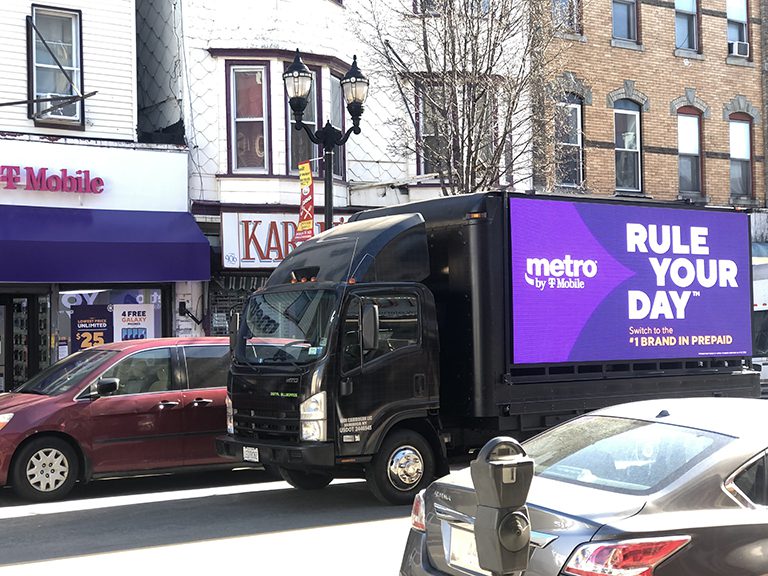
A mobile LED billboard truck at a conference does something that no other advertising format at the same event can do: it reaches the full attendee population on their terms, in the spaces they actually move through, without requiring them to walk past your booth, open your email, or click on your ad. While every other exhibitor’s marketing effort is confined to the exhibit hall or the inbox, an LED truck running the hotel corridor and the approach routes during show hours is visible to essentially every attendee who steps outside.
That reach is the core argument for mobile billboard advertising at conferences. Convention attendees are a remarkably dense, geographically concentrated audience for three to five days. They eat at the same restaurants, sleep in the same hotel blocks, and move through the same streets on predictable daily schedules. A properly routed LED truck in that environment generates thousands of impressions per hour, at a cost-per-impression that most exhibitors cannot match with any booth-based strategy.
At American Guerrilla Marketing, our team deploys LED billboard trucks at major conferences and trade shows across the US. We design the routes, manage the deployments, produce the content, and deliver the post-event reports. This guide covers how we route trucks at the major convention markets, when to deploy, what content works, and why the evening window is the most valuable deployment time most brands are not using.
Why Mobile Billboards Outperform Static Advertising at Conferences
Static advertising at conferences — banner stands, directional signage, sponsored columns — is fixed in place and requires attendees to pass the specific location where the ad is positioned. Mobile billboard trucks invert that dynamic. The truck goes to the audience rather than waiting for the audience to come to it. That mobility is particularly valuable in convention environments where attendee movement patterns are predictable but spread across a geographic area that no fixed placement can cover comprehensively.
The Approach Corridor Advantage
The approach corridors between convention center hotels and the venue entrance are some of the highest-concentration advertising locations in any city during a major show. Every attendee traveling from their hotel to the convention center passes through these corridors, typically twice a day at minimum. An LED truck running these corridors during the morning approach window reaches the maximum daily audience in a compact time window, before they enter the building and before the show floor sensory overload begins.
The Hotel Zone Reach
The hotel zone around a major convention center hosts not just sleeping attendees but the morning breakfast traffic, the evening happy hour and dinner crowd, and the late-night networking scene that continues after the official programming ends. An LED truck in the hotel zone during these windows reaches attendees in a receptive, relaxed frame of mind that is distinct from the on-floor or approach-corridor mindset. Evening hotel zone deployments are particularly valuable for brands targeting senior decision-makers who are often more active in the evening networking environment than on the show floor.
How We Route LED Trucks at Major Convention Centers
Route design is the most important variable in mobile billboard performance at a conference. A poorly routed truck runs through empty streets and generates minimal impressions. A well-routed truck runs through the specific corridors where the highest concentrations of convention attendees move during each part of the day.
Pre-Deployment Location Survey
Before every conference deployment, our operations team surveys the convention district on foot. We map the pedestrian flow patterns, identify the highest-traffic intersections, document any permit restrictions or route limitations in that city’s convention zone, and design the route around the actual geography of the attendee movement. That survey is the foundation of every route we design. It is why our trucks generate higher impression numbers than standard LED truck deployments that use generic urban routes without event-specific mapping.
Las Vegas Conference Routes
Las Vegas conference routes focus on the Las Vegas Boulevard corridor from the Strip hotel blocks to the LVCC main entrance, the Koval Lane and Paradise Road corridors serving the hotel properties east of the convention center, and the restaurant cluster on the Arts District and downtown blocks that captures evening networking traffic. For the Venetian Expo and Mandalay Bay conference venues, routes shift to the corresponding Strip corridors adjacent to those properties.
New York Conference Routes at Javits
New York conference deployments at Javits Center route trucks along 11th Avenue and the cross-streets connecting the Hudson Yards hotel properties to the convention center entrance, with evening routes extending east into the Hell’s Kitchen restaurant zone on 9th and 10th Avenue. Our New York team, based in Industry City, Brooklyn, manages all permitting and route coordination for Manhattan conference deployments and can activate within short lead times for brands booking within a few weeks of their show.
Chicago Conference Routes at McCormick Place
McCormick Place’s lakefront location creates unique routing requirements. The primary McCormick routes run along Lake Shore Drive approaching from the South Loop hotel cluster, along Martin Luther King Drive serving the shuttle corridor, and into the Cermak Road restaurant zone for midday and evening coverage. Our Chicago team coordinates with the city’s permit office for all McCormick-area conference deployments.
The Nighttime Opportunity: Why Evening Deployments Drive Results
The most underutilized deployment window for conference mobile billboard advertising is the evening networking period. When the convention floor closes at 5 or 6 PM, attendees do not disappear. They move to the hotel bars, the restaurant reservations, the sponsored networking events, and the evening programming that continues throughout the conference days. That movement concentrates the full attendee population — often at their most relaxed, most socially connected, and most receptive — in the hotel and restaurant zone around the venue.
An LED truck in that zone during the 6 to 10 PM window is the only active advertising platform in the environment. No other exhibitors are running field marketing during those hours. The streets are occupied by conference attendees who have already processed the day’s floor activities and are now in a social mode that is more receptive to brand impressions than the show floor mindset. High-lumen LED content at dusk and into the evening hours is also significantly more visually impactful than daytime content, creating a brand impression that is both more visible and more memorable.
Evening Content Strategy for Conference LED Trucks
Evening conference content should shift away from booth location and feature messaging toward brand narrative and networking hook messaging. Content that references the conference by name, that acknowledges the shared industry context attendees are in, or that speaks directly to the evening social environment performs significantly better than generic daytime brand content repurposed for the evening deployment. Our creative team produces conference-specific content packages that include distinct daytime and evening creative, with messaging calibrated to each deployment window.
Combining Mobile Billboards with Other Conference Marketing Tactics
LED billboard trucks at conferences produce the strongest results when integrated with complementary street-level tactics. An attendee who receives a product sample at the hotel lobby entrance in the morning, walks past a sidewalk stencil on the approach corridor, and sees the brand’s LED truck on the return hotel route in the evening has accumulated three separate brand impressions before ever encountering the brand’s booth. That multi-touchpoint awareness is the difference between a booth that attendees arrive at with some existing brand recognition and one that has to establish the brand from a standing start in every interaction.
Our guerrilla marketing team designs integrated convention programs that stack LED truck deployments with brand ambassador programs, product sampling, sidewalk stencils, and where applicable, projection advertising on conference center exterior walls during evening hours. The specific tactic mix depends on the venue geography, the event’s attendee profile, and the brand’s objectives and budget.
Content Production for Conference LED Trucks
LED billboard truck content for conference deployments needs to communicate quickly and clearly. Attendees pass a moving truck in seconds; the content needs to register the brand identity and a single key message within that window. The most effective conference LED truck content follows a simple structure: brand identity at the largest possible scale, a short value message that connects to what the brand does for the conference audience, and a clear next step (booth number, URL, or QR code for mobile-first audiences).
Content should be built for the LED format: high contrast, minimal text, large type sizes that read from 50 feet at walking speed. Conference-specific elements like the show name, dates, or booth location add relevance without adding complexity. Our production team creates conference LED content as part of the deployment package, with turnaround times that accommodate short-lead conference bookings.
LED Billboard Truck Specifications for Conference Deployments
Not all LED billboard trucks are equal in performance for conference marketing deployments. The specifications that matter most for a convention environment are screen resolution, lumen output, screen size, and content update capability. A truck with a small, low-resolution screen or insufficient lumen output will produce an adequate impression in direct sunlight but fail to register effectively in the mixed-light conditions of early morning or evening deployments — precisely the windows when convention mobile billboard advertising is most valuable.
Lumen Output Requirements for Convention Deployments
For daytime convention marketing on open-air approach routes, a minimum of 5,000 lumens per square meter is required to maintain content visibility in direct sunlight conditions. For evening deployments in the hotel and restaurant zones where ambient light is lower, that requirement drops and a 3,000-5,000 lumen output is typically sufficient for excellent visibility. Las Vegas is the exception: the Strip’s extreme ambient light environment from hotel tower lighting and signage requires higher-lumen equipment than any other US convention market for evening deployments.
Screen Size and Content Readability
Screen size determines how far away the content is legible. For a truck moving through a convention approach corridor at street speed, the content needs to register in the three to five seconds of view time available as the truck passes a stationary pedestrian. A minimum screen width of 10 feet is required for content to be legible at 50 feet of viewing distance with appropriately formatted text. Our fleet uses screens ranging from 10 to 20 feet wide depending on the market and the specific route requirements, with larger screens deployed on routes with higher-speed vehicle traffic where longer viewing distances compensate for shorter exposure windows.
Real-Time Content Update Capability
The ability to update content between deployment windows is a significant operational advantage at conferences where the messaging should shift from show-floor-hours content to evening-networking content as the day progresses. Our trucks support wireless content updates, allowing the production team to push new creative to the truck between the morning and evening deployment windows without requiring the truck to return to a staging location. This capability allows a single truck to carry tailored morning creative (booth location, show floor hours) and tailored evening creative (brand narrative, networking event promotion) on the same deployment day.
Measuring Mobile Billboard Performance at Conferences
We deliver post-deployment reporting that covers GPS-tracked route data showing actual truck movement and location throughout each deployment day, impression estimates calculated from the pedestrian and vehicle traffic counts on each route segment, timestamped photo documentation from multiple points on the route, and any QR code scan data where applicable. For brands running integrated programs, we correlate LED truck impression data with ambassador distribution counts and booth traffic metrics to provide a unified view of the convention district marketing program’s performance.
Frequently Asked Questions
How are mobile billboard trucks routed at conferences and conventions?
Routes are designed around the primary attendee transit corridors between the convention center and the hotel district, the approach streets with the highest pedestrian and vehicle traffic, and the restaurant and bar zones active during evening networking hours. We survey each venue and design custom routes based on the specific geography of that convention market.
What content works best on a mobile billboard truck at a conference?
Daytime conference content leads with the brand name, a short value proposition, and the booth number or location. Evening content shifts to brand storytelling and event-specific messaging. LED trucks allow content updates between deployments, so morning, afternoon, and evening creative can be different, which we recommend for multi-day conference programs.
How many impressions does a mobile billboard truck generate at a major trade show?
At a major trade show with 30,000 attendees, a well-routed LED truck running 8 hours per day on the primary approach and hotel corridors typically generates 15,000 to 40,000 impressions per day. Evening deployments in dense hotel zones can push that number higher due to concentrated foot traffic in a smaller geographic area.
Can mobile billboard trucks operate during evening networking hours at conferences?
Yes, and evening is often the highest-value deployment window. When the convention floor closes, attendees concentrate in the hotel and restaurant zone around the venue. An LED truck in that zone during the 6 to 10 PM window reaches a highly concentrated, relaxed audience in an environment where no other active advertising is running at street level.
Do you handle permits for mobile billboard trucks at convention centers?
Yes. Our operations team handles all permits and route clearances for mobile billboard deployments in every market we operate. Some convention cities have specific restrictions on billboard truck routes near convention centers, and we navigate those requirements as part of our standard program management.
What is the difference between an LED billboard truck and a traditional wrapped truck?
An LED billboard truck displays full-color digital content on a high-resolution LED screen. Content can be animated, updated in real-time, and changed between deployments. A wrapped truck has static printed graphics. LED trucks are significantly more visible at night and in low-light conditions and offer content flexibility that static wraps cannot match. For conference evening deployments, LED is the only viable format.