Physical brand presence has always mattered in Kansas City, and guerrilla marketing campaigns in Kansas City’s agriculture, logistics, and financial technology economy reach the exact audiences that drive commercial decisions. When your target market is working through Kansas City’s commercial corridors, between client meetings, transit stops, and neighborhood retail, a well-placed guerrilla marketing campaign reaches them in precisely those moments. American Guerrilla Marketing has built guerrilla marketing campaigns for brands across Kansas City that needed local market authority, not just national reach.
Market timing matters as much as placement location for guerrilla marketing in Kansas City. Campaigns running during Kansas City Jazz & Heritage Festival, St. Louis Pride, Gateway Cup cycling, and Mizzou game weekends reach concentrated audience volumes that normal operating windows can’t match. American Guerrilla Marketing calendars Kansas City campaigns around these peak windows, ensuring that budget is deployed when the audience-to-impression ratio is highest. The brands that consistently get the strongest ROI from Kansas City street-level advertising are those that coordinate campaign timing with the city’s commercial rhythm rather than running on continuous flat deployment.
Use this page as a planning reference for guerrilla marketing in Kansas City. The sections below cover neighborhood and corridor selection, format options and their relative ROI in this market, how American Guerrilla Marketing structures field execution across Kansas City’s commercial environment, what campaign documentation looks like, and how budget scales to results. The final sections include an FAQ and direct contacts for getting a campaign started.
What Are Guerrilla Projections?
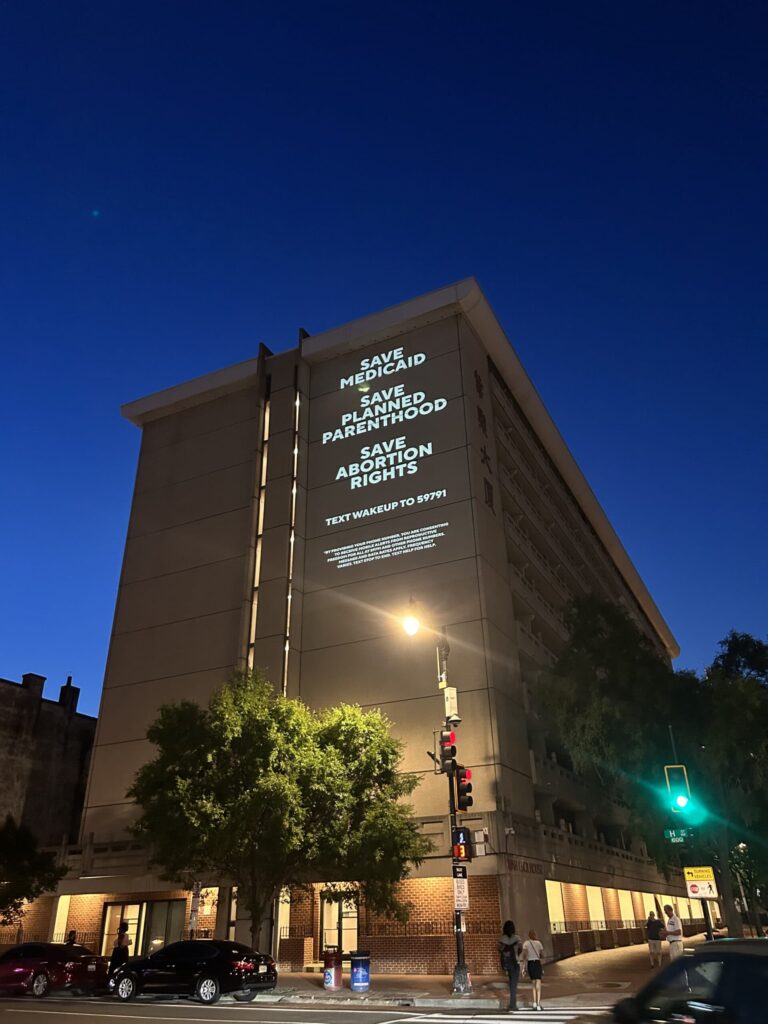
Guerrilla projections are high-powered light installations that turn existing architecture into temporary brand display surfaces. A professional projector, running anywhere from 10,000 to 30,000 lumens depending on building size and ambient light conditions, throws brand imagery, animation, or video content onto building facades, bridge piers, parking structures, stadium walls, and other large vertical surfaces after dark. No permanent modification to the building is required. The entire installation, including setup and breakdown, can be accomplished in under two hours for a standard single-location campaign.
What separates guerrilla projections from conventional digital OOH isn’t just the visual scale, it’s the context of discovery. When someone encounters a billboard, they know it’s an ad. When they turn a corner and see an entire building transformed into a living brand canvas, the cognitive interruption is total. That moment of surprise and visual spectacle is what drives the social sharing behavior that multiplies a projection campaign’s effective reach far beyond the physical audience at the activation site.
Projection campaigns work across a wide range of brand objectives: product launches, event promotions, political messaging, cause campaigns, brand awareness in a new market, and competitive conquesting in a rival’s stronghold. The format is inherently flexible, content can be swapped between nights, locations can be sequenced across a city in a single evening, and real-time social monitoring can inform adjustments to content or messaging mid-campaign.
Why Missouri Is a Strong Market for Projection Campaigns
Missouri’s urban geography creates a distinctive opportunity for projection advertising. Kansas City and St. Louis, the state’s two major metro areas, both feature dense urban cores with walkable entertainment districts, abundant brick and concrete building facades ideal for high-contrast projection, and nightlife concentrations that ensure large pedestrian audiences during evening campaign windows.
Missouri’s major metros also punch above their population weight in terms of social media engagement. Both Kansas City and St. Louis have highly active local social media communities, with strong Instagram and TikTok usage among the 21–35 demographic that projection campaigns most reliably convert into organic sharers. A well-placed projection in the Crossroads Arts District or Soulard neighborhood will reach thousands of phones before midnight, and those posts extend the campaign’s reach into social networks that no paid placement can reach as efficiently.
The architectural inventory in both cities adds another dimension. Kansas City’s historic stockyard buildings, Crossroads warehouses, and Country Club Plaza’s Spanish Colonial facades all offer projection surfaces with visual character that plain concrete walls simply can’t match. In St. Louis, the late 19th-century brick commercial buildings lining downtown and the Soulard district provide rich textures that make projections feel embedded in the city’s history rather than imposed on it. That authenticity is a brand asset that projection campaigns exploit better than any other outdoor format.
Missouri’s events calendar also creates natural amplification opportunities. The Kansas City Chiefs’ seasonal schedule brings massive concentrated audiences to the Crossroads and Power & Light corridors on game nights. St. Louis Cardinals games pack the Ballpark Village area and surrounding streets. The Missouri State Fair in Sedalia, the St. Louis Art Fair in Clayton, and Springfield’s Artsfest all create high-density pedestrian moments where a well-timed projection can reach thousands of concentrated targets in a single evening deployment.
Kansas City: Best Locations and Neighborhoods for Guerrilla Projections
Power & Light District
Kansas City’s Power & Light District is the city’s highest-density after-dark entertainment concentration, a 9-block corridor drawing 7,000+ pedestrians on a typical Friday or Saturday night. The district’s mix of surface parking structure walls, entertainment venue facades, and open plaza space creates multiple projection surfaces within a single deployment radius. Campaigns here regularly generate 500–1,000+ organic social media posts per night from audience members who photograph and share the projection spontaneously.
Crossroads Arts District
The Crossroads is Kansas City’s creative hub, a neighborhood of converted warehouses and mid-century commercial buildings south of downtown that houses galleries, studios, restaurants, and bars. The area’s brick warehouse stock provides excellent high-contrast projection surfaces, and the culturally engaged audience that concentrates here on First Fridays and weekend evenings is predisposed to notice and share unexpected visual spectacle. Projections on the larger warehouse facades in the Crossroads can reach 100-foot display widths with proper projector positioning.
Country Club Plaza
The Plaza’s distinctive Spanish Colonial Revival architecture, terracotta tile roofs, ornate facade details, and the famous J.C. Nichols Memorial Fountain at its center, creates a theatrical backdrop for projection campaigns that plays differently from the industrial aesthetic of the Crossroads or the glass-and-neon density of Power & Light. Plaza projections work especially well for luxury, lifestyle, and fashion brands whose creative benefits from an upscale environmental frame.
Westport and the 18th & Vine District
Westport’s dense bar and restaurant corridor on Pennsylvania Avenue offers a high-volume pedestrian environment on weekend evenings, with building facades on the east side of the street providing workable projection surfaces when traffic is cleared. The 18th & Vine Jazz and Blues District, Kansas City’s historic jazz heartland, offers powerful brand association value for campaigns targeting cultural and music audiences, with the American Jazz Museum building wall providing a large-format projection opportunity.
St. Louis: Architecture, Foot Traffic, and Opportunity
Laclede’s Landing
Laclede’s Landing is the historic nine-block district on the riverfront beneath the Gateway Arch, a concentration of 19th-century warehouse buildings converted into bars, restaurants, and event venues. The area’s brick facades and cobblestone streets create an atmospheric backdrop, and the steady pedestrian traffic generated by Gateway Arch National Park visitors provides a built-in audience for daytime-adjacent projection events. The riverfront setting also allows projection onto bridge piers and the retaining walls along the Mississippi embankment for campaigns that want a truly distinctive scale.
Soulard
St. Louis’s oldest neighborhood features some of the city’s most visually compelling 19th-century brick commercial buildings, and Soulard’s bar and restaurant scene generates consistent pedestrian density on weekend evenings year-round. The neighborhood’s Mardi Gras celebration draws 100,000+ attendees, making it the single highest-density projection opportunity in Missouri for brands that can align their campaign with the February festival calendar.
The Delmar Loop
University City’s Delmar Loop, a stretch of Delmar Boulevard that houses an eclectic mix of restaurants, record stores, theaters, and bars, draws a younger, culturally engaged demographic that over-indexes on social media sharing behavior. The Loop’s walk-of-fame sidewalk and the Tivoli Theatre building provide distinctive visual context, and the Washington University student population that frequents the area ensures high baseline engagement with unexpected visual spectacle.
Grand Center Arts District
St. Louis’s Grand Center district, anchored by the Fox Theatre and Powell Symphony Hall, is the city’s institutional arts hub. The Fox Theatre’s ornate 1929 facade is one of the most photogenic projection surfaces in Missouri, its elaborate architectural detail responds dramatically to well-designed projection content, creating images that viewers photograph repeatedly for social sharing. Grand Center events draw well-heeled audiences with high social media engagement rates.
Springfield, Columbia, and Missouri’s Secondary Markets
Missouri’s secondary markets offer projection opportunities that major-market budgets often overlook, and in those markets, the novelty factor of a guerrilla projection campaign is even higher because the format has been seen less frequently.
Springfield, Missouri’s third-largest city and home to Missouri State University and Drury University, has a concentrated nightlife corridor on Commercial Street (C-Street) and a downtown core on Park Central Square that provides workable projection surfaces and consistent evening foot traffic. Springfield’s 170,000-person metro population is dense enough to generate significant campaign momentum but small enough that a single well-placed projection becomes city-wide conversation by morning.
Columbia is home to the University of Missouri’s main campus, approximately 30,000 students, plus a thriving downtown restaurant and bar scene along Broadway and 9th Street. University towns punch significantly above their population weight for guerrilla campaign virality because dense student populations with high social media usage spread visual content faster than any comparable demographic. An AGM projection campaign during a Mizzou home football weekend can reach audiences far beyond the campus itself within hours of deployment.
Joplin, at the Missouri-Oklahoma-Kansas crossroads, offers opportunities for brands seeking regional reach in the four-state area. Jefferson City, the state capital, provides unique political and governmental brand associations for advocacy and cause campaigns. Independence, as part of the Kansas City metro, offers a distinct market identity and lower competitive clutter than the urban core.
Content Strategy and Creative for Missouri Projections
The content that performs best in guerrilla projections shares specific characteristics regardless of brand category. Simple, high-contrast visual compositions with bold color read most clearly at projection scale, complex, layered designs that look sophisticated on a monitor often lose visual hierarchy when expanded to 50 or 100 feet wide. Animation should be deliberate and unhurried; fast cuts and complex motion graphics that work in digital contexts lose impact when projected because viewer eyes are adjusting to an unexpected display in a natural environment.
Missouri-specific content elements dramatically improve performance. Brand imagery that references the Gateway Arch, the Chiefs’ arrowhead, Missouri’s blues and jazz heritage, the Ozark space, or specific neighborhoods signals local authenticity rather than generic national campaign overlay. Audiences in St. Louis and Kansas City both have strong regional identity, acknowledging that identity in the creative produces measurably higher engagement and social sharing rates than content that could have run in any city in the country.
Temporal relevance matters more for projections than for most other outdoor formats. Content tied to a current event, a product launch, a Championship game, a cultural moment, or a local news hook, drives sharing behavior because it gives people a reason to post that goes beyond just “look at this projection.” AGM’s creative team builds content timelines that align projection campaigns with the Missouri events calendar to maximize relevance windows.
Call-to-action integration is achievable within the projection format. QR codes integrated into projection content, sized and positioned for readability from projection audience distances of 30–150 feet, drive measurable digital response and provide direct attribution connecting the physical activation to website visits, app downloads, or purchase behavior. In campaign measurement, QR scan volume from projection audiences consistently provides the clearest evidence of active engagement versus passive viewing.
Equipment, Lumen Output, and Surface Selection
Projection equipment selection is the variable that most determines whether a campaign looks professional or amateur. The fundamental constraint is ambient light: a projector that delivers a sharp, vibrant image at 10,000 lumens in a dimly lit alley will wash out entirely if deployed in a brightly lit commercial district with significant neon signage and streetlight competition. AGM’s Missouri campaigns routinely deploy 15,000–25,000 lumen industrial projectors for urban commercial locations, scaling up to 30,000+ lumen units for large-scale building facades or venues with high ambient light competition.
Throw distance, the gap between the projector and the projection surface, determines both the achievable image size and the required lumen output. A building facade 150 feet wide requires both sufficient throw distance for the lens configuration and enough output to maintain image brightness at that scale. AGM’s advance location surveys establish precise throw angles, surface characteristics, and ambient light conditions for every campaign site before equipment is selected, eliminating the on-site surprises that can compromise execution quality on campaign night.
Surface selection is equally critical. Smooth, light-colored concrete or painted masonry surfaces produce the clearest projection images. Dark brick, rough stone, and heavily textured surfaces scatter light and reduce image clarity. Glass building facades create specular reflection issues that require specific lens and positioning solutions. Kansas City’s and St. Louis’s inventory of painted brick warehouse walls, many of them deliberately light-colored for exactly this kind of use, provides excellent natural projection surfaces. AGM’s location team identifies the specific walls in each target neighborhood that will deliver optimal results before a site is confirmed for a campaign.
Campaign Strategy & Market Considerations
A guerrilla projection campaign is not a production order, it’s a strategic decision that requires the same rigorous audience and market thinking as any other significant media investment. The questions that determine campaign design are: who is the target audience, where do they concentrate in the physical environment, what content will create genuine engagement rather than passive observation, and what specific outcomes does the brand need to generate to justify the investment?
In Missouri, audience concentration varies significantly by neighborhood, by night of the week, and by season. Power & Light in Kansas City draws peak crowds on Friday and Saturday from 9 PM onward, with Chiefs game nights and special events adding significant volume. Soulard in St. Louis peaks on weekend nights and during Mardi Gras season, which begins weeks before Fat Tuesday and builds steadily through the festival. Columbia’s downtown peaks during Mizzou home football weekends from September through November. Aligning projection campaign windows with these concentration peaks is the most straightforward way to maximize the active audience size for any Missouri deployment.
Multi-night and multi-city campaign structures offer compelling efficiency advantages for Missouri brands seeking statewide reach. A campaign that projects in Kansas City on Thursday, pivots to St. Louis on Friday, and closes in Springfield on Saturday can reach three distinct metro audiences in a single production mobilization, with equipment and crew costs amortized across three locations rather than multiplied. AGM structures multi-city Missouri campaigns as integrated deployments with unified creative but location-specific content variations that acknowledge each city’s identity.
Competitive context shapes campaign strategy as much as the brand’s own objectives. In a market where a competitor has dominated conventional outdoor advertising, a guerrilla projection campaign can disrupt category familiarity and create visual associations that override established brand preferences. In a market where the brand is already strong, a projection reinforces dominance and generates enthusiasm among existing customers whose social sharing amplifies the brand’s presence organically. AGM’s pre-campaign market analysis establishes the specific strategic role projection advertising should play before the creative brief is written.
Seasonal timing affects both logistics and audience behavior. Missouri winters, particularly in January and February, bring cold temperatures that reduce pedestrian density in outdoor entertainment districts, affecting the live audience size for projections. Spring and fall represent the optimal windows: temperatures that support extended outdoor congregation, active entertainment district foot traffic, and the clear skies that maximize projection visibility. Summer campaigns benefit from long daylight that delays the effective projection window until 9 PM or later, requiring later crew calls and extended campaign nights.
Measuring Your Missouri Projection Campaign
Projection campaign measurement has become substantially more rigorous as brands have demanded the same accountability from physical activations that they apply to digital channels. AGM’s measurement framework for Missouri campaigns integrates multiple data streams that together provide a complete picture of campaign reach, engagement, and business impact.
On-site audience counting establishes the verified live audience, the people who witnessed the projection in person. AGM field supervisors conduct structured counts at regular intervals during the projection window, documenting crowd density, audience composition, and engagement behaviors (stopping to watch, photographing, gathering in larger groups). These counts provide the foundation for estimated impression figures and serve as the baseline against which social amplification is measured.
Social media monitoring tracks organic posts using location tags, campaign hashtags, and image recognition to identify projection-related content as it’s published. In Missouri’s highly connected urban markets, a successful projection campaign generates organic social posts within minutes of launch, and monitoring those posts in real time allows the AGM team to amplify high-quality organic content through brand channels, dramatically extending campaign reach without additional paid media spend.
QR code attribution provides the most direct connection between physical activation and measurable digital behavior. AGM integrates campaign-specific QR codes into projection content where the format and context support it, tracking scan volume, landing page behavior, and conversion actions through the campaign window and a defined attribution period afterward. For campaigns with direct-response objectives, QR attribution is the primary performance metric.
Branded search lift measures the change in Missouri-market search volume for brand terms during and immediately after the campaign window. Significant projections in high-traffic areas consistently produce detectable branded search increases that represent a quantifiable measure of the campaign’s impact on audience intent. These search lift figures are documented in AGM’s post-campaign reports alongside social metrics and audience estimates.
Earned media documentation captures the press coverage, blogger mentions, and editorial references that major projections generate. In Missouri’s mid-size media markets, a visually striking guerrilla projection in a high-visibility location consistently attracts coverage from local news stations, alt-weekly publications, and social influencers with local followings in the thousands to hundreds of thousands. AGM’s documentation team captures this earned media and calculates equivalent advertising value as a standard component of post-campaign reporting.
Frequently Asked Questions
What is a guerrilla projection and how does it work?
A guerrilla projection uses high-lumen industrial projectors to cast brand imagery, animation, or video onto building facades, bridges, monuments, and other large vertical surfaces after dark. The projector is positioned on a vehicle, rooftop, or improved platform at the necessary throw distance to fill the target surface. Setup takes 30–90 minutes; the campaign runs for the specified evening window; and breakdown leaves no trace on the projection surface. The format requires no permits in most cases for projections onto private surfaces with owner permission.
Where are the best locations for projection advertising in Missouri?
In Kansas City, the Power & Light District, Crossroads Arts District, and Country Club Plaza deliver the highest pedestrian density and most photogenic projection surfaces. In St. Louis, Laclede’s Landing, Soulard, the Delmar Loop, and the Grand Center arts district are the top locations. In Springfield, downtown’s Park Central area and C-Street provide workable density. Columbia’s downtown Broadway corridor performs well during Mizzou event windows. AGM’s advance location surveys identify the specific walls and surfaces within each area that will deliver optimal projection quality.
How much does a guerrilla projection campaign cost in Missouri?
Missouri projection campaigns typically range from $4,500 for a single-night, single-location activation to $25,000+ for multi-night, multi-city deployments with custom animation. Cost variables include projector size and lumen output, content production complexity, crew mobilization, number of locations, and campaign duration. AGM provides complete, itemized budget proposals for every campaign before any commitment is made.
Is projection advertising legal in Kansas City and St. Louis?
Projecting onto private buildings with the property owner’s permission is legally straightforward in most Missouri markets. Projecting in public rights-of-way or onto public property involves coordination with municipal authorities and sometimes requires advance notification. AGM manages all location agreements and municipal coordination as part of campaign execution, ensuring that every projection is properly authorized and that no campaign faces interruption from avoidable compliance issues.
How do you measure the impact of a guerrilla projection campaign?
AGM measures projection impact through on-site audience counts, social media monitoring for organic posts and shares, QR code scan tracking for digital attribution, branded search lift analysis, and earned media documentation. Post-campaign reporting is delivered within 48 hours of completion and includes all metrics, social media captures, and equivalent advertising value calculations for earned media coverage.
Can projection campaigns be integrated with other marketing tactics?
Absolutely, in fact, projection campaigns perform best when integrated with complementary tactics. Wheat Paste Poster Campaigns in the same neighborhoods during the days before a projection creates audience priming. Brand ambassadors deployed at projection sites can capture UGC content and drive on-site engagement. LED billboard trucks positioned on adjacent streets extend the campaign’s reach to audiences that don’t pass the projection surface directly. AGM regularly designs integrated Missouri campaigns that combine projections with wheatpasting, ambassador programs, and mobile billboard elements for maximum market saturation.