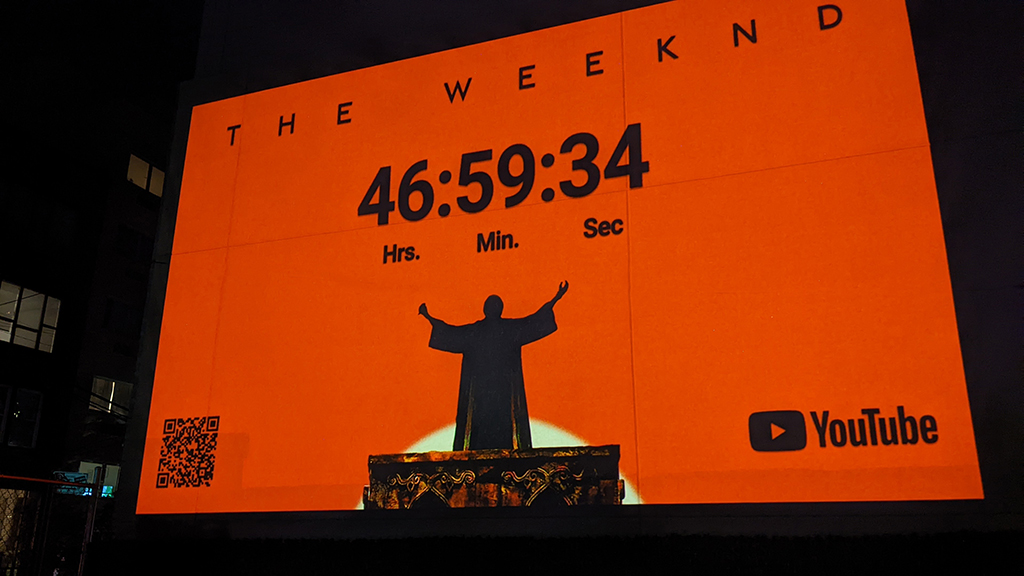
Guerrilla Projections in Santa Fe Mexico City: Corporate Towers and Executive Audiences
Santa Fe sits in the western fringe of Mexico City, and depending on when you first visited, you may not recognize it today. Thirty years ago this was a scarred landscape of exhausted quarries and one of the largest garbage dumps in Latin America. The open-pit mines left behind by decades of extraction had turned the hillside into an unusable wound in the city’s geography. What replaced it over the 1990s and 2000s is one of the most concentrated corporate real estate environments anywhere in Latin America — a forest of glass towers, elevated highways, multinational headquarters, and residential complexes that now constitutes Mexico City’s undisputed financial and business district.
For AGM, Santa Fe is one of the most strategically important projection markets in all of CDMX. The audience concentration is unlike anything else the city offers. Hundreds of thousands of office workers, executives, financial professionals, and corporate decision-makers move through this district every weekday. The towers are modern, the facades are glass and concrete, and the sight lines created by the elevated highway system create projection angles that simply do not exist in older parts of the city. When a brand needs to reach senior professionals at scale, Santa Fe is where that conversation starts.
This post covers everything our team thinks about when we plan a Santa Fe projection campaign — the physical geography, the audience layers, the specific buildings and corridors that matter, and the strategic differences between running a weekday corporate campaign versus an evening or weekend residential one.
From Garbage Dump to Glass Towers: Understanding What Santa Fe Actually Is
The transformation of Santa Fe is one of Mexico City’s most dramatic urban stories, and it matters for projection strategy because the physical environment it produced is fundamentally different from every other part of the city. Unlike Centro Historico, Polanco, or Condesa, Santa Fe was built almost entirely from scratch. There are no colonial facades, no 19th-century residential blocks, no organic street grids that evolved over centuries. The street plan is wide, modern, and designed for car traffic at scale. The buildings are tower-format rather than low-rise. The entire visual character of the district reads as a deliberate corporate construction.
That matters because projection campaigns in older CDMX neighborhoods are always working with and against the existing visual vocabulary of those places. In Roma Norte, a projection on a Porfirian facade has to contend with ornate stonework and architectural detail. In Centro, you’re projecting onto surfaces with hundreds of years of visual history. In Santa Fe, you’re projecting onto what amounts to a blank canvas — glass curtain walls, flat concrete service facades, smooth stucco on residential towers, and the long blank side walls of commercial podium buildings.
Santa Fe generates an estimated 500,000 daily vehicle and pedestrian trips through the district on weekdays, with a workforce concentration that includes the Mexican headquarters of dozens of Fortune 500 companies.
The corporate tenant list in Santa Fe reads like a roll call of global industry leaders. Citibanamex operates a significant presence here. Torre Santa Fe is one of the anchor office addresses. IBM’s Mexico operations are headquartered in the district. Hewlett-Packard, Televisa’s corporate operations, Nestle Mexico, Procter and Gamble Mexico, GE Mexico, and a long list of major law firms and investment banking offices all maintain Santa Fe addresses. This is not a mixed-use neighborhood where corporate offices share blocks with taquerias and vecindades. Santa Fe is a purpose-built corporate campus spread across an entire district.
The Tower Geometry: Why Santa Fe Projects Differently
Anyone who has driven the Viaducto Bicentenario understands what makes Santa Fe’s projection geometry unusual. The raised highway runs along the northern edge of the Santa Fe district and elevates drivers to the height of mid-level floors on the surrounding office towers. You’re not looking up at buildings from street level — you’re looking across at them, at eye height, from a moving vehicle. The same phenomenon applies along the Autopista Mexico-Toluca corridor that forms the district’s western approach.
This creates projection opportunities that don’t exist anywhere else in CDMX. A projector positioned to throw an image onto a tower facade at the 8th or 10th floor reads to highway drivers as a billboard at eye level rather than a ground-level installation. The image doesn’t compete with street signage, vendor displays, or pedestrian activity — it lives in a visual layer that only highway-level viewers can access. For brands targeting commuters specifically, that separation from street-level visual noise is valuable.
At street level, Santa Fe’s wide modern avenues also differ from older parts of the city. The main arterials — Avenida Santa Fe, Prolongacion Paseo de la Reforma as it enters the district, Avenida Guillermo Gonzalez Camarena — are broad enough that a projector can throw across significant distances without obstruction. There are no narrow colonial alleyways or overhead cables creating interference. The geometry is clean.
Tower Facades vs. Podium Walls
In practice, our team works with two distinct surface types in Santa Fe. The first is the upper facades of office towers — typically glass or glass-and-concrete composite surfaces where projection requires careful brightness calibration because of the reflective properties of curtain wall systems. The second is the podium-level service walls and parking structure facades that sit at the base of towers — usually flat, matte concrete in grey or off-white, which are among the best projection surfaces in the city. Many Santa Fe towers have substantial blank concrete service walls facing secondary streets, and those surfaces receive projections with excellent contrast and sharpness even at high magnification.
The shopping center facades at Centro Comercial Santa Fe and Patio Santa Fe are also worth noting. Centro Comercial Santa Fe is one of the largest malls in Latin America by retail area, and its exterior faces major pedestrian arrival routes. Evening and weekend foot traffic concentrates around the mall entrances, which creates a captive audience for projections on surrounding buildings.
The Audience Stack in Santa Fe
What makes Santa Fe genuinely complex for projection strategy is that the audience is not monolithic. Three distinct populations move through the district at different times, and each one calls for different campaign decisions.
The Corporate Workforce
The core Santa Fe audience is the office workforce — hundreds of thousands of professionals who arrive Monday through Friday on a fairly predictable schedule. Morning ingress between 7:30 and 9:30 AM packs the elevated highways and surface streets. The lunch hour creates pedestrian activity between towers and the restaurant-lined streets near the shopping centers. Evening egress from roughly 6:00 PM to 8:30 PM puts the highest volume of commuter traffic back onto the elevated highways.
This population skews heavily toward professional seniority. Entry-level employees exist in Santa Fe, but the tenant mix of the district’s towers means that a disproportionately large share of the workforce holds director, VP, and C-suite titles compared to any other CDMX district. Financial services professionals, technology sector managers, legal and consulting executives, and multinational brand managers are the daily commuter base.
The Iberoamerican University campus in Santa Fe enrolls more than 12,000 students, injecting a younger, aspirational audience into the district’s otherwise corporate daily traffic.
The Student Population
The Iberoamerican University — Universidad Iberoamericana — operates its main campus inside Santa Fe, and it changes the audience character substantially. The Ibero is one of Mexico’s most prestigious private universities, with an undergraduate and graduate student body that skews upper-income and internationally oriented. These students share streets, food options, and transit corridors with the corporate workforce, but they move on a different schedule and respond to a different register of brand communication.
For brands that want to reach an affluent 18-to-28 demographic alongside an executive one, the Ibero’s presence makes Santa Fe a rare environment where both audiences are available in the same physical space. Technology, fashion, media, and aspirational consumer brands often find Santa Fe projections more valuable precisely because the student layer sits underneath the executive one.
The Residential Population
Santa Fe has grown into a significant residential district as well. The towers along the Lomas de Santa Fe hillside corridor hold thousands of high-income families in some of the most expensive residential square footage in Mexico City. These residents move through the district for shopping, dining, and recreation at times that barely overlap with the corporate commuter schedule — evenings, weekends, and midday on weekdays when the office corridors are comparatively quiet.
Weekend evenings in Santa Fe around Centro Comercial Santa Fe and Patio Santa Fe produce a noticeably different audience than Tuesday afternoon at the same locations. Families from the residential towers, couples from Lomas de Santa Fe, and shoppers who have driven in from surrounding affluent neighborhoods like Interlomas and Huixquilucan fill the same streets that host executive commuters during the week.
Brand Categories That Work in Santa Fe
Not every brand belongs in Santa Fe, and the district’s corporate identity is both its greatest strength and a constraint. A streetwear brand targeting 19-year-old skaters will find a more receptive audience in Tepito or Doctores. A mezcal brand building grassroots cultural credibility should look at Roma Norte or Condesa. Santa Fe’s audience rewards brands that fit the environment.
Category
Audience Match
Best Projection Window
Financial services and fintech
Executive commuter, professional workforce
Weekday morning and evening
Enterprise software and SaaS
Corporate technology buyers
Weekday business hours, lunch
Premium automotive
Executive, high-income residential
Weekday evening, weekend
Luxury real estate
High-income residential, executives
Weekend evening
Executive recruitment platforms
Professional, director-and-above
Weekday morning commute
Business travel and premium hospitality
Frequent-traveler executives
Weekday any hour
Aspirational consumer brands
Ibero students, young professionals
Midday, evening
Financial services brands get particular value from Santa Fe because the audience’s relationship to financial products is more sophisticated and higher-stakes than in most other districts. These are not consumers making their first bank account decision — they are professionals managing significant personal wealth, making corporate treasury decisions, and evaluating investment products. A projection campaign for a brokerage, a fintech platform, or a private banking service lands in front of people who will actually use those products.
Enterprise software gets a similar premium. Santa Fe is where Mexico’s technology buyer community physically concentrates. CIOs and IT directors from multinational Mexico subsidiaries, procurement managers from major corporations, and digital transformation consultants all operate in this district. A B2B software brand that projects in Santa Fe during the commuter windows reaches more qualified technology buyers per impression than any other outdoor medium in the city.
The Elevated Highway Effect: Projections Above Street Level
We’ve mentioned the Viaducto Bicentenario and Autopista Mexico-Toluca, but it’s worth going deeper on what elevated highway traffic actually means for a projection campaign. These highways carry an enormous volume of daily vehicle trips at speeds that are often slowed by congestion — particularly during morning and evening rush periods, which are exactly the windows when corporate commuter attention is highest.
Slow traffic on an elevated section means extended dwell time. A driver sitting in a congestion point on the Viaducto Bicentenario may spend several minutes in view of a tower projection. That’s a fundamentally different exposure unit than a 30-second drive-by on a surface street. The image has time to register, the brand message has time to communicate, and the viewer has time to pull out a phone and photograph or video what they’re seeing.
This is where Santa Fe projection campaigns produce some of their strongest organic content moments. Commuters stuck in elevated highway traffic are already on their phones. A striking projection on a tower facade nearby becomes an immediate photo and video subject, and because that content captures the visual language of the city’s corporate core, it tends to perform well on professional networks and personal social feeds simultaneously.
Projector Positioning for Elevated Highway Visibility
Achieving good visibility from elevated highways requires positioning the projection surface and the projector angle differently than a street-level campaign. The target surface needs to be on the upper floors of a tower rather than the base. The projector typically needs to be positioned at an elevated angle itself — often on a rooftop, an elevated parking structure, or a terrace — rather than at ground level. Our team scouts each Santa Fe location with the highway viewing angle in mind as a primary variable, not an afterthought.
Santa Fe’s Visual Environment: No Colonial Architecture, Different Rules
Every projection campaign is in dialogue with the visual environment it occupies. In Centro Historico, that dialogue is with 500 years of accumulated architecture. In Coyoacan, it’s with cobblestone streets and colonial church facades. In Santa Fe, the visual dialogue is with glass, steel, and concrete that is largely less than 30 years old.
This creates a cleaner projection environment in some ways and a more demanding one in others. The cleanliness comes from the absence of visual clutter at the building-facade level — there are no ornate cornices, no balcony ironwork, no colonial tile patterns competing with the projected image. A flat concrete wall in Santa Fe is just a flat concrete wall.
The demand comes from the corporate visual environment itself. Santa Fe buildings are already covered in corporate signage, branded building wraps, and polished exterior branding from the tenants inside. A projection campaign needs visual impact strong enough to stand out against a background that is already professionally designed and well-lit. The creative bar is higher here than in neighborhoods where the ambient visual environment is more raw.
“Santa Fe is where you can speak directly to Mexico’s corporate class on their own ground. The challenge isn’t finding the audience — it’s designing an image strong enough to earn their attention in an environment built to project corporate authority.”
Shopping Center Geography: Centro Comercial Santa Fe and Patio Santa Fe
The two major shopping centers in Santa Fe serve different audience purposes and project-campaign roles. Centro Comercial Santa Fe is massive — one of the largest malls by area in all of Latin America — and its pedestrian traffic includes both corporate workers from surrounding towers using the food courts and full-scale shoppers from the residential areas. The mall’s exterior faces Avenida Vasco de Quiroga and the central Santa Fe district, and the approach routes to its parking structures run past building facades that are excellent projection surfaces.
Patio Santa Fe, slightly to the north, is a more open-format retail center with a stronger family and residential character. Weekend afternoons and evenings at Patio Santa Fe look more like a high-income residential neighborhood commercial center than a corporate district amenity. That audience shift changes the campaign brief significantly — brands reaching Patio Santa Fe weekend crowds are in a completely different conversation than brands projecting during weekday executive commuter windows.
Both shopping centers generate the highest pedestrian concentration in the district outside of office building lobby hours, which makes the buildings facing their approach and exit routes among the most strategically valuable projection surfaces in Santa Fe.
Lomas de Santa Fe: The Residential Corridor
Lomas de Santa Fe runs along the hillside above and behind the tower district, and it is one of the most expensive residential addresses in Mexico City. The corridor consists primarily of residential towers and gated housing developments, with a household income profile that matches the executive tenant base of the corporate towers below.
What matters for projection strategy is that Lomas de Santa Fe residents connect to the main Santa Fe district through a relatively small number of arterials and access roads. Those access roads create natural concentration points where residential commuters, shoppers, and leisure-seekers pass predictably. Evening projections on buildings along those arteries reach the residential population in their most receptive moments — returning home from work, heading out for dinner, or driving to the mall.
The Lomas de Santa Fe population indexes very high for premium automotive, luxury real estate, high-end travel, private banking, and premium lifestyle brands. Weekend projections targeting this audience are a different strategy than weekday corporate projections, but both are available within the same district geography.
Evening and Night Campaigns: When the District Transforms
Santa Fe after business hours becomes a different place. The commuter tide recedes, the elevated highways ease, and what’s left is the residential district and the entertainment/dining activity around the shopping centers. Evening projection campaigns in Santa Fe work best when they’re designed for this transformed environment rather than trying to replay the corporate commuter campaign in lower-traffic conditions.
The buildings that work best for evening campaigns are those that face the dining, entertainment, and residential approach routes rather than the corporate tower corridors. The streets around Centro Comercial Santa Fe’s restaurant row, the approaches to Patio Santa Fe from the residential side, and the main arterials through Lomas de Santa Fe all carry significant evening pedestrian and vehicle traffic from a high-income leisure audience.
High-lumen projectors are particularly important for Santa Fe evening campaigns because the district’s corporate architecture tends to be well-lit at night. The ambient light levels around major towers are higher than in residential neighborhoods of the city, and a projection that looks sharp in Doctores or Tepito may wash out against the illuminated glass facades and plaza lighting of Santa Fe’s corporate core. Our team calibrates equipment for the specific ambient conditions of each Santa Fe location.
Multi-Tower Campaign Strategy
Santa Fe’s tower concentration creates an opportunity that doesn’t exist in any other CDMX district: the ability to run projections on multiple adjacent towers simultaneously, creating a corridor effect where a commuter or pedestrian moves through a series of brand impressions rather than a single one. The corporate spine of Santa Fe along Avenida Santa Fe and the streets running parallel to it has enough projection-viable building faces within walking distance that a multi-site campaign can dominate the visual environment of the district for a single evening.
This approach is particularly effective for product launches and brand awareness campaigns where saturation within a specific high-value geography is more important than broad city-wide reach. A financial services brand that wants to own the Santa Fe visual environment on its launch night can do so with a coordinated multi-projector campaign in a way that simply isn’t possible in more dispersed neighborhoods.
A coordinated multi-projector campaign can place a brand on three to five tower faces within a 600-meter stretch of the Santa Fe corporate spine, creating an impression of market dominance that no single billboard placement can achieve.
How Santa Fe Compares to Other CDMX Corporate Zones
The most common planning question our team gets when brands are considering Santa Fe is how it compares to Polanco and to Reforma as projection markets. Each of those three zones serves a distinct strategic purpose, and they’re not interchangeable.
Reforma is a transit corridor — the audience is moving through it on the way to somewhere else, which means dwell time is shorter but volume is extremely high. A Reforma projection during rush hour reaches an enormous number of people quickly. Santa Fe’s audience is destination-based rather than transit-based, which means dwell time is longer and the same commuter sees the projection multiple times over multiple days.
Polanco is an audience quality play — the Masaryk corridor and surrounding streets deliver some of the highest per-capita income pedestrians in Mexico City. But Polanco’s physical environment is more constrained for projection, with lower buildings, significant tree canopy, and a visual environment packed with high-end retail signage. Santa Fe’s modern towers are physically better projection surfaces even though Polanco’s street-level audience may be wealthier.
The three districts serve three different campaign objectives, and a well-designed CDMX corporate campaign often uses all three in rotation rather than treating them as substitutes for each other.
Frequently Asked Questions
What makes Santa Fe Mexico City a strong projection market for corporate brands?
Santa Fe is Mexico City’s densest concentration of multinational corporate headquarters, with companies like Citibanamex, IBM, Hewlett-Packard, Nestle Mexico, Procter and Gamble Mexico, GE Mexico, and major investment banks all operating tower campuses. That concentration means a projection campaign can reach hundreds of thousands of office workers and executives in a single corridor, with no other district in CDMX delivering that combination of volume and professional seniority.
How do the raised highways affect projection campaigns in Santa Fe?
The Viaducto Bicentenario and the Autopista Mexico-Toluca create aerial viewing angles that don’t exist in older parts of CDMX. Drivers and passengers on raised sections look across at building facades at height, which means projection surfaces on upper floors and rooftop-adjacent walls get seen in a fundamentally different way than street-level projections in Roma Norte or Centro Historico. A well-placed projector can hit a tower wall at the same height as passing highway traffic.
What brand categories perform best in Santa Fe guerrilla projection campaigns?
Financial services, enterprise software, premium automotive, luxury real estate, executive recruitment platforms, and business travel brands all have strong performance reasons to project in Santa Fe. The audience skews higher on income, education, and professional seniority than almost any other CDMX district. Consumer brands targeting the upper-income residential corridors in Lomas de Santa Fe extend that reach into family and household purchase decisions.
Does the Iberoamerican University campus change the audience character in Santa Fe?
Yes significantly. The Ibero campus brings more than 12,000 students into Santa Fe daily, and they move through the same streets, mall corridors, and public plazas as the corporate workforce. That layering creates a dual audience — the established executive and the aspirational student — which benefits brands that want reach across a career arc rather than just senior professionals.
How do evening and weekend projections in Santa Fe differ from weekday campaigns?
Weekday campaigns in Santa Fe are saturated with corporate commuter traffic, which suits B2B and executive-targeted brands. Evening and weekend campaigns flip toward the residential towers and the Lomas de Santa Fe neighborhood, reaching high-income families, couples at the Centro Comercial Santa Fe and Patio Santa Fe malls, and a more leisure-oriented audience. Premium lifestyle brands, luxury real estate, and entertainment content campaigns often prefer weekend projection windows for exactly this reason.