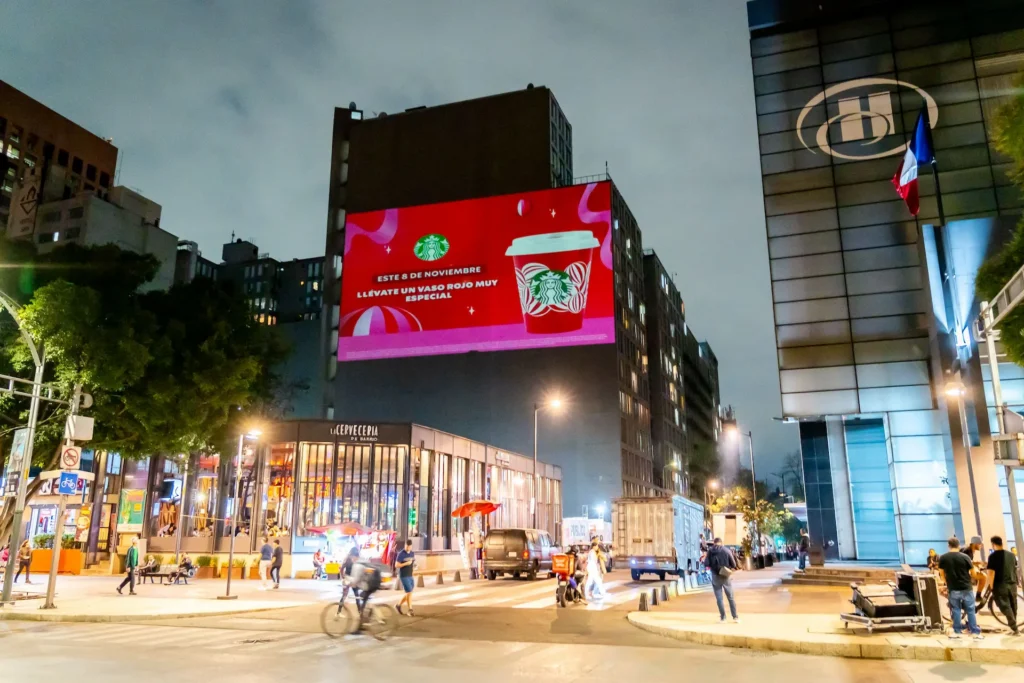
Guerrilla Projections in Roma Norte Mexico City: Buildings, Streets, and Campaign Strategy
Roma Norte is the kind of neighborhood that makes campaign planners rethink what outdoor advertising can accomplish. On a Friday night, Avenida Álvaro Obregón runs hot from 8 PM to 2 AM with a crowd that has come specifically to be in the middle of something interesting. Artists, architects, musicians, journalists, tech workers, chefs, and an enormous population of international residents from Buenos Aires, New York, Barcelona, and Berlin all share this colonia and its sidewalks. When you project onto the right wall at the right moment in Roma Norte, you are not showing an advertisement to a passive audience. You are contributing a visual event to a night that people are already highly invested in experiencing.
We have run multiple projection campaigns in Roma Norte over the years, and each time we come back, the colonia has added more layers. New murals have gone up on walls we scouted six months earlier. New restaurants have opened on blocks that were quiet on our last visit. New buildings have been completed. The colonia moves fast, which means scouting is not a one-time exercise. It is a continuous practice. This guide captures what we know about Roma Norte as a projection market as of mid-2026, including specific streets, surfaces, buildings, audience timing, and the brand categories that consistently see the strongest results in this district.
If you are planning a projection campaign in Mexico City and want to work in the market’s most creatively charged neighborhood, here is what you need to know about Roma Norte from a field practitioner’s perspective.
Roma Norte is bounded by four major streets that planners should internalize before any scouting session. Avenida Chapultepec runs along the northern boundary, connecting the colonia to the Bosque de Chapultepec and Reforma. Avenida Insurgentes, one of the longest urban avenues in the world at over 28 kilometers, forms the western boundary. To the east, Calle Medellín marks the transition to Roma Sur. The southern boundary blends informally into Roma Sur somewhere around Avenida Insurgentes Sur and the Sonora market area.
Within those boundaries, the internal street grid is a regular pattern of streets running northeast-southwest and northwest-southeast, which is slightly off the standard cardinal-direction orientation of Mexico City’s broader grid. This angled orientation creates diagonal sightlines on many blocks that are genuinely useful for projection planning. A projector positioned at one end of a block on Calle Sonora, for example, can illuminate a wall on the next block over at an angle that creates a visual surprise for pedestrians walking perpendicular to the projection axis.
The Main Arteries
Avenida Álvaro Obregón is the undisputed main street of Roma Norte. It runs east-west through the colonia, and its defining feature is the broad pedestrian median that runs down the center of the avenue. This median is planted with trees, fitted with seating, and decorated with sculptures and fountain basins. On weekday evenings, it fills with people eating, talking, watching, and moving between the restaurants and cafes that line both sides of the avenue. On weekend nights, it becomes one of the most densely trafficked pedestrian corridors in the entire Federal District.
The buildings on both sides of Álvaro Obregón are a mix of early 20th-century residential structures converted to commercial use, mid-century apartment buildings with ground-floor retail, and occasional newer mixed-use construction. The facades facing the avenue are generally in the four-to-six story range, with some taller structures near the Insurgentes intersection. The north-facing facades on the south side of the avenue receive no direct sun after midday, which means they are already in shadow by early evening — a significant advantage for projection campaigns that want to extend their deployment window earlier in the evening.
Calle Orizaba runs north-south between Álvaro Obregón and Sonora and has become one of the most refined commercial streets in the colonia. The boutiques and restaurants on Orizaba attract a crowd that is slightly more higher in income and more internationally oriented than the general Álvaro Obregón foot traffic. The Brick Hotel on Orizaba at Álvaro Obregón has brought a significant influx of design-oriented international travelers into the immediate area. The facades on Orizaba include some of the best-preserved early 20th-century residential architecture in Roma Norte, with ornate plasterwork and stone detailing that can serve as striking projection surfaces for 3D mapping work.
Calle Colima, which runs parallel to Álvaro Obregón one block to the north, is the colonia’s restaurant and cultural corridor. Lined with some of the most photographed facades in Roma Norte, Colima’s buildings include Porfirian-era townhouses with elaborate window surrounds and cornices, converted mansion interiors housing restaurants, and the kind of architecture that ends up in travel magazines. Foot traffic on Colima runs strong on weekend evenings, driven by the concentration of high-profile restaurants.
Roma Norte’s Avenida Álvaro Obregón has been ranked as one of the top 10 “most livable” urban streets in Latin America by multiple urban planning organizations, reflecting its combination of pedestrian infrastructure, commercial density, and residential use.
Specific Projection Surfaces: Buildings and Walls
The most important skill in projection campaign planning is reading surfaces. Not all walls are equal. Scale, surface texture, color, reflectivity, ambient light competition, and audience sight lines all determine whether a projection will be a vivid visual event or a washed-out disappointment. In Roma Norte, we have identified several categories of surfaces that consistently deliver strong results.
Warehouse Walls South of the Eje 1 Norte
The blocks immediately south of the Eje 1 Norte in the northern part of the colonia still contain several former industrial buildings whose exterior walls have not been converted or covered. These warehouse walls, typically unpainted or whitewashed concrete block, run up to 15 meters tall and 20 meters wide. They are the largest available projection surfaces in Roma Norte and they sit on streets with enough foot traffic from the surrounding restaurant clusters to deliver real audiences.
The area around Calle Sonora between Álvaro Obregón and the Eje 1 Norte has several such surfaces. One particularly strong wall on the eastern face of a converted warehouse near the intersection of Sonora and Laredo spans approximately 18 meters wide and 12 meters tall, with a uniform gray plaster finish that handles projection light extremely well. We have used this surface for entertainment client campaigns where the scale requirement was too large for any residential facade in the colonia.
The Porfirian Residential Facades on Colima and Durango
Calle Colima and Calle Durango, which runs parallel to it two blocks further north, both have concentrations of the multi-story Porfirian-era townhouses that were built between 1890 and 1920 for Mexico City’s elite. These buildings have broad, relatively flat facades with ornamental detailing concentrated at the cornice line, window surrounds, and entry portals. The wall area between the ornamental elements, typically occupied by flat plaster, is ample enough for projection content that respects the building’s proportions.
The most photogenic facades on these streets are the ones that have been maintained in their original light ochre, cream, or pale green finishes, which provide better projection reflectivity than the darker grays and dark greens that some buildings have been repainted. Scouting specifically for light-colored facades in good repair is worth the extra time in this part of Roma Norte.
The Converted Warehouse on Calle Guanajuato
Calle Guanajuato, one of the colonia’s diagonal streets, has a section between Sonora and Laredo where several former light-industrial buildings survive largely unmodified. The largest of these has a blank concrete end wall on its northern face that runs about 14 meters wide and 10 meters tall, faces a slightly wider section of the street, and has no permanent competing light sources in the immediate vicinity. This surface has been used by street artists multiple times and has some residual paint layers that actually improve its matte surface quality for projection. From a deployment standpoint, the street geometry here allows a van to park on the opposite side of Guanajuato with a direct throw angle of approximately 15 meters — perfect for a 20,000-lumen projector in a medium-scale brand activation setup.
Mid-Century Concrete Apartment Buildings on Insurgentes
The Avenida Insurgentes frontage in Roma Norte has several mid-century concrete apartment buildings from the 1960s and 1970s with broad, relatively plain facades on their side walls facing the perpendicular cross streets. These buildings are typically 8-12 stories tall, with poured-concrete facades that are painted in neutral grays and creams. Their side walls face quieter residential streets where projection setup is easier than on the main Insurgentes corridor itself.
The intersection area where Insurgentes crosses Álvaro Obregón is a major pedestrian node, and side-wall projections on buildings in this quadrant catch pedestrian traffic moving through this intersection from multiple directions simultaneously.
Avenida Insurgentes is officially recognized as one of the longest urban avenues in the world at approximately 28.8 kilometers from north to south through Mexico City. The Roma Norte segment handles some of the highest combined pedestrian and vehicle volumes of any stretch of the avenue.
The Plazas: Jardín Pushkin, Plaza Luis Cabrera, and Plaza Rio de Janeiro
Roma Norte has three significant public plazas that function as natural gathering points and natural projection venues. Each has a different character and serves a different campaign purpose.
Jardín Pushkin
Jardín Pushkin sits on the corner of Álvaro Obregón and Orizaba, at the intersection of the colonia’s two busiest pedestrian corridors. The park itself is small, a roughly triangular green space with seating, trees, and a central fountain, but its position at that intersection makes it one of the highest-pedestrian-exposure locations in Roma Norte. A projection aimed at the building facade facing the park on either the north or east side can be seen simultaneously by pedestrians walking along both Álvaro Obregón and Orizaba, effectively doubling the audience exposure relative to a projection on a building mid-block.
The building on the north side of the park facing the intersection has a smooth, cream-colored plaster facade in the lower stories that serves as a strong medium-scale projection surface. We have used this location for product launch activations where the creative brief required a specific intersection aesthetic — the cafe tables and tree canopy in the foreground of a projection shot creates an image that performs well on social media because it reads as authentically from that neighborhood.
Plaza Luis Cabrera
Plaza Luis Cabrera is a larger, more formal plaza on the eastern side of Roma Norte, between Calle Orizaba and Calle Jalapa. It has a central fountain, mature tree cover, and is surrounded by some of the best-preserved residential architecture in the colonia. Weekend afternoons bring families, artists working en plein air, and a regular crowd of neighborhood residents using the benches and fountain area. Evening hours bring a younger crowd using the plaza as a gathering point before moving on to nearby restaurants and bars.
The building facades surrounding Plaza Luis Cabrera are particularly valuable for projection campaigns because their scale and the plaza’s width allow for longer throw distances, which enables larger image sizes than are practical on the narrower side streets. The plaza’s open geometry also means that projection content is visible from multiple approach vectors — someone coming down Orizaba toward the plaza will see the projection on the facing building from half a block away, giving the image time to register before they reach the space.
Plaza Rio de Janeiro and the David Replica
Plaza Rio de Janeiro on Calle Orizaba between Álvaro Obregón and Sonora is one of Roma Norte’s most photographed spaces. It is anchored by a replica of Michelangelo’s David, which sits in a central fountain basin, and surrounded by ornate early 20th-century apartment buildings on all sides. The plaza draws a consistent stream of tourists and visitors alongside the regular neighborhood crowd, and it functions as something of a visual landmark for the colonia.
For projection purposes, Plaza Rio de Janeiro presents an interesting creative opportunity. The surrounding buildings are excellent surfaces — three to five stories of ornate early 20th-century plasterwork with broad flat wall areas between windows. A projection that wraps around two or three facades surrounding the plaza creates an immersive environment rather than a single-wall billboard effect. We have seen this format used to great effect for fashion and entertainment brands whose creative content benefits from a 270-degree environmental presentation rather than a single-surface display.
Roma Norte is the neighborhood that tests whether your creative is actually good. The audience here has seen everything. Street murals by internationally known artists. Wheatpaste campaigns by major brands. Performance installations in plaza spaces. They engage with content that surprises them and ignore content that doesn’t. Budget for a creative that can hold its own on these walls.
The Visual Culture Context: Why Roma Norte Receives Projection Differently
To understand how projection advertising lands in Roma Norte, you have to understand the visual culture that has been accumulating in this colonia for decades. Roma Norte is not a neutral environment for public imagery. It is one of the most visually sophisticated street environments in Latin America, with a tradition of public art that runs from the muralism revival of the 1990s through the contemporary street art scene that has made it one of the most photographed urban neighborhoods in Mexico.
The Mural Tradition
Mexico’s muralism movement was born in Mexico City, and Roma Norte has been a canvas for that tradition in its contemporary form for at least 30 years. The walls of the colonia carry work by some of the most respected muralists in Mexico and the Americas, and new work continues to appear on building facades throughout the neighborhood. This context means that any brand entering the public visual space of Roma Norte through projection is entering a conversation, not a vacuum. The audience reads public imagery with genuine critical attention. They notice when something is well-crafted. They notice when something is lazy.
For campaign planners, this means that creative execution is not just an aesthetic consideration in Roma Norte. It is a strategic one. A projection campaign with real creative ambition in this neighborhood generates a level of organic engagement, photography, social sharing, and earned media that a technically similar campaign in a less visually literate market would not produce. The upside for getting the creative right is significantly higher here than in most other markets.
The Street Art and Paste Campaign Tradition
Beyond mural painting, Roma Norte has one of the most active wheatpaste and street poster traditions in Mexico City. Brand marketers, independent artists, musicians, and political activists all use the walls and construction hoardings of the colonia as posting surfaces. Large-format paste campaigns from entertainment labels, streaming platforms, and major consumer brands are a regular part of the visual landscape. The audience is familiar with these formats and has developed the visual vocabulary to receive them.
Projection advertising in this context occupies a premium position in the public visual hierarchy. It is more ephemeral than a paste campaign, which stays on the wall for weeks, but it commands far more immediate attention because of its scale, luminosity, and moving image quality. A projection event in Roma Norte draws a crowd in a way that a paste campaign, however well-designed, typically does not. The live, light-based quality of the medium makes it feel like an event rather than an advertisement, and in a neighborhood full of people who are out specifically looking for interesting things to happen, that event quality is enormously valuable.
Audience Profile: Who Is Walking Roma Norte at Night
Understanding the Roma Norte audience in depth is essential for any campaign planning exercise. This is not a uniform demographic. The colonia serves multiple overlapping populations, each with different brand sensitivities and different patterns of public space engagement.
The International Expat Community
Roma Norte has been one of Mexico City’s primary landing zones for international residents for at least two decades, and the pace of that arrival has accelerated significantly since 2020. The influx of remote workers, primarily from the United States, Canada, and Western Europe, but also from South America, has reshaped the colonia’s commercial and social life substantially. This community is concentrated in the western blocks of the colonia near Insurgentes and in the streets immediately adjacent to Álvaro Obregón.
Internationally mobile remote workers and digital nomads are among the highest-value audiences for certain brand categories: technology products, premium consumer goods, travel and hospitality, streaming entertainment, and financial technology. They are also extremely high social media users, meaning that a projection campaign encounter in Roma Norte has a high probability of reaching their networks globally if the content is visually compelling.
Mexico City’s Creative Class
The founding population of Roma Norte’s current cultural identity is the city’s creative class: graphic designers, architects, artists, writers, photographers, filmmakers, and musicians who chose the colonia for its building stock, its cultural density, and its proximity to clients and collaborators in the commercial creative industries. This community is highly networked within Mexico City and beyond, and they are early adopters of brands that demonstrate genuine visual or cultural credibility.
This audience is the Roma Norte constituency that earned-media projection campaigns are most likely to activate. They photograph interesting public experiences instinctively. They share to selective audiences of fellow creative professionals. And they have genuine cultural authority in the city’s brand conversation that translates into real value for campaigns that earn their attention.
The Restaurant and Nightlife Crowd
On Thursday, Friday, and Saturday nights, Roma Norte draws an enormous inflow of visitors from across Mexico City who are coming specifically for the restaurant and bar scene. Licorería Limantour on Álvaro Obregón, a consistent presence on the World’s 50 Best Bars list, draws an international clientele. Dozens of other bars and restaurants with regional and national profiles concentrate along Álvaro Obregón, Colima, Orizaba, and the surrounding streets. This nightlife crowd represents the broadest possible demographic cross-section of Mexico City’s affluent and aspirational consumer population.
For brands in the food and beverage, entertainment, and consumer lifestyle categories, this nightlife audience is the primary target for Roma Norte projection campaigns. The deployment window for maximum exposure to this crowd is 9 PM to midnight on Thursday and Friday, and 9 PM to 1 AM on Saturday.
Licorería Limantour on Avenida Álvaro Obregón has appeared on the World’s 50 Best Bars list continuously since 2014, making Roma Norte one of the most internationally recognized nightlife destinations in Latin America and driving consistent international visitor traffic to the colonia.
Campaign Strategy: What Works in Roma Norte
General projection advertising principles apply in Roma Norte, but the colonia has specific strategic logic that experienced practitioners learn to work with. Here are the strategic considerations that shape how we approach projection campaigns in this market.
Creative Ambition as a Non-Negotiable
We said this already but it bears repeating with more specificity. Roma Norte audiences do not respond to standard advertising. They respond to visual experiences that have genuine creative integrity. For projection campaigns, this means the content loop needs to function as something worth watching, not just as a billboard that happens to be lit from behind a projector. A 90-second content loop in Roma Norte should have narrative arc, visual sophistication, and a relationship to the specific location that makes it feel like it belongs there rather than like it was designed for a highway billboard and then adapted for projection.
The brands that see the strongest organic engagement from Roma Norte projections are the ones that brief their creative teams with the specific cultural and architectural context of the deployment location. A content treatment designed for a projection on the stucco wall facing Plaza Rio de Janeiro, incorporating the plaza’s scale and character into the creative concept, will outperform a generic brand spot by a measurable factor in terms of organic shares, photography, and earned media generation.
Multi-Site Strategy Within the Colonia
Roma Norte is dense enough and active enough to support multi-site projection campaigns in a single night. With two projection rigs, a skilled team can move through three or four sites over the course of a three-hour window, hitting Álvaro Obregón at 9 PM, a warehouse wall on Guanajuato at 10 PM, and the Plaza Luis Cabrera building faces at 11 PM. Each location change generates a new wave of organic discovery, as different audience segments encounter the campaign fresh.
Multi-site campaigns in Roma Norte also create a perception of scale and presence that single-site activations cannot match. When multiple points of conversation and photography emerge from different parts of the colonia on the same night, the social media footprint of the campaign multiplies. Different people in different locations are sharing content from different physical perspectives, and the aggregate effect is a sense of the brand having genuinely saturated the neighborhood’s visual environment for that evening.
Timing With Cultural Events and Activations
Roma Norte has a dense cultural programming calendar that smart campaign planners use as a force multiplier. Noche de Museos, the last Wednesday of every month when museums across Mexico City open late and admission is free, draws a large arts-oriented crowd through the colonia’s gallery and cultural venue cluster. Art fairs, gallery opening weekends, and major restaurant soft launches all generate above-average foot traffic concentrations that increase the potential audience for projection campaigns aligned with those dates.
The Mercado Sonora corridor generates concentrated pedestrian traffic on weekend mornings that is distinct from the nighttime restaurant crowd. A projection campaign timed to coincide with one of the colonia’s regular cultural market events, the weekly Tianguis Cultural del Chopo draws heavily from Roma Norte’s resident population, can reach an audience that is more deeply rooted in the neighborhood’s creative culture than the nighttime restaurant crowd.
Location
Surface Type
Approx. Scale
Best For
Warehouse wall, Calle Sonora/Laredo
Concrete block, painted
18m × 12m
Large-scale brand campaigns, entertainment
Jardín Pushkin corner facade
Plaster, light-colored
10m × 8m
Product launches, social-media-driven activations
Plaza Luis Cabrera facades
Early 20th-c. plaster
12m × 10m
Multi-face immersive formats, fashion and arts brands
Plaza Rio de Janeiro surroundings
Ornate plaster, multiple faces
3-face, 8m each
Immersive wrap formats, tourism, luxury
Mid-century side walls on Insurgentes
Painted concrete, 8-12 stories
15m × 20m+
Maximum-scale brand awareness
Brand Categories and Roma Norte Fit
Not every brand category is an equally strong fit for Roma Norte projection campaigns. The colonia’s audience profile and cultural environment create specific advantages for certain types of brands and certain campaign objectives. Here is how we assess brand-neighborhood fit for Roma Norte.
Streaming and Entertainment
Streaming platforms and entertainment brands see consistently strong results in Roma Norte because the colonia’s population is exactly the kind of culturally engaged, media-literate, digitally active audience that these platforms are competing for. A major Netflix series launch, a new album release, or a film premiere campaign projection in Roma Norte reaches an audience that immediately understands the cultural context, is likely to be on the platform already, and is highly likely to share the campaign organically. Several major streaming platform campaigns we have executed in this market have generated earned media impressions that far exceeded the direct projection audience through the organic sharing behavior of the Roma Norte audience.
Music
Music campaigns in Roma Norte benefit from the colonia’s deep roots in the city’s live music scene. The area around Álvaro Obregón has a concentration of venues ranging from intimate mezcal bars with live music to mid-size concert rooms. A projection campaign for an artist or festival timed to coincide with a performance in the immediate area creates a geographical clustering effect where the audience for the show and the audience for the projection are effectively the same people.
Restaurants and Food Culture
Roma Norte is Mexico City’s highest-density restaurant district, and food and beverage brands have a natural home here. Campaigns for restaurant openings, food product launches, street food brands with lifestyle positioning, and drink brands all perform well because the audience is literally in Roma Norte for food and drink reasons. A projection on Álvaro Obregón advertising a new mezcal brand or a restaurant opening elsewhere in the colonia is speaking to an audience whose present behavior perfectly aligns with the campaign’s intent.
Fashion with a Creative Edge
Mainstream fashion campaigns can work in Roma Norte, but the strongest performers are brands that have genuine creative credibility — independent labels, designer collaborations, fashion brands with a streetwear or art-world positioning. The colonia’s audience is highly aware of fashion trends but is more likely to respond to a brand that presents itself as part of a creative conversation rather than as a traditional fashion advertiser. Projection content for fashion in Roma Norte should feel more like an art installation and less like a catalog.
The Street Art and Muralism Legacy as Context
It is worth spending more time on the muralism and street art context of Roma Norte because understanding it changes how you approach projection campaigns in this colonia. Mexico’s muralist tradition is one of the most significant artistic movements of the 20th century globally, and its roots are in Mexico City. Diego Rivera, David Alfaro Siqueiros, and José Clemente Orozco built a practice and a philosophy of public visual communication that has shaped how Chilangos relate to walls, to publicly visible imagery, and to the idea that art has a civic function.
Roma Norte carries that tradition forward in a contemporary form. The walls of the colonia are a record of the city’s creative output across decades. Artists like Saner, Smithe, and dozens of others have major works on the colonia’s facades. International artists have added their work during Zona MACO and other events. The cumulative effect is a street environment where the visual quality of public imagery is held to a high standard by the population that lives alongside it.
This standard applies to projection campaigns, and smart campaign planners embrace it rather than ignoring it. When a projection in Roma Norte feels like it belongs in the same visual conversation as the murals and street art around it, when it has visual ambition, cultural intelligence, and genuine craft, it earns the attention and organic engagement of an audience that could just as easily have walked past it without looking. When it feels like a generic advertisement that happened to be projected instead of printed, it gets exactly the reception that deserves.
Frequently Asked Questions
Why is Roma Norte considered one of the best projection advertising districts in Mexico City?
Roma Norte combines a high concentration of culturally sophisticated residents and visitors, an architectural mix that includes both massive blank industrial surfaces and ornate early 20th-century facades, and a nighttime economy that keeps thousands of people on the streets until 2 AM or later on weekends. The colonia also has deep roots in street art and public visual culture, which means audiences here are more receptive to projection advertising than in most other districts. They approach public imagery with genuine visual attention rather than ignoring it, which translates directly into higher organic engagement rates for well-executed campaigns.
What are the best specific streets in Roma Norte for projection campaigns?
Álvaro Obregón is the highest-traffic corridor, functioning as Roma Norte’s main street with a pedestrian median and constant evening foot traffic. Calle Orizaba offers upscale boutiques and cafes with an audience that skews toward well-traveled, higher-income consumers. Calle Colima has stunning early 20th-century residential facades and a restaurant scene that concentrates large audiences on weekend nights. The blocks around Calle Sonora and Guanajuato south of the Eje 1 Norte offer larger industrial walls for maximum-scale projection work with less architectural competition for sight lines.
What times and days are best for projection campaigns in Roma Norte?
Thursday through Saturday nights are the peak deployment windows for reaching the nightlife and restaurant crowd. Foot traffic on the main corridors reaches its highest density between 9 PM and 1 AM. Friday nights tend to deliver the largest total audiences because both the local resident population and visitors from other colonias concentrate in Roma Norte’s bars and restaurants. For campaigns targeting the creative professional resident population, Sunday evenings also see solid foot traffic on the plaza spaces and pedestrian streets.
What brands perform best with projection campaigns in Roma Norte?
Streaming and entertainment platforms, music artists and festivals, restaurant and food brands, fashion labels with a creative edge, craft spirits and beer brands, art and culture institutions, and consumer tech companies all tend to see strong reception in Roma Norte. The colonia’s audience is internationally connected and media-literate, which means campaigns with genuine creative ambition tend to outperform straightforward brand awareness spots. The earned media multiplier for campaigns that genuinely engage this audience is among the highest of any neighborhood in Mexico City.
How does Roma Norte’s street art culture affect projection campaign reception?
Roma Norte has one of the densest concentrations of commissioned murals, wheatpaste campaigns, and unsanctioned street art of any urban district in Latin America. This history means that the colonia’s residents and regulars approach public visual content with genuine visual literacy and high expectations. Campaigns with real creative investment generate organic sharing and discussion at rates well above what similar projection campaigns produce in less visually sophisticated neighborhoods. Generic or low-effort executions tend to be ignored or actively dismissed by an audience that holds public visual art to a genuine standard.