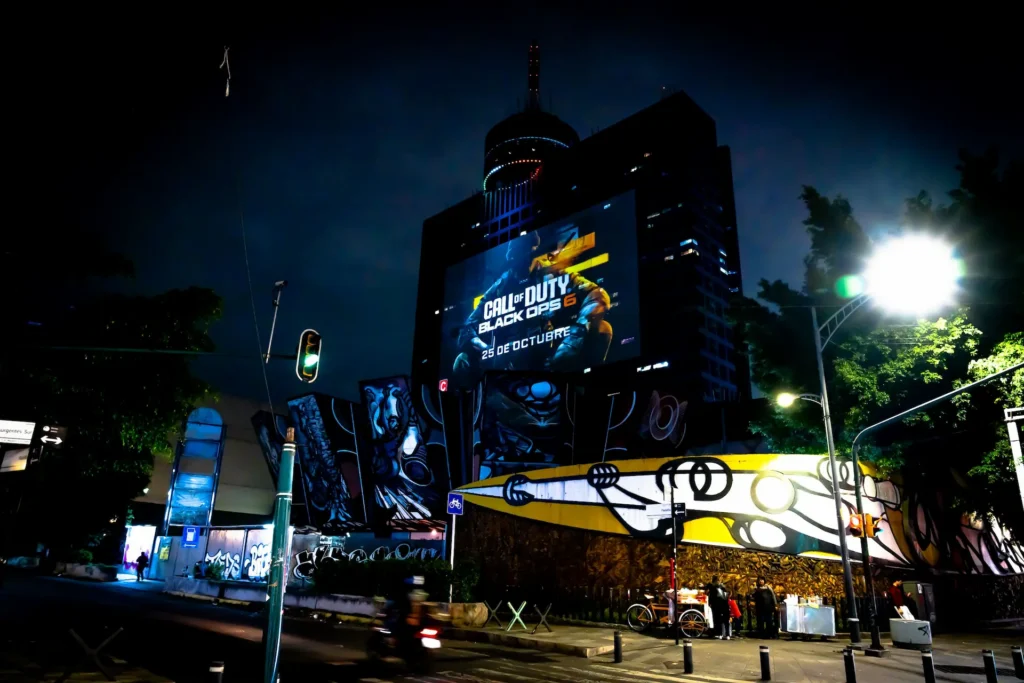
Guerrilla Projections in San Angel Mexico City: Historic Architecture and Weekly Market Energy
San Ángel is one of those Mexico City colonias that does not fit neatly into the standard advertising playbook. It lacks the young-professional density of Roma Norte, the luxury retail corridors of Polanco, and the tourist hotel clusters of Condesa. What it has instead is something rarer: genuine colonial architecture, a functioning 65-year-old weekly art market, and an intellectual community of artists, writers, and academics that gives the neighborhood a cultural gravity unlike anywhere else in the southern city.
For AGM, San Ángel is a precision instrument. This is not a colonia for mass-market reach campaigns — you come here when the cultural positioning of the association matters as much as the impression count, or when a Saturday evening activation can put a brand in front of the specific audience that attends Bazar Sábado and stays in the neighborhood for dinner afterward. That audience is not huge by Del Valle standards, but its cultural authority is disproportionate to its size.
Projection advertising in San Ángel also offers something technically distinct: the colonial stone and plaster facades of 17th and 18th century convents, haciendas, and institutional buildings. These surfaces absorb and texturize projected imagery in ways that modern stucco cannot replicate. When the content is designed to work with the architecture rather than against it, the visual result is among the most memorable projection work AGM produces anywhere in Mexico City.
The Architecture of San Angel: Why Colonial Stone Changes the Projection Game
Most projection campaigns in Mexico City work with modern stucco facades — the painted concrete faces of mid-century apartment buildings. These surfaces are predictable. They are relatively smooth, they reflect evenly, and they produce consistent image quality across the frame. San Ángel breaks this pattern entirely.
The colonia’s core residential and civic buildings date to the 17th and 18th centuries. They are built from tezontle — the reddish volcanic stone characteristic of colonial Mexico City construction — and from thick lime-plaster-over-stone composites that create walls of substantial mass. The textures of these walls are irregular, historic, and deeply photogenic. Under projection light, that texture transforms the image: it is not a flat digital impression but something that appears to grow out of the stone itself.
The Museo del Carmen: Stone Walls and Carmelite Architecture
The Museo del Carmen occupies a 17th century Carmelite convent on Avenida Revolución — one of the most architecturally significant colonial structures in southern Mexico City. The convent’s exterior walls are thick, relatively smooth lime-plaster over stone, and rise to significant height on the Revolución frontage. The tiled domes of the church, visible above the roofline, add a distinctive silhouette to the building’s profile.
For projection work, the long wall faces along Revolución are particularly useful. The pale plaster surface reflects light cleanly, and the building’s height gives a projected image vertical scale that smaller structures cannot provide. Evening projection on this wall creates an immediate visual landmark — visible from considerable distance down the boulevard.
Colonial Haciendas and Cobblestone Side Streets
San Ángel’s residential streets — Calle Amargura, Calle Dr. Gálvez, Calle Francisco Sosa at its edges — are lined with colonial and near-colonial structures that carry enormous projection potential. These streets are narrow by modern city standards, which changes the projection geometry: throw distances are shorter, so projector placement requires wide-angle lenses, but the resulting image is seen at intimate range by pedestrians passing through the street.
The cobblestone surface of San Ángel’s pedestrian streets slows foot traffic naturally. People do not hurry through San Ángel’s narrow lanes the way they move on a wide commercial boulevard. That slower pace translates into longer dwell time with a projected image — people stop, look, photograph. The same projection that might get a three-second glance on División del Norte in Del Valle gets thirty seconds of attention on a San Ángel cobblestone side street.
Bazar Sábado at Plaza San Jacinto has operated continuously since 1960, drawing an estimated 2,000 to 4,000 visitors each Saturday — a concentrated cultural audience with strong collector and consumer spending profiles.
Plaza San Jacinto and the Bazar Sábado Economy
The Bazar Sábado is the cultural anchor of San Ángel’s weekly calendar. Every Saturday, the Plaza San Jacinto and its surrounding Casa del Risco fill with artisans, painters, sculptors, jewelers, and craftspeople displaying work for sale. The market has been running continuously since 1960, which makes it one of the longest-operating open-air art markets in Latin America.
The audience that attends Bazar Sábado is specific: collectors, gallery visitors, tourists with cultural interests, and Mexico City residents who make the Saturday trip to San Ángel a habit. These are people with discretionary income and genuine aesthetic preferences. They are browsing. They have time. They are receptive to visual experience in a way that the commuter audience at Metro Zapata during evening rush hour is not.
How Bazar Sabado Shapes Projection Campaign Timing
The market’s Saturday schedule creates a specific audience window. Morning and afternoon bring the primary market crowd. By late afternoon, many visitors have made their purchases and are transitioning to the restaurants and cafes that ring the plaza. By evening, the market is winding down but the neighborhood is not — the restaurant scene around Plaza San Jacinto and on nearby streets stays active through 10pm or later.
AGM’s most productive San Ángel projection windows run from approximately 7:30pm to 11pm on Saturdays. This timing catches the transition from market activity to dinner and evening socializing. Projection targets during this window include the building faces around Plaza San Jacinto itself, the Museo del Carmen wall on Revolución, and the facades of the colonial structures on the streets connecting the plaza to the main restaurant corridors.
The Casa del Risco and Plaza Context
The Casa del Risco, sitting at the edge of Plaza San Jacinto, is one of San Ángel’s most ornate colonial buildings — a 17th century mansion with an extraordinary baroque fountain in its interior courtyard, now operating as a cultural center. The building’s exterior facade facing the plaza is a colonial plaster surface that reflects projection light well. More significantly, its position at the heart of the plaza means any projection on its face is visible to the entire plaza gathering — there is no better audience-to-surface position in the neighborhood.
The Museo Casa Estudio Diego Rivera y Frida Kahlo
On Calle Diego Rivera, just off the main San Ángel circuit, sits one of the most photographed artist residences in Mexico City: the twin-house studio complex that Juan O’Gorman designed in 1932 for Diego Rivera and Frida Kahlo. The two connected houses — Rivera’s large blue structure and Kahlo’s smaller pink one, linked by a rooftop walkway — are now a museum operated by the Instituto Nacional de Bellas Artes.
The houses’ exterior surfaces are among the most recognizable architectural faces in Mexican modernism. The bold primary colors — cobalt blue on Rivera’s house, pink on Kahlo’s — make them instantly identifiable and visually dominant on their residential street. Projection work near this building requires specific content consideration: the existing color and texture of the facades creates a layered visual field rather than a neutral screen. Brands that work with this complexity rather than trying to override it produce the most compelling results.
The street-facing facades of the Kahlo-Rivera house complex draw a steady stream of visitors and photographers throughout the week, with peaks on weekends. Evening projection here captures both visitors lingering in the area and the local residents who live on surrounding streets.
San Angel’s intellectual community includes some of Mexico’s most prominent writers, artists, and academics — the colonia has been home to figures including Carlos Fuentes, Juan Rulfo, and numerous UNAM faculty members throughout the 20th century.
Avenida Revolución: The Main Commercial Artery
Avenida Revolución is San Ángel’s primary commercial corridor, running north-south through the colonia and connecting it to Mixcoac to the north and the Pedregal colonias to the south. Unlike the narrow colonial streets in San Ángel’s heart, Revolución is a proper urban boulevard with vehicular traffic, bus lines, and commercial ground floors that create consistent foot traffic throughout the day and evening.
The street has a mixed character — some blocks feel more like a standard Mexico City commercial corridor than a colonial neighborhood. But the Museo del Carmen frontage, the San Ángel Inn access road, and the buildings near the colonia’s core add architectural interest. For projection campaigns that need both visual impact and audience volume, Revolución offers larger projection surfaces than the cobblestone side streets while still benefiting from San Ángel’s cultural positioning.
The San Angel Inn
The San Ángel Inn sits in an 18th century hacienda near the colonia’s center — one of Mexico City’s historic restaurants, operating in a space that has served as a convent, a military headquarters, and a private residence before becoming a restaurant. The hacienda’s thick adobe and stone walls, its gardens, and its colonial-era architecture attract a high-income dining audience.
The surrounding streets see concentrated upscale foot traffic in the evenings, particularly Thursday through Saturday. Projection campaigns near the Inn target an audience with strong brand responsiveness — the kind of consumer that luxury and premium brands need to reach.
UNAM’s Influence on San Angel’s Extended Audience
Ciudad Universitaria — the main campus of UNAM, one of the largest universities in the world by enrollment — sits immediately south of San Ángel. UNAM has an enrollment of over 350,000 students across its campuses, with a significant concentration on the main CU campus adjacent to San Ángel.
This proximity shapes San Ángel’s audience in ways that are not always obvious from street-level observation. The colonia’s cafes, restaurants, and bookshops draw a consistent student and academic population from UNAM. The Librería El Sótano on Camino al Desierto de los Leones and other independent bookstores in the area serve this intellectual community. Graduate students, professors, and researchers pass through San Ángel as part of their regular geography.
Weekday vs. Weekend Audience Composition
This UNAM influence creates a meaningful split in San Ángel’s audience profile by day of week. On weekdays — particularly Tuesday through Thursday — the colonia’s population skews strongly toward the academic community: students, faculty, researchers, and the professionals who work in or near the neighborhood. This is a young, educated, culturally engaged audience with specific consumer preferences.
On Saturdays, the Bazar Sábado crowds shift the composition toward the collector and cultural consumer demographic: older, more affluent, more diverse in origin (many tourists, out-of-neighborhood visitors, and international visitors find their way to Bazar Sábado). The audience on a Saturday evening in San Ángel is genuinely different from the audience on a Wednesday evening.
AGM structures San Ángel campaigns accordingly — weekday content and positioning targets the academic and professional community, Saturday content targets the cultural consumer and collector audience. These two runs can use different creative, different target zones within the colonia, and different call-to-action strategies.
Jardín de la Bombilla and the Alvaro Obregón Monument
The Jardín de la Bombilla sits at the intersection of Insurgentes and Revolución, a compact park built around the monument to President Álvaro Obregón, who was assassinated nearby in 1928. The park is a transition point between San Ángel and the Mixcoac colonia to the north, and it serves as an informal gathering spot for the area’s pedestrian traffic.
The surrounding intersection is one of the highest-traffic points in San Ángel’s geography. Insurgentes carries heavy vehicular and Metrobus traffic past the park, and the intersection sees significant pedestrian crossings throughout the evening. Building facades visible from this intersection — particularly along Insurgentes south of the park — are high-visibility projection surfaces that capture both vehicular and pedestrian audiences simultaneously.
San Angel’s Southern CDMX Position
San Ángel’s location in the southern part of Mexico City — roughly 12 kilometers from the Centro Histórico — means it sits outside the cluster of colonias that most tourist-oriented campaigns target. This distance from the central tourist circuit is a feature, not a bug, for certain campaign types. The audiences here are predominantly Mexican residents rather than international tourists. They are local, culturally fluent, and less likely to have already been saturated by campaigns running in the central colonias.
For brands building authentic cultural associations in Mexico City rather than just tourist-area visibility, San Ángel’s southern position and its genuine intellectual community make it a more credible association than a projection run in a heavily touristed central location.
Avenida Insurgentes passes directly through San Ángel and the adjacent Jardín de la Bombilla, carrying Metrobus Line 1 traffic that represents over 450,000 daily riders across the full line — a significant portion of whom pass through the San Ángel zone.
Building Surface Strategy for San Angel Campaigns
San Ángel’s surface mix requires more scouting than a colonia like Del Valle, where the building type is predictable and repeatable. Here, viable projection surfaces range from colonial convent walls to 20th century mixed-use buildings on Revolución, and the characteristics of each are different enough to require individual assessment.
Surface Type
Characteristics
Projection Suitability
Best For
Colonial plaster over stone
Pale, textured, irregular
High — creates visual depth
Cultural brands, heritage associations
Museo del Carmen stone walls
Light-colored plaster, large expanse
Excellent — clean and large
High-impact single-surface campaigns
20th century stucco on Revolución
Standard painted stucco, variable condition
Good — consistent and predictable
Commercial brand campaigns
Hacienda adobe walls
Warm earth-tone, irregular surface
Good — warmth adds character
Food, lifestyle, and luxury brands
Cobblestone side street facades
Varied surface, close audience distance
Moderate — intimate but short throw
Directional campaigns, event promotion
Our surface scouting for San Ángel always includes a daytime walk of the primary cobblestone streets as well as the Revolución corridor and the blocks around Plaza San Jacinto. We photograph each candidate surface in natural light, assess paint condition and texture, measure approximate throw distance from the street, and identify any obstructions (trees, signage, parked vehicles) that might interrupt the projected field.
Weekend Cultural Audiences vs. the Monday-Friday Residential Population
The strategic question that every San Ángel projection brief eventually surfaces is: who are you actually trying to reach, and on what schedule? The two primary audience pools here are distinct enough that a campaign should be designed specifically for one or the other — or, in a multi-night structure, explicitly for both.
The Saturday cultural audience — Bazar Sábado attendees, restaurant-goers, visitors to the Museo del Carmen and the Casa Estudio — is a tourism and cultural consumption audience. These are people making discretionary spending decisions, consuming culture, and receptive to brand experiences that align with their aesthetic values. They are present in concentrated form for a defined window (roughly noon to 10pm Saturday) and they are paying attention.
The Monday-to-Friday residential and academic population is a different proposition. Smaller in the evening hours than the Saturday crowd, but consistent seven days a week. These are the people who live and work in San Ángel and the UNAM campus zone — faculty, professionals, graduate students, artists who have studios in the area. They are not tourists. They know the neighborhood. Projection campaigns targeting this population benefit from running across multiple weeknights to build frequency rather than relying on a single Saturday saturation event.
“The Saturday Bazar Sábado crowd is the most culturally specific projection audience we encounter anywhere in Mexico City — they are collectors, artists, and tastemakers who respond to visual quality.”
Campaign Integration: San Angel as Part of a Southern CDMX Strategy
San Ángel works best when it is part of a southern Mexico City campaign circuit rather than a standalone activation. The natural cluster for southern CDMX projection work pairs San Ángel with Coyoacán to the east and the UNAM campus area — three distinct neighborhood characters that together cover the full spectrum of southern CDMX’s cultural and residential audience.
Coyoacán brings the tourist-heavy Frida Kahlo Museum crowd and the family-oriented Sunday market energy at Mercado de Artesanías. San Ángel brings the Bazar Sábado cultural collector audience and the Revolución residential population. The UNAM campus zone brings the student and academic cohort. Run across three to five nights distributed among these locations, a southern CDMX projection campaign achieves geographic and demographic coverage that no single-neighborhood campaign can match.
For brands specifically targeting educated professionals and cultural consumers in southern Mexico City — a segment that is real, sizable, and underserved by advertising formats concentrated in the central colonias — this three-node southern circuit is the template we recommend.
Frequently Asked Questions About Guerrilla Projections in San Angel Mexico City
What makes San Angel’s architecture well-suited for projection campaigns?
San Ángel’s 17th and 18th century haciendas, convents, and colonial churches feature large flat stone or plaster facades with minimal window interruption. The Museo del Carmen’s thick stone walls and the blank faces of colonial-era structures on cobblestone side streets offer projection surfaces that create a dramatic contrast between modern digital imagery and centuries-old architecture.
When is the best time to run a guerrilla projection campaign in San Angel?
Saturday evenings are the single most productive window, coinciding with the Bazar Sábado crowds in and around Plaza San Jacinto. The market’s cultural audience remains in the neighborhood through the evening, and the combination of market foot traffic and the Jardín de la Bombilla nearby creates a concentrated, engaged pedestrian audience after dusk.
How does the UNAM campus near San Angel affect campaign reach?
UNAM’s main campus sits immediately south of San Ángel, and student and faculty populations regularly pass through the colonia via Avenida Insurgentes and surrounding streets. Evening campaigns on weeknights can capture this student movement, particularly along Insurgentes and Revolución where students commute between campus and the colonia’s restaurants and bars.
What brands are a good fit for San Angel guerrilla projections?
San Ángel’s cultural and artistic character makes it well-suited for arts organizations, cultural institutions, luxury consumer brands, high-end restaurants and hospitality, and anything aimed at educated professional audiences with strong cultural engagement. The Bazar Sábado audience specifically skews toward collectors, artists, and design-aware consumers.
Can projection campaigns in San Angel use the colonial stone surfaces directly?
Yes, and it is one of the most visually distinctive options in Mexico City. Colonial stone texturizes the projected image in a way that modern stucco does not — the result is a visual effect where the content appears embedded in the architecture rather than pasted onto it. This works especially well for heritage brands, cultural organizations, and campaigns that benefit from a sense of permanence and history.