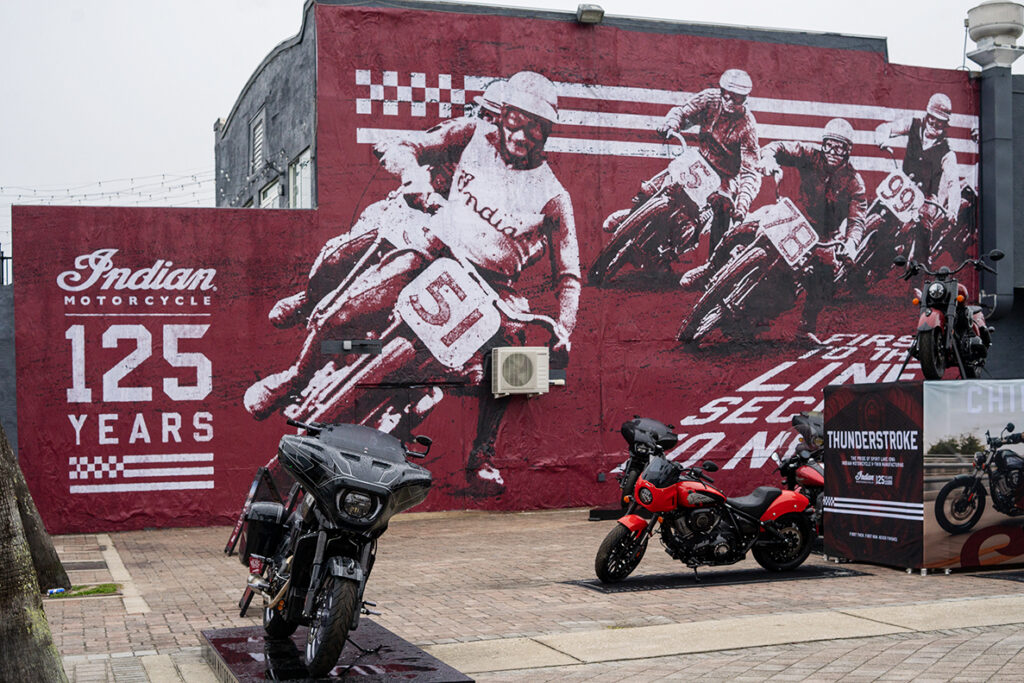
My name is Justin Phillips. I run American Guerrilla Marketing out of Industry City, Brooklyn. What I’m going to tell you is what actually happened when Indian Motorcycle came to us for Daytona Bike Week 2026, not the version with the polished case study language, but the version where I walk you through what we did, what the problems were, and what it looked and felt like when 520,000 people spent ten days riding past a bridge wall with one brand on it.
I’ve been doing this work for a long time. Street marketing, large format, wheatpasting, LED trucks, the whole spectrum. But there are a handful of campaigns that you carry differently than the others. The Indian Motorcycle Daytona campaign was one of them.
It wasn’t the biggest budget we’ve ever worked with. It wasn’t the most complicated logistics. But the combination of location, format, scale, and audience made it one of those weeks where you remember why you got into this business in the first place.
There was a moment on day two of the installation, standing on an aerial lift above Main Street with the crew finishing the last section of the bridge wall, watching the bikes start rolling below us, when I thought: this is exactly what we’re supposed to be doing.
The Brief: What Indian Motorcycle Needed
When the Indian Motorcycle team approached us, the objective was direct: they wanted Daytona Bike Week presence that didn’t look like a brand tent or a booth setup or a banner on a fence.
They wanted to be part of the physical environment of the event, to feel like they belonged there the way the bikes and the bars and the sun belong there. Not advertising in the environment. Part of the environment.
That’s a brief we understand because it’s the only kind of brief that makes guerrilla marketing worth doing.
If the goal is just impressions, you can buy a billboard. If the goal is integration, brand presence that feels native to the culture rather than superimposed on it, that requires different thinking, different location intelligence, and a different kind of execution.
Daytona Bike Week runs ten days in March, drawing 520,000 attendees from across the country and internationally.
The event is centered on Main Street in Daytona Beach, the strip that becomes the spine of the event, where riders cruise, stop, congregate, and spend the bulk of their time during the week.
Any brand that wants to be present at Bike Week in a meaningful way needs to be on Main Street, not adjacent to it.
Location Scouting: Why 615 Main Street
I do every major location scout personally. I don’t send a crew and look at photos.
I walk the site, stand in the pedestrian flow, look at what the audience actually sees from the ground level, check the surface conditions, figure out the access constraints, and ask the question that matters:
If this campaign runs at this location, does it look like it belongs here, or does it look like someone put a sign on a wall?
On Main Street in Daytona Beach, the bridge at 615 Main Street stood out immediately.
The wall surface of the bridge is large, continuous, and visible from both the street approach and the pedestrian sidewalk that runs the length of Main Street.
Every person riding or walking the core event strip passes this wall. There’s no way to avoid it.
It’s not a wall you might see if you turn a certain direction, it’s a wall that is directly in the sightline of the full event corridor.
More importantly, the bridge wall at 615 Main Street has architectural authority.
It’s a structure, not a construction hording or a temporary fence.
Brands placed on structures read differently than brands placed on surfaces that feel temporary.
A large-format installation on a bridge wall says: this brand is here, it’s committed, it’s not going anywhere.
That’s the reading we needed for Indian Motorcycle at Bike Week, a brand with genuine roots in American motorcycle culture, not a newcomer purchasing proximity.
The Logistics Challenge: Bridge Wall, Aerial Lifts, Two Days
Here is what working on a bridge wall looks like in practice: you need aerial lifts.
Not scaffolding, not extension ladders. Aerial lifts that can position a crew member and materials at height on a surface that is neither plumb nor consistent.
Bridge walls have irregular surfaces, expansion joints, texture variations, sections where the concrete has weathered differently than adjacent sections.
Every one of those surface inconsistencies affects how the material goes up and whether it stays up.
We brought in two aerial lifts for the Indian Motorcycle installation.
The installation required two full days, day one for surface prep, material layout, and the primary installation run; day two for finishing, alignment verification, and edge sealing.
At bridge height, wind is a factor you plan for in a way you don’t have to think about at ground level.
Material that is controlled and manageable when you’re two meters off the ground behaves very differently at the height of a bridge wall above an active street.
Your crew has to know what they’re doing, and they have to communicate constantly.
The Installation: Day One and Day Two
Day one started at first light.
We staged the aerial lifts, prepped the surface, and laid out the full material run to check dimensions before the first section went up.
When you’re working at height on a large continuous surface, you don’t want to discover that your material plan has a dimensional error halfway through the installation.
You check everything on the ground first, then you go up.
The crew we use for high-complexity installations like this one is experienced specifically with large-format and aerial work, not general installation crews that can also do aerial work when required.
The expertise matters.
By end of day one we had the primary installation sections up and initial alignment verified.
The creative was visible from the street.
Riders passing on Main Street that evening could see it.
That evening, one of the crew texted me a photo from the street, he’d walked down the block after we wrapped up and taken it from the audience’s perspective.
The Indian Motorcycle creative on the bridge wall looked exactly like it was supposed to: part of the environment, not superimposed on it.
Ten Days on the Wall: The Maintenance Run
A ten-day outdoor installation at a major event requires active maintenance.
This is something that clients unfamiliar with large-format outdoor work don’t always anticipate, the installation doesn’t go up and then take care of itself for the duration of the campaign.
Edge lift, pedestrian contact on lower sections, humidity effects on specific material types, and occasional damage from accidental contact with equipment or vehicles are all real possibilities during a ten-day run on an active event street.
We had a maintenance crew on-site throughout Bike Week.
Daily inspection, repair of any edge lifting within 24 hours of detection, documentation of condition throughout the run.
The goal was that on day ten, the campaign looked as close as possible to day one.
What 520,000 Attendees Looks Like from a Bridge Wall
I want to be honest about what 520,000 people at a single event means for a brand installed at the center of that event.
It doesn’t mean 520,000 people stop and study your creative.
It means 520,000 people pass through an environment where your brand is part of the physical structure of the experience.
The impression is ambient, accumulated, and environmental, not transactional.
That ambient, accumulated impression is worth more than most brands give it credit for.
The person who rides past the Indian Motorcycle bridge installation five times over the course of Bike Week, on the way to the vendor strip in the morning, back to the hotel in the afternoon, out to the bars in the evening, doesn’t consciously process the brand each time.
But the cumulative exposure is building an association between Indian Motorcycle and Bike Week itself that lives in memory differently than a single processed ad impression.
March 9: The Removal
We removed the installation on March 9, the day after Bike Week ended.
The removal protocol for bridge wall campaigns requires the same level of care as the installation, the surface has to be left clean and undamaged.
We use specific removal techniques calibrated to the surface type and the materials used for the original installation.
A bridge wall that looks worse after our campaign than before is not acceptable.
The removal took most of one day.
By the afternoon of March 9, the bridge wall at 615 Main Street was clean.
Indian Motorcycle’s presence at Daytona Bike Week 2026 was over, but the riders who were on Main Street that week had seen it, photographed it, and carried it home in the accumulated memory of what Bike Week looks and feels like.
Frequently Asked Questions
What is the Daytona Bike Week attendance?
Daytona Bike Week draws approximately 500,000–520,000 attendees over its ten-day run in early March, making it one of the largest motorcycle events in the world.
The event is centered on Main Street in Daytona Beach, Florida, with the primary audience concentration running the full length of the Main Street corridor.
What types of surfaces can American Guerrilla Marketing install on?
We work on concrete, masonry, painted metal, timber, and a range of other exterior architectural surfaces with appropriate material specifications for each substrate.
High-complexity surfaces, bridge walls, elevated structures, textured masonry, require aerial equipment and specific installation protocols.
How long in advance should a Bike Week campaign be planned?
Daytona Bike Week runs in early March.
Planning should begin no later than December of the prior year to allow for location scouting, property relationship confirmation, material production, crew scheduling, and logistics planning.
Does American Guerrilla Marketing work at other motorcycle events?
Yes. We work at Sturgis Motorcycle Rally in South Dakota, Laconia Bike Week in New Hampshire, Myrtle Beach Bike Week, and other major motorcycle culture events across the country.
The location intelligence and large-format outdoor execution approach we used at Daytona translates to any event environment where physical presence in the core event geography is the objective.
Can I see documentation from the Indian Motorcycle Daytona campaign?
Can I see documentation from the Indian Motorcycle Daytona campaign?
We provide complete geo-tagged placement documentation for every campaign we execute, including installation photography, maintenance run documentation, and post-campaign condition records.
For inquiries about our work with specific clients, we address documentation sharing on a case-by-case basis in consultation with our clients.
Contact us to discuss your campaign objectives and what documentation looks like for programs at your scale.