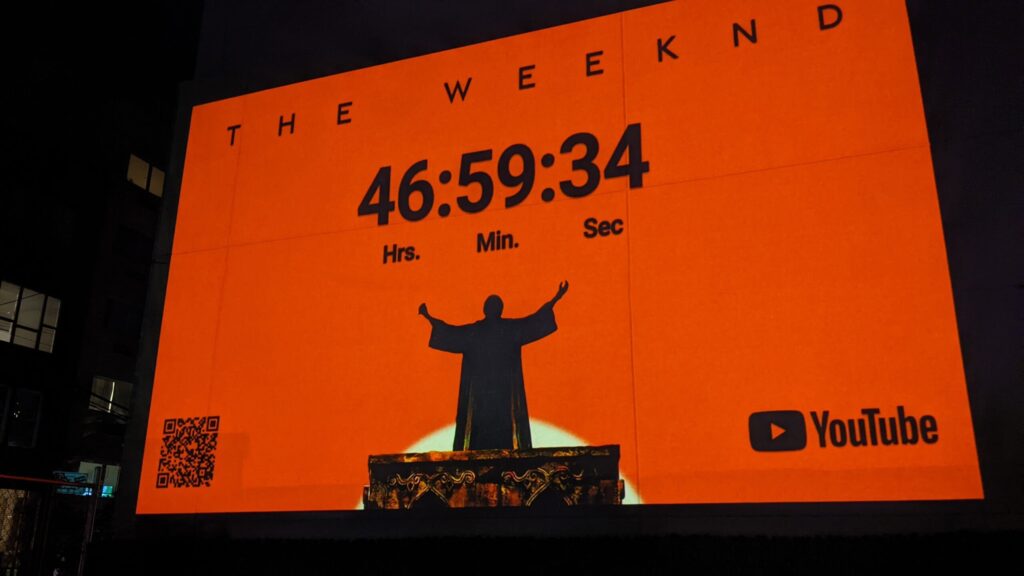
New York City never runs out of advertising surfaces. Times Square alone has enough display inventory to overwhelm any brand’s visual message. But there is one form of visual communication that cuts through the noise of even New York’s most saturated environments: a guerrilla projection on a building, a bridge, or an urban landmark at night. Large-scale, unexpected, impossible to ignore — a guerrilla projection in NYC doesn’t compete with the advertising environment. It rewrites it for a few hours.
At American Guerrilla Marketing, our team has been executing guerrilla projection campaigns in New York City long enough to know where they land hardest, what content stops pedestrians in their tracks, and how to time and position projections for maximum earned media amplification. We operate from our base in Industry City, Brooklyn, NY and deploy projection campaigns across all five boroughs — from building facades in Midtown to the Brooklyn Bridge approaches, from Williamsburg warehouse walls to SoHo’s cast-iron building faces that have served as New York’s best projection surfaces for over a decade.
This guide covers the power of guerrilla projections in NYC: why they work, where they work best, how we execute them, and what brands should expect from a professionally deployed projection campaign in the world’s most competitive media market.
Why Guerrilla Projections Work in New York City
New York City’s visual environment is uniquely challenging for brand communication. The city’s residents and visitors are trained to filter advertising — they walk past Times Square’s billion-dollar display ecosystem without registering most of it. But guerrilla projections work because they violate the expected visual grammar of the city. A 60-foot image on a building that wasn’t there last night doesn’t read as advertising — it reads as an event. And New Yorkers stop for events.
Pattern Interruption at Urban Scale
The psychology behind guerrilla projection effectiveness is straightforward: the human visual system is trained to notice unexpected change. A pedestrian walking the same block for years notices instantly when something has changed in their visual environment. A building they’ve walked past a thousand times that is now illuminated with a vivid, large-scale image stops them — not because they’re looking for advertising, but because their perceptual system flags an anomaly. This is the core mechanism: guerrilla projections create a pattern interrupt that forces attention from even the most ad-blind urban consumer.
The Earned Media Effect
A guerrilla projection in a high-traffic NYC location doesn’t just reach the people physically present — it reaches everyone those people share it with. In a city where millions of people have social media audiences and document the unusual things they see, a dramatic building projection becomes social content within seconds of deployment. Media photographers, local news outlets, and marketing industry publications regularly cover well-executed NYC projection campaigns, generating press impressions that dwarf the cost of the activation itself. Our team designs projection campaigns with this earned media potential as an explicit campaign objective, not a lucky byproduct.
The Impossibility Impression
Guerrilla projections communicate brand scale in a way that few other marketing tactics can match. A brand that can project its message on a Manhattan building is, by implication, a significant brand. The medium itself confers authority and scale regardless of the actual size of the brand executing it. For challenger brands trying to create the impression of market presence beyond their actual size, or for established brands making launch announcements in the world’s most visible market, this impression value is substantial.
NYC’s Best Projection Locations by Campaign Objective
Location is everything in guerrilla projection. The surface, the surrounding pedestrian and vehicle traffic, the neighborhood context, and the projection angle all determine whether a campaign achieves its potential.
SoHo and the Lower East Side
SoHo’s cast-iron building facades are among the best projection surfaces in New York. Large, flat, well-illuminated by existing street lighting to create context, and located in neighborhoods with a sustained evening pedestrian culture of consumers who tend to be young, brand-aware, and active social media users. The Lower East Side offers similar surface quality in a neighborhood with a distinctive downtown energy. Projections in these areas reach consumers with high social media engagement rates, which amplifies the earned media potential of every activation.
Brooklyn: Williamsburg and DUMBO
Williamsburg’s warehouse facades and the DUMBO waterfront beneath the Manhattan and Brooklyn Bridges offer some of the most dramatic projection surfaces in the entire city. DUMBO projections under the Brooklyn Bridge approach reach a dense evening pedestrian flow of tourists and locals in one of the most photographed locations in New York. Williamsburg’s Bedford Avenue corridor and the manufacturing-to-creative-economy streets north of Grand Street offer large, flat surfaces ideal for content-rich projection campaigns targeting the creative and millennial consumer demographic.
Midtown and the Theater District
Midtown Manhattan’s density means that a well-placed projection reaches massive pedestrian volumes in compressed time windows. The area around Madison Square Garden, Hell’s Kitchen along 9th and 10th Avenues, and the blocks surrounding Grand Central Terminal all offer surface and traffic combinations that generate thousands of organic impressions per hour during evening deployment windows. For brands launching around major events at MSG or timed to major media moments in Midtown, these locations maximize the coincidence of projection impact and earned media moment.
High-Line and Meatpacking District
The High Line and surrounding Meatpacking District serve one of the most brand-receptive and socially active consumer demographics in the city. Evening foot traffic on and below the High Line consists largely of the exact consumers who photograph brand experiences and share them widely — young, creative, social-media-active adults with significant follower audiences. Projections visible from the High Line or the street-level Meatpacking corridors create immediate social content that amplifies the campaign reach by orders of magnitude.
Citi Field and Barclays Center Surroundings
Around major event nights at Citi Field in Flushing and Barclays Center in Downtown Brooklyn, the concentrated consumer audiences moving through transit corridors and surrounding streets represent high-density projection audiences with a built-in media moment framing. A projection timed to coincide with post-game crowd egress from Barclays reaches a massive, concentrated audience in a compact time window. These event-adjacent projections are among our most effective in terms of per-impression earned media generation.
Projection Equipment and Technical Execution
The difference between a guerrilla projection that generates earned media and one that looks like an accident is equipment quality and technical execution. Our team deploys professional-grade projection infrastructure that delivers the visual impact New York requires.
High-Lumen Projector Fleet
We operate projectors in the 20,000 to 50,000+ lumen range. In NYC’s nighttime urban lighting environment, projectors below this output level produce images that read as dim and underwhelming rather than dramatic and brand-appropriate. Our projector fleet allows us to address surfaces ranging from 30 to 100+ feet in width with full image clarity and color accuracy. Projector selection for each campaign is based on projection distance, surface dimensions, and surrounding ambient light levels.
Content Optimization for Urban Surfaces
Not all brand imagery translates well to projection. Designs with high contrast, bold typography, and limited background complexity project with maximum impact on building surfaces. Detailed imagery with subtle color gradations loses definition at scale and distance. Our team works with client design assets to optimize projection content before deployment — adjusting contrast, color temperature, typography scale, and animation timing to maximize visual impact on the specific surface selected for the campaign.
Vehicle and Mobile Projection Capability
Beyond static building projections, we deploy mobile projection vehicles that move through NYC neighborhoods, projecting campaign content onto multiple surfaces in a single activation evening. Mobile projection campaigns cover more geographic ground, create a sense of brand presence across multiple neighborhoods simultaneously, and generate earned media across multiple social channels as the campaign moves through the city. This mobile capability pairs effectively with our LED billboard trucks for brands running multi-format visual campaigns in the same market window.
Guerrilla Projections as Part of an Integrated NYC Campaign
Guerrilla projections reach their maximum power when they are part of a coordinated NYC campaign rather than standalone activations.
Brand Ambassador Ground Teams
Our brand ambassador agency deploys ground teams during projection activations to capture consumer reactions, distribute brand materials, collect opt-ins, and engage pedestrians who stop to photograph the projection. The combination of a dramatic visual overhead and a brand representative at street level creates a full-spectrum brand experience that drives both mass impressions and individual conversions simultaneously.
Street Team Distribution
Our street team marketing squads work the pedestrian corridors around active projection sites, distributing brand materials to consumers who stop to engage with the projection. The natural crowd-stopping effect of a guerrilla projection makes surrounding street team distribution significantly more effective than typical intercept distribution — the projection has done the awareness work; the street team converts that awareness into brand contact and data capture.
Wheatpaste and Poster Amplification
For multi-day campaign windows, wheatpaste poster campaigns in the neighborhoods surrounding projection sites extend brand presence through daytime hours when projections aren’t active. The combination of daytime poster saturation and nighttime projection activation creates around-the-clock brand presence in the target neighborhood, dramatically compressing the consumer awareness timeline. Our sidewalk stencils add additional ground-level brand touchpoints that reinforce the campaign’s visual presence throughout the day.
Pop-Up Event Coordination
Timing a pop-up event to coincide with a guerrilla projection campaign in the same neighborhood creates a dual-attraction activation that generates substantially more earned media than either tactic alone. The pop-up gives media and social content creators a story about the brand; the projection gives them a visual backdrop. Together they create a campaign moment that can achieve the kind of organic media coverage that marketing budgets ten times the campaign cost couldn’t buy through paid channels.
Planning and Executing Your NYC Projection Campaign
Executing a guerrilla projection campaign in New York City requires significantly more planning and logistical infrastructure than most other markets.
Site Reconnaissance and Surface Assessment
Every NYC projection campaign starts with on-the-ground site reconnaissance. Our team evaluates candidate surfaces for projection quality, sight line clearances, ambient light interference, pedestrian traffic patterns, and accessible projector placement positions. Sites that look ideal on satellite imagery often have ground-level complications — power access, vehicle obstruction, or surface reflectivity issues — that make them impractical. We assess candidate sites in person before committing to any location.
Content Production and Technical Review
Once sites are selected, we work with client creative teams or our in-house production team to optimize content for projection. This includes resolution testing, color calibration for the specific projection surface, animation timing review, and test projections when feasible. The difference between content that was designed for a screen and content optimized for building-scale projection is substantial — brands that skip this optimization step see their projection investment underperform because the content isn’t fully legible at scale.
Documentation and Reporting
Every NYC projection activation is documented with professional photography and video from multiple angles, capturing both the projection imagery and the consumer reactions at street level. This documentation serves multiple purposes: social media content for your brand’s channels, earned media materials for press outreach, and campaign performance records for internal reporting. All guerrilla marketing services we provide operate on this documentation standard.
Frequently Asked Questions About Guerrilla Projections in NYC
What are guerrilla projections and how do they work in NYC?
Guerrilla projections use high-lumen projectors to cast brand imagery, messages, or video content onto building facades, bridges, and large surfaces in New York City. The projection creates a massive, attention-commanding visual statement that reaches pedestrians, motorists, and media without the cost of permanent signage.
Where does AGM execute guerrilla projection campaigns in NYC?
We execute projections across all five boroughs and key Manhattan locations including Midtown, SoHo, the Lower East Side, Brooklyn Bridge approaches, Williamsburg, and other high-traffic locations. Specific site selection depends on campaign goals, target audience, and projection surface availability.
How does a guerrilla projection campaign generate earned media?
Guerrilla projections in high-traffic NYC locations stop pedestrians, prompt social media photography, and attract press coverage. The unexpected, visually dramatic nature of a building-scale projection creates an earned media moment that can generate millions of impressions beyond the people physically present.
What resolution and lumen output do AGM’s projectors deliver?
We deploy professional-grade projectors in the 20,000-50,000+ lumen range depending on projection distance and surface size. At this output level, projections are fully visible in urban nighttime environments and generate the visual impact required for effective NYC guerrilla campaigns.
Can AGM coordinate NYC projection campaigns to coincide with product launches or events?
Yes. We regularly time guerrilla projection campaigns to coincide with product launches, brand activations, album or film releases, sporting events, and media moments. Contact our team at (646) 776-2770 to discuss timing your NYC projection campaign.
How many nights does a typical NYC guerrilla projection campaign run?
Most guerrilla projection campaigns run 1-3 nights to generate maximum earned media impact before the novelty effect diminishes. Some campaigns extend to 4-7 nights for sustained neighborhood presence. The optimal duration depends on campaign objectives and the rate of organic social media and press pickup.
What brands are guerrilla projections most effective for in NYC?
Entertainment, fashion, technology, consumer goods, and social cause campaigns all achieve strong results with NYC guerrilla projections. The tactic is particularly effective for brand launches, product announcements, cultural moments, and campaigns where visual drama and earned media coverage are primary objectives.
Frequently Asked Questions
What is illuminate nyc the power of guerrilla projections?
American Guerrilla Marketing provides illuminate nyc the power of guerrilla projections services across 50+ U.S. markets. Every campaign is planned, scouted, executed, and GPS-documented by our field teams. We work with regional brands and Fortune 500 companies on campaigns that require real street-level execution and documented proof of performance.
How does AGM approach guerrilla projections?
Our process starts with a market consultation to understand your goals, target audience, and budget. We then scout locations, handle any required permissions or permits, coordinate production and installation with our local crews, and provide a full GPS-tagged photo report after the campaign runs.
What markets does American Guerrilla Marketing cover for guerrilla projections?
We operate in 50+ U.S. markets including New York, Los Angeles, Chicago, Miami, Houston, Atlanta, Seattle, Denver, Boston, and dozens of secondary markets. Contact us to confirm availability and pricing for your specific market.
How much does a guerrilla projections campaign cost?
Campaign pricing depends on market, format, quantity, and duration. We work with budgets ranging from targeted single-market runs to national rollouts across multiple cities. Use our RFP Builder or contact us directly for a custom quote based on your specific campaign requirements.
How do I get started with guerrilla projections through AGM?
The fastest way to get started is to submit your campaign details through our RFP Builder at americanguerrillamarketing.com, or contact us directly at [email protected] or (646) 776-2770. Our team typically responds within one business day with availability and initial pricing.