
November 10, 2026
How Long Chalk Stencils Last: A Marketer’s Guide
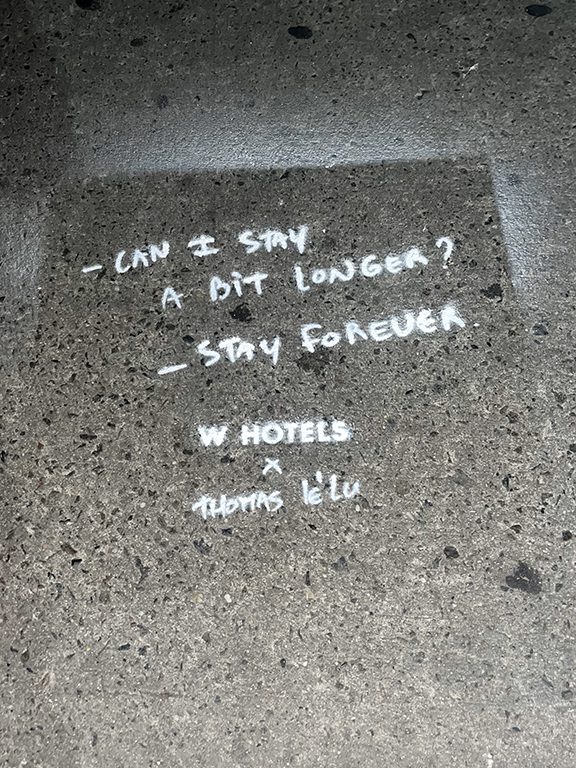
Somebody on your side is going to ask for a number. A fortnight, a month, a date they can put in a plan. I understand why, and I am going to explain why the number does not exist and what to use instead.
Chalk stencils do not have a shelf life. They have a wear curve, and the shape of that curve is set almost entirely by things that have nothing to do with the material: how many shoes cross the mark, what the pavement is made of, how much it rains, and whether a property owner’s cleaning contractor turns up in week one.
I have had two identical marks, same artwork, same material, same crew, same night, degrade at completely different rates because one sat in the walking desire line and the other sat three feet to the side against a building wall. Nothing about the product differed. Everything about the location did.
So this page gives brand marketers something more useful than a number. The phases a mark goes through, the variables that stretch or shorten each phase, how to plan a campaign around a curve instead of a date, and how to set expectations internally before anyone commits to a stakeholder.
The three phases, and why you should adopt this language
I recommend clients use these three words internally, because they prevent most of the arguments that happen later.
**Sharp.** Crisp edges, full colour, reads clearly from several paces, photographs well. This is your hero phase and it is the shortest of the three. If the campaign has a press or social objective, it has to land inside this window.
**Legible.** Edges softened, colour faded, but a person walking past still sees a mark and understands what it is. This phase lasts considerably longer than the sharp phase, and honestly it is where most of a campaign’s real exposure happens. Marketers tend to write this phase off because it looks worse in photographs, which undervalues it.
**Ghost.** Visible as a change in surface tone if you know where to look, not legible as an image. Functionally finished.
The reason this framing matters is that “how long does it last” is actually three different questions depending on which phase the person asking cares about. A PR lead cares about sharp. A brand presence objective cares about legible. A property owner cares about ghost, because that is when it stops being their problem.
Pin down which phase your objective depends on and the planning gets much easier.
What actually wears a chalk stencil away
Five forces. They act at very different speeds depending on the site.
**Foot traffic abrasion.** The dominant one on any sidewalk. Shoes are abrasive and they carry grit. A mark in the middle of a walking desire line wears from the centre outward and you can often watch the pattern develop as a soft smear through the busiest part of the image. A mark two or three feet off the line, toward the building edge or the kerb, can last several times longer while still being perfectly visible.
**Rain.** Water removal is the design intent for chalk based materials, so rain is the clock. A sustained heavy rain shortly after install can take a campaign down to ghosts overnight. Light rain usually softens rather than erases. There is no reliable rule here and I will not invent one for the sake of a cleaner answer.
**Surface texture.** Open porous concrete holds material down in the pores, so it keeps a ghost far longer but loses sharpness faster, because the edges were never as crisp to begin with. Smooth dense concrete gives you a sharper mark that sits on the surface and therefore wears off the top more readily. Different curves, not better and worse.
**Grit and street debris.** Wind blown sand, winter grit, and the general material that accumulates on a sidewalk all act as abrasive under foot traffic. Coastal and winter markets wear marks faster for this reason alone.
**Cleaning.** The sudden one. This does not wear a mark down, it ends it. A property owner’s scheduled wash, a neighbouring business cleaning their frontage, a pressure washing contractor doing seasonal work. In my experience this is the single most common reason a placement disappears early, and it is almost entirely preventable with one question, which I will come to.
Notice that four of the five are properties of the location rather than the product. That is the central insight. If you want longer life from a chalk stencil campaign, you buy it with location selection, not with material.
Which placements hold longest
Ranked from crew experience.
**Sheltered vertical adjacent areas and covered walkways** top the list where the format is usable at all. No rain, reduced traffic, slow wear.
**Just off the walking desire line on a wide sidewalk.** The best practical choice on most campaigns. Still clearly visible to anyone walking past, but outside the concentrated wear strip. Against the building edge or in the zone near the kerb.
**Plaza areas off the direct route.** Open ground where people cross in dispersed patterns rather than funnelling.
**Mid block stretches** rather than corners. Corners concentrate turning foot traffic and pivoting shoes, which is unusually abrasive.
**The walking desire line itself.** Shortest life, frequently the highest value position, and that tension is a real planning decision rather than a problem to be solved. For a short burst it is the right call. For a longer run it is not.
**Entryways and thresholds.** Worst case. Concentrated traffic, grit tracked in from outside, and usually cleaned regularly as well. I steer campaigns away from these for anything except a very short burst.
**Bus stops, transit exits, queue areas.** Mixed. Heavy traffic but often slow moving and dispersed, and the attention value is high. Worth the shorter life.
The question that saves more placements than anything else
Ask every property owner: when do you wash this frontage, how often, and will you skip a cycle while the campaign runs.
That is it. That is the highest value question in the entire process and almost nobody asks it.
Owners agree to skip a cycle readily when asked in advance, because it costs them nothing and they already said yes to the campaign. They will never think to mention it unprompted, because to them washing the frontage is routine maintenance and not a campaign event.
Unasked, a cleaning contractor arriving in week one is the most common way a placement vanishes. The brand team then concludes the format does not last, when what actually happened is that nobody had a thirty second conversation.
Ask it in writing, alongside the permission, and get the answer in writing too.
Material tier changes the curve, within limits
The word chalk covers a range, and the tier you choose shifts the whole curve rather than extending one phase.
**Dry chalk** is genuinely temporary and rarely survives commercial use outdoors. Fine for a controlled event footprint over a day. Not a campaign material.
**Chalk based temporary spray** is the commercial workhorse. Reasonably crisp, designed to wash away, suits a burst of a few days around a moment.
**Water based temporary marking** is a step up. Crisper, more opaque, more resistant to foot traffic and rain, visible for weeks rather than days. The trade is a more serious permission conversation and a removal that is real work rather than a rinse.
**Printed sidewalk decals** leave the stencil world entirely. Identical artwork in every market, appearance held for a defined period, removal on a known schedule.
Here is the important part for a brand marketer. Moving up a tier does not make a mark last forever in a high traffic position. It shifts the curve, but abrasion still dominates. A water based mark in a doorway will underperform a chalk spray mark in a sheltered spot. Location beats material every time, and clients who try to solve a placement problem by buying a more durable product are usually disappointed.
One hard rule regardless of tier: name the actual material to the property owner. Never let the word chalk cover something more durable. An owner who agreed to chalk and got water based marking paint is an owner lost, and fairly so.
Artwork decisions change lifespan more than people expect
The design affects how long a mark remains useful, and this is free durability that costs nothing in crew time.
**Stroke weight is lifespan.** Marks wear from the edges and the high points inward. Thin lines vanish while heavy forms are still strong. A logo at generous weight will outlive the same logo rendered faithfully with its fine elements.
**Open the internal counters.** The enclosed spaces in letterforms close up as material spreads and wears. Open them wider than brand guidelines normally allow or the wordmark becomes a blob in week two.
**Scale up.** A larger mark loses proportionally less at the edges and degrades far more gracefully.
**Simplify to silhouette.** Gradients, outlines and drop shadows do not exist here on day one, never mind day ten.
**One colour.** Multi colour marks degrade unevenly as layers wear at different rates, which looks worse than a single colour fading cleanly. Registration also drifts visually as edges soften.
**Drop the fine text.** URLs and legal lines are the first thing to go. QR codes I will not promise on textured pavement even when fresh, let alone worn.
Brand teams push back on simplification constantly. The honest trade is a faithful mark that is unreadable quickly or a simplified mark that works for the whole run. Pavement is not a reproduction surface.
How to plan a campaign around a curve
Four patterns, and most briefs fit one of them.
**Moment driven.** An event, a launch weekend, a conference. Durability is nearly irrelevant. Install as close to the moment as the schedule allows, take the high traffic desire line placements, accept a short life and get maximum density and contrast on the days that matter. Installing early to be safe is counterproductive here, because it spends the sharp phase on nobody.
**Sustained presence.** Weeks of visibility in defined corridors. Shift the material tier up, move placements off the desire line, and scope a refresh visit from the beginning rather than bolting one on when someone notices the marks have worn.
**Earned media.** The sharp phase has to coincide with when photographers, journalists and social posts happen. Time install tightly to that and over invest in the hero placements.
**Multi market programme.** Accept staggered rollout. Weather windows differ by market, permission chains move at different speeds, and surfaces vary. Anyone promising a synchronised national install night on a weather gated format has not run one. Also accept that marks will not look identical across markets, because every pavement is different. Concept consistency is achievable. Visual consistency is not.
For anything beyond a short burst, build the refresh into the plan and the schedule. A refresh is quicker than the original install because the site is known, the stencil exists and there is a ghost to align to, but it is still a scheduled crew visit with travel and weather dependency. Keep stencils labelled per placement with registration marks, or a refresh lands off register and leaves a doubled edge that looks worse than the faded mark did.
Measuring the curve instead of guessing at it
Nobody knows how a campaign is ageing unless somebody looks.
Our standard per placement is a before photograph of the untouched surface, an after photograph from the viewer’s standing position, a wider context shot, location, timestamp and the crew log.
For any run beyond a few days, add scheduled re photography from the same standing position. Two rules make this worth doing. Daylight only, because overnight photographs flatter everything when artificial light hits at a low angle and exaggerates contrast. And the same position every time, or the comparison means nothing.
A few rounds of that gives you a real wear curve per placement. That curve tells you which positions in that city hold, which burn out fast, and when a refresh is actually needed rather than when someone guessed it might be. On a repeat programme it converts the next campaign from estimate to evidence, and it is the single most useful thing a brand team can ask for.
What I will not give you is an impressions figure derived from multiplying footfall by a guess. Documented reality is more defensible and more useful.
Permission and removal, briefly
The permission conversation affects lifespan directly, which is why it belongs in a page about duration.
A written permission that names the surface, the dates, the artwork, the exact material, the expected persistence and the removal commitment sets the owner’s expectations correctly. An owner expecting a mark to vanish in days who watches a ghost linger for weeks will wash it off and will not work with you again.
On the ordinance side, this is a grey area. Whether temporary commercial marking on pavement is treated as advertising requiring a permit, as a marking of no particular concern, or as something touching local nuisance or defacement provisions varies by municipality, and enforcement is inconsistent between cities and sometimes between districts in one city. We default to privately controlled surfaces for that reason. We are campaign operators and not lawyers, and we do not characterise the format as legal or illegal anywhere.
Removal gets committed in writing before install even for materials that weather off. That commitment is what makes owners comfortable and what gets a crew invited back.
What we talk brand teams out of
**Asking for a guaranteed visible duration.** It cannot be given honestly. We commit to install quality, documentation, refresh and removal. Not a date.
**Long runs on desire line placements.** Correct for a weekend, poor value across weeks.
**Entryways for anything but a burst.**
**Buying a more durable material to solve a bad placement.** Location beats material.
**Installing early to be safe.** The sharp phase is short. Spending it before anyone is looking wastes the best part of the campaign.
**Faithful detailed artwork on a long run.** Fine elements vanish first.
**Skipping the cleaning schedule question.** The most expensive thirty seconds not spent in this format.
**Expecting identical appearance across markets.** Every pavement has its own texture and history.
**Carrying a multi month national presence entirely on stencils.** That means repeated install nights across many markets, which is a far larger operation than clients expect. For sustained consistent presence, printed sidewalk decals hold their appearance for a defined period and come up on a known schedule, which is usually what the brief wanted before it was written down as chalk.
The structure that works most often is decals carrying the long consistent layer and chalk stencils delivering concentrated bursts around the moments that matter.
Frequently asked questions
How long do chalk stencils last?
There is no fixed duration, because they wear on a curve rather than expiring. Think in three phases: sharp, legible and ghost. Foot traffic abrasion dominates, rain is the clock, and surface texture changes the shape of the curve. A mark just off the walking desire line can outlast one in the middle of it several times over with identical material.
What makes a chalk stencil disappear fastest?
Concentrated foot traffic directly across the mark, especially at corners, entryways and thresholds where shoes pivot and grit gets tracked in. Sustained rain shortly after install is the next biggest factor. The most common cause of an early loss is not wear at all, it is a property owner’s cleaning contractor washing the frontage during the run.
Will a more durable material make the campaign last longer?
It shifts the whole curve but it does not override placement. Abrasion still dominates, so a water based mark in a doorway will underperform a chalk spray mark in a sheltered position. Buy longer life with location selection first and material tier second. Always name the actual material to the property owner rather than calling everything chalk.
Can you refresh worn chalk stencils mid campaign?
Yes, and for anything beyond a short burst you should scope a refresh visit from the start. It is faster than the original install because the site is known, the stencil exists and a ghost remains to align to. Keep stencils labelled per placement with registration marks built in, or the refresh lands off register and looks worse.
How should artwork change to last longer?
Increase stroke weight, open internal counters wider than brand guidelines normally allow, scale up and simplify to silhouette. Marks wear from the edges inward, so fine elements vanish while heavy forms stay strong. Use one colour, since multi colour marks wear unevenly as layers degrade at different rates. Drop URLs, legal lines and QR codes.
How do you prove to stakeholders what the campaign actually did?
Documented reality rather than modelled numbers. Before and after photographs per placement, a context shot from the viewer’s position, location, timestamp and crew log, then scheduled re photography from the same standing position in daylight only. Several rounds produce a genuine wear curve per site, which informs refresh timing and makes the next campaign evidence based.
Request a campaign quote
Tell us which phase your objective depends on, how long the marks need to stay useful, and which corridors matter. Send close up photographs of the actual pavement and a note on who controls each surface. We will put placements where they will survive the run you need, set honest expectations with your stakeholders up front, and scope refresh and removal visits rather than leaving them to be discovered later.
If someone has already promised a duration we cannot support, we would rather have that conversation now than in week three.
Request a campaign quote and we will start with the duration your campaign actually needs.

Ready to Run Your Campaign?
Call us or email us. We’ll tell you exactly what we can do in your market and what it costs.
Related Services
Explore similar advertising solutions offered by American Guerrilla Marketing.
American Guerrilla Marketing — Los Angeles
Street-level campaigns in Los Angeles and nationwide. Wheatpasting, LED trucks, street teams, and more.
(646) 776-2770
Related Articles
-
How Sidewalk Decals & Stencils Runs in Grand Rapids
November 10, 2026
-
Sidewalk Decals and Stencils in Orlando: How It Runs
November 10, 2026
-
How Sidewalk Decals & Stencils Runs in Fort Lauderdale
November 6, 2026
-
How Sidewalk Decals & Stencils Runs in Sacramento
November 5, 2026
-
Reverse Graffiti Stencils Explained for Brand Marketers
November 5, 2026