
November 6, 2026
How Sidewalk Decals & Stencils Runs in Fort Lauderdale
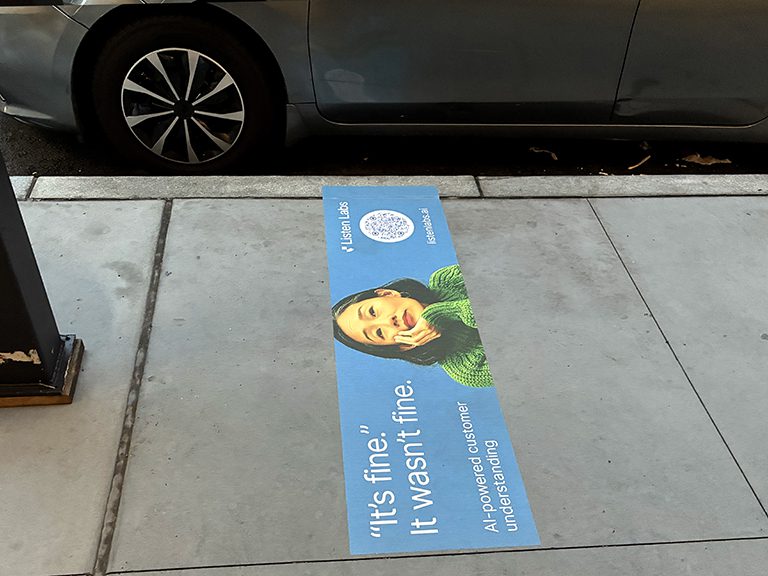
Everything I know about posting walls in Fort Lauderdale is close to useless on the ground plane. Decals are a different medium with a different failure list, a different work shift, and a different permission conversation.
Wall work here is a night job. Decal work is mostly a daylight job, because you cannot bond adhesive film to pavement that is wet with dew, and in this climate the pre-dawn hours are exactly when dew load is highest.
That one difference changes everything downstream. A daylight crew is visible. A visible crew needs the property owner to have actually agreed, in writing, in advance, because a passer-by will ask. In a city whose core corridors are the tourism shopfront and are maintained to a visible standard, that is not a small operational detail. It is the whole plan.
Buyers usually come to me wanting decals on Las Olas Boulevard and on the beach promenade along A1A. Those are the two surfaces in Fort Lauderdale I argue hardest against, and the reasons are physical before they are anything else.
Here is how Sidewalk Decals & Stencils actually runs in this market.
Fort Lauderdale pavement is not one surface
Decals bond to what is under them. In this city that varies enormously over short distances, and nobody can tell from a photograph.
Las Olas Boulevard is the signature retail, gallery and dining corridor running east from downtown toward the beach, with continuous boutique and restaurant frontage and heavy evening footfall. It is also a corridor with decorative and jointed paving treatments in front of a lot of that frontage. Joint lines are the problem. A film laid across a joint has no substrate under the gap, foot traffic pushes it down into the void, water sits in it, and the edge peels from the inside out. Decals in this corridor belong on continuous poured sections, or on a private forecourt, not spanning decorative work.
The downtown riverfront and the paths around it are generally more continuous and better suited, though they also carry the most routine cleaning attention in the city.
Himmarshee, around Himmarshee Street and SW 2nd Street, is the bar and club cluster off downtown. The ground here takes a beating. Spilled drink, grease, cleaning residue and heavy late-night footfall mean the surface is often contaminated at the microscopic level even when it looks clean. Prep here is not a formality, it is most of the install time.
Flagler Village and FAT Village have the most forgiving ground in the city for this format. FAT Village, the Flagler Arts and Technology Village that has been the city's arts and culture hub for about twenty years, sits on warehouse and light-industrial stock with broad poured concrete aprons, loading frontage and private forecourts. Flat, continuous, privately owned, and with property owners who already understand commissioned surface work. That combination does not exist anywhere else here in the same density.
Fort Lauderdale Beach and the A1A corridor. Linear, tourist-weighted, seasonal, and carrying sand. I will come back to sand, because it is the single biggest reason beach decals disappoint.
The Oakland Park and Wilton Manors corridor north of the core is a separate municipality and part of the same nightlife continuum, with a long-established LGBTQ+ nightlife centre. Its ground plane is mixed and needs its own survey.
Sistrunk and Victoria Park change block by block and should never be bought from a map.
Heat, dew and sand: the three bond killers here
Adhesive film has a service window for application. Surface temperature, surface moisture and surface cleanliness all have to land inside it at the same moment. Fort Lauderdale makes that harder than most markets, in three specific ways.
Surface heat. The city gets abundant sunshine year-round, and the temperature band runs roughly between 61 and 89 degrees across the year. Unshaded concrete under midday sun in this climate runs far hotter than the air temperature. Film applied to over-hot pavement grabs instantly at the first point of contact, which sounds good and is not. It prevents repositioning, it traps air, and it sets up a stressed bond that releases later. On a summer install we work shaded sections, or we work early in the usable window before the ground loads up with heat.
Dew. Overnight is often when moisture load is highest here, which is the opposite of the assumption people bring from dry climates. Pavement holds that moisture well past sunrise in shaded sections. A crew that starts at first light will spend the first hour watching a surface that still will not take film. The practical window on most days is mid-morning onward on the dry side of the day, which is also when the sidewalk is busy. That tension is built into the format in this city.
Sand. Along A1A and anywhere within a few blocks of the beach, there is sand on the pavement all the time. It is not debris, it is a continuous resupply. You can sweep, wash and prep a section perfectly, and wind puts a fresh layer down before the film cures. Sand under the edge of a decal is a failure already in progress, and sand on top of a decal is an abrasive being ground in by every foot that lands on it. Beach-corridor decals look tired in a fraction of the time they would last inland. Clients ask for that corridor because it is the image of the city. It is the worst ground in Fort Lauderdale for this format.
Downpours. The summer pattern delivers frequent heavy convective storms. The ground plane is where that water collects. Standing water sits on low sections and against joint lines, and the drying lag after a storm takes a usable afternoon out of a schedule. We build weather contingency into decal days rather than treating it as bad luck.
Salt air. Salt is chemically aggressive, conductive, and attacks metal faster than ordinary humidity does. Coastal trades report painted metal near the coast showing fading, chipping and rust inside one to two years, and FEMA guidance cited in coastal roofing notes the same exposure corroding connectors and fasteners. Decals themselves are not metal, but anything we bring with them near the beach, frames, anchors, stencil hardware, gets specified as corrosion-resistant and inspected more often.
No freeze-thaw. The northern failure mode, where water gets under a decal, freezes and lifts it from below, does not happen here. That is a genuine advantage. Fort Lauderdale takes it back through heat, dew and sand instead.
Film, stencil, or neither
Two formats get called the same thing and behave very differently.
Adhesive film decals are the durable option. Full-colour, sharp edges, defined shape, several weeks of service on good ground with good prep. They require the cleanest surface and the most install discipline, and they require a removal plan, because they come up as a physical object that somebody has to deal with.
Stencil work, including water-soluble and chalk-based applications, is the lighter touch. It is less precise, it does not demand the same bond, it weathers off, and it suits short promotional windows and event footprints. In a city with this much summer rain, stencil life is short in the wet season and that should be priced into the expectation rather than discovered.
In Flagler Village and FAT Village, where ground is broad and owners are receptive, film earns its keep. On event approach routes where the message is relevant for a weekend, stencil is usually the better buy. On the beach promenade I would steer away from both.
Permission on the ground plane is a question of whose ground
Posting and marking permission in any American city is a grey area. It varies by municipality, enforcement is inconsistent, and the outcome depends on who owns the surface and whether they agreed. I am not going to tell you where the line sits in Fort Lauderdale, and I would not trust any operator who claims certainty. Anyone relying on a specific provision should check the current municipal code directly rather than take a paraphrase from a marketing page.
What I can describe is the structure we work to.
Private ground is the whole strategy here. Forecourts, plazas, parking aprons, loading frontage, private walkways between buildings, event footprints under a venue's control. In Fort Lauderdale that pushes the format toward Flagler Village and toward private frontage along the riverfront and the nightlife blocks, rather than toward open sidewalk.
Public sidewalk sits in the uncertain zone. Pavement in the public right-of-way is not where I want a client's brand in this market. Removal without notice is the lesser risk. The larger one is reputational, in a city where Las Olas and the beach are actively groomed as the tourism shopfront and where there is visible business interest in keeping frontage tidy.
Written consent, scoped and dated. A named ground area, a start and end date, and a removal commitment. The FAT Village property ownership has roughly twenty years of experience with commissioned surface work in that district, which makes those the most productive permission conversations available in this city.
Documentation. Before photographs, install photographs, after-removal photographs. If a question arrives later, the answer is already on file.
Removal is part of the job, not an afterthought. For film we specify a removal date and we come back for it. For stencil work we agree with the owner what the weathering expectation is before anything goes down. On ground plane work, the removal commitment is often the single thing that gets a cautious property manager to yes.
Crew logistics: a daylight job in a city that parks badly
This is where decals diverge most sharply from wall work in Fort Lauderdale.
Daylight shift. Dew makes early work unproductive and the wet season makes afternoons unreliable. The practical slot on most days is mid-morning through early afternoon, on the dry side of the day, in the dry season. That is a visible shift in a busy place.
Crowds are the time cost. Working Las Olas or Himmarshee ground during business hours means working around people, deliveries, outdoor seating and cleaning crews. Every install takes longer than its equivalent in a quiet warehouse forecourt, sometimes considerably.
Prep dominates the clock. Sweep, wash, degrease where needed, dry, then apply. On nightlife ground that prep step is the majority of the time on site. Crews that treat prep as optional produce the failures that make buyers distrust the format.
Cure before traffic. Film needs an undisturbed period after application. On a busy sidewalk you either cone the area with the owner's agreement or you pick ground that is naturally quiet for an hour. Private forecourts solve this. Open sidewalk does not.
Park once, work on foot. The city's nightlife and culture districts spread across roughly five separate areas over several miles, so there is no city-wide walking route. Flagler Village and FAT Village are walkable internally, and the consistent local experience there is that parking is hard to find but once you have a space it is a good walk from wherever you landed. We secure a space early and work out from it.
The beach is a parking problem before it is anything else. Metered, tourist-contested and expensive in season, on a linear corridor. A crew that has not budgeted for parking there will lose a large part of the shift to it.
Wilton Manors and Oakland Park is a separate drive and a separate shift. Different municipality, different rhythm. Not an add-on.
Crew shape. Two people is the working unit for ground plane work, one on prep and one on application, with the roles leapfrogging along a run. Three makes sense when the install area is large, when cones and crowd management are needed, or when a single day has to cover two districts. Adding people past that does not speed up prep, which is the actual constraint.
The calendar that makes ground-plane work worth it
Decals reach people who are already standing in a place. That makes event and district timing more important for this format than for almost any other.
FAT Village Art Walk, monthly. The most useful recurring date in Fort Lauderdale for this format. Reliable district-scale footfall, in the district with the broadest private ground and the most receptive owners, in a part of the city where people walk slowly and look down as well as up. If a brand wants a repeating local presence, this is the anchor.
Seminole Hard Rock Winterfest Boat Parade, December. The parade runs a roughly twelve-mile water route through Greater Fort Lauderdale with events the preceding night, and it draws one of the largest single-day audiences of the year. The audience watches water, so nothing on the ground competes during the parade itself. What works is the approach and the parking-to-viewing walking routes, where people are funnelled, slowed and looking at their feet.
Rock the Ocean's Tortuga Music Festival, Fort Lauderdale Beach Park, three days in April. The 2026 edition ran 10 to 12 April. Big beachfront crowd, country and crossover bill, ocean-conservation framing. The sand problem applies to the ground near the beach, so the usable ground is on the consented approach side rather than the promenade.
Pride Fort Lauderdale, described as the state's oldest Pride celebration, pairs with the Wilton Manors corridor and concentrates a specific audience into a few blocks for a weekend. Stencil work suits that window better than film.
Boat shows and the marine trade calendar genuinely move high-value visitor traffic in this city, where boating is central to the economy and the identity.
Winter and early spring are the tourist peak and the dry, comfortable part of the year. Summer is the weather-constrained trough. For ground plane work that seasonality is stronger than it is for wall work, because the install itself depends on dry pavement.
Confirm current-year dates before committing budget. Several of these move.
What I talk clients out of, and what goes wrong
Beach promenade decals. Sand, salt, the harshest sun exposure in the city, contested parking, the most scrutinised frontage, and a largely visiting audience. Every physical factor runs against the format there. If the brand sells to people who live in Broward County, that money belongs in Flagler Village.
Decorative paving on Las Olas. Film across joints and textured treatments fails from the gap outward. We either find continuous poured sections, move onto a private forecourt, or recommend a different format for that corridor.
Summer full-flight commitments. Afternoon storms, standing water and heat-loaded pavement make summer installs slower and summer service life shorter. Either the dates move into the dry season or the plan carries refreshes and shorter cycles from the start.
Public sidewalk placement. The uncertain zone, with reputational exposure attached, in a city that grooms its shopfront corridors. I would rather deliver a smaller consented footprint than a larger one the client has to apologise for.
Skipping prep to fit more sites into a day. This is the failure I see most often from plans built on site counts rather than install time. A poorly prepped decal on Himmarshee ground lifts at a corner within days, and one visibly failing placement damages the campaign more than a missing one would.
The other recurring failure is expecting film to behave like paint. It is a surface-mounted object sitting on top of a hostile environment, taking foot abrasion, heat cycling, storm water and, near the coast, airborne grit. On good private ground with proper prep in the dry season it performs well. On open sidewalk in August it does not, and no product choice fixes that.
For campaigns that need reach across this city rather than depth in one district, I usually pair ground plane work with LED Trucks & Mobile Billboards. The decals own the place where people stand still, and the truck covers the driving distance between five separate districts that no walking campaign can bridge.
Frequently asked questions
How long do sidewalk decals last in Fort Lauderdale?
Service life depends on ground quality, prep, foot traffic and exposure. A well-prepped film on continuous private concrete in the dry season performs well for a multi-week window. The same film on busy sand-carrying ground near the beach degrades much faster through abrasion. We set refresh expectations by site rather than quoting one lifespan.
Which districts suit this format best here?
Flagler Village and FAT Village first, for broad poured concrete, private forecourts and property owners used to commissioned surface work. The downtown riverfront and consented private frontage along the nightlife blocks second. The beach promenade last, because sand and sun work against the format continuously.
Are sidewalk decals permitted in Fort Lauderdale?
It is a grey area that varies by municipality, surface ownership and the current local code, and enforcement is inconsistent. Our approach removes the ambiguity rather than testing it: private ground with written owner consent scoped to an area and dates, documentation at install, and an agreed removal commitment on every placement.
Why do you work in daylight instead of overnight?
Adhesive film will not bond to damp pavement, and overnight here is when the dew load is heaviest. The usable window is generally mid-morning onward on a dry day. That makes the install visible, which is another reason we work private ground with consent already in place rather than improvising on open sidewalk.
What is the difference between decals and stencils?
Film decals are durable, full-colour and precise, and they require clean ground, careful prep and a removal plan. Stencil work, including water-soluble applications, is lighter, less precise, weathers away on its own, and suits short event windows. In the wet season here, stencil life is short, which should be built into expectations.
When is the best time of year to run ground plane work?
The dry season, broadly winter into early spring, when pavement dries properly, storms are less frequent and the tourist peak is on. Summer installs are slower and shorter-lived. For a repeating local presence, timing placements to the monthly FAT Village Art Walk is the most dependable rhythm in this city.
Request a campaign quote
Tell us where your audience actually stands still in Fort Lauderdale, what you want them to do, and the window you are working to. We will survey the ground rather than the map, tell you honestly which sections will hold film and which will not, name the permission route for each area, and build the install day around prep time instead of a site count.
Request a campaign quote and we will check the pavement before we quote the campaign.

Ready to Run Your Campaign?
Call us or email us. We’ll tell you exactly what we can do in your market and what it costs.
Related Services
Explore similar advertising solutions offered by American Guerrilla Marketing.
American Guerrilla Marketing — Los Angeles
Street-level campaigns in Los Angeles and nationwide. Wheatpasting, LED trucks, street teams, and more.
(646) 776-2770
Related Articles
-
How Sidewalk Decals & Stencils Runs in Sacramento
November 5, 2026
-
Reverse Graffiti Stencils Explained for Brand Marketers
November 5, 2026
-
Sidewalk Decal Material Options: An Honest Breakdown
November 5, 2026
-
Sidewalk Decals and Stencils in Miami: How It Works
November 4, 2026
-
Removing Sidewalk Decals Without Damage
November 4, 2026