
November 10, 2026
Sidewalk Decals and Stencils in Orlando: How It Runs
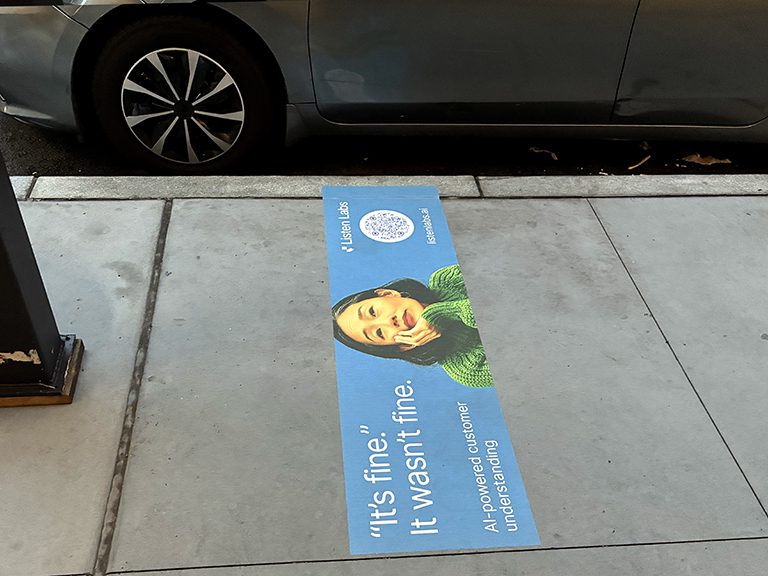
Most people who call us about Orlando have already decided the city is a theme park with some roads attached. They want sidewalk decals on International Drive, they want them near the attractions, and they are surprised when I spend the first ten minutes of the call talking them out of it.
I-Drive and Universal CityWalk are not street inventory. They are privately controlled frontage from kerb to building line, and the ground you want to put a decal on belongs to somebody with a leasing department. That is not a campaign conversation, it is a property negotiation, and it runs on a timeline that rarely matches a launch date.
The Orlando that actually works for ground graphics sits north and east of the resort belt, in four small districts that each behave differently after dark.
What follows is how we approach decal and stencil work in this specific market: which pavement is worth the effort, what the humidity does to adhesive and laminate, how the right-of-way question complicates things here more than in most cities, and how a crew realistically covers the city in a night.
The four districts where Orlando ground graphics make sense
Orlando is car-dependent at metro scale and intimate at district scale. That combination is the single most useful planning fact about the city, and it shapes every decal campaign we run here.
Mills 50 is the first place I look. It takes its name from the crossing of Mills Avenue and East Colonial Drive, and it is Orlando's indie and creative district: dense Asian dining, murals, small bars and live music packed into a connected corridor. It is an official Main Street district, which matters for permission reasons I will come to. For ground work the appeal is concentration. People walk between venues here rather than driving between them, which is exactly the behaviour a sidewalk decal depends on. A decal only works if somebody is looking down while moving slowly, and Mills 50 produces that posture naturally.
The Milk District is the dive-bar and live-music side of the city, grouped with Mills 50 as the heart of the LGBTQ+ scene. Similar logic, slightly rougher pavement, and a crowd that arrives later and lingers.
Downtown, along the Church Street corridor and Orange Avenue, carries the bar and theatre traffic and is anchored by the Dr. Phillips Center. This is the highest-volume pedestrian ground in the city on a weekend night. It is also the hardest to work, for reasons that are entirely about timing rather than permission.
Thornton Park, immediately east of downtown, is quieter and more residential. Wine bars, patios, neighbourhood energy rather than club volume. Lower footfall, but a dwell pattern that suits a decal well because people are standing around outside rather than moving in a stream.
Lake Eola is the civic set-piece, used for fireworks and large public gatherings. It is a different kind of opportunity and a different kind of permission question.
My standard recommendation for a first Orlando decal flight is Mills 50 and the Milk District as the core, downtown Church Street and Orange Avenue as the volume layer, and Thornton Park only if the creative rewards dwell rather than glance. That is a tight, defensible footprint. Clients who want the whole metro covered end up with decals in parking lots nobody walks across.
What Orlando's climate actually does to a decal
This is where Orlando stops being a generic warm-weather market and starts having specific, predictable failure modes.
Orlando is humid year-round. Even the driest month, March, averages around seventy per cent relative humidity. That number is the one I quote to clients who assume Florida means dry sunny concrete.
The practical consequence is that you cannot judge a decal install by air temperature here. Condensation on masonry and concrete in the morning is normal. A sidewalk that looks dry at six in the morning can be holding enough surface moisture to kill the adhesive bond, and the failure will not show up for two or three days, by which point the crew has gone home and the client is looking at lifted edges.
So we judge surface dryness directly, not ambient conditions. That means touching the concrete, and in practice it means favouring installs later in a dry stretch rather than first thing after a humid night. It is the single biggest difference between a decal flight that holds and one that peels.
The second Orlando-specific issue is biological. High humidity environments promote fungal and bacterial growth on vinyl unless the surface or coating resists it. In a dry market a decal ages by fading and abrasion. In Orlando it also ages by staining, and a long-dwell decal can go visibly grubby in a way that looks like neglect rather than wear. For anything running more than a few weeks we specify laminates with that in mind, and we build a cleaning pass into the schedule rather than pretending it will stay crisp on its own.
Third, UV. The load here is high enough that even January, the weakest month, averages a UV index around four. Combined UV, humidity and storm debris is a recognised cause of printed outdoor material fading inside six months in Florida conditions. UV-stable inks and laminates are the baseline specification in this city, not an upgrade, and I will not quote a long Orlando flight on unlaminated stock.
Fourth, storms. Atlantic hurricane season runs from the first of June to the end of November, with most activity between mid-August and mid-October and a climatological peak around the tenth of September. Orlando is inland, so it is not a storm-surge market, but it still takes the wind and rain field, and the routine summer convective downpours matter more for ground graphics than the named storms do. Standing water on a sidewalk, repeatedly, is a bond test that most adhesives eventually fail.
The practical scheduling rule I give Orlando clients: if the flight has to run between mid-August and mid-October, plan for a mid-flight replacement pass and say so in the budget conversation up front. Pretending that window behaves like March is how campaigns end badly here.
Permission, right-of-way and why Orlando is more complicated than it looks
This is a grey area and should be read that way. I am not going to tell you any particular placement is permitted or prohibited, because that depends on the surface, the current city code and how enforcement is actually practised, and those are questions for the city and, where it matters commercially, for a lawyer.
What I can describe is the structure of the problem in Orlando, which has a wrinkle most cities do not.
Orlando's street furniture and much of its pedestrian right-of-way sits under city management, but the district you most want to work has state-numbered roads running straight through it. Mills Avenue and East Colonial Drive, the two streets that give Mills 50 its name, are state routes. The practical reality is that anything placed in that right-of-way has at least two possible owners with an interest in removing it, and nothing placed there has a settled life expectancy.
That is not a reason to avoid Mills 50. It is a reason to be precise about which square metre of ground you are standing on.
The durable, defensible route in Orlando is the private route: privately owned forecourts, entrance aprons, courtyards, plaza ground, and the pavement inside a property line rather than outside it. The boundary between private frontage and public sidewalk is frequently invisible to the eye and completely decisive to the outcome, and establishing it is part of the survey, not an afterthought.
Orlando has one genuine advantage here, and it comes from the Main Street district structure. Mills 50 and the downtown Church Street area are organised districts with named associations and a visible mural culture. That means there are identifiable people to ask about specific properties rather than guessing, and there is an established local habit of businesses saying yes to creative work on their frontage. We use that. Approaching a district organisation and then individual operators is slower than just putting decals down, and it produces a campaign that survives its own flight.
One warning I give every Orlando client: do not read mural tolerance as posting tolerance. A district full of commissioned wall art is telling you that property owners here are comfortable with creative work on surfaces they control. It is not telling you anything about ground in the public right-of-way, and the two get conflated constantly.
Tourist corridors are simpler to understand and harder to execute. I-Drive and CityWalk are permission-first, fully private, and the conversation is commercial from the first sentence.
Our standard across all of it: written owner permission naming the surface and the dates, documentation carried by the crew on the night, geotagged photography at install, and a funded removal pass. Removal matters more for decals than for almost any other format, because a decal that has been scuffed down to a grey rectangle of adhesive residue is a worse outcome for the client's reputation than never having run.
How an install night actually runs in Orlando
The geography dictates the shift pattern, and Orlando's pattern is unusual in a useful way.
The driving is between districts, not within them. Mills 50, the Milk District, Thornton Park and the Church Street core are each small enough to work entirely on foot once a vehicle is parked, and they sit close enough together that a single night can realistically cover two or three. That is better than most cities of this size, where the postable areas are strung out along arterials.
A typical crew for a decal flight here is two to four people. Ground graphics are slower than posters and the labour is front-loaded into preparation rather than application. Concrete has to be cleaned properly, which in practice means scrubbing and drying each position before anything is laid, and on older pavement in the Milk District that is the majority of the time spent. A clean position goes down in a few minutes. A dirty one takes four times as long or it fails.
The night window differs by district, and getting this wrong wastes a shift.
Church Street and Orange Avenue stay busy late on weekends. Working ground graphics inside a moving crowd is slow, conspicuous and bad for the install quality, because you need the surface clear and dry for long enough to lay and roll the decal. The clean downtown window is late-night midweek or pre-dawn, and I would rather run a Tuesday than fight a Saturday.
Mills 50 and the Milk District quieten earlier, which makes them workable on a wider range of nights.
Parking is street and lot based in Mills 50 and the Milk District and tighter downtown on event nights, particularly around the Dr. Phillips Center and Lake Eola. Checking what is on at Dr. Phillips before committing a downtown night is a two-minute job that saves a wasted shift.
In summer the calculus changes again. Pre-dawn work is favoured on heat and storm grounds alike. Afternoon and early-evening convective storms are frequent enough through the wet season that we treat the late-evening and pre-dawn windows as the dependable ones and plan contingency days into every summer schedule.
Timing a flight against the Orlando calendar
Orlando's event calendar is split between audiences that overlap less than people expect, and that split should drive the schedule.
Orlando Fringe in May is the strongest single arts-audience window in the city, with additional Fringe events running year round. For culture-facing creative, a decal campaign in Mills 50 and downtown timed to Fringe reaches an audience that is already out on foot, already looking at things, and already in a receptive frame. If a client has one window a year for Orlando, this is usually the one I argue for.
Fireworks at the Fountain on the fourth of July at Lake Eola concentrates an enormous downtown crowd into a single evening. That is an activation opportunity rather than a decal opportunity, and it is worth being honest about the difference.
The Orange County Convention Center runs a year-round calendar, and convention weeks move large non-local audiences into the I-Drive corridor rather than into the walkable districts. If the target is convention attendees, a decal campaign in Mills 50 will not reach them, and the honest answer is a different placement plan or a different format.
The University of Central Florida term drives the east-side audience and shifts the student-facing picture substantially at term start and end.
The seasonal read is straightforward. The mid-August to mid-October storm peak is the weakest window for exposed ground dwell. The cooler, drier months are the quality window for adhesion. March, the driest month, is still around seventy per cent humidity, so “dry” here is relative, and the install discipline does not relax.
What goes wrong, and what we talk clients out of
Decals on ground nobody walks slowly across. The most common Orlando mistake. A decal needs a downward glance from somebody moving at walking pace. Put it on a wide plaza people cross diagonally at speed, or on a transit route where everybody is looking ahead, and it is invisible regardless of how good it looks in the mockup. We survey for walking posture, not for footfall volume.
Assuming I-Drive is available. Covered above, and worth repeating because it is the single most frequent opening request we get for this city.
Skipping surface preparation to fit more positions into a night. This is the failure mode I police hardest. In a humid market with dirty pavement, preparation is the campaign. A crew that lays sixty positions badly has delivered less than a crew that lays thirty properly, and the difference shows up in week two when the client is not standing there.
Long flights on unlaminated stock. Non-negotiable here given the UV, humidity and biological staining picture.
Running a September flight as if it were a March flight. If the dates cannot move, the replacement pass goes in the plan.
Stencil work on surfaces the owner has not specifically agreed to. Stencilling raises a permanence question that a removable decal does not, and the conversation with a property owner is correspondingly more serious. We will do it where the owner has agreed in writing to that specific treatment on that specific surface, and we will not treat a general permission as covering it.
Decals as the whole campaign. Ground graphics are a close-range, high-dwell format. They are excellent at converting attention somebody already has and poor at generating attention from distance. In Mills 50 in particular, where the walls are already part of the district's visual culture and owners are used to being approached, pairing a decal run with a permissioned poster campaign gives the campaign something working at eye level and from across the street as well as underfoot. When a client asks me to carry an Orlando launch on decals alone, that is the upsell I argue for, and it is the one I believe in most.
Frequently asked questions
Where in Orlando do sidewalk decals actually work?
Mills 50 and the Milk District first, because people walk between venues there rather than driving, which produces the slow downward glance a decal needs. The Church Street and Orange Avenue corridor downtown adds volume. Thornton Park suits creative that rewards dwell. International Drive and CityWalk are privately controlled frontage and are a property negotiation, not a street campaign.
How long will a decal last on Orlando pavement?
It depends far more on install quality and season than on the material. A properly prepared position laid in a dry window on clean concrete holds well. The same decal laid on damp or dirty pavement fails at the edges within days. Expect faster visible ageing through the summer storm period, and expect biological staining as well as fading on long flights.
Does Orlando’s humidity really change the install?
Yes, and it is the main thing crews new to the market get wrong. Even March averages around seventy per cent relative humidity, and morning condensation on concrete is routine. We judge the surface by touching it rather than by air temperature, which usually means installing later in a dry stretch rather than at first light after a humid night.
What about permits and the right-of-way?
This is a grey area and depends on the surface, the current city code and local enforcement practice, so it is a question for the city rather than for me. The structural complication in Orlando is that Mills Avenue and East Colonial Drive are state routes, so right-of-way there has more than one interested owner. We work from documented private-property permission instead.
When is the best time of year to run?
The cooler, drier months give the most reliable adhesion. Orlando Fringe in May is the strongest arts-audience window and is usually what I recommend if a client has one flight a year. Mid-August to mid-October is the weakest window for exposed ground dwell because of the storm peak, and any flight in it should budget a replacement pass.
Can you do stencils instead of decals?
Sometimes, and only with specific written owner agreement for that treatment on that surface. Stencilling raises a permanence question that a removable decal does not, so a general permission to use a frontage does not cover it. Where an owner is comfortable, stencil work holds up well on textured concrete that decals struggle to bond to.
Request a campaign quote
If you are planning ground graphics in Orlando, the two things worth settling before anything else are which districts you are actually targeting and which months you can actually run in. Get those right and the rest is execution.
Tell us the audience, the window you are working to, and whether the target is the walkable districts or the convention and resort corridors, because those are different campaigns with different answers. We will come back with a district-level placement plan, an honest read on what the season will do to dwell, the permission route we would take, and a removal commitment written into the same document.
If the brief is really an I-Drive brief, we will say so early rather than selling you a street campaign that cannot reach the people you want.
Request a campaign quote and we will scope it properly.

Ready to Run Your Campaign?
Call us or email us. We’ll tell you exactly what we can do in your market and what it costs.
Related Services
Explore similar advertising solutions offered by American Guerrilla Marketing.
American Guerrilla Marketing — Los Angeles
Street-level campaigns in Los Angeles and nationwide. Wheatpasting, LED trucks, street teams, and more.
(646) 776-2770
Related Articles
-
Sidewalk Decals & Stencils in Nashville: How It Runs
November 11, 2026
-
Sidewalk Decals & Stencils in Tempe: How It Runs
November 11, 2026
-
Sidewalk Decals & Stencils in Oklahoma City
November 11, 2026
-
Stencil Advertising Campaign Planning and Install
November 11, 2026
-
How Sidewalk Decals & Stencils Runs in Durham
November 11, 2026