The philosophy, psychology, and operational reality behind the marketing approach that consistently outperforms conventional advertising on cultural impact per dollar spent.
Guerrilla marketing is the practice of reaching a target audience through unexpected, unconventional, and often physical encounters rather than through conventional paid media channels. The term originates from guerrilla warfare, where smaller forces achieve disproportionate results through tactical creativity, precise timing, and deep knowledge of terrain rather than raw firepower. In marketing, the same logic applies: a brand with a smart idea, the right location, and precise execution can create more impact than a competitor spending ten times as much through traditional channels.
We have been running guerrilla marketing campaigns for over a decade. New York, Los Angeles, Chicago, Miami, Austin, Atlanta, and every other major US market where street-level brand presence creates the kind of cultural credibility and community connection that digital advertising cannot replicate. What follows is an honest account of what guerrilla marketing is, why it works at a psychological level, and what separates campaigns that deliver genuine results from those that look good in a debrief but do nothing meaningful on the street.
Jay Conrad Levinson named and defined the approach in his 1984 book, writing for small business owners who could not compete with larger brands on budget alone. His argument was that a business willing to invest creativity, time, and genuine effort in reaching its audience could achieve results equivalent to or better than much larger competitors who relied on media spend. The book was practical, specific, and built on the real-world observation that people respond to unexpected, creative, and human-scaled advertising in ways they do not respond to broadcast advertising at scale.
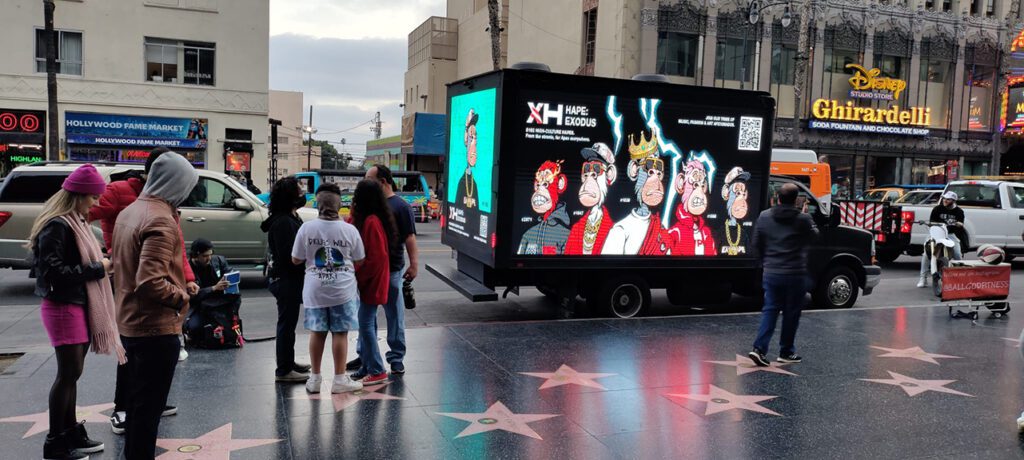
The principles Levinson articulated have remained stable while the specific tactics have evolved significantly. The neighborhood postering campaigns of the 1980s and 1990s have been joined by building projections, QR-enabled activations, brand-wrapped vehicles, and street team programs designed specifically to generate social media content. The underlying mechanism has not changed: put something unexpected and genuinely compelling in a physical space where your audience actually is, and they will pay attention in a way that broadcast advertising cannot manufacture.
The digital saturation of the past fifteen years has made guerrilla marketing more valuable, not less. As digital advertising inventory has expanded and audiences have developed more sophisticated avoidance behaviors, the premium on physical, unexpected, human-scaled brand encounters has increased. Brands that were entirely digital-first ten years ago are now investing in street-level campaigns because they have learned that physical presence creates a depth of brand recognition that no volume of digital exposures replicates.
The Psychology Behind Why Guerrilla Marketing Works
Guerrilla marketing works because of how human attention and memory actually function. Understanding the psychological mechanisms helps explain why the format consistently outperforms conventional advertising on brand recall, even when conventional campaigns have larger budgets and greater reach.
The Novelty Effect
Human brains are hardwired to notice and remember things that are unexpected in their environment. When something breaks pattern, the brain flags it as potentially important and allocates additional processing resources to it. A large-format projection on a building that was blank yesterday breaks pattern in a way that a banner ad in its expected digital location does not. The surprise creates involuntary attention, which creates stronger memory encoding. This is why guerrilla marketing placements consistently outperform conventional advertising on brand recall surveys: the unexpected encounter produces a stronger memory trace.
Social Proof and Crowd Dynamics
Humans use other humans as a cue for what to pay attention to. When we see a group of people gathered around something, we want to know what it is. When we see a physical installation, a piece of advertising, or a street activation that appears to have attracted the attention of other people around us, we are more likely to engage with it. Guerrilla marketing activations that attract a crowd compound their own effectiveness through this mechanism: each additional person who stops creates a stronger signal to the next person walking by.
Physical Memory Encoding
Physical experiences are encoded differently in memory than digital experiences. A brand encounter that involves real physical space, real time, and sometimes physical touch through sampling or interaction creates a richer memory trace than a two-second display ad impression. The person who accepted a product sample from a brand ambassador at a subway exit will recall that brand more readily, and with more positive association, than a person who saw that brand’s display ad in a social media feed fifty times.
Context Relevance
The most effective guerrilla marketing places brand messages in the specific physical contexts where they are most relevant to the audience’s current state of mind. A fitness brand that appears at the entrance to a running track is meeting the audience at the precise moment when fitness is front of mind. A food brand that appears near a transit exit at lunchtime is meeting the audience when they are actively thinking about eating. Context relevance increases message receptivity in ways that no amount of frequency in an unrelated context can compensate for.
AGM Field Note: The brands that get the most skeptical about guerrilla marketing are often the ones most invested in digital attribution models. When you measure everything through last-click attribution, the physical brand encounter that moved someone from indifferent to curious never shows up in the data. It still happened. It still worked. The measurement model missed it.
What Guerrilla Marketing Looks Like in Practice
The gap between the theory of guerrilla marketing and its execution is where most campaigns succeed or fail. Here is what professional guerrilla marketing actually looks like at the operational level.
The Briefing
Every campaign starts with a thorough briefing that covers the brand, the audience, the target markets, the goal, the timeline, and the budget. The brief is not a creative brief in the conventional agency sense. It is an operational document that determines everything that comes after: which formats are appropriate, which locations can serve the campaign, what production is required, and what success looks like in measurable terms.
The Scout
Before production begins, we scout the target locations. The scout is a physical visit to the target neighborhoods and specific streets to assess what is actually available, what the competitive advertising environment looks like, what the foot traffic patterns are at different times of day, and which specific placements will serve the campaign best. We document everything with GPS coordinates and photographs. The scout report gives clients a clear picture of exactly where their campaign will run and why those specific locations were selected.
Production
Production standards in guerrilla marketing determine whether a campaign looks like a professional brand investment or an amateur effort. We work with print partners who produce at the quality levels appropriate for outdoor exposure: correct paper weights for weather resistance, inks that maintain color accuracy in outdoor light, and finishes appropriate for the specific format. Street team materials, projection content, and vehicle wraps are all produced to the same standard we apply to any other visible brand touchpoint.
Installation and Activation
Installation is executed by our field teams in each market. Every placement is documented with GPS-tagged, date-stamped photographs. Street team activations run with briefed and trained ambassadors who understand the brand and can speak to the product authentically. Projections are tested in advance and executed with professional projection operators. The execution standard is consistent across every format and every market because we run our own crews rather than subcontracting to third parties who do not share our standards.
Documentation and Reporting
Post-campaign reporting includes full placement documentation, organic social monitoring, and brand recall data where surveys were conducted. We report honestly on what the campaign delivered. When a placement underperformed, we say so and explain why. That honesty is part of what makes long-term client relationships possible.
Guerrilla Marketing versus Other Advertising Formats
Format
Attention Quality
Brand Recall
Cultural Credibility
Social Amplification
Guerrilla / Street
High (unexpected)
High
High
High
Digital Display
Low (expected, avoided)
Low
None
None
Traditional OOH (Billboards)
Medium
Medium
Low
Low
TV / Streaming Ads
Low to Medium
Medium
Low
None
Influencer / Paid Social
Low (recognized as paid)
Low to Medium
Low
Medium
Common Guerrilla Marketing Mistakes
Most guerrilla marketing campaigns that underperform make the same mistakes. Knowing what they are in advance prevents repeating them.
Wrong location. This is the most common and most costly mistake. Placing a campaign in a neighborhood that is the right city but the wrong cultural zone, or on the wrong blocks within the right neighborhood, dramatically reduces effectiveness. Location precision is the single most important variable in guerrilla marketing, and it requires knowledge you can only get from experience in those specific streets.
Weak creative for the format. Graphic design that works beautifully on a phone screen or in a magazine often fails at large format on a wall. The visual hierarchy, the text size, and the image composition all need to be calibrated for how the piece will be seen in its actual environment: from twenty feet away, in variable lighting, by someone walking at a normal pace. Creative that has not been tested at the actual output scale and in actual outdoor conditions frequently underperforms.
Compressed timeline. Guerrilla marketing has a reputation for being fast to execute because some formats can move quickly. But the campaigns that deliver the best results are the ones with adequate lead time for scouting, production quality, and installation preparation. Rushing any of those steps produces campaigns that look rushed.
No documentation strategy. A campaign that runs and is not documented cannot be amplified, reported on, or built upon for future campaigns. Documentation should be planned before execution begins, not improvised after the fact.
AGM Field Note: We have inherited many campaigns from other agencies that failed for a single reason: the locations were decided from a map rather than a scout. A map tells you where the streets are. A scout tells you which streets actually have foot traffic, available surfaces, and the right demographic at the right time of day. These are different pieces of information.
Guerrilla Marketing Across the Campaign Lifecycle
Guerrilla marketing is often positioned as a launch tool, something brands use to announce themselves to a new market. That is one valid use, but it is far from the only one. Across the full campaign lifecycle, guerrilla marketing serves different functions at different stages, and brands that understand those functions can deploy the format strategically at each stage rather than reserving it for moments of novelty.
At the awareness stage, guerrilla marketing creates the initial brand encounter in the physical environments where the target audience lives and socializes. The goal is first impression: to establish that the brand exists, that it has a visual identity and a perspective worth paying attention to, and that it is present in the spaces the audience cares about. Postering campaigns and building projections are the most efficient formats for this awareness-building function because they create sustained visual presence in the target neighborhoods over the campaign period.
At the consideration stage, guerrilla marketing creates the direct human encounter that moves the audience from passive awareness to active engagement. Street team activations with sampling, demonstrations, or meaningful brand conversations are the primary format for this function. The person who has seen the brand on the walls of their neighborhood and then receives a direct, quality interaction with a brand ambassador has been moved along the consideration process in a single encounter in a way that no other format achieves as efficiently.
At the loyalty and advocacy stage, guerrilla marketing maintains brand presence for the community that has already adopted the brand, reinforcing their sense that the brand understands and is committed to the cultural spaces they inhabit. Brands that continue street-level presence after their launch period build a depth of community relationship that creates genuine advocates: people who feel that the brand is authentically part of their world, not just running a campaign in it.
Understanding guerrilla marketing across the full campaign lifecycle helps brands avoid the trap of treating it as a one-time tactic and instead building a coherent long-term street-level presence strategy that compounds in value over time. The brands with the strongest community relationships in their target cultural neighborhoods are almost always the brands that have maintained consistent street-level presence over years, not the ones that ran the most spectacular single activation.
Who Guerrilla Marketing Is For
Guerrilla marketing is not the right approach for every brand in every situation. It is the right approach for brands that need to build genuine cultural presence, create authentic first-hand experiences with their target audience, generate organic social content that performs like third-party endorsement, or establish credibility in a new market without the cost of conventional media.
It is particularly effective for consumer brands with a specific target demographic that concentrates in identifiable urban neighborhoods. Streetwear, music, food and beverage, entertainment, fitness, and tech brands with consumer-facing products all have natural fits with the format. It is less effective for B2B brands with diffuse professional audiences or brands in categories where the target consumer does not move through the kinds of public spaces where guerrilla marketing works best.
The brands that get the most out of guerrilla marketing over time are the ones that treat it as a sustained investment rather than a one-off experiment. The cumulative effect of consistent physical presence in the right neighborhoods over months and years builds a depth of brand recognition that no single campaign achieves. The brands that do that well become part of the visual and cultural environment of their target markets in a way that creates genuine competitive advantage.
Guerrilla Marketing Formats in Detail
Understanding the specific operational characteristics of each guerrilla marketing format is essential for building campaigns that use each format where it performs best. The choice of format is not primarily a creative decision. It is a strategic decision that determines the kind of brand encounter the campaign creates and the audience with whom it creates it.
Postering: The Workhorse Format
Postering is the most versatile and most frequently used guerrilla marketing format. It scales from a small targeted run of twenty placements in a single neighborhood to a citywide saturation campaign across hundreds of locations. The format rewards strong graphic design: the visual needs to work at street scale, from twenty to thirty feet away, read in two seconds, in variable lighting. The production quality of print materials directly affects campaign performance. Low-quality print on cheap paper placed in premium locations produces a brand signal that is the opposite of what most brands intend.
The strategic advantage of postering is duration. A well-produced, correctly installed postering campaign maintains brand presence in its target locations for two to four weeks. That sustained presence creates repetition within the target audience’s regular movement patterns: the same person walks past the same poster three or four times over the campaign period, which builds recognition incrementally. This is a different mechanism from the single-impression model of event activations, and for awareness-building campaigns it is often more efficient.
Street Teams: The Engagement Format
Street teams create direct human encounters with the brand in physical spaces. The quality of those encounters depends entirely on the quality of the ambassadors executing them. A well-briefed ambassador who genuinely understands the brand and can speak to it naturally creates a brand moment that leaves a lasting impression. A poorly briefed ambassador reading from a script creates an uncomfortable interaction that associates the brand with awkwardness. We brief every ambassador we deploy before every activation. That briefing is not optional and it is not a five-minute overview. It is a comprehensive preparation for representing the brand correctly in an unpredictable real-world environment.
The locations where street teams perform best are determined by the intersection of audience density and contextual relevance. Grand Central Terminal between 7am and 9am on weekdays is the highest-volume sampling opportunity in New York: millions of commuters moving through a compressed space in a two-hour window. The Fairfax and Melrose intersection in LA on a Saturday afternoon is the highest-cultural-density sampling opportunity in the city for streetwear and lifestyle brands. Identifying and accessing these moments requires location knowledge that only comes from field experience in those specific spaces.
Building Projections: The Event Format
Building projections are the highest-impact, shortest-duration guerrilla format. A single night of projection on the right building in the right neighborhood can generate more organic social documentation than a month of postering in the same area. The spectacle of a high-lumen projection on a major building face stops foot traffic completely. People gather, photograph, discuss. The event quality of the encounter is what drives the social amplification: people share events, not placements.
The operational requirements for projections are more demanding than for any other guerrilla format. Surface selection, lumen requirements for the ambient light conditions at the target location, content resolution and aspect ratio calibration for the specific building face, power access, equipment transport, and crew logistics all need to be planned and executed precisely for the activation to perform. We run projections regularly across New York, Los Angeles, Chicago, and Miami. Every activation is scouted and tested before the night of execution.
Guerrilla Marketing Campaign Planning: What You Need Before You Start
The campaigns that run best are the ones that start with clarity. Brands that come to a first conversation already knowing who they are trying to reach, where those people are, and what the campaign needs to accomplish can move to execution faster and with less revision than brands that are still sorting out the brief during the production phase. That is not a criticism; many brands discover what they actually need through the planning process. But clarity on these three things before the first conversation shortens the path from brief to execution significantly.
The audience definition needs to be specific enough to generate a location recommendation. “Millennials in New York” does not generate a location strategy. “Sneaker-collecting men aged 22 to 35 who spend time in Williamsburg and SoHo” does. The more precise the audience definition, the more precisely the location strategy can target the campaign, and the more efficiently the campaign budget performs.
The goal definition needs to be specific enough to determine the right format. “Increase brand awareness” is too vague to drive format selection. “Increase brand recall among our target demographic in New York by the time our product launches in four weeks” generates a specific campaign architecture: postering for sustained presence over the pre-launch period, a street team activation on launch day, and documentation of both for digital amplification. The goal determines the format, the format determines the locations, and the locations determine the budget. Without the goal, the budget conversation has no anchor.
The timeline definition needs to account for the production lead time required for the planned formats. Print campaigns require print production time. Projection campaigns require content preparation and equipment planning. Street team campaigns require ambassador recruitment and briefing. None of these happen overnight. A campaign that is conceived with the right goal, the right audience definition, and the right format selection but then compressed into an impossible timeline will produce results below its potential regardless of how well everything else was planned. We advise on realistic timelines for every campaign scope we build, and we do not accept briefs that require compromising the production quality that the format demands.
Frequently Asked Questions
What is guerrilla marketing in simple terms?
Guerrilla marketing is reaching your audience in unexpected physical spaces rather than through conventional paid media. Instead of buying a banner ad that people scroll past, you put something surprising and compelling on a street they actually walk down. The unexpected encounter creates stronger attention and better brand recall than conventional advertising at equivalent or lower cost.
Why is it called guerrilla marketing?
The term comes from guerrilla warfare, where smaller forces achieve outsized impact through tactical creativity and knowledge of terrain rather than raw force. Jay Conrad Levinson applied the same logic to marketing: a brand with smart ideas and precise execution can outperform much larger competitors who rely on budget alone.
Does guerrilla marketing work for established brands?
Yes. Established brands use guerrilla marketing to build cultural credibility, maintain presence in key markets, launch new products, and generate organic social content that performs better than paid social assets. The format is not reserved for brands with small budgets. It is used by brands of every scale for outcomes that conventional advertising cannot deliver.
What makes a guerrilla marketing campaign succeed?
The right idea in the right location with strong production quality and adequate lead time for preparation. Location precision is the single most important variable. A great concept in the wrong neighborhood or on the wrong blocks within the right neighborhood will underperform. Location intelligence, which means knowing the specific streets and the specific audiences that move through them, is what separates effective guerrilla campaigns from ones that miss.
How does guerrilla marketing differ from traditional out-of-home advertising?
Traditional out-of-home advertising like billboards operates through repetition in high-traffic locations over extended periods. Guerrilla marketing operates through surprise, specificity, and cultural alignment in precisely targeted locations. A billboard is passive; the audience drives past it. A guerrilla marketing installation is active; it stops the audience and demands engagement. The recall and cultural impact are correspondingly different.
Can guerrilla marketing generate social media reach?
Yes. Physical advertising that is visually compelling, unexpected, or experientially engaging gets documented and shared by the people who encounter it. In culturally active urban neighborhoods, a strong guerrilla marketing campaign can generate hundreds of organic posts within days, reaching a digital audience many times larger than the physical foot traffic at the placement location.
How do I know if guerrilla marketing is right for my brand?
If your target audience concentrates in specific urban neighborhoods or moves through identifiable physical spaces, guerrilla marketing is worth a serious look. If your brand goals include building cultural credibility, generating first-hand product trial, or creating organic social content, guerrilla marketing is one of the most efficient ways to achieve those outcomes. Call us at (646) 776-2770 and we will tell you honestly whether and how it applies to your situation.
What is the minimum budget for a guerrilla marketing campaign?
Minimum investment depends on the format and market. A focused postering campaign in a single neighborhood in a single city is the lowest-cost entry point. A street team deployment adds crew costs on top of materials. Building projections and multi-market campaigns require larger budgets. Contact us at (646) 776-2770 for a scope-specific estimate.