In Hartford, where finance, insurance, and biomedical research drive the economy and consumer options are dense, brands that don’t show up in physical space get outmaneuvered by those that do. Guerrilla marketing creates the consistent presence that makes your brand feel like part of Hartford’s commercial fabric, not another digital impression that scrolls past. American Guerrilla Marketing has executed guerrilla marketing campaigns in Hartford’s most competitive commercial corridors, and we know which placements translate directly into sales-funnel movement.
Consumer attention in Hartford is a finite resource that every advertiser in the market is competing for. The advantage of guerrilla marketing is that it operates in an attention environment that digital advertising has systematically vacated: the physical world. When Hartford consumers are walking New Haven’s commercial corridors, waiting for transit, or moving through entertainment districts, they’re not staring at a screen, which means a well-designed physical campaign reaches them without competition from the algorithmic content feeds that dominate their digital attention.
The sections below address the questions Hartford brands ask most often about guerrilla marketing: which neighborhoods generate the best ROI, how long campaigns need to run to build genuine frequency, what the permitting space looks like, how AGM documents field execution, and what outcomes are realistic at different budget levels. This is practical campaign intelligence built from actual Hartford field work, not theoretical marketing frameworks.
What Is Guerrilla Projection Advertising?
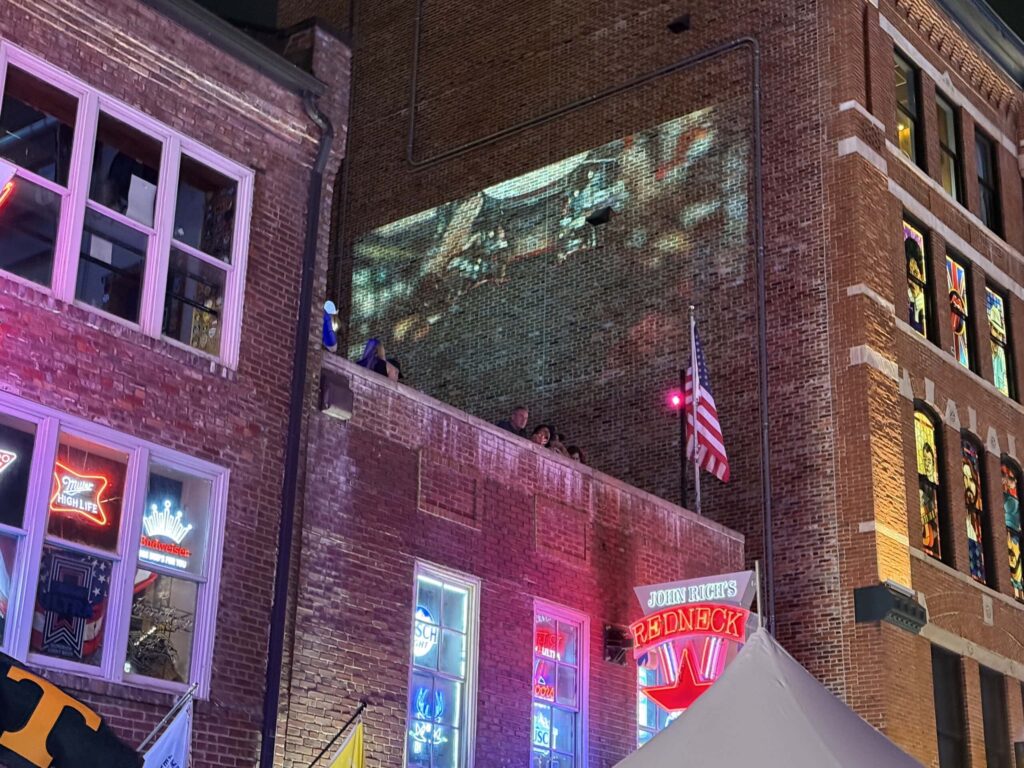
Guerrilla projection advertising deploys high-powered projectors to display brand messaging, imagery, animation, or video on building facades, bridges, monuments, and urban infrastructure in public spaces. The format creates brand encounters that are unavoidable, non-skippable, and inherently remarkable, generating the kind of genuine audience attention that conventional advertising can’t purchase and the kind of social media content creation that conventional advertising can’t engineer.
When a New Haven pedestrian walking from the train station through the Ninth Square district encounters a building-scale brand projection on one of the neighborhood’s historic brick buildings, they stop, they look, and they create content. That organic social content, instinctively photographed and shared by witness audiences, is the projection format’s multiplier effect that extends campaign reach far beyond the physically present audience at zero additional media cost.
Connecticut’s Urban Markets
Connecticut’s three primary urban markets offer distinct advertising opportunities and distinct projection environments:
Hartford is Connecticut’s capital city and its most significant governmental and insurance industry center. The downtown’s revitalization, anchored by the XL Center (arena), Dunkin’ Donuts Park (minor league baseball), and the ongoing development around the Colt Gateway complex, has created genuine evening and weekend foot traffic in specific corridors that support guerrilla projection campaigns.
New Haven is Connecticut’s most vibrant urban cultural environment, a genuine city anchored by Yale University, with a food, arts, and music culture that rivals cities several times its size. The combination of Yale’s educational and research economy with New Haven’s historic architecture and dense walkable neighborhoods creates an excellent guerrilla projection environment. New Haven’s reputation as one of America’s most culturally productive mid-sized cities makes it a high-prestige market for brands seeking association with educational excellence and cultural creativity.
Stamford is Connecticut’s corporate and financial hub, the most demographically and economically significant Connecticut city from a consumer spending standpoint. Stamford’s downtown has undergone significant development in recent years, anchored by the Mill River and the dense residential towers and office buildings that make it Connecticut’s most urban experience outside New Haven. Its commuter demographics (direct Metro-North rail access to Manhattan) create a mix of Connecticut residents and New York commuters that represents a particularly affluent advertising target.
Hartford: Colt Gateway and Downtown
Hartford’s Colt Gateway complex, the historic Colt Manufacturing facility on Van Dyke Avenue, with its distinctive blue onion dome, is one of New England’s most architecturally spectacular repurposed industrial complexes. Now housing creative businesses, restaurants, and residential lofts, the Colt complex provides both extraordinary projection surfaces (the massive brick factory buildings) and a growing evening pedestrian community of creative professionals and residents. Projection campaigns at Colt Gateway reach an audience that is highly attuned to creative visual culture and genuinely receptive to brand experiences that demonstrate artistic ambition.
Downtown Hartford’s revitalization around the XL Center and the Dunkin’ Donuts Park area creates game-day and event-night audience concentrations that are the best projection windows in the city. Hartford Yard Goats baseball games through the summer season, Hartford Wolf Pack hockey games, and the various arena events at the XL Center all concentrate foot traffic in the downtown corridors where projection campaigns achieve maximum audience density. The Front Street Development, Hartford’s entertainment-focused downtown retail and restaurant complex adjacent to the stadium, is Connecticut’s most consistent warm-season pedestrian entertainment zone.
New Haven: Yale, Ninth Square, and the Arts Community
New Haven is Connecticut’s highest-priority guerrilla projection market. The city’s combination of Yale architectural grandeur, Ninth Square’s revitalized historic commercial blocks, Wooster Square’s Italian-American cultural heritage, and the Arts Council of Greater New Haven’s vibrant local arts scene creates multiple projection environments with distinct audience profiles and aesthetic contexts.
Ninth Square
The Ninth Square Historic District, bounded roughly by Chapel, Orange, Crown, and State streets, is New Haven’s most successful downtown revitalization zone. The neighborhood’s concentration of restaurants, bars, and creative businesses draws consistent evening foot traffic from Yale students and faculty, New Haven’s growing young professional population, and the broader city residents who use Ninth Square as their primary downtown social destination. The neighborhood’s historic brick commercial buildings provide excellent projection surfaces visible from the Chapel Street and Orange Street corridors.
Yale Campus Perimeter
Yale’s Gothic collegiate architecture creates some of the most spectacular projection surfaces in Connecticut, the Woolsey Hall facade, the Sterling Memorial Library’s monumental entrance, and the various Gothic and Georgian buildings along College and Chapel streets provide architectural canvases that would be extraordinary in any context. Projection campaigns on Yale-adjacent buildings reach both the Yale community (17,000+ students and faculty) and the New Haven residents and visitors who regularly walk the Yale campus perimeter as one of Connecticut’s premier architectural experiences.
Wooster Square and Orange Street
Wooster Square’s park and surrounding residential and restaurant streets, home to New Haven’s famous Italian-American pizza culture, anchored by Frank Pepe Pizzeria, Sally’s Apizza, and Modern Apizza, create a distinct and beloved neighborhood character. The streets surrounding Wooster Square generate consistent evening pedestrian traffic from both New Haven residents and the visitors who travel specifically to the neighborhood’s famous pizza restaurants. This is a high-quality activation zone for brands with food, beverage, or community-adjacent positioning.
Stamford: Connecticut’s Corporate and Financial Hub
Stamford’s downtown core, concentrated along Main Street, Atlantic Street, and the Mill River Greenway, has been transformed by significant residential and mixed-use development in the past decade. The Mill River Park in downtown Stamford is a particularly attractive projection environment: the park’s water features, pedestrian paths, and connection to the Atlantic Street commercial corridor create both excellent projection surfaces and a consistent recreational and social audience. Stamford’s high-income residential population (household incomes significantly above national averages) makes it a premium market for brands targeting the affluent professional demographic.
Stamford’s direct Metro-North rail connection to Grand Central Terminal makes its commuter audience particularly distinctive: New York corporate professionals who live in Stamford’s premium residential towers bring purchasing power and media consumption habits calibrated to New York’s advertising environment, which means they’re highly attuned to creative brand campaigns and have significantly higher brand spending capacity than typical mid-sized Connecticut city audiences.
Technical Considerations for Connecticut Projections
Connecticut’s climate creates specific technical considerations for guerrilla projection campaigns. The state’s winters (December-March) are cold and often wet or snowy, requiring cold-weather equipment specifications and crew preparation for challenging outdoor operating conditions. Summer humidity and heat (July-August) create different equipment and operations considerations. The transition seasons, April-June and September-November, offer the best balance of moderate weather, available darkness, and outdoor audience density for projection campaigns in Connecticut’s markets.
Connecticut’s fog, particularly in coastal markets and during certain atmospheric conditions, can affect projector throw distance and image clarity. AGM accounts for Connecticut’s climate variability in equipment selection and campaign timing recommendations, ensuring that projection campaigns are activated under conditions that allow the visual impact the format is designed to create.
Connecticut Events Calendar Alignment
Connecticut’s event calendar creates specific projection campaign timing opportunities:
Campaign Strategy and Market Considerations
Connecticut guerrilla projection campaigns benefit from the state’s under-use of the format relative to New York and Boston markets. The novelty premium that projections carry in less-saturated markets applies strongly in Connecticut, particularly in Hartford and New Haven, where building-scale brand projections in public spaces are genuinely rare and therefore inherently remarkable to witness. This novelty advantage should inform creative ambition: campaigns that would be visually competitive in New York achieve even greater relative impact in Hartford and New Haven simply by showing up with serious production quality.
Connecticut’s proximity to New York creates specific brand positioning opportunities. For brands whose primary market is the New York metro but who want to establish presence in the Connecticut suburban market, the affluent Fairfield County towns and Stamford’s corporate community, Connecticut projection campaigns can extend brand presence into the market where New York metro residents actually live without the expense and competition of executing in New York City proper.
AGM Connecticut Projection Capabilities
Building a Guerrilla Marketing Strategy That Performs in Connecticut
Guerrilla marketing is often described in terms of tactics, the unconventional, the unexpected, the street-level. But the brands that consistently generate results from guerrilla campaigns don’t think of it as a collection of tactics. They think of it as a strategic framework for reaching audiences in environments where conventional advertising doesn’t follow them, at the moment when they’re most receptive to brand messages embedded in their actual physical world.
Why Guerrilla Marketing Works Differently Than Digital
Digital advertising delivers impressions inside the screens that compete for attention. The consumer’s relationship with digital advertising is fundamentally adversarial: the ad is interrupting something they were trying to do, and their instinct is to dismiss it as quickly as possible. Physical guerrilla marketing meets consumers in their environment on their own terms. A compelling mural, a perfectly placed Wheat Paste Poster Campaign, or a brand activation at a community event delivers a brand encounter that feels native to the environment rather than imposed on it, and that distinction produces meaningfully different psychological responses in the consumer.
The Integrated Campaign Advantage
Guerrilla marketing is most powerful when it functions as part of an integrated campaign rather than in isolation. Physical street-level campaigns build the brand awareness that makes digital retargeting more effective. Brand activations generate social content that extends campaign reach beyond the immediate audience. Snipe and sticker campaigns reinforce broader brand messaging from billboards or digital advertising. When all these elements are coordinated around consistent creative and messaging, the total campaign effect exceeds the sum of its parts.
Measuring Guerrilla Marketing Effectiveness
Guerrilla marketing measurement requires a broader framework than the click and conversion metrics that digital advertising normalizes. Physical campaigns build brand awareness, mental availability, and word-of-mouth that manifest in business results over longer time horizons. Branded search volume tracking, social mention monitoring, brand awareness surveys in campaign geographies, and business-side metrics, foot traffic, trial rates, sales velocity, provide the most complete picture of guerrilla campaign performance. AGM provides campaign documentation including geotagged photography and deployment data to support client measurement processes.
Campaign Scalability
One of guerrilla marketing’s underappreciated advantages is scalability. A campaign concept that works in one market can be deployed simultaneously across dozens of markets using the same creative system and strategic framework. AGM executes integrated guerrilla marketing campaigns in Connecticut as standalone market programs or as part of national multi-market rollouts, maintaining the same execution standard whether the campaign covers one city or thirty.
Campaign Measurement: Connecting Street-Level Activity to Business Outcomes
Measuring physical marketing campaign effectiveness requires a different framework than digital advertising measurement, but the core question is the same: did the campaign generate business results? For physical campaigns in Connecticut, measurement typically combines direct campaign documentation with business-side indicators that reflect the campaign’s real-world impact.
Documentation as Baseline
AGM provides geotagged, time-stamped photography confirming every placement location, material condition, and deployment coverage. This documentation serves as both verification of campaign delivery and as creative assets for client reporting and future campaign planning. Deployment logs capture quantitative coverage metrics, number of placements, locations covered, formats deployed, that support impression estimation and CPM calculations.
Business-Side Measurement Indicators
The most reliable indicators of physical campaign impact are business-side metrics captured during and after the campaign window: branded search volume in the target geography (trackable through Google Search Console), website traffic from campaign market locations, promotional code redemptions, foot traffic at target locations, and direct sales or trial metrics. Comparing these metrics against pre-campaign baselines and control geographies isolates the campaign’s contribution from other business factors.
Social Media Signal Tracking
For campaigns with strong visual creative or large-format elements, social media mention monitoring tracks organic documentation and sharing by consumers who encounter the campaign. This metric both validates campaign effectiveness and quantifies the earned media value generated beyond the physical placements, a critical component of total campaign ROI for brands with strong social media engagement from their target demographic.